

Partner payment delays often start with fragmented records and approval steps, not the transfer itself. To understand how to streamline partner payments, keep transaction records in one place, connect accounts payable data, apply consistent payment terms, and use a clear approval workflow. Offer partners suitable payment options and reconcile each payment against its supporting records.
Manual tracking makes it harder to spot missing information, resolve discrepancies, and see which payments await approval. A structured process puts these tasks in a consistent sequence, giving teams clearer records and reducing avoidable handoffs.
This article explains how to organize payment history, reduce approval workload, connect AP data, set consistent terms, and give partners practical ways to receive payments. It also covers what to consider when integrating payment workflows with channel management, so the process can scale without adding administrative friction.
Key Takeaways
- Centralize payment records and reconciliation so teams can trace each transaction and resolve discrepancies more efficiently.
- Make approvals easier to manage by clarifying responsibilities and routing complete, accurate payment information through a consistent workflow.
- Connect accounts payable data across systems to reduce manual handoffs and improve visibility into payment status.
- Set clear, consistent terms with partners and align payment timing with your organization’s cash-flow needs.
- Offer practical payment methods and use PartnerPortal™ to support more organized channel management.
Managing payments and transaction history
Keep partner payment records in a shared, searchable ledger rather than separate spreadsheets. Link each transaction to its approval, supporting invoice, currency, settlement date, and reconciliation status.
Automated Payment Workflows
Automate repeatable steps: capture approved payment data, route it for review, schedule processing, and match the resulting transaction to its invoice. Automated reconciliation tools can match payments with invoices without human intervention. According to the Board of Governors of the Federal Reserve System, a bank used a third-party payments app to import mobile payment requests into its existing ACH process for near-real-time settlement.
When onboarding partners, collect the partner’s legal name, business address, tax classification, payment instructions, and an authorized contact. Attach the signed agreement and supporting tax documentation to the partner record. Validate account details through an established process before the first transfer, then restrict changes to authorized staff. These steps give payment processing a complete record to work from.
Multi-currency payments need clear transaction-level details. Record the invoice currency, settlement currency, exchange rate applied, and conversion date so finance teams can explain differences between the approved amount and bank deposit. If an invoice is denominated in one currency and settled in another, preserve both amounts in the transaction history. This supports reconciliation and gives management a useful view of cash flow.
Owners and managers need more than a bank balance. Use monthly financial statements to distinguish completed payments, approved obligations, pending transactions, and partner-related balances. A cash-flow forecast can include scheduled payments alongside expected receipts, helping decision-makers time disbursements while keeping obligations in view. Consistent records also support supplier relationship management: teams can answer payment-status questions using the same transaction trail.
Payment Controls and Compliance
Build controls into the workflow before releasing payments. Match each request to an approved invoice or documented program obligation, check the partner identifier and amount, and flag duplicate invoice numbers or payment references. Separate payment preparation from final approval, and keep an audit trail of edits, approvals, and release dates. These checks help reduce entry errors, fraud exposure, and duplicate payments.
Protect payment instructions when partners request bank-account changes. Require an authorized reviewer to verify the change through a previously established contact channel, then retain the approval record with the partner profile. Restrict access to sensitive payment data by role. During reconciliation, investigate unmatched transactions and document whether each difference reflects timing, currency conversion, or incorrect partner details.
U.S. tax reporting depends on the payment’s purpose and the recipient’s tax status, so retain records that support classification and filing decisions. The U.S. Government Accountability Office explains that partnership income, losses, credits, and other tax-related items pass through to partners, who report their shares on their own tax returns. Distinguish those allocations from routine partner disbursements in the ledger, and preserve the supporting agreement and transaction history for reporting.
Approval time and staff workload
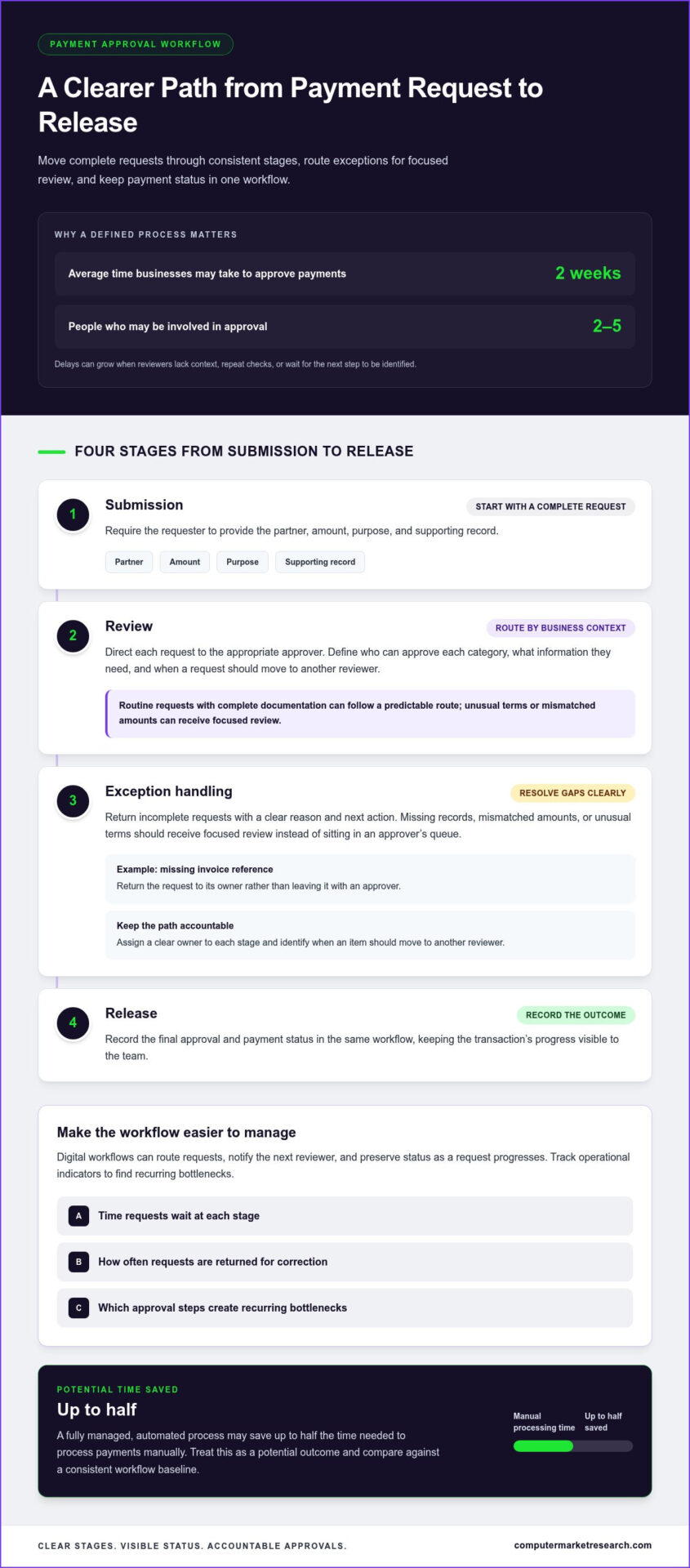
Payment approvals can stall when a request moves through an unclear chain of reviewers. Businesses may take an average of two weeks to approve payments, while approval may involve two to five people. Delays can grow when reviewers lack context, repeat checks, or wait for someone to identify the next step. Map the approval path from submission to release, then assign a clear owner to each stage.
Start by separating routine payments from exceptions. A standard request with complete documentation can follow a predictable route, while mismatched amounts, missing records, or unusual terms receive focused review. This prevents approvers from repeatedly examining straightforward transactions. Define who can approve each category, what information they need, and when an item should move to another reviewer.
- Submission: Require the requester to provide the partner, amount, purpose, and supporting record.
- Review: Direct the request to the appropriate approver based on its business context.
- Exception handling: Return incomplete requests with a clear reason and next action.
- Release: Record the final approval and payment status in the same workflow.
Digital workflows reduce the effort spent finding requests across email, spreadsheets, and finance systems. Automation can route a request, notify the next reviewer, and preserve its status as it progresses. For example, if a request lacks an invoice reference, the workflow can return it to its owner rather than leaving it in an approver’s queue. Teams can still apply judgment where review is necessary.
Measure workload with operational indicators, not just total processing time. Track how long requests wait at each stage, how often they are returned for correction, and which approval steps create recurring bottlenecks. If one reviewer receives every payment request, redistribute authority according to role and risk. This makes the queue easier to manage while maintaining clear accountability for suppliers and internal stakeholders.
A fully managed, automated process may save up to half the time needed to process payments manually. Treat that figure as a potential outcome and assess your workflow against a consistent baseline. Compare approval time, staff touchpoints, and returned requests before and after changes. A brief review with finance and operations can identify which manual handoffs to remove first, without weakening controls that protect payment accuracy.
Automated invoice matching can reduce the time and costs associated with manual accounts receivable work. At one pub, changing the card processing cut-off time from 6pm to 2am took about six weeks and required 14 phone calls.
Disconnected AP systems and data silos
When accounts payable data sits in separate systems, a partner’s invoice, approval, and payment status can tell different stories. Map where each record originates, who updates it, and which system holds the authoritative value. For example, define whether the accounting platform or partner database owns the partner identifier.
Reconcile partner payments with accounting systems by matching each transaction to its invoice, partner ID, amount, currency, and payment reference. Import or integrate those fields into the accounting workflow, then route unmatched records for review before closing the books.
Integration works best when teams standardize shared fields before connecting systems. Create a data dictionary for partner name, partner ID, invoice number, payment date, currency, and program reference. If one platform labels a field “partner code” and another uses “account ID,” document the mapping so records stay connected during transfer.
Next, define how data moves between AP, accounting, banking, and partner-management systems. An approved invoice can enter the payment queue, while settlement details return to accounting for reconciliation. Choose a transfer method that fits existing systems, such as a supported integration or scheduled file exchange. The goal is a traceable handoff, not another disconnected repository.
- Match records: Use a stable partner identifier and invoice reference across systems.
- Standardize formats: Set consistent rules for dates, currencies, and status labels.
- Track exceptions: Record why a payment cannot match, such as a missing reference or changed amount.
- Assign ownership: Name the team responsible for correcting each field and resolving each exception.
An invoice may show one amount while the bank record reflects a different settlement currency. Preserve the invoice value, settlement value, and conversion details in linked records. This makes the difference easier for finance staff to explain and review in billing reports. A clear audit trail also supports supplier relationships by helping teams answer questions with consistent transaction information.
Once connected, test the integration with representative records before relying on it for routine processing. Include a standard invoice, a credit, a changed partner detail, and an unmatched transaction. Compare what AP sends with what accounting receives, then correct field mappings or workflow rules. Review exception patterns regularly: repeated errors often point to an upstream entry or handoff that needs refinement.
Consolidated AP data helps managers view obligations alongside recorded payments, improving cash-flow analysis and reducing duplicate entry. Align access permissions with each team’s role, and document changes to mappings or workflows. These controls make information easier to trace while preserving the detail needed for accurate accounting and dependable partner relationships.
Negotiating consistent payment terms
Consistent terms give finance teams and partners a shared expectation for payment timing. Begin by listing current agreements, including due dates, discounts, required documentation, and any exceptions. Compare those terms against cash-flow forecasts and accounting close processes. If one partner expects payment on receipt while another follows net 30, net 60, or net 90, the difference affects scheduling, forecasting, and processing effort.
Set a standard starting position, then identify when a different arrangement makes business sense. Consider partner history, transaction volume, seasonal purchasing patterns, and the time needed to validate receipts. For example, a distributor with variable monthly orders may need terms that reflect documented order cycles. Record the agreed terms in the partner agreement and payment platform so staff do not have to rely on email or memory.
- Define the baseline: Document the standard due-date rule and the event that starts the payment period.
- Set exceptions: Record who can approve different terms and where approval is stored.
- Align records: Match agreement terms to the partner profile and accounting system.
- Review performance: Compare planned and actual payment dates to identify recurring mismatches.
During negotiations, explain the operational reason for a requested term. A consolidated payment window, for example, can reduce separate processing runs when suppliers agree to aligned dates. Discuss how the arrangement affects both parties’ cash flow, receipt timing, and reconciliation. A clear record of the agreed schedule helps teams answer questions without reopening settled terms.
Payment solutions should reflect agreed terms rather than create a separate timetable. Configure due dates, approval requirements, and payment status labels consistently across the platform and accounting records. If a partner agreement specifies a different schedule, flag the exception for review rather than silently changing the standard rule. This keeps reporting comparable while preserving the negotiated arrangement.
Review terms when partner activity or business needs change. If order frequency shifts, for example, compare actual receipts and payment timing with the existing agreement before proposing an adjustment. Share the proposed change with the partner, document the accepted terms, and update the relevant records together. This limits conflicting instructions across billing, finance, and partner-facing teams.
Track exceptions by reason, such as a negotiated schedule, incomplete receipt, or disputed invoice. Patterns can reveal whether a term creates unnecessary effort or teams need clearer documentation. Use those findings in the next supplier review. A consistent framework makes individual negotiations easier to manage while keeping payment commitments visible to accounting and operations.
Offering multiple payment methods
Offer payment methods that suit partner preferences and your accounts payable workflow. The right mix makes settlement practical while keeping transaction records consistent.
Available Payment Methods
Common options include bank transfers, ACH, EFT, credit and debit cards, and digital wallets. Select methods based on partner access, processing time, reconciliation needs, and how each payment enters your accounting workflow. Electronic payments may reach suppliers more quickly than traditional methods. A self-service payment portal can also let payees select a method and manage recurring billing.
Keep the operating process clear. For each method, define who initiates payment, where confirmation appears, and how the transaction matches its supporting record. For example, a bank transfer may need a payment reference that accounts payable can match to an approved invoice. Consistent reference fields help teams track spending and reduce avoidable errors.
Platform and Method Costs
Typical costs and fees depend on the platform, integration requirements, transaction mix, and chosen payment methods; the price depends on the case and is provided after a quote request. Compare cost structures alongside processing effort, reconciliation needs, and the effect on partner adoption.
Credit cards may be convenient, but some suppliers may hesitate because of processing fees or pass those costs to customers. Consider the whole workflow, not just the payment step: a method that creates extra reconciliation work can add administrative effort elsewhere. Document any fee treatment in partner terms before activating that option.
Before adding another method, map its data path through accounts payable and accounting. Confirm that the platform captures the payment date, amount, partner identifier, and reference needed for reconciliation. If a method creates a separate report, assign an owner to import and match its transactions. This keeps records complete across payment channels.
- Assess partner needs: Identify which methods partners can use and prefer.
- Review workflow fit: Check how each option connects to approval, payment processing, and reconciliation.
- Compare total effort: Include fees, administration, exception handling, and reporting.
- Set clear terms: Document payment instructions, expected timing, and any fee responsibilities.
Test each payment method with a controlled transaction before wider rollout. Follow the record from initiation through settlement, then confirm that accounts payable can match it without manual reconstruction. Track failed or unmatched transactions and use them to refine instructions. Well-integrated payment options give partners flexibility while preserving visibility into spending and payment status.
Explore payment workflow options to assess how a more structured channel process could support partner transactions.
Computer Market Research: PartnerPortal™
Computer Market Research offers PartnerPortal™ to centralize partner onboarding, deal registration, and performance tracking. When payment administration connects with channel programs, partner data can help teams maintain clearer records of partner activity. Co-op/MDF Management and Rebates & Incentives address related fund and incentive processes, while Deal Registration supports tracking registered opportunities.
Consider this approach when partner information and program records are spread across manual workflows, making consistent oversight harder. A centralized channel management platform can help organize the data teams use to manage partner relationships alongside payment processes.
To discuss how PartnerPortal™ may fit your channel operations, contact Computer Market Research or visit computermarketresearch.com.
Make the Next Improvement Deliberate
Treat payment administration as an operating process, not a series of isolated transactions. Choose one recurring friction point, document how it affects partner operations, and assign an owner to test a focused improvement. This creates a practical starting point for deciding how to streamline partner payments without adding another layer of manual work.
Then assess whether your channel data and payment workflows provide a consistent view of partner activity. If teams still rely on disconnected records, a channel management platform can help create a more coordinated foundation for partner operations. Computer Market Research’s PartnerPortal™ supports partner onboarding, deal registration, and performance tracking, while Co-op/MDF Management and Rebates & Incentives address related channel programs.
Use that operational context to identify where a more connected approach could fit your organization. Explore PartnerPortal™ and take the next step toward a more manageable partner workflow. A clear improvement plan can make payment operations easier to maintain as partner programs evolve.
Frequently Asked Questions
What are the best ways to streamline partner payments?
A practical way to streamline partner payments is to eliminate repeated data handling between partner records and finance processes. Start with one payment type, map its request-to-reconciliation journey, then identify duplicate entry and avoidable handoffs. For example, a channel team can standardize the reference used on incentive claims before finance receives them. Review exceptions with both teams, then extend the improved workflow to other partner payment categories.
Which partner payment platforms and software are available?
Options include accounts payable software, payment processing platforms, accounting-system payment modules, and partner relationship management platforms. They serve different purposes: AP tools manage invoice workflows, while partner platforms organize channel activity and program information. PartnerPortal™ is Computer Market Research’s partner relationship management platform. It centralizes partner onboarding, deal registration, and performance tracking, complementing finance processes where channel records inform payment administration.
How do ACH, wire transfers, virtual cards, and checks compare for partner payments?
ACH and wire transfers move funds electronically between accounts, while virtual cards provide card-based payment details and checks use a paper instrument. Compare options by recipient acceptance, processing steps, record matching, security controls, and how confirmations reach accounting. For example, virtual-card transactions may need card-specific reconciliation, while check processes need a way to track issuance and clearing. Choose methods that fit partner needs and internal controls.
How can businesses handle international partner payments, exchange rates, and cross-border fees?
For international payments, agree on the invoice currency and settlement currency before processing. Record the exchange rate and conversion date alongside both currency amounts, then reconcile the final deposit against the original obligation. Have finance record any intermediary-bank or conversion charges rather than treating the difference as an unexplained variance. Clear payment instructions help partners understand the amount and currency to expect.
What steps should a business take to optimize partner payment terms and schedules?
Begin by comparing partner agreements with actual payment cycles and finance planning needs. Identify terms that create frequent exceptions, then propose a consistent schedule partners can support operationally. Document the effective date, payment trigger, required records, and exception approval path in the agreement and relevant systems. For instance, align a partner’s submission deadline with the team’s processing calendar, then review whether the arrangement works for both parties.

Article by
Del Heles
Del Heles is the founder and CEO of Computer Market Research (CMR), a channel management software company he launched in 1984. With more than 40 years of experience, he’s known for helping manufacturers and distributors simplify complex partner programs through practical, customer-focused technology solutions.