

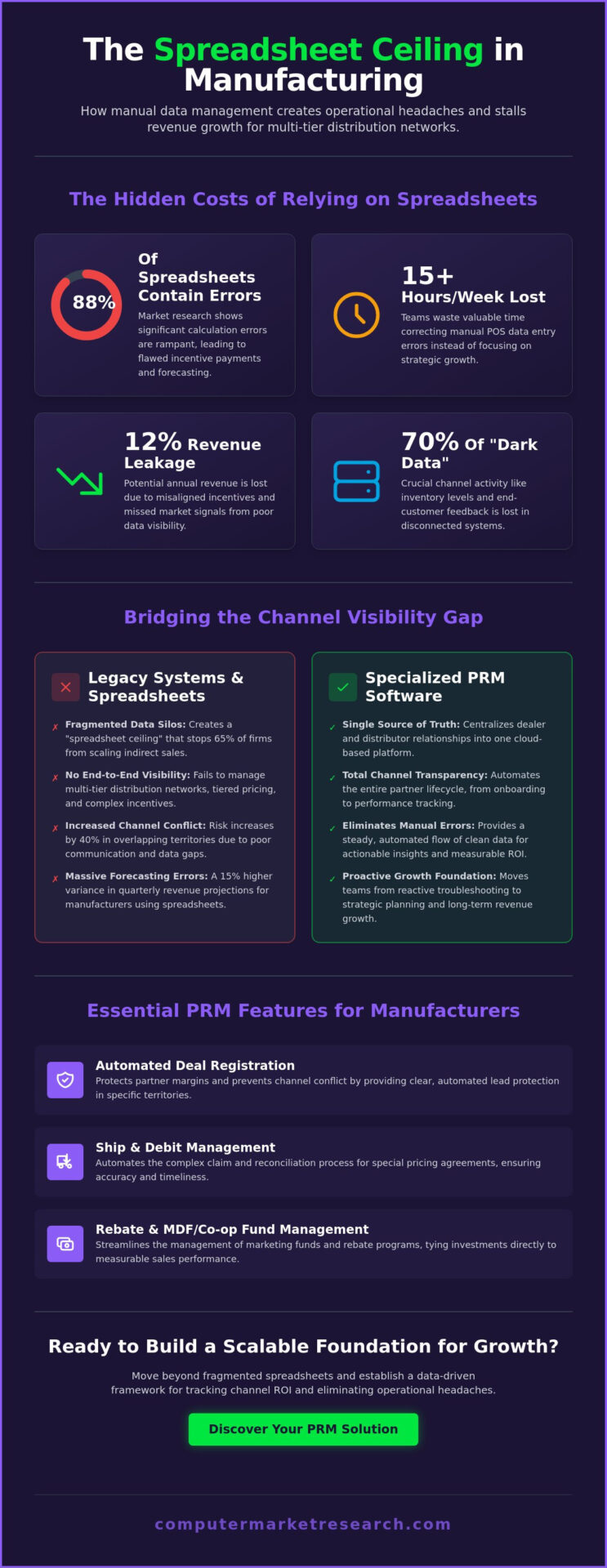
Market research indicates that 88% of spreadsheets contain significant calculation errors, yet many channel leaders still rely on them to manage multi-tier distribution networks. If your team spends over 15 hours every week correcting manual data entry errors in POS reports, you aren’t just losing time; you’re losing the visibility required to scale effectively. Implementing specialized prm software for manufacturing industry is no longer a luxury for 2026. It’s a strategic necessity for those who want to replace operational headaches with a steady, automated flow of clean data.
To further support these growth efforts, Information Technology Partners offers a specialized platform dedicated to job openings within the route sales and distribution industry, helping you find the right professionals to manage your expanding network.
We understand that managing complex rebate structures and MDF claims often feels like a constant battle against fragmented data silos. You’ve likely felt the frustration of processing incentive payments based on incomplete or inaccurate information from your partners. This guide promises a clear path out of that administrative burden. You’ll discover how to transition from manual oversight to a specialized system that delivers actionable insights and drives measurable ROI. We will examine the technical shift toward cloud-based infrastructure and show you how to achieve total channel transparency through automated partner management.
Key Takeaways
- Understand why traditional CRM systems fall short in multi-tier global distribution and how to bridge the visibility gap between manufacturers and their partners.
- Learn how specialized prm software for manufacturing industry centralizes dealer and distributor relationships to eliminate manual data errors and operational headaches.
- Discover the essential features, such as automated deal registration and Ship & Debit management, that protect partner margins and prevent channel conflict.
- Identify the strategic steps to move beyond fragmented spreadsheets and establish a data-driven framework for tracking measurable channel ROI.
- Explore how a modular approach to partner management allows you to solve immediate data challenges while building a scalable foundation for long-term revenue growth.
Navigating the Complexity of Modern Manufacturing Channels
Manufacturers no longer rely on a straight line from factory to customer. The 2026 landscape is defined by multi-tier distribution networks that span continents and time zones. While a standard CRM tracks individual customer interactions, it fails to manage the complex incentives, tiered pricing, and logistical hurdles of third-party partners. Relying on legacy systems creates a “spreadsheet ceiling” where manual tracking stops 65% of Global 2000 firms from effectively scaling their indirect sales operations. It’s a point of diminishing returns where adding more partners actually decreases overall efficiency.
Implementing specialized Partner relationship management (PRM) systems allows firms to capture “dark data.” This term refers to the estimated 70% of channel activity, such as local inventory levels and end-customer feedback, that typically vanishes into unread emails and disconnected PDFs. Without this visibility, manufacturers lose an average of 12% in potential annual revenue due to misaligned incentives and missed market signals. To stay competitive, sales operations must move toward automated, cloud-ready infrastructure that provides a single version of the truth.
The following video illustrates how integrated systems support these complex distribution and manufacturing workflows:
The Evolution of Dealer and Distributor Networks
Customer expectations have shifted dramatically. By 2026, 80% of B2B buyers expect the same transparency and fulfillment speed found in retail environments. This pressure forces manufacturers to launch aggressive partner-based strategies that require strict Service Level Agreements (SLAs) across the entire network. For a channel manager overseeing 200 or more distributors, the administrative burden often exceeds 20 hours per week when using manual tools. This workload prevents strategic planning and keeps teams stuck in a cycle of reactive troubleshooting rather than proactive growth.
Common Operational Headaches in Manufacturing Sales
Fragmented communication remains the primary barrier to sustainable growth. When manufacturers and dealers operate in data silos, the risk of channel conflict increases by 40% in overlapping territories. This friction results in internal price wars that erode brand value and trust. Beyond communication gaps, manual data silos lead to massive forecasting errors. Industry data shows that manufacturers relying on spreadsheets report a 15% higher variance in quarterly revenue projections. Utilizing prm software for manufacturing industry applications eliminates these silos by centralizing Point of Sale data and automating incentive management, ensuring that every partner is aligned with corporate goals.
What is PRM Software for the Manufacturing Industry?
PRM software for the manufacturing industry is a centralized, cloud-based infrastructure designed to manage the intricate relationships between manufacturers and their external sales channels. While traditional CRM systems focus on direct customer interactions, a dedicated PRM platform coordinates the activities of distributors, dealers, and value-added resellers (VARs). It effectively ends the “death by spreadsheet” era by consolidating fragmented data into a single, accessible environment. This technology automates the entire partner lifecycle. From the moment a partner is onboarded to the continuous tracking of their quarterly performance, every touchpoint is recorded and optimized.
Generic partner management solutions often fail in a manufacturing context because they don’t account for the technical complexity of physical goods. Specialized prm software for manufacturing industry needs is built to handle variables like lead protection, co-op fund management, and complex incentive structures. It provides the visibility required to eliminate data silos that typically hide channel performance. By the time we reach 2026, the ability to access clean, real-time data will be the primary differentiator between market leaders and those struggling with manual errors. Manufacturing PRM acts as a strategic layer that bridges the gap between an internal Enterprise Resource Planning (ERP) system and the external partner ecosystem.
Hierarchical Management and Multi-Tier Distribution
Manufacturing ecosystems rarely follow a linear path. A robust PRM system maps complex, multi-tier relationships where a primary distributor might manage dozens of sub-dealers or authorized service centers. Data must flow seamlessly through every tier to ensure that point-of-sale (POS) data from a local dealer reaches the manufacturer without manual entry errors. Role-based access control is essential here. It ensures that a regional distributor sees high-level performance metrics while a local dealer only accesses the specific lead data and marketing assets relevant to their territory.
The Strategic Value of a Unified Partner Portal
The partner portal serves as the single source of truth for the entire channel. It centralizes critical product specifications, real-time pricing updates, and marketing assets in one location. This eliminates the operational headache of partners using outdated brochures or incorrect technical specs. Beyond simple document storage, the portal facilitates partner enablement through structured technical training and certifications. When partners have immediate access to the tools they need, they sell more effectively. Businesses that transition from manual processes to automated channel data management solutions often see a significant reduction in administrative overhead and a faster time-to-market for new product lines.
Essential Features: From Deal Registration to Ship & Debit
Effective prm software for manufacturing industry isn’t just a partner portal; it’s a centralized control center designed to manage complex distribution networks. In 2024, industry reports indicated that 45% of channel partners cite administrative burdens as a primary reason for disengagement. Automation removes these friction points by replacing manual entries with streamlined workflows. Deal registration is the first line of defense in this ecosystem. It prevents channel conflict by locking an opportunity to the partner who first identified it. This protects partner margins and ensures their pre-sales investment isn’t undercut by a competitor at the last minute.
Managing Point of Sale (POS) data is often a manufacturer’s greatest operational headache. Sales reports arrive in disparate formats, often resulting in a 15% to 20% error rate when processed manually. PRM tools normalize this data into actionable insights. This creates total inventory visibility across the entire channel. When you can track stock levels at every distributor location, you can prevent overproduction and costly stockouts. Similarly, managing Market Development Funds (MDF) and Co-op funds through spreadsheets is a recipe for wasted budget. Automated systems track fund allocation and calculate ROI with precision, ensuring every dollar spent drives measurable growth.
Automating Financial Incentives and Rebates
Manufacturing rebates involve complex logic that standard CRM systems can’t handle. You’re likely balancing volume-based discounts with specific performance-based incentives. Ship & Debit automation is critical for protecting your profitability. It validates claims against actual POS data in real-time, which eliminates overpayments and reduces claim disputes by up to 30%. By moving away from manual validation, you embrace a system where financial accuracy is the default, not the exception. This shift marks the final death of the spreadsheet in your financial operations.
Decision-Grade Insights through Channel Analytics
Basic reporting tells you what happened last month; channel data management tells you what will happen next quarter. Advanced prm software for manufacturing industry transforms raw numbers into predictive insights. You can identify top-performing partners and spot under-served market segments before your competitors notice the gap. This level of visibility fuels better production planning. It ensures your factory floor aligns perfectly with actual market demand, reducing the risk of carrying obsolete inventory.
- Predictive Analytics: Anticipate market shifts based on historical POS trends.
- Partner Tiering: Automatically categorize partners based on real-time performance metrics.
- Production Alignment: Use channel stock levels to dictate manufacturing schedules.
The Path to Optimization: Moving Beyond Spreadsheets
The transition from manual tracking to a specialized prm software for manufacturing industry requires a structured, four-step methodology. Relying on fragmented spreadsheets creates data silos that stifle growth and introduce human error. To regain control, manufacturers must adopt a systematic approach to digital migration that prioritizes data integrity and partner participation.
- Step 1: Audit current partner data. Identify where information is missing or outdated. Research indicates that 40 percent of channel contact lists become obsolete within 12 months without automated validation.
- Step 2: Define KPIs. Establish clear metrics for the new system before launch. Aim for specific targets, such as reducing claim processing time by 50 percent or increasing deal registration accuracy.
- Step 3: Select modular software. Choose a platform that allows you to activate features like MDF or Co-op management as needed. A modular prm software for manufacturing industry ensures you don’t pay for unused functionality while providing a foundation for future growth.
- Step 4: Phased implementation. Roll out the system to a pilot group of 10 percent of your top-performing partners. This strategy allows for troubleshooting and refinement before a full-scale global launch.
Overcoming the Fear of Digital Transformation
Partners often view new software with skepticism; they fear “Big Brother” oversight into their private sales pipelines. Address these concerns by acting as a Reliable Specialist. Demonstrate how the platform provides immediate value, such as accelerating lead distribution by 25 percent. When partners see that automation simplifies their administrative burden, adoption rates typically climb to over 85 percent within the first 90 days of implementation.
Integrating PRM with ERP and CRM Systems
A stand-alone PRM creates a new data silo, which is a liability for financial accuracy. Seamless integration is mandatory. Bi-directional data flow between the PartnerPortal™ and internal ERP or CRM systems ensures that sales figures and inventory levels remain synchronized. This connectivity maintains a clean system of record, which is vital for passing financial audits and managing complex incentive programs. By automating these connections, manufacturers eliminate the 15 to 20 hours per week typically spent on manual data reconciliation and error correction.
Stop struggling with manual data entry and start scaling your channel operations with precision. Discover how Computer Market Research streamlines partner management.
Scaling Revenue with CMR’s PartnerPortal™ for Manufacturers
Scaling revenue in a complex distribution network requires more than just a portal; it requires a high-performance data engine. Computer Market Research (CMR) addresses the fragmentation that plagues the manufacturing sector by centralizing disparate data streams into a single source of truth. By eliminating the reliance on manual spreadsheets, our prm software for manufacturing industry transforms how brands interact with their distributors and resellers. It’s about moving from reactive fire-fighting to proactive channel management.
The power of the PartnerPortal™ lies in its modularity. Manufacturers don’t have to overhaul their entire operation overnight. They can implement specific modules, such as Point of Sale (POS) tracking, Co-op/MDF management, or Lead Distribution, to address their most immediate bottlenecks. This phased approach allows companies to see a measurable impact on channel ROI without the risk of a massive, disruptive rollout. When you only pay for and implement the tools you need today, you create a lean, efficient path toward a fully automated ecosystem.
The real-world results of this transition are significant. Manufacturers using CMR’s automated workflows typically report a 25 to 35 percent reduction in administrative overhead within the first 12 months. By automating the validation of claims and the collection of inventory data, staff members are freed from data entry and can focus on high-value partner recruitment and strategic planning. This shift ensures that every dollar spent on the channel is tracked, verified, and optimized for maximum growth.
Why Fortune 500 Manufacturers Trust CMR
Clean data is the only foundation for channel success. CMR has focused on this discipline since 1984, providing a level of technical depth that generalist software providers simply can’t match. Our managed data services are a key differentiator; we don’t just provide the platform, we provide the expertise to scrub, validate, and normalize your incoming channel data. This specialized focus ensures that the “Reliable Specialist” persona we’ve built over four decades translates into actionable insights for your sales operations teams.
Take Control of Your Channel Data Today
The transition from manual data headaches to total channel visibility is the single most important step a manufacturer can take toward sustainable growth. We invite you to request a customized demo of the PartnerPortal™ to see how our web-based infrastructure can streamline your specific partner workflows. By 2026, automation will no longer be a luxury for the prm software for manufacturing industry; it’ll be the baseline requirement for any company that intends to remain competitive in a transparent, data-driven global market.
Future-Proofing Your Channel Strategy for 2026
The shift toward automated channel management is no longer optional for organizations looking to scale. Relying on manual spreadsheets creates fragmented data silos that directly lead to lost revenue and operational errors. By adopting a specialized prm software for manufacturing industry, your team gains the visibility required to manage complex Ship & Debit claims and POS data modules with absolute precision. Computer Market Research has successfully deployed these solutions for Fortune 500 and Global 2000 companies, ensuring that channel data remains a strategic asset rather than a liability. Our cloud-based infrastructure provides seamless CRM and ERP integration, allowing your sales operations to function with a single source of truth. You’ll eliminate the “spreadsheet headache” and replace it with a systematic approach to incentive management and partner performance. It’s time to transition from reactive troubleshooting to proactive growth through technical competence and clean data. We’re ready to help you build a more resilient and profitable distribution network.
Request a Demo of CMR’s Manufacturing PartnerPortal™
Frequently Asked Questions
What is the difference between CRM and PRM for manufacturers?
CRM systems manage your direct interactions with end-users, while prm software for manufacturing industry centralizes your indirect sales channels. CRM focuses on the internal sales pipeline. In contrast, PRM provides a secure portal for distributors to access training, register deals, and claim rebates. Without a dedicated PRM, manufacturers often lose visibility into the 75% of revenue that typically flows through third-party partners.
How does PRM software help prevent channel conflict?
Deal registration modules prevent channel conflict by providing a timestamped record of every opportunity. When a dealer registers a lead, the system alerts administrators to potential overlaps with existing accounts. This transparency reduces internal friction. According to industry benchmarks, automated deal registration can decrease lead disputes by 40% compared to manual spreadsheet tracking. It replaces the ambiguity of email chains with a definitive source of truth.
Can manufacturing PRM handle multi-tier distribution (distributors and dealers)?
Modern PRM platforms support complex multi-tier distribution by segmenting data access between master distributors and local dealers. You’re able to set specific permissions so a distributor sees the performance of all their sub-dealers while individual dealers only see their own metrics. This structure ensures that 100% of your channel data remains organized and secure across every layer of the supply chain. It’s the most efficient way to manage hierarchical relationships.
How long does it typically take to implement a manufacturing PRM system?
A standard implementation for a manufacturing PRM typically takes between 60 and 90 days. This timeline includes data migration, portal configuration, and initial partner onboarding. Complex integrations with existing ERP or CRM systems might extend this period by 30 days. Starting the process in January ensures your system is fully operational and data-ready before the peak Q4 sales cycle. It’s a structured path toward total channel visibility.
What are the most important KPIs to track in a manufacturing partner portal?
The most critical KPIs include partner login frequency, deal registration conversion rates, and the time it takes to process claims. You should also track the percentage of partners achieving their quarterly sales targets. Monitoring these metrics allows you to identify the top 20% of distributors who drive the majority of your volume. This visibility helps you allocate MDF resources where they generate the highest ROI for the business.
Is PRM software suitable for small to mid-sized manufacturing firms?
Yes, prm software for manufacturing industry is highly effective for mid-sized firms that have outgrown manual spreadsheets. Small firms often spend 15 hours per week on manual data entry, which is a significant operational drain. Implementing an automated system allows smaller teams to manage a larger network of partners without hiring additional administrative staff. It provides the same technical infrastructure used by global enterprises but at a much more manageable scale.
How does PRM software automate Ship & Debit and rebate processing?
PRM software automates Ship & Debit by validating Point of Sale (POS) data against your specific contract terms in real-time. The system automatically calculates the difference between the book price and the discounted price; this eliminates 95% of manual calculation errors. This automation ensures that rebates are paid accurately and on time. It ends the “death by spreadsheet” cycle that often plagues sales operations and finance departments.
Will my partners actually use a new portal?
Partners will adopt a new portal if it simplifies their daily workflow and accelerates their payments. When a portal offers instant access to marketing assets and real-time claim status, partner engagement typically increases by 50% within the first six months. The key is removing friction. If the software makes it easier for a dealer to close a sale, it’s seen as a valuable asset rather than an administrative burden.

Article by
Del Heles
Del Heles is the founder and CEO of Computer Market Research (CMR), a channel management software company he launched in 1984. With more than 40 years of experience, he’s known for helping manufacturers and distributors simplify complex partner programs through practical, customer-focused technology solutions.