

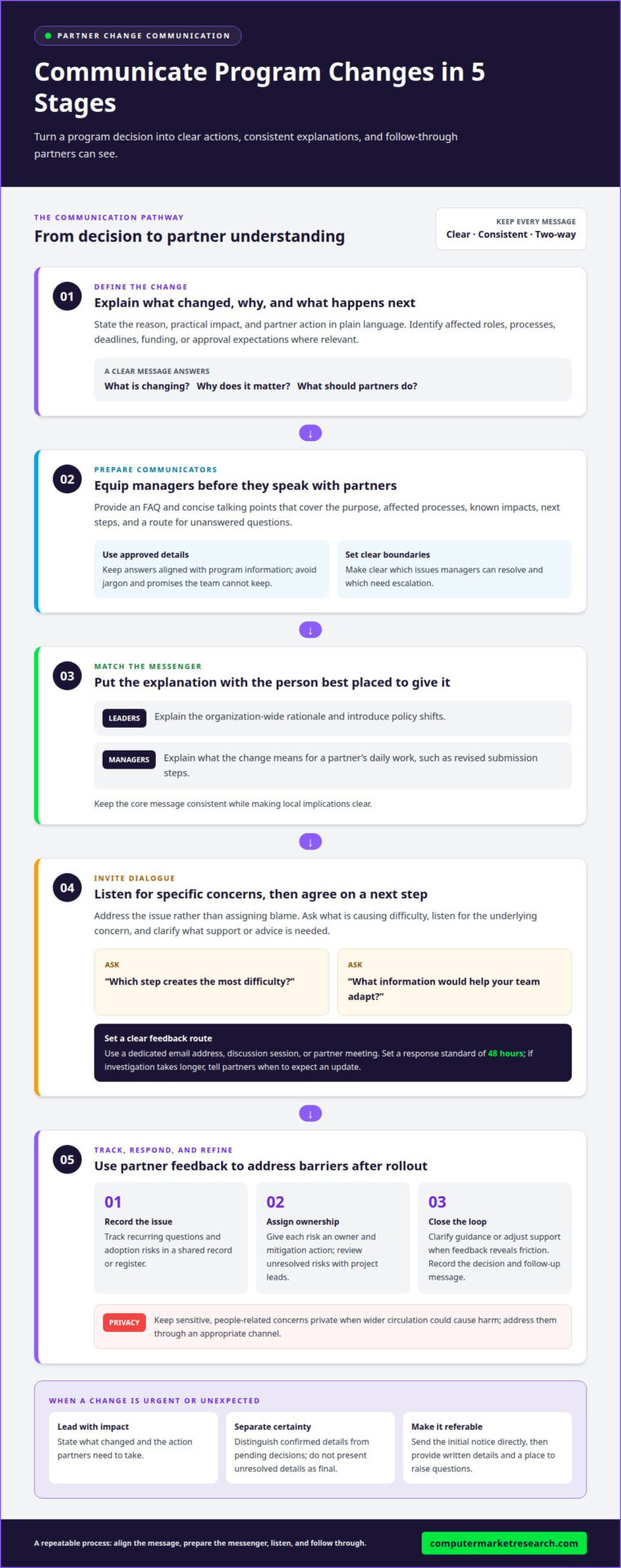
A change announcement works only when partners understand what is changing, why it matters, and what they need to do next. Knowing how to communicate program changes to partners starts with identifying who and what the change affects, then sharing clear, consistent information and inviting questions. Follow up after rollout to spot issues and adjust support.
Sending an update is not the same as communicating. Partners may still be unsure how a program change affects their roles, timelines, funding, or daily processes, especially when details arrive late or conflict across channels.
This guide explains how to assess partner impact, clarify the reasons and practical implications, and plan the right messages and timing. You’ll also learn how to invite feedback, address concerns, and use what you hear after launch to keep the change on track.
Key Takeaways
- Prepare managers with clear FAQs and talking points so partners receive consistent explanations.
- Make communication a two-way process: invite questions, listen to concerns, and respond with clear next steps.
- Assess how each change affects partner objectives, resources, timelines, and readiness before setting the message and rollout pace.
- After launch, use open-ended questions and partner feedback to spot friction and shape follow-up support.
- Build a communication calendar early, with defined audiences, messages, channels, owners, and follow-up points.
What Exactly is Change Management Communication?
Change management communication turns a program decision into clear actions for leaders, managers, and partners. Use the steps below to prepare communicators, address concerns, and identify adoption risks before they disrupt working relationships.
- Clarify what changed, why, and what partners need to do differently. For example, a revised funding process may affect submission steps, deadlines, or approval expectations. Explain the reason, practical impact, and next action in plain language. This gives leaders and managers a consistent basis for conversations instead of leaving partners to piece together fragmented updates.
-
Prepare Managers with FAQs and Talking Points
Give managers an FAQ and concise talking points before they speak with partners. Cover the change’s purpose, affected processes, known impacts, next steps, and a contact route for unanswered questions. Ensure every answer reflects the approved program details, and avoid jargon or promises the program team cannot keep. Managers should know which issues they can resolve and which need escalation.
- Choose the sender best placed to explain each message. Leaders should communicate the organization-wide rationale, while managers can explain what the change means for a partner’s daily work. For example, a senior leader can introduce a policy shift, then a partner manager can explain the revised submission steps. This keeps the core message consistent while making local implications clear.
- Make difficult conversations constructive by addressing the issue rather than assigning blame. If a partner is angry about a revised process, pause to lower the tension, then ask what specifically is causing difficulty. Listen for the underlying concern, clarify what support or advice is needed, and agree on a next step. Direct questions and specific requests help prevent assumptions and defensive exchanges from harming the relationship.
-
Manage Adoption Risks
Record adoption risks in a shared register, assigning an owner and mitigation action to each issue. Include practical obstacles such as unclear responsibilities, process gaps, or limited partner understanding. Keep sensitive, people-related concerns private when wider circulation could cause harm, and address them through an appropriate channel. Review unresolved risks with project leads so communication responds to real barriers, not assumptions.
Effective change communication is a repeatable process, not a one-time announcement. To communicate program changes to partners well, align each message with a real decision, prepare the people delivering it, and use questions to uncover confusion. When managers share consistent talking points and leaders explain the rationale, partners can understand both the change and their role in adopting it.
Is Your Communications Plan Telling or Communicating?
For urgent or unexpected changes, update partners promptly and directly. State what changed and what action they should take. Separate confirmed details from pending decisions, then explain how partners can raise concerns and receive follow-up.
-
Execute Communications and Respond to Feedback
Use the channel partners already rely on for program updates, and track responses in one shared record. If a partner says a revised submission process is blocking a current request, acknowledge the specific issue, assign an owner, and explain the next step. Avoid a generic reply that leaves the partner unsure whether anyone is addressing the concern.
-
Establish Feedback Loops and Dialogue
Build a clear feedback route into the communication plan, such as a dedicated email address, discussion session, or partner meeting. Set a response standard of 48 hours, and tell partners when they can expect an update if an issue needs more investigation. Record recurring questions by topic, so the program team can distinguish an isolated concern from a process-wide problem.
-
Address Urgent or Unexpected Changes
For an unexpected adjustment, lead with the immediate impact and required action. For example, if a program deadline moves, state the new deadline, which submissions it affects, and where partners can ask questions. Send the initial notice through a direct channel, then provide written details partners can refer to. Don’t present unresolved details as final.
- Invite partners to describe both their practical needs and their response to the change. Ask, “Which step creates the most difficulty?” or “What information would help your team adapt?” These prompts uncover specific friction without putting partners on the defensive. Make room for positive feedback, too: a partner may find that a revised step is already working well for their team.
- Use stakeholder feedback to improve the plan, not merely to fill a response log. If several partners misunderstand the same eligibility instruction, clarify it in the next update and explain what changed. If feedback reveals a local workflow issue, revise the guidance or offer a focused discussion. Record the concern, decision, owner, and follow-up message so partners can see how their input shaped the response.
Communication is the successful sharing of ideas and feelings. Change communication plans should make room for two-way exchanges so people can raise concerns, give feedback, and ask questions. Involve affected stakeholders in refining a restructuring plan to build shared ownership.
When discussing budget changes, ask partners about their concerns and suggestions, and listen carefully. Encourage them to describe their own feelings and needs rather than make accusations. Be direct, not passive-aggressive, when expressing concerns.
Assessing change impact and organizational readiness
A partner announcement should explain what is changing, why it matters, who is affected, and what happens next. Include key dates, required actions, likely impacts, known risks, available support, and a contact route for unanswered questions.
- Map the change against partner workflows before deciding how to roll it out. Identify affected teams, processes, data, and commitments. For example, a revised claims process may change submission steps, approval ownership, or reporting requirements. Record each impact and its owner, then distinguish direct operational effects from secondary ones, such as extra training or delayed reporting.
- Assess readiness by checking whether affected partners have the ability, access, and information to adopt the new process. A system update may be technically ready while partner teams lack revised instructions or access permissions. Identify these gaps before launch, assign an owner to resolve each one, and define a clear readiness measure with the business owners responsible for adoption.
- Connect the change to organizational purpose and partner outcomes. Explain how it supports a program objective, such as improving data accuracy or aligning incentives with current priorities. Then describe the trade-offs. If a new approval step improves oversight but adds work for partner administrators, explain both effects so the rationale feels relevant rather than abstract.
- Use a risk register to capture adoption barriers, dependencies, and planned responses. Include risks such as conflicting instructions, an incomplete partner roster, or a process that depends on a later change. Assign an owner and response to each item. Keep sensitive, people-related concerns in an appropriate private channel until the team can address them safely.
- Build transparency into the announcement and rollout schedule. Tell partners what is decided, what remains in progress, and when the next update will arrive. For example, if a timeline depends on a system change, explain the dependency rather than presenting the date as settled. Match the pace of communication to the urgency and impact, and use readiness signals to adjust the rollout when needed.
- Review readiness using evidence before and after launch. Before rollout, check whether partners can complete the required steps; afterward, monitor whether transactions and program activities remain stable or improve. If a data source no longer provides reliable insight, use another relevant signal, such as support requests or completion records. This helps the team respond to actual adoption conditions rather than assumptions.
Two-way listening after rollout
After launch, partner feedback shows how the change works in real workflows. Set a clear process for listening, then use what partners share to guide follow-up.
- Schedule a post-rollout conversation with partners using the changed process. Ask open-ended questions such as, “Which step is working as intended?” and “Where does your team lose time?” Specific prompts let partners describe their experience without steering them toward approval. Record examples, affected workflows, and any follow-up they need.
- Listen actively before explaining or defending the decision. Let the partner finish, summarize their point, and check that you understood correctly. If a distributor says a new reporting step is unclear, acknowledge the concern before discussing the guidance. This shows empathy and helps distinguish a process issue from a misunderstanding. Avoid planning your response while the partner is still speaking.
- Pay attention to how partners communicate, not just the words they use. During a video call, a long pause or a change in tone may signal uncertainty about the new workflow. Ask, “Would you like to explain what feels unclear?” rather than assuming the cause. For written feedback, follow up with a focused conversation if the issue affects execution or partner confidence.
- Connect individual concerns to the program’s vision without dismissing their immediate impact. Explain how the change supports the intended outcome, then address the practical issue the partner raised. For example, if a partner supports better data accuracy but struggles with a revised reporting step, acknowledge both points. This preserves the purpose while identifying where instructions or processes need improvement.
- Turn feedback into visible next steps. Group comments by theme, such as unclear instructions, access problems, or process delays, and assign an owner to each issue. Tell partners what the team will address, what needs further review, and when they’ll hear back. If feedback leads to updated guidance, explain what changed and why. Closing the loop shows partners how their input informed action.
- Check whether the response resolved the original concern. After clarifying an instruction, ask the partner to walk through the relevant step using the revised guidance. If the difficulty remains, revisit the process rather than repeating the explanation. Record the outcome alongside the initial feedback so the team can assess whether the issue was resolved and identify broader adoption barriers.
Creating a change communications plan and editorial calendar
Notify partners after a change is approved and before it affects their work. Set the timing according to its urgency, scope, and the preparation partners need to act.
- Start planning change communication while the project is taking shape, not just before rollout. Bring project, business, and communications leads into the same planning conversations. Together, define the change, its purpose, affected partner groups, and the actions each group must take. Early coordination helps identify missing information before it becomes a partner concern.
- Map each audience to its practical impact and information needs. A distributor submitting claims may need revised instructions, while a sales contact may need to explain the change to their team. Note each audience, the message it needs, the right sender, and the channel it uses. This keeps updates relevant instead of sending every detail to everyone.
- Build an editorial calendar around decision points and partner actions. Include the announcement, reminders, implementation guidance, and post-launch follow-up. For each item, assign an owner, audience, channel, approval status, and intended action. If a change affects external partners, coordinate internal communication shortly before the external announcement so employees are ready for partner questions.
- Use the calendar to keep messages consistent across conversations and channels. Maintain a central version of approved wording, key dates, FAQs, and contact routes. If a program timeline changes, update the source material before managers send new messages. Avoid circulating old and revised instructions together, since partners may act on conflicting details.
- Build feedback and revision into the schedule, rather than treating them as afterthoughts. Set aside time to review partner questions, identify recurring concerns, and decide whether guidance needs clarification. Record who owns each response and when the next update will reach partners. If feedback shows a step is difficult to complete, revise the instructions or process and explain the adjustment in the next scheduled message.
- Review the calendar whenever scope, timing, or partner impact changes. Project and business owners should co-author updates, confirm dependencies, and agree on what partners need to know next. This keeps the plan aligned with actual decisions rather than an outdated launch sequence. To organize partner program workflows alongside change communications, start your free trial.
Computer Market Research
Computer Market Research helps businesses administer channel programs and manage partner information through cloud-based solutions. When changes affect partner onboarding, deal registration, or incentive workflows, its PartnerPortal™ centralizes these processes and supports clearer, more consistent program operations.
Co-op/MDF Management, Rebates & Incentives, and Deal Registration support common channel program processes. These solutions can help when fragmented records or manual workflows make it difficult to apply updates consistently and maintain visibility across partner activity.
If you’re planning a program change and want to discuss how Computer Market Research can support your channel operations, contact the team.
Make Every Program Change Easier to Navigate
Treat each program update as an opportunity to strengthen how your organization works with partners. A disciplined approach to how to communicate program changes to partners can become part of your operating rhythm, helping teams align decisions, partner expectations, and follow-through as programs evolve.
Connect communication with the workflows behind your channel programs. Clear information and organized partner data help teams manage updates consistently and reduce reliance on scattered messages and manual tracking. Computer Market Research supports channel operations with PartnerPortal™, Co-op/MDF Management, and Rebates & Incentives.
Consider where fragmented processes make partner updates harder to coordinate, then decide what would make the next change easier to manage. Explore the platform with a free trial and identify a practical next step for your program. With a clear process and the right operational support, your team can move forward with greater confidence.
Frequently Asked Questions
What communication channels work best for announcing program changes to partners?
Choose a channel partners can access easily, then reinforce important details in a lasting written format. For a change that needs discussion, hold a video or in-person briefing and follow up by email with decisions and actions. For a straightforward update, a concise written notice may be enough. Consider partner locations, roles, and access needs, and don’t rely on a single announcement partners might miss.
How should program changes be tailored for different partner groups?
Tailor each message to the partner’s responsibilities and exposure to the change. A distributor handling program administration may need process instructions, while a sales partner may need to know how updated rules affect deal submissions. Keep the core rationale consistent, but adjust examples, required actions, and supporting detail. A message matrix can map each group to its impact, sender, channel, and next step.
What steps should organizations follow to plan and deliver partner communications about program changes?
Document the approved decision, its owner, and the partner actions it requires. Then map affected audiences, prepare suitable messages, choose channels, and assign reviewers before distribution. For example, a team changing a claims workflow can test its instructions with a small group of internal users, clarify confusing steps, and distribute the final version. Keep current guidance in an accessible location.
How can organizations explain the reasons and benefits behind a program change to partners?
Explain the business reason, partner impact, and expected benefit in a clear cause-and-effect sequence. For example, standardizing data fields may help teams reconcile partner submissions consistently, while requiring partners to adjust their reporting format. State both the benefit and the practical trade-off. Avoid abstractions and connect the rationale to a workflow or outcome partners recognize.
How should organizations gather partner feedback and questions about program changes?
Offer a structured way to submit questions, such as a dedicated form or shared mailbox, with prompts that capture the affected process, the issue, and its consequence. Group submissions by theme to distinguish recurring confusion from partner-specific cases. For example, separate access problems from unclear eligibility rules. Share a response or status update through the channel partners used.
What risks can arise from poor communication of program changes to partners, and how can they be prevented?
Poorly controlled updates can leave partners following outdated instructions, missing required actions, or interpreting program rules differently. Prevent this with a dated change log, one approved source for current guidance, and a reviewed distribution list. If partners use downloadable documents, replace obsolete copies or label them clearly as superseded. These controls reduce confusion across teams and partner organizations.
How can organizations measure whether partners understand and act on program change communications?
Measure understanding through observable actions, not message delivery alone. Track whether partners complete the revised process, submit required information correctly, and follow the new instructions. Where useful, compare these signals with the previous workflow, and review recurring support questions for signs of confusion. If partners receive the update but continue using the old process, investigate whether the guidance, access, or workflow needs adjustment.

Article by
Del Heles
Del Heles is the founder and CEO of Computer Market Research (CMR), a channel management software company he launched in 1984. With more than 40 years of experience, he’s known for helping manufacturers and distributors simplify complex partner programs through practical, customer-focused technology solutions.