

What if distributor data could be viewed and managed in one place instead of reconciled across separate files and systems? Centralizing data from multiple distributors brings information from those sources into a shared repository, giving teams a clearer, more consistent view of business and marketing activity.
Fragmented records make it harder to find current information, compare performance, and spot inconsistencies. Centralization can improve access, but it also requires clear decisions about how data is collected, standardized, protected, and maintained.
This article explains what centralized distributor data means and how it can support more reliable information. It covers practical ways to improve access and data quality, challenges that can arise during consolidation, and how connected channel-management processes help teams work with distributor data.
Key Takeaways
- Learn how data from different distributors can be consolidated into a shared source of truth for reporting and analysis.
- See how role-based permissions and routine quality checks can improve access while protecting sensitive information.
- Understand how consistent data definitions help teams compare performance across departments and channels.
- Identify common migration, integration, and data ownership challenges before they disrupt workflows.
- Explore how POS Data Management and related channel offerings can support clearer distributor data processes.
What Does “Centralized Data” Really Mean?
Centralized data brings records from separate distributor systems into a shared, organized destination. When centralizing data from multiple distributors, the goal is accurate, accessible information that supports consistent analysis and decisions.
Automated Data Collection
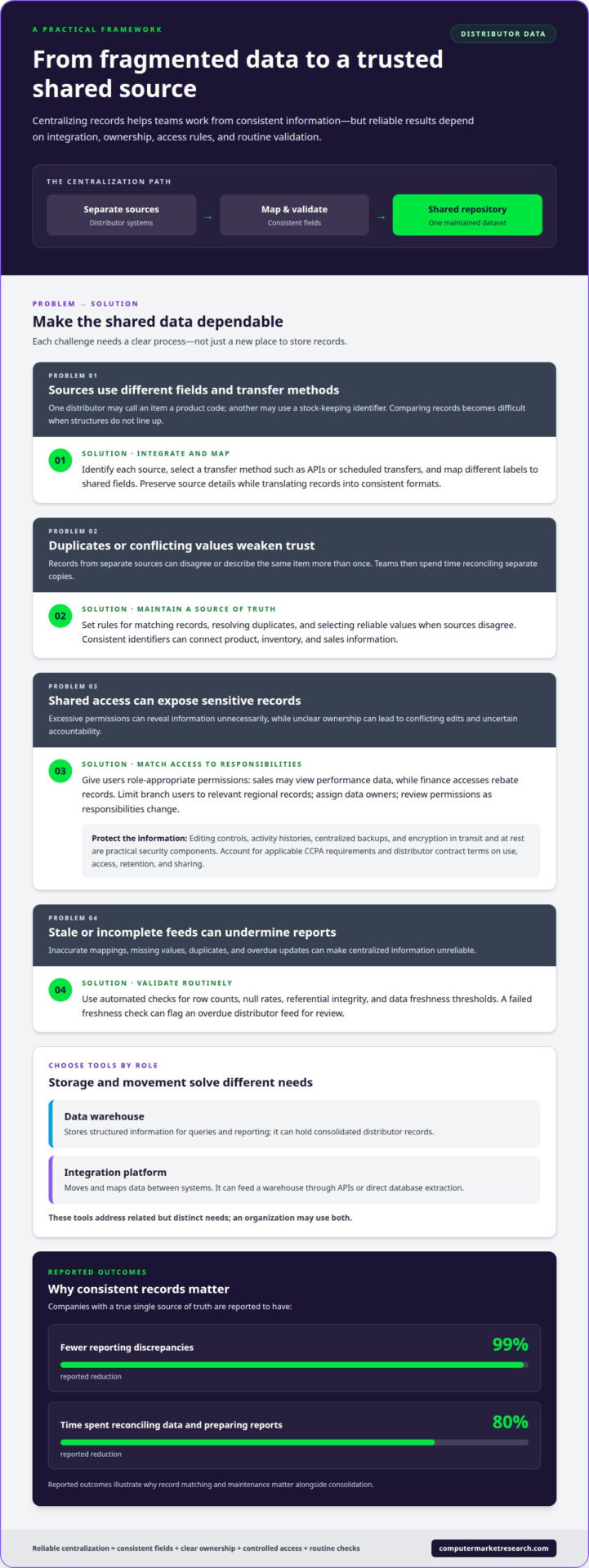
Automated data collection uses connections such as APIs or scheduled transfers to gather records from separate sources and deliver them to a central system. Teams can then work with incoming distributor data without repeatedly copying files by hand. A practical design identifies each source, selects a transfer method, and sets rules for when new records enter the shared repository.
Integrating Disparate Data Sources
Integration connects systems that may use different field names, structures, and transfer methods. A distributor might label an item as a product code while another uses a stock-keeping identifier; mapping both to a shared field makes comparison possible. Common formats and API options vary by distributor, so the integration design should preserve source details while translating records into consistent fields. This supports clear channel data workflows.
Consolidating Data into a Single Source of Truth
Consolidation combines incoming records in a maintained repository that serves as the business’s source of truth. The system needs rules for matching records, resolving duplicates, and choosing reliable values when sources disagree. For example, a shared product record can connect distributor inventory and sales information through consistent identifiers. Teams can then analyze the same dataset instead of reconciling separate copies.
Data Warehouses and Integration Platforms
A data warehouse stores structured information for queries and reporting, while an integration platform moves and maps data between systems. They address related but distinct needs, and organizations may use both. A warehouse can store consolidated distributor records, fed by APIs or direct database extraction. A typical build assesses sources, maps fields, ingests and stores records, then makes validated data available to reporting and other tools.
A Product Information Management (PIM) system can gather product data in a centralized database that serves as a single source of truth for a company. This can give teams a consistent place to maintain product details, rather than relying on separate copies that may drift apart. The value of that arrangement is not limited to where records are stored: shared, dependable information can also make reporting and day-to-day comparisons more consistent. Companies with a true single source of truth are reported to have 99% fewer reporting discrepancies and to reduce time spent reconciling data and preparing reports by 80%. These reported outcomes illustrate why matching and maintaining records is as important as bringing them together.
Centralized collection can include more than distributor records. Data collection tools can gather information from websites, applications, and internet of things (IoT) devices and transfer it to a central repository. A centralized data architecture can replace numerous point-to-point integrations with a cleaner network feeding one destination. This can make it easier to see where information enters and how it becomes available for use. Teams also gain a shared place to validate and organize records while preserving the distinctions needed to understand their sources. Centralization is useful when the destination and its processes support trustworthy, accessible information, not simply because many records sit in one place.
Role-based access and data quality checks
Centralized distributor data needs clear access rules and routine validation. These controls support collaboration, limit exposure, and help teams identify unreliable records.
Role-based access gives each person permissions suited to their responsibilities. Sales may view performance data, while finance accesses rebate records and approved analysts build reports. Branch-level permissions can limit users to relevant regional records. A deliberate access model makes shared information useful without giving every user administrator privileges.
Permissions across departments should reflect how teams work together. Sales and finance, for example, may need access to the same incentive record, while only designated finance users can edit payment fields. Assign data owners to maintain accuracy and documentation, and review permissions when responsibilities change. Clear ownership reduces conflicting edits and supports accountable collaboration.
Cloud-based access can make shared records available to authorized team members in different locations. Branch users can view current data in the same system, while synchronization rules determine how updates move between connected sources. Activity histories, editing controls, centralized backups, and encryption in transit and at rest help protect information. Access controls, encryption, and monitoring are practical components of centralized security.
What U.S. regulations or contract terms affect sharing distributor data? The California Consumer Privacy Act (CCPA) requires stringent management of personal information and data privacy. Distributor agreements may also set limits on permitted uses, access, retention, and sharing, so governance should account for the applicable contract terms.
What are the security, privacy, and data-quality risks of centralizing distributor data? Excessive permissions can expose sensitive records, and weak security can increase privacy risks. Inaccurate mappings, missing values, duplicate entries, and stale feeds can undermine reports, so access protections must work alongside validation.
Automated checks can test row counts, null rates, referential integrity, and data freshness thresholds. For instance, a failed freshness check can flag an overdue distributor feed before teams rely on it. Assign an owner to investigate exceptions and document corrections. For teams shaping these workflows, explore a centralized channel data workflow as a practical next step.
Organizations centralizing sensitive performance data should use role-based access controls. Give relevant team members and stakeholders access according to their responsibilities. A cloud-based PIM system can let team members access product data from devices in different countries. Centralized data governance can address quality, privacy, and security concerns. Assign an owner to each dataset to maintain its accuracy and documentation.
Benefits of consolidating business and marketing data
A unified data platform helps teams compare distributor activity with business and marketing results. Its value is clearest when reports use shared definitions and current records.
Consistent Reporting and Shared Data
Consistent reporting uses the same definitions and calculations across reports, allowing teams to interpret results on a common basis. If sales and marketing define “revenue” differently, for example, their reports may show conflicting totals despite using the same distributor records. Shared metric definitions make comparisons more meaningful and help managers trace decisions to consistent information.
Shared data also supports collaboration across departments. A marketing analyst can examine campaign activity alongside sales outcomes, while finance uses the same approved figures for incentive reporting. Rather than assembling separate spreadsheets, teams can follow a common process: apply governed definitions, select the relevant period, and compare like-for-like distributor records. This makes discrepancies easier to spot and discuss.
A Unified Data Platform
A unified platform brings business and marketing records together for analysis instead of leaving teams to work from isolated files. For example, shared identifiers can connect a distributor’s product data, campaign activity, and sales results. Analysts can then examine how the records relate without manually matching separate exports for each report.
What are the benefits of consolidating distributor data in one platform? Teams gain a shared reporting view, can apply consistent definitions, and may spend less time reconciling disconnected records. Centralization can also make current information available to relevant workflows, such as comparing inventory trends with sales activity. Its usefulness depends on accurate source mappings and a dataset that stays current.
Unified access can improve how decisions move between teams. A sales manager reviewing distributor performance and a marketing lead assessing campaign results can refer to the same underlying records. When a report shows a change, analysts can trace connected data back to its source and investigate the activity. This creates a clearer path from shared information to coordinated action.
For example, a team can connect campaign identifiers with distributor sales records and use a consistent reporting period to assess activity. This gives decision-makers a more coherent view than comparing unrelated reports. Consolidation does not replace analysis; it gives analysts a dependable foundation for examining results and sharing findings across the business.
Centralization implementation challenges
Consolidating distributor records can reveal differences in formats, definitions, and update schedules. Assessing existing sources and processes first helps identify integration work before a new database changes established workflows.
Migration and Integration Challenges
Migration transfers existing records into a new system, while integration connects that system to active data sources. Both can reveal mismatched fields, duplicate records, and gaps in historical information. Two distributor files, for example, may use different product identifiers, requiring mapping rules before they can be combined. That preparation supports consistent records without carrying avoidable errors into the destination.
A controlled rollout helps teams test those rules before broader adoption. Start with a defined dataset, compare migrated records against their source, and document exceptions such as missing identifiers. The recommended approach is to initially skip historical inventory-by-day data covering the last 3 years when building a distributor data pipeline. This keeps early migration focused on essential operational needs.
Data Centralization Challenges
Centralization requires shared definitions and clear ownership, not just a connected database. If distributors define a return differently, a combined report may distort comparisons. A data dictionary can standardize terms, calculations, and field meanings across the organization. Assigning an owner to each dataset also clarifies who maintains its accuracy and documentation.
Scope is another challenge. Bringing every available field into the first release can complicate design, testing, and adoption. An organization can identify which distributor records support priority reports, then add other data in phases. A phased rollout can reduce disruption by letting teams resolve issues in a smaller, controlled part of the workflow before expanding access.
Integration maintenance continues after launch. A distributor may change a file structure or update schedule, interrupting a feed or leaving reports stale. Documenting source dependencies and assigning an owner for responses helps teams trace failures. For example, monitoring can flag an unexpected field change so it is addressed before downstream reports rely on incomplete records.
Successful implementation balances technical migration with operational readiness. A practical sequence is to assess sources and processes, define priority data, document shared terms, test mappings, and roll out in phases. Each step helps teams resolve a specific issue before it spreads across the centralized system. Clear ownership keeps decisions accountable as new sources are added.
Organizational data silos and fragmented decisions
Sales, finance, and marketing may each hold different versions of distributor and customer records. These silos limit visibility and leave decisions based on incomplete information.
Fragmented Systems and Data Visibility
Fragmented systems store related information in separate tools, making a shared view harder to assemble. Sales might track distributor activity in a CRM, while finance keeps incentive records in spreadsheets. The records may describe the same account differently, forcing employees to search across systems before assessing performance or responding to a customer.
The cost can reach daily workflows: the average sales representative spends more than 6 hours per week searching for information across disconnected tools. Meanwhile, 65% of sales teams say they lose deals because of poor data visibility. A centralized record can connect account details and activity, helping teams see relevant context before making a sales decision.
Risks of Fragmented Data
Inconsistent details in fragmented records create practical risks. A customer, for example, may appear under different names in a CRM and an order system, splitting purchase history across records. A representative could miss a prior interaction or assess the account using incomplete information. Such gaps make customer decisions less reliable.
Manual reporting can add another layer of risk. An employee may spend three days tracing a discrepancy caused by different spreadsheet filters. Finance teams that pull and reconcile data from multiple systems during the last week of every quarter may face a slower close and more errors. Static ERP exports in Excel can also become outdated after extraction, separating decisions from current activity.
Centralized customer records offer a contrasting model: connected account details, interactions, and distributor activity can be viewed together instead of reconstructed from separate files. The transition requires consistent identifiers and clear ownership, but gives teams a stronger basis for decisions. Start by identifying a recurring visibility gap, such as missing account history, then trace which systems hold the relevant records. This shows where fragmented information affects an important business decision.
To see how a unified workflow can support distributor data visibility, explore the available trial.
Computer Market Research: POS Data Management
Computer Market Research is a relevant next step when distributor point-of-sale information needs structured management alongside channel activity. Its POS Data Management offering supports the POS data part of that workflow, while the appropriate supporting tools depend on the business process.
Consider POS Data Management when distributor sales records matter to reporting but arrive through separate workflows. Bringing those records into a managed process can help teams work with POS information more consistently. The value depends on clear data definitions, reliable source records, and a process for handling discrepancies, not simply storing more files together.
Other channel processes may call for different offerings. PartnerPortal™ centralizes partner onboarding, deal registration, and performance tracking, making it relevant when teams need to manage those activities in a connected channel environment. It differs from POS Data Management: one supports partner processes, while the other addresses point-of-sale data.
Co-op/MDF Management is relevant when an organization needs to manage cooperative marketing funds. Rebates & Incentives supports administration of those programs. These offerings may matter when distributor data is used alongside channel fund or incentive processes, but each addresses a distinct operational need. Choosing the relevant function helps align the workflow with the problem teams need to solve.
Consider these capabilities when teams repeatedly reconcile POS records, partner activity, or incentive information across disconnected processes. For example, a business reviewing distributor sales alongside partner performance may use POS Data Management and PartnerPortal™ for separate parts of its channel workflow. A team managing marketing funds or rebate programs may instead use Co-op/MDF Management or Rebates & Incentives.
Start by identifying the operational issue: POS information management, partner onboarding and deal registration, cooperative funds, or incentive administration. This helps determine which offering fits without treating every data challenge as the same problem. Computer Market Research’s channel offerings address these specific processes, so the next conversation can focus on the workflow and information your team needs to manage.
Contact Computer Market Research to discuss your distributor data needs.
Make Your Next Data Decision Deliberate
The next step in centralizing data from multiple distributors is to turn a broad goal into a defined operational priority. Choose the distributor records and business decisions that need better coordination first, then use that focus to guide how your organization manages channel workflows.
For related channel processes, Computer Market Research offers PartnerPortal™, Co-op/MDF Management, and Rebates & Incentives. These offerings address partner activity, cooperative marketing funds, and incentive programs. They may be relevant when those workflows connect to the distributor information your teams are managing.
A focused conversation can help clarify which process is most relevant to your needs. Contact Computer Market Research to discuss your channel data requirements and potential next steps. With a clear priority and a practical plan, your team can move toward more accessible, manageable distributor information.
Frequently Asked Questions
What does centralizing data from multiple distributors mean?
It means organizing distributor information so teams can use consistent records for operational decisions. For example, a manufacturer could align each distributor’s account and product identifiers, then view related sales records together rather than treating each file as a separate account history. The goal is not simply to store information in one place, but to make records comparable and useful for a defined business purpose.
How do you integrate data feeds from different distributors?
Document each feed’s source, delivery method, fields, and update schedule. Then map equivalent fields to a shared structure, preserve the distributor’s original values for traceability, and test a sample against its source before using it in reports. If two feeds name the same account differently, for example, set a matching rule and route uncertain matches for review rather than silently merging unrelated records.
How can you standardize product, pricing, and inventory data across distributors?
Set shared definitions and identifiers for each data category, then document how incoming values map to them. A product mapping can connect distributor-specific item codes to an internal product identifier; pricing rules should clarify which price type each field represents. For inventory, define units of measure and location fields consistently. Retain original distributor values so teams can trace standardized records back to their source.

Article by
Del Heles
Del Heles is the founder and CEO of Computer Market Research (CMR), a channel management software company he launched in 1984. With more than 40 years of experience, he’s known for helping manufacturers and distributors simplify complex partner programs through practical, customer-focused technology solutions.