

A channel incentive can support partner sales and still reduce reported net sales. To understand what contra revenue in channel finance means, start with this distinction: contra revenue is an amount deducted from gross revenue, such as a return, rebate, or customer discount, rather than a separate operating expense.
Channel programs can be difficult to evaluate when sales, partner claims, and finance records sit in different systems. Classification depends on the payment’s purpose and its connection to a sale. This article explains how returns and allowances affect net sales, how rebates and co-op or market development funds may be recorded, and where contra revenue appears on the income statement. It also distinguishes contra revenue from operating expenses, helping you interpret program costs consistently and understand their effect on reported revenue.
Key Takeaways
- Separate reductions from gross sales in dedicated contra revenue accounts to make sales activity and net results easier to analyze.
- Classify returns, discounts, allowances, and rebates according to how each item relates to the original sale.
- Distinguish customer incentives that reduce revenue from operating expenses that support selling or promotion.
- Track channel program terms and claims consistently so finance teams can assess their effect on reported revenue and partner activity.
- Present gross sales, contra revenue, and net revenue clearly on the income statement to support more reliable financial analysis.
What Is Contra Revenue?
Contra revenue records reductions to sales separately from revenue earned before those reductions. In channel finance, this distinction helps teams separate gross sales from the net amount retained after customer-related adjustments.
Contra Revenue Definition and Treatment
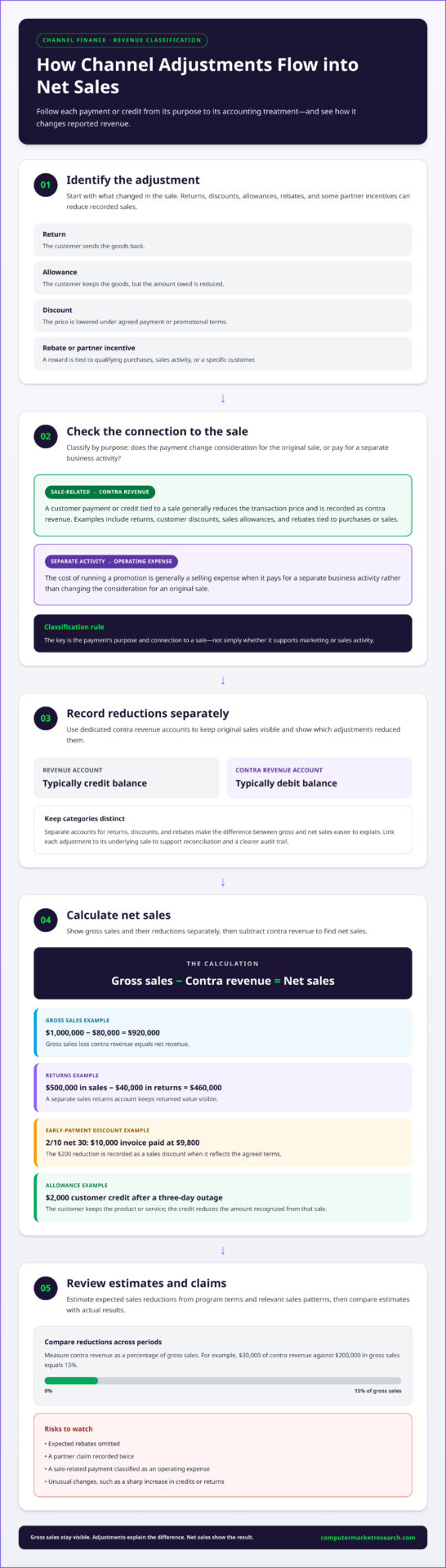
A contra revenue account tracks amounts that reduce revenue, such as rebates or customer credits tied to sales. Revenue accounts normally carry a credit balance, while contra revenue accounts typically carry a debit balance. Under ASC 606, consideration paid to a customer and tied to a sale generally reduces the transaction price and is recorded as contra revenue. Separate tracking helps finance teams see both the original sales value and its reductions.
Reducing Gross Revenue to Net Sales
Contra revenue accounts reduce gross sales to calculate net sales, keeping the two figures visible rather than combining them. For example, $1 million in gross sales less $80,000 in contra revenue produces $920,000 in net revenue. The basic calculation is gross sales minus net sales, which identifies the recorded reduction. This presentation helps teams assess sales performance without overlooking the impact of returns, credits, or incentives.
Separate accounts for returns, discounts, and rebates show which adjustments explain the difference between gross and net sales. For example, comparing sales returns with rebates helps a business see whether customer returns or channel incentives contributed more to the reduction. This makes period-to-period analysis clearer and helps finance teams reconcile original sales with later adjustments.
Accounting practices vary by industry and distribution model because sales arrangements and customer programs differ. A manufacturer selling through distributors may track partner rebates or deal-registration incentives, while a direct seller may focus on customer returns and discounts. The key question is whether a payment or credit relates to a sale, not simply whether it supports marketing or sales activity.
Forecast contra revenue by estimating expected sales reductions from program terms and relevant sales patterns, then compare those estimates with actual results. Measure it as a percentage of gross sales by dividing contra revenue by gross sales. For example, $30,000 of contra revenue against $200,000 in gross sales equals 15 percent, making the deduction easier to compare across periods.
Common risks include omitting expected rebates, recording a partner claim twice, or classifying a sale-related payment as an operating expense. These errors can distort net sales and expense reporting. Separate accounts and records that link adjustments to their underlying sales create a clearer audit trail and help teams identify unusual changes, such as a sharp increase in credits or returns.
Sales returns and allowances
Sales returns, discounts, allowances, and rebates can all reduce recorded sales, but for different reasons. A return reverses a sale when a customer sends goods back. An allowance reduces the amount owed while the customer keeps the goods. A discount lowers the price under agreed payment or promotional terms, while a rebate rewards qualifying purchases or sales activity.
Consider an apparel seller with $500,000 in sales and $40,000 in customer returns. Its net revenue is $460,000 after recording those returns against sales. A separate sales returns account preserves the returned amount, so reports can distinguish the original sales volume from the value retained after returns. The account also helps teams compare return activity across products, customers, or reporting periods.
Discounts also reduce sales revenue when they lower the customer’s payment for a transaction. For example, under 2/10 net 30 terms, a customer paying a $10,000 invoice at $9,800 receives a $200 sales discount. That reduction belongs in sales discounts when it reflects the agreed early-payment terms. Tracking it separately shows how much revenue was given up to encourage prompt payment.
An allowance applies when a seller adjusts the price without taking the product back. For example, a company that credits a SaaS client $2,000 after a three-day outage records the credit as a sales allowance in the cited example. The adjustment reduces the amount recognized from that sale, while keeping it distinct from a full return. This distinction helps reports explain why revenue changed.
In channel sales, examples include distributor rebates tied to purchases, partner incentives linked to sales, and ship-and-debit price support for a specific customer. A promotional rebate may temporarily reduce prices across a broader set of transactions. The key is the connection to the sale: a sales-related payment or credit generally reduces revenue, while the cost of running a promotion may be an operating expense.
For a practical review, match each adjustment to its transaction, identify whether goods were returned or retained, and record the reduction in the account that reflects its purpose. A distributor rebate equal to 4% of sales, for example, should remain distinguishable from customer returns and payment discounts. Separate categories let finance teams explain the sources of reduced sales without blending different causes.
Distinguishing contra revenue from operating expenses
Classification depends on whether a payment changes the consideration for an original sale or pays for a separate business activity. A customer discount tied to a transaction reduces revenue; the cost of running a promotion is generally a selling expense. The distinction affects reported net sales and where the amount appears in financial results. Classifying each item by purpose keeps revenue and expenses separate.
Consider a disputed card payment of $300 and a separate $25 card-network fee. The payment reversal is recorded as sales returns in the example, while the network fee remains separate. The reversal adjusts the original sale because the customer’s payment was disputed. The network charge is a cost of processing, not a reduction to the sales price. Combining them would obscure the reason each amount changed the result.
A marketplace promotion illustrates the distinction. A discount given to a customer reduces revenue, while a marketplace fee for running the promotion is a selling expense. If the marketplace refunds its fee after a sale is returned, the refund reduces the original fee expense rather than creating contra revenue. These classifications distinguish customer consideration from platform costs.
Contra revenue reduces net sales before the remaining margin is assessed; an operating expense is reported separately and affects profit through expenses. If a customer discount is recorded as an expense, reported sales remain higher than the reduced consideration suggests, and operating costs may appear larger. The effects on margin and profit depend on the related sale, product costs, and other expenses.
Forecasts also depend on using the right category. A finance team forecasts customer credits tied to sales as a revenue reduction, while expected promotion fees belong with selling expenses. If a distributor rebate is recorded as an expense instead of a sales reduction, forecast net sales may be overstated, even if the expected outflow is unchanged. Comparing estimates with actual claims and promotion charges helps explain variances and improve later forecasts.
For each adjustment, identify the payee, the underlying transaction, and the reason for the payment or credit. A customer concession linked to a specific sale points toward contra revenue; a marketplace charge for campaign placement points toward operating expense. If an adjustment includes both, separate the sales reduction from the service cost when the records support that distinction. This gives management a clearer view of original sales, margin, and profit.
Rebates, SPIFs, co-ops, and market development funds
Channel incentives may reward purchases, partner sales activity, or marketing that supports demand. Their accounting treatment depends on program terms and whether the benefit relates to a sale. For example, a volume rebate rewards a distributor after purchases meet an agreed threshold. A SPIF incentivizes partner sales representatives, while co-op and market development funds support partner marketing activities.
These programs serve different purposes. Volume and growth rebates encourage partner organizations to increase purchases or sales. SPIFs focus on sales representatives’ efforts. Co-op and market development funds can reimburse partners for demand-generating work, such as trade-show participation or digital marketing materials. For example, a program might reimburse 50% of trade-show costs or 80% of eligible digital marketing costs. The program’s terms define eligible activity and reimbursement.
For accounting, a manufacturer may accrue a volume rebate as qualifying distributor sales occur. One example accrues a $200,000 rebate on $2 million in distributor sales. If the rebate relates to those sales, it generally reduces revenue rather than being treated as an unrelated operating expense. The estimate should reflect the program’s conditions and the sales activity that qualifies.
An earned but unpaid rebate may be recorded on the balance sheet as an accrued liability until it is settled. The corresponding entry reduces revenue when the obligation is recognized; payment clears the liability. Co-op or market development funding also needs to be classified according to its terms and relationship to sales. A partner reimbursement is not automatically a sales discount.
Partners typically claim an incentive by submitting eligible sales or activity records with supporting documentation. The manufacturer matches the claim to program terms, validates and approves the amount, then reconciles payment or credit against the partner account. Clear records help prevent duplicate claims and mismatches between approved incentives and recorded sales.
Useful controls include written eligibility rules, documented approvals, claim evidence, and a record of the calculation. For a co-op claim, evidence might link approved marketing activity to invoices and proof of completion. For a rebate, sales records should support the qualifying purchases and calculation. Consistent controls give finance teams a traceable basis for accruals, settlements, and later review.
Reporting net revenue on the income statement
An income statement may show gross sales, contra revenue, and net sales as separate lines. This layout presents original sales before deductions and the amount remaining afterward. Calculate net sales by subtracting returns, discounts, allowances, and other sale-related reductions from gross sales. Keeping the figures visible makes the effect of adjustments on reported income easier to understand.
A monthly example shows how the figures reconcile. In October, gross sales were $200,000, with $18,000 in discounts, $10,000 in returns, and $2,000 in allowances. Those reductions total $30,000, leaving net sales of $170,000. In November, gross sales were $400,000, while discounts were $68,000, returns were $26,000, and allowances were $6,000. The $100,000 total reduction leaves $300,000 in net sales.
Presenting each reduction separately helps explain the change between those months. Gross sales doubled from October to November, an increase of 100%, while net sales increased by 76.5%. Discounts accounted for 17% of November gross sales, compared with 9% in October. The statement therefore shows not just higher sales, but also how a larger share of sales was offset by discounts.
For clear presentation, group adjustments by accounting purpose and reporting period. A returns line should reflect returned sales, while discounts and allowances should remain identifiable rather than being combined into one unexplained amount. If a business accrues a sales-related rebate before paying it, the income statement reflects the revenue reduction when recognized; the unpaid obligation is tracked separately as a liability.
Reconciliation supports reliable reporting. Finance teams can compare gross sales records with the contra revenue accounts, then confirm that their differences equal the net sales shown on the statement. In the November example, $400,000 less $68,000, $26,000, and $6,000 reconciles to $300,000. This check helps identify omitted adjustments, duplicate entries, or amounts posted to the wrong period before they distort reported income.
A related way to interpret net revenue is to consider customer retention measures. A company reports 120% logo retention and 90% net revenue retention after promotional credits are reflected. These measures should be read together rather than treated as interchangeable: one is identified as logo retention, while the other is net revenue retention after those credits have been taken into account. The contrast shows why revenue adjustments matter when readers assess a reported revenue outcome. Looking only at the logo retention figure would not convey the effect promotional credits have on the net revenue retention figure. Keeping the measures distinct makes the role of credits visible without implying that the percentages describe the same result.
For financial reporting, the useful point is to consider promotional credits in the interpretation of the net revenue measure they affect. They should not be overlooked when comparing the two reported percentages. The 120% logo retention and 90% net revenue retention communicate distinct results, with the latter reported after promotional credits. This distinction helps readers avoid assuming that a retention percentage alone explains the net revenue outcome. It also connects the treatment of sales reductions on an income statement with the broader question of how credits influence reported net revenue. Clear presentation lets readers see both the retention measures and the effect of the stated adjustment.
Computer Market Research
Computer Market Research helps channel teams manage partner programs and the data connected to sales incentives. Its offerings support the administration of rebate claims, co-op funding, deal activity, and sales records. This can improve visibility into channel activity, helping finance and program teams review the information behind sales-related adjustments.
When partner program details are spread across disconnected processes, teams can struggle to connect eligibility, partner activity, and claims. PartnerPortal™ centralizes partner onboarding, deal registration, and performance tracking, giving teams a clearer view of partner information used in channel operations. Accounting decisions still depend on the relevant program terms.
Co-op/MDF Management helps businesses administer funds for partner marketing activities. Rebates & Incentives supports the organization of incentive programs and related partner activity. These offerings manage programs, but do not replace a company’s accounting policies. Finance teams determine whether each payment or credit reduces revenue or belongs in operating expenses.
Deal Registration helps teams manage registered sales opportunities and channel activity. Connecting registration records with program rules provides context for reviewing related incentives, including why an incentive was approved and which partner activity it supports.
These capabilities are especially relevant when manual tracking makes it difficult to reconcile partner claims, sales activity, and program terms. They support a more organized channel workflow and give teams better access to information for program administration and financial review. Each transaction still needs to be classified according to its purpose and relationship to a sale.
If channel program administration is creating gaps between partner activity and finance records, contact Computer Market Research to discuss how its offerings can support your workflow.
Frequently Asked Questions
What is a Contra Account?
A contra account offsets the balance of a related account, keeping the original amount visible while showing the adjustment separately. For example, accumulated depreciation offsets an asset’s recorded cost without erasing its original cost. Contra revenue works similarly: it tracks sales reductions alongside revenue accounts. This presentation distinguishes the underlying balance from adjustments that change its reported net amount.
What does contra revenue mean in channel finance?
In channel finance, contra revenue means sales-related reductions connected to partner transactions or programs. A manufacturer might give a distributor a credit tied to qualifying purchases; that credit can reduce revenue recognized from those sales. The program terms and connection to the transaction matter. Linking the adjustment to channel records helps finance teams understand how partner activity affects recognized revenue.
How do rebates, discounts, and co-op marketing funds affect contra revenue?
Rebates and discounts tied to a customer’s purchase generally reduce the consideration for that sale. Co-op marketing funds require attention to purpose and terms: a payment tied to a sale may reduce revenue, while reimbursement for a distinct marketing activity may be treated differently. For example, evaluate a partner’s campaign reimbursement against the agreement and evidence of the activity, rather than classifying it by its label alone.
How is contra revenue recorded under GAAP?
Under GAAP, the accounting depends on the substance of the arrangement. Under ASC 606, consideration paid to a customer that is tied to a sale generally reduces the transaction price and is recorded as contra revenue. The entry typically debits a contra revenue account and credits cash, a payable, or another relevant account. For estimates, teams should use the arrangement’s terms and qualifying sales activity to support the recorded amount.
How does contra revenue differ from operating expenses and cost of goods sold?
Contra revenue reduces the amount reported as sales, while operating expenses reflect costs of running or promoting the business. Cost of goods sold represents costs associated with products sold, rather than a customer credit or rebate. For example, a discount that lowers a buyer’s transaction price affects revenue; the cost of manufacturing the product remains part of cost of goods sold. Keeping these categories separate clarifies sales, gross margin, and expenses.

Article by
Del Heles
Del Heles is the founder and CEO of Computer Market Research (CMR), a channel management software company he launched in 1984. With more than 40 years of experience, he’s known for helping manufacturers and distributors simplify complex partner programs through practical, customer-focused technology solutions.