

The longest security questionnaire isn’t automatically the most useful. A PRM software security questionnaire should compare vendors against consistent criteria, then weigh the evidence against the data and workflows each platform will handle. Focus on data protection, compliance evidence, recovery planning, governance, security controls, and vulnerability management.
It’s reasonable to expect clear answers about how a vendor protects sensitive information and responds when something changes. But a completed questionnaire is only a snapshot. The quality of the evidence and the process for reviewing risks matter just as much as the answers. This guide explains how to compare vendors without treating every question as equally important. You’ll learn what evidence to assess, how to evaluate controls and recovery practices, and how to tailor the review to a PRM platform’s role in partner operations. A side-by-side criteria table and practical decision guide can help your team make a consistent, documented comparison.
Key Takeaways
- Match the vendor’s privacy and compliance evidence to the data your PRM platform will handle and the requirements that apply to your organization.
- Compare recovery plans by examining how the vendor sets recovery objectives, communicates during incidents, and restores service.
- Assess governance by looking at security ownership, policy oversight, and how the vendor manages changes that could affect risk.
- Review vulnerability management practices, including application security testing and how findings are tracked and addressed.
- Compare access controls, authentication, and encryption against your operational needs, then use the evidence to make a consistent vendor decision.
Data protection, encryption, and compliance evidence
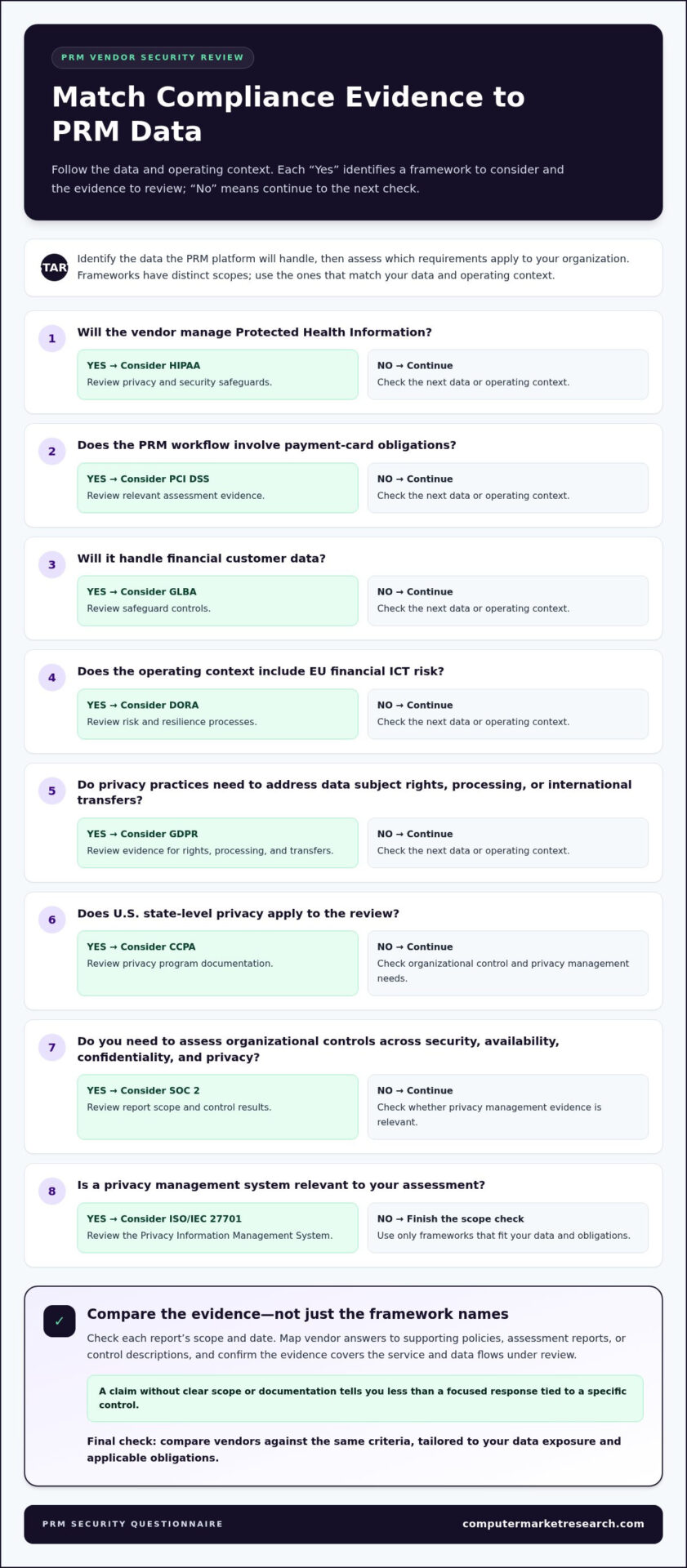
A PRM software security questionnaire should connect privacy obligations, encryption evidence, and control documentation to the data the platform handles. Compare the evidence with your organization’s applicable frameworks rather than relying on a generic checklist.
For a practical overview of questionnaire workflows, watch this explanation of third-party vendor assessments:
Compliance Laws and Standards
GDPR helps assess data subject rights, processing, and international transfers, according to the European Union. HIPAA is relevant when vendors manage Protected Health Information, with privacy and security safeguards emphasized by the U.S. Department of Health and Human Services. CCPA addresses U.S. state privacy, while SOC 2 assesses controls across security, availability, confidentiality, and privacy. These frameworks have distinct scopes, so select those that match your data and operating context.
| Option | Primary focus | Useful evidence |
|---|---|---|
| GDPR | Privacy practices | Rights, processing, transfers |
| HIPAA | Protected Health Information | Privacy and security safeguards |
| CCPA | State-level privacy | Privacy program documentation |
| SOC 2 | Organizational controls | Report scope and control results |
| PCI DSS | Payment-card obligations | Relevant assessment evidence |
| GLBA | Financial customer data | Safeguard controls |
| DORA | EU financial ICT risk | Risk and resilience processes |
| ISO/IEC 27701 | Privacy management | Privacy Information Management System |
Vendor Security Features and Certifications
Compare PRM vendors by documented controls, not assumed feature parity. Ask which protections cover stored and transmitted data, then review each report’s scope and date. AES-256 and TLS 1.3 are examples vendors may specify. A well-designed prm software security questionnaire captures implementation details and covered systems, not just standards’ names.
Map each answer to supporting evidence, such as policies, assessment reports, or control descriptions. Check that the evidence covers the service and data flows under review. A claim without clear scope or documentation tells you less about a vendor’s security posture than a focused response tied to a specific control.
Questionnaire tools collect and track answers; compliance platforms organize programs, evidence, and framework mappings. A manual questionnaire can suit a narrow review, while centralized evidence management helps with repeated assessments. Applying SIG can standardize questions and map relevant controls to NIST SP 800-161r1 for supply chain risk or the NIST AI RMF for AI risk management.
Choose frameworks and evidence that fit your data exposure and obligations, then compare vendors against the same criteria. Reviewing channel sales management software alongside its data access paths can clarify what your assessment should cover.
Business continuity, recovery objectives, and incident response
A PRM disruption can interrupt partner onboarding, deal workflows, or access to program records. Assess recovery and incident response based on the operational impact of losing each function, rather than relying on a general continuity statement.
Start with the recovery time objective (RTO) and recovery point objective (RPO). RTO is the target time to restore a service; RPO is the acceptable point to which data can be recovered. Ask the vendor to define both for the PRM services in scope. Compare those objectives with the time-sensitive workflows your teams rely on, such as partner deal registration or incentive administration.
Business continuity documentation should explain how the vendor handles infrastructure failures, unavailable personnel, and disruptions at critical subcontractors. Look for clear ownership, escalation paths, backup arrangements, and evidence of exercises. A written plan describes intended actions; a dated test record shows whether teams practiced them and documented the results.
- Map critical PRM functions to the business process they support.
- Compare stated RTO and RPO objectives with your recovery needs.
- Review test records, remediation actions, and accountable owners.
Incident response is a separate measure of readiness. Ask how the vendor detects, classifies, investigates, and communicates incidents affecting your data or service. Review the response plan for named roles, escalation routes, customer notification processes, and post-incident analysis. If partner records become inaccessible, for example, the response should clarify who coordinates restoration and updates affected customers.
Third-party risk management also requires understanding which service providers support the PRM platform. Ask for documentation of critical dependencies and how the vendor assesses disruptions that could affect service delivery. In financial services, healthcare, and critical infrastructure, regulators expect continuous vendor risk oversight rather than annual checkbox reviews. Ongoing assessments are therefore more useful than relying on onboarding answers alone.
Questionnaire responses provide a point-in-time view, so establish a process for reviewing changes. Revisit recovery evidence quarterly or after significant changes to policies, technology, regulations, or standards. Record what changed, which controls were affected, and who approved the updated assessment. This creates an audit trail and helps distinguish current information from outdated documentation.
Apply the same criteria to every vendor, but weight them according to operational impact. A platform supporting essential partner transactions warrants closer scrutiny of tested recovery plans, incident communications, and dependency management. A lower-impact use case may call for a narrower review. Connect documented recovery capabilities to the workflows your organization must restore first.
Governance and organizational structure questions
Governance questions show who owns security decisions and how those decisions inform daily operations. For an enterprise PRM vendor, map accountability across security, engineering, privacy, and customer support. Named owners make escalation paths easier to assess than a general statement that “the security team” handles risk.
Ask for the vendor’s organizational chart or equivalent role descriptions, then connect each role to a control. Identify who approves access changes, reviews security policies, manages exceptions, and communicates incidents. Check whether responsibilities remain clear when a team member leaves or a service changes. The answers show whether governance is built into workflows or depends on informal knowledge.
Frameworks can help structure this review. ISO/IEC 31000 provides a baseline for evaluating risk management practices. SOX is relevant when a vendor supports financial reporting processes, where internal controls and data accuracy matter. BCBS 239 focuses on risk data aggregation and reporting, especially in financial services. Each framework emphasizes a different governance concern, so align questions with the vendor’s role.
- Record the accountable owner for security, privacy, and risk decisions.
- Match control approvals to documented roles and review workflows.
- Trace exceptions from approval through remediation and closure.
For a vendor involved in financial reporting, ask how governance supports reliable data and controlled changes. For example, request the process for approving changes to a reporting workflow, including who reviews the effect on data accuracy. If the vendor handles broader enterprise information, ask how leadership receives risk updates and assigns corrective actions. Look for specific records, such as policy approvals, risk registers, and action logs.
Regulatory context can help shape assessment criteria. The SEC’s cybersecurity disclosure rules and the NYDFS cybersecurity regulation are relevant to third-party risk assessment. Ask how the vendor assigns responsibility for tracking applicable obligations, documenting decisions, and updating controls. Keep the review focused on the vendor’s role in your environment rather than assuming every regulation applies to every supplier.
Governance should support continuous monitoring, not just onboarding. Define how your organization will receive notice of material changes to ownership, security leadership, or risk processes. Automated vendor assessments can help organize repeat reviews, but an accountable reviewer still needs to evaluate exceptions and assign follow-up. A useful record links each concern to an owner, a decision, and a resolution.
Compare vendors based on clear accountability, relevant frameworks, and the quality of governance documentation. Choose a structure that gives your team a reliable way to monitor changes and manage unresolved risks.
Security controls and vulnerability management
Assess a PRM vendor’s security controls by examining how it identifies weaknesses, prioritizes fixes, and records outcomes. Connect each control to the systems, integrations, and data flows included in your deployment. For example, check whether the partner-facing application and its connected services fall within the same testing scope.
Common risks in PRM integrations include excessive permissions, exposed credentials, and weaknesses in connected applications or data transfers. These gaps can enable unauthorized access or expose information during a breach. Include every integration in the risk assessment, then record its data access, authentication method, and accountable owner.
Use established frameworks to make application security questions specific. The OWASP Top 10 focuses on application security and is often referenced when evaluating vendor web application practices. Ask how the vendor identifies relevant weaknesses, validates fixes, and tracks unresolved findings against the application. A clear answer should describe controls and evidence, not simply cite the framework’s name.
- Map each integration to the information it can access.
- Identify who approves and reviews integration permissions.
- Ask how vulnerability findings receive severity and remediation priorities.
- Review testing scope, results, and closure records.
Testing frequency offers another comparison point. Annual penetration testing, for example, may score higher than having no testing. Ask which systems the test covered, whether it included relevant application components, and how findings led to remediation. Scope matters: testing a separate environment may not demonstrate controls for the PRM service you plan to use.
ISO/IEC 27001 is the most common baseline for assessing vendor information security management systems. It can help structure questions about how an organization manages security, but application-specific practices still require attention. The SANS Top 20 Critical Security Controls offers a short list developed by security experts, based on practices considered effective for reducing cyber risks. Use these references to organize questions, not as substitutes for control-level evidence.
For each finding, record the affected component, severity, owner, planned action, and evidence of closure. Distinguish a documented policy from an implemented control. A vulnerability policy describes the process; a remediation record shows how the vendor handled a specific issue. This distinction gives you a more useful view of vendor risk than a simple yes-or-no response.
Finally, connect findings to business impact. A vulnerability affecting partner account access may have different consequences from one affecting a rarely used integration. Compare vendors using consistent criteria, while prioritizing controls that protect your PRM workflows and the information they process.
What access controls, authentication, and encryption features do PRM tools offer?
Access controls determine who can view or change partner records, deal details, and program data. Compare PRM tools based on how they assign permissions, authenticate users, and protect information moving between connected systems. Focus on capabilities that fit your organization’s partner workflows.
Start with role-based access. Ask whether administrators can assign distinct permissions to partner users, internal sales teams, and finance staff. For example, a partner may need to submit a deal registration without viewing another partner’s pipeline. Check whether permissions separate viewing, editing, approval, and administration.
Least-privilege access gives each account only the permissions needed for its tasks. Review how the platform handles role changes and departing users. A useful assessment follows an account from creation through permission updates and deactivation. Ask whether administrators can review assignments and identify accounts with broader permissions than their roles require.
Authentication controls help verify a user’s identity. Compare support for multifactor authentication, single sign-on, and organization-managed identity, where available. Ask how these options apply to employees, partner users, and administrators. Distinguish requirements for privileged accounts from sign-in methods available to general users.
- Map user groups to the PRM tasks they perform.
- Compare permission granularity for viewing, editing, and approvals.
- Review authentication choices for employees and external partners.
- Examine how access changes and account activity are recorded.
Audit records support accountability. Ask which user actions are logged, how administrators search the records, and whether each entry identifies the account and action. A record of a changed partner profile, for example, can help teams trace who made the update. Compare the evidence available for investigating unusual access with the controls used to grant access.
Assess encryption throughout the information lifecycle. Ask how the vendor protects stored data, information exchanged with integrations, and data included in exports or backups. Identify which systems and data types the answer covers. A general encryption statement doesn’t show whether partner records, authentication details, and downloaded files receive consistent protection.
For a practical comparison, create a matrix covering user groups, permissions, authentication, logs, and data flows. Record each vendor’s answers alongside supporting documentation and scope limitations. This keeps the assessment focused on operational differences rather than feature labels and helps security and operations teams agree on the most important controls.
Use this review to assess how access and data protections fit your partner workflows. Explore the platform in a 90-day free trial to evaluate its fit for your requirements.
Computer Market Research: PartnerPortal™
Computer Market Research offers PartnerPortal™ to centralize partner onboarding, deal registration, and performance tracking. If your vendor assessment has identified fragmented partner workflows, this platform offers a focused way to manage channel operations alongside your security review.
Use your assessment criteria to evaluate how PRM processes align with governance requirements. Teams managing partner funding can consider Co-op/MDF Management, while organizations coordinating partner opportunities can consider Deal Registration. Rebates & Incentives supports another channel workflow. Assess security evidence and operational fit separately, so product alignment doesn’t replace a careful review of vendor controls.
Contact Computer Market Research to discuss how PartnerPortal™ fits your partner management workflows.
Turn the Review Into a Repeatable Decision
Use your vendor review to create a repeatable decision process, not just approve a single purchase. A well-designed PRM software security questionnaire can provide a baseline for future assessments when teams record why each control matters and who owns follow-up. That record helps procurement, security, and channel operations apply consistent criteria as systems and partner workflows change.
Before adoption, align stakeholders on the risks most likely to affect daily operations. Assign owners to unresolved findings, define which material changes will trigger reassessment, and keep the decision rationale with the vendor record. This makes security review practical governance rather than a one-time approval step.
If you’re ready to evaluate how partner workflows fit your operational needs, explore PartnerPortal™ in a free trial. A structured next step can help your team move forward with greater clarity and control.
Frequently Asked Questions
What is PRM software, and what does a security questionnaire cover?
PRM software manages business relationships with channel partners through activities such as partner onboarding and deal registration. A security questionnaire documents how a proposed deployment handles information, user access, integrations, and operational risks. For a useful review, first describe the intended workflows. Then document what data enters the platform, which teams use it, and which connected systems exchange information.
Which security certifications and compliance standards should PRM software vendors support?
The relevant standards depend on your organization’s industry, data, and regulatory obligations. Treat a certification or framework as evidence with a defined scope, not as proof that every product function meets your needs. Compare the assessed service, covered locations or systems, and assessment period with your intended use. A standard relevant to your organization’s obligations is more useful than a longer list of unrelated credentials.
How do PRM platforms protect partner and customer data?
Protection depends on controls for account access, data handling, and system connections. Review how the platform separates one partner’s records from another’s and limits access for internal roles. Map each integration to the information it sends or receives, then assess how credentials and permissions are managed. This helps identify exposure from unnecessary data sharing rather than relying only on general security statements.
How do PRM vendors handle data storage, retention, deletion, and backups?
Review the data lifecycle from collection through deletion, including copies held in backups or exports. Document where each data category is stored, how long it remains available, and what triggers deletion. Clarify how deletion requests affect archived copies and connected systems. Removing a partner record from the active platform, for example, may differ from removing information retained in a backup cycle or a separate integration.
What security incident response and breach notification commitments do PRM vendors provide?
Commitments should explain how incidents are classified, escalated, investigated, and communicated. Review the contract and response documentation for notification triggers, communication channels, named responsibilities, and information shared during an investigation. If a suspected exposure involves partner records, teams need a clear route to report the issue and receive updates. Record these commitments alongside internal escalation contacts so coordination doesn’t depend on informal communications.
What questions should a company ask before approving a PRM software vendor?
Ask questions that connect the proposed service to your actual workflows: Which data will the platform process? Which integrations will access it? Who approves permissions and changes? What evidence supports the vendor’s control statements? How are unresolved findings tracked? Identify your internal decision owner and the conditions for reassessment, too. These answers help security, procurement, and channel operations make a documented decision using shared criteria.

Article by
Del Heles
Del Heles is the founder and CEO of Computer Market Research (CMR), a channel management software company he launched in 1984. With more than 40 years of experience, he’s known for helping manufacturers and distributors simplify complex partner programs through practical, customer-focused technology solutions.