

Is your market development fund program still tethered to a web of complex spreadsheets? If weeks-long claim processing, frustrated channel partners, and a complete lack of visibility into fund utilization sound familiar, you are not alone. This manual approach doesn’t just create administrative bottlenecks; it exposes your organization to compliance risks and undermines the strategic potential of your channel investments. As we look toward 2026, effective mdf management is no longer a matter of meticulous data entry-it is a critical component of scalable growth.
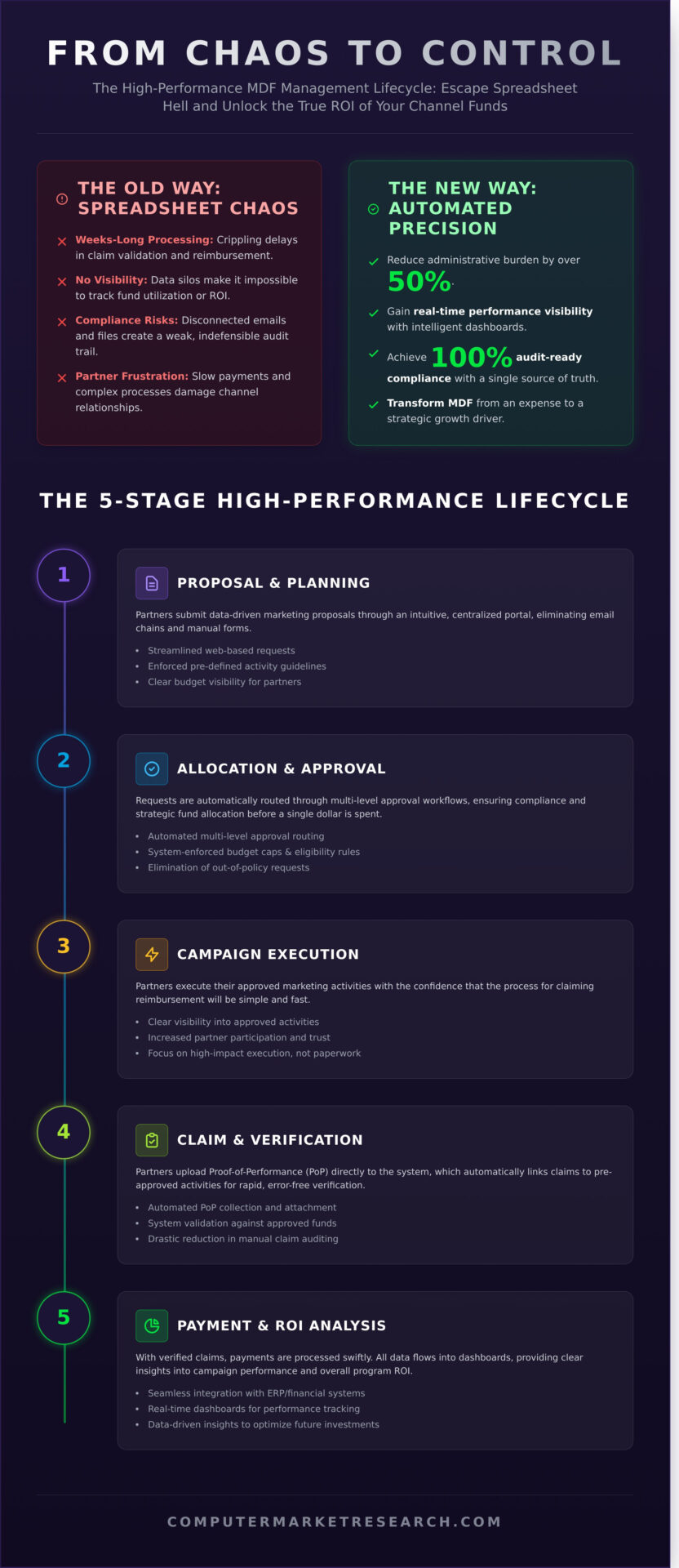
The transition from operational chaos to an automated, high-ROI program is the only logical step. This article provides a definitive blueprint for that evolution, outlining the exact steps required to streamline your channel funds and eliminate the “headaches” of manual reimbursement and audit preparation. Prepare to discover how to reduce administrative burden by over 50%, gain real-time performance visibility through intelligent dashboards, and achieve a state of 100% audit-ready compliance. It’s time to move beyond the spreadsheet and unlock the true power of your MDF.
Key Takeaways
- Identify the hidden operational costs and data integrity risks associated with managing channel funds via manual spreadsheets.
- Implement a standardized 5-stage lifecycle to eliminate operational bottlenecks and create a predictable, scalable program.
- Uncover the data-driven strategies needed to solve fund underutilization and transform your mdf management into a strategic growth driver.
- Define the essential technical requirements for an automation platform, including critical integrations with existing CRM and ERP systems.
Table of Contents
- The Crisis of Manual MDF Management: Why Spreadsheets are Killing Your ROI
- The 5-Stage Lifecycle of High-Performance MDF Management
- Solving the Underutilization Trap: Engaging Partners with Better Data
- Technical Essentials: What to Look for in an MDF Management Platform
- Optimizing Channel ROI with Computer Market Research
The Crisis of Manual MDF Management: Why Spreadsheets are Killing Your ROI
For too long, channel leaders have treated Market development funds (MDF) as a cost of doing business rather than a strategic lever for growth. This perspective is a direct result of the tools used to administer them. When your entire program runs on a patchwork of spreadsheets, email chains, and manual claim forms, your team is trapped in a reactive cycle of processing paperwork. This is not strategic mdf management; it is an administrative burden that actively erodes the return on your channel investment.
This “spreadsheet hell” creates two critical failures: rampant human error and debilitating data silos. Inaccurate formulas and copy-paste mistakes lead to overpayments and compliance risks, while disconnected data makes it impossible to see which partners and campaigns are truly driving sales. As business accelerates toward 2026, the demand for real-time visibility and data-driven decisions will only intensify. A manual system cannot provide these insights. To thrive, you must transition your channel team from a reactive “claims-payer” to a proactive “growth-driver,” using clean data to allocate funds where they will generate the highest impact.
The High Cost of Administrative Friction
Consider the cumulative hours your team loses to manually validating claims, chasing partners for proof-of-performance PDFs, and reconciling disparate spreadsheets. This administrative friction does more than drain resources; it damages relationships. Slow reimbursement cycles breed frustration and erode partner trust, discouraging them from participating in future campaigns. Worse, it leads to “phantom” marketing-funds are spent, but without a streamlined data trail, their true impact on pipeline and revenue remains a mystery.
Compliance and the Audit Trail
In an environment of increasing financial scrutiny, manual MDF systems fail the test of a modern audit. A trail of emails and disconnected files is not a defensible record of fund allocation and can expose your organization to significant compliance risk. Effective mdf management requires a centralized, immutable record that documents every transaction from proposal to payment. Transitioning to an automated platform creates this “single source of truth,” ensuring every dollar is accounted for and making audits a simple, transparent process.
The 5-Stage Lifecycle of High-Performance MDF Management
To accurately calculate ROI, you must first establish control over the entire fund lifecycle. Inefficient, spreadsheet-driven processes create operational bottlenecks that obscure performance data and drain internal resources. For many manufacturers, Market Development Funds represent a significant marketing investment, and managing it without a structured system is a direct threat to profitability. High-performance mdf management is built on a standardized workflow-from initial proposal to final payment-that replaces manual friction with automated precision. This systematic approach ensures every dollar is allocated, executed, and measured against clear objectives.
From Proposal to Allocation
Effective budget control begins with a disciplined pre-approval process. By automating the initial stages of the fund lifecycle, you embed compliance directly into the workflow, eliminating out-of-policy requests before they consume resources. This foundational control ensures funds are consistently directed toward high-impact activities. Key components include:
- Automated Guidelines: Setting clear, system-enforced rules for fund eligibility, qualifying activities, and regional budget caps.
- Streamlined Requests: Providing partners with an intuitive, web-based portal to submit proposals, which drastically reduces administrative overhead for both parties.
- Multi-Level Approvals: Implementing automated approval workflows that route requests to the correct stakeholders for timely review, a critical function for maintaining control at enterprise scale.
Execution, Claim, and Verification
Ensuring partner accountability should not create an administrative burden. Automation transforms the claim and verification stage from a time-consuming manual audit into a streamlined, data-driven process. This allows your team to focus on strategy, not paperwork. A robust system facilitates:
- Automated Proof-of-Performance (PoP): Systematically collecting and attaching required documentation (e.g., invoices, event photos) directly to the corresponding marketing activity.
- Linked Claims: Requiring partners to submit claims directly against pre-approved activities, which prevents duplicate payments and budget overruns.
- Automated Validation: Using pre-set rules to instantly validate claims against approved amounts and PoP requirements, dramatically accelerating the reimbursement cycle and improving partner satisfaction.
Solving the Underutilization Trap: Engaging Partners with Better Data
Industry reports consistently show that up to 40% of Market Development Funds (MDF) go unspent each year. This isn’t merely a line item of lost budget; it is a critical symptom of a disconnect between vendor goals and partner execution. When funds are complex to claim or the value proposition is unclear, partners inevitably disengage, undermining the core purpose outlined in Gartner’s definition of MDFs as a tool for driving localized demand. The antidote to this costly underutilization is not a larger budget, but smarter data.
The solution lies in transforming your MDF program from a passive reimbursement system into a proactive, data-driven growth engine. By providing partners with clean, actionable Point of Sale (POS) and inventory data directly within their portal, you shift the conversation from “Here is money” to “Here is exactly where the opportunity is.” This data-first approach creates a crucial psychological shift: the portal becomes a strategic resource for identifying growth pockets, not an administrative chore for submitting claims. It empowers partners to build effective campaigns based on proven demand.
For instance, partners can use their funds to launch highly targeted campaigns by connecting with a top-tier Influencer, turning MDF into measurable local buzz.
Similarly, MDF can fund hospitality elements for key events, ensuring a premium experience for top partners or clients. For example, arranging executive transportation can set the tone for a successful meeting; you can learn more about MSP Car Service as a model for this type of high-touch service.
Of course, empowering partners with data is only the first step. To translate that data into successful campaigns, partners often need the right marketing infrastructure. For those looking to build a robust marketing funnel, it’s wise to explore Lead Generation services that can convert MDF investments into a predictable stream of qualified leads.
For partners with a local service fleet, MDF can be powerfully invested in vehicle wraps, turning company cars into mobile billboards. This is a classic example of using funds to build brand visibility in a specific territory; to see what high-quality commercial wraps look like, you can visit Yeahgor.
Content marketing is another key area where MDF can be applied. For example, partners can use funds to produce a professional podcast series to reach new audiences and build brand authority. For those in Canada, a service like Mobile Podcasting Montreal offers on-location recording, simplifying the production process for high-quality audio content.
Another powerful use of MDF is to boost local search visibility, ensuring that when customers in a specific territory search for relevant products, the partner’s business appears prominently. For partners needing expertise in this area, hiring a specialist agency like KD Interactive can turn MDF investment into measurable local foot traffic and sales.
Furthermore, real-time performance data allows for dynamic and intelligent mdf management. Channel managers gain the visibility needed to proactively re-allocate funds from underperforming campaigns to high-potential initiatives, ensuring capital is always deployed for maximum impact and eliminating year-end fund forfeiture.
Incentivizing the Right Partner Behaviors
An effective program moves beyond a reactive, “first-come, first-served” model. Instead, it creates a meritocracy where high-value engagement and performance are systematically rewarded. This structure incentivizes partners to become more invested in mutual success. Consider implementing a system that:
- Rewards partners who consistently provide high-quality POS and inventory data.
- Offers tier-based MDF access or bonus funds for top-performing partners.
- Uses gamification elements to encourage timely claims and marketing activity.
Bridging the Communication Gap
Automation is key to closing the communication loop that so often leads to partner confusion and inaction. A modern platform for mdf management builds a culture of transparency and support through a centralized PartnerPortal™, ensuring partners are always informed and equipped to act. Essential features include:
- Automated notifications for expiring funds, pending claims, and new opportunities.
- A built-in library of marketing templates and “ready-to-go” campaigns.
- A clear, consolidated dashboard providing visibility into fund status and performance metrics.
Often, the most effective use of these funds involves partnering with an expert to execute digital marketing campaigns that drive local demand. For a strong example of an agency focused on boosting online performance and visibility, you can visit Posicionar.
Equipping partners with these tools streamlines both funding and creative execution. The final step is the physical production of these campaign materials, where working with a centralized specialist can ensure brand consistency. As an example of a company that manages a network of printing and signage workshops to deliver this consistency, Grupo Mirazul provides a model for high-quality execution.
Technical Essentials: What to Look for in an MDF Management Platform
Moving beyond spreadsheets to calculate ROI requires a purpose-built platform. The right software is not merely a tool for processing claims; it is the central engine for your entire channel marketing strategy. Effective mdf management hinges on a system’s ability to integrate, automate, and provide actionable intelligence. Without the right technical foundation, your program will remain mired in the operational headaches of manual data reconciliation.
When evaluating solutions, demand a platform that provides these non-negotiable capabilities:
- Seamless CRM and ERP Integration: Your platform must establish a direct, two-way connection with your CRM and ERP systems. This is the only way to automatically correlate fund allocation with closed-won opportunities and verify sales performance, creating a closed-loop ROI model.
- Dynamic Load Management: For enterprise-level programs, processing thousands of claims can cripple lesser systems. Look for a solution engineered to handle high-volume claim submissions and data processing without compromising speed or stability, ensuring business continuity.
- Configurable Taxonomy: Your business has its own language for channel incentives, whether you call it MDF, Co-op, or BDF. A flexible platform should adapt to your terminology and program rules, not force you into a rigid, one-size-fits-all framework.
- Robust Reporting and POS Correlation: The ultimate goal is visibility. A superior platform features a reporting engine that doesn’t just track fund distribution but directly correlates that spend with Point of Sale (POS) data, revealing which partners and activities are truly driving sales.
This integration is most powerful when partners have a strong digital presence to generate leads in the first place. For those looking to improve their online marketing funnel, it’s often beneficial to explore web design services in conjunction with choosing the right sales and marketing software.
The Power of Integrated Channel Data
Your MDF platform cannot operate in a data silo. It must communicate with your complete channel data ecosystem, including Ship & Debit and inventory data, to provide a holistic view of partner profitability. By linking fund requests to sales data within your CRM, the system automates the ROI calculation, transforming a once-laborious quarterly task into a real-time metric. This level of automation is only possible with a cloud-based, mobile-ready infrastructure that provides secure, on-demand access for both your team and your partners.
User Experience (UX) for Partners and Admins
Powerful technology is useless if it is too complex for your partners to adopt. An intuitive, clean dashboard design is critical for reducing the learning curve and encouraging program participation. The platform should offer self-service capabilities, allowing partners to submit pre-approvals, file claims, and check payment statuses without administrative intervention. Partner Enablement, the primary goal of a well-designed UX, is the process of equipping your channel partners with the tools and information they need to market and sell your products effectively and autonomously.
Ultimately, a modern approach to MDF management unifies these technical elements into a single source of truth, moving your program from a cost center to a demonstrable revenue driver. Building this foundation requires a platform engineered specifically for the complexities of the channel, a core focus at computermarketresearch.com.
Optimizing Channel ROI with Computer Market Research
Measuring the ROI of your channel marketing efforts is not just an accounting exercise; it is a strategic imperative. Yet, without a robust system, true visibility remains elusive. Effective mdf management requires moving beyond spreadsheets and manual processes to a centralized, automated solution. This is where Computer Market Research (CMR) provides a decisive advantage.
Our PartnerPortal™ is engineered to streamline the entire MDF lifecycle, from fund allocation and partner proposals to claim validation and payment processing. We combine deep technical expertise with practical utility-the “Reliable Specialist” approach-to deliver a system that produces clean, actionable data. This systematic approach delivers quantifiable results. For instance, our platform has enabled Global 2000 enterprises to reduce their MDF claim audit times by over 70%, freeing up critical resources to focus on strategy rather than administration. With scalable SaaS modules, our solution grows alongside your partner ecosystem, ensuring you have the right tools at every stage.
The CMR Advantage: Clean Data, Clear Results
At the core of our platform is an unwavering focus on data normalization. We eliminate the operational headaches of manual POS data entry and inconsistent claim submissions by automating the validation process. This ensures that every ROI calculation is based on accurate, reliable information. Our expert-led implementation means we don’t just hand you software; we partner with you to deploy a comprehensive system tailored to your channel program’s unique demands.
Next Steps: From Chaos to Control
Transitioning from operational chaos to strategic control is a clear, methodical process. We provide the tools and expertise to help you gain complete visibility into your channel investments and maximize their performance. To begin optimizing your mdf management program, we recommend the following steps:
- Assess your program’s maturity: Use our checklist to identify gaps and opportunities for automation in your current MDF workflow.
- Schedule a demo: See firsthand how PartnerPortal™ provides a single source of truth for your channel funds, incentives, and performance data.
- Book a personalized walkthrough of our MDF Management Platform: Let our specialists show you how to build a more profitable and predictable channel program.
Future-Proof Your Channel Growth with Strategic MDF Management
The era of managing channel funds with spreadsheets is over. As we’ve explored, manual processes actively undermine ROI and strain partner relationships, while a structured, data-driven approach transforms funds from a tactical expense into a powerful performance driver. Effective mdf management is about creating a transparent, automated ecosystem where partners are engaged and every dollar is accountable. This shift from reactive tracking to proactive investment is what separates market leaders from the competition.
For over 40 years, Computer Market Research has provided the tools for this transformation. Trusted by Fortune 500 and Global 2000 manufacturers, our modular SaaS platform is designed to handle high-volume enterprise data with precision. It’s time to gain complete visibility and control over your channel investments. Automate your MDF program with CMR’s PartnerPortal™ and turn your channel strategy into a measurable success.
Frequently Asked Questions About MDF Management
What is the difference between MDF and Co-op funds?
MDF (Market Development Funds) are discretionary funds awarded to partners before a marketing activity, based on a proposal to drive future growth. In contrast, Co-op (Cooperative Advertising) funds are earned and accrued by partners based on past sales performance, typically as a percentage of revenue. While both support channel marketing, MDF is strategic and proposal-driven, whereas Co-op is a tactical, performance-based rebate. Understanding this distinction is fundamental to effective fund allocation and program strategy.
How can I track the ROI of my MDF program effectively?
Effective ROI tracking requires moving beyond spreadsheets and manual reconciliation. A centralized platform is essential for linking MDF-funded activities directly to Point of Sale (POS) data. By automating this connection, you gain clear visibility into which partner campaigns generate actual sales lift. This data-driven approach transforms your mdf management from an expense center into a predictable revenue driver, providing actionable insights to optimize future fund allocation and maximize performance across your channel.
Is MDF management software compatible with my CRM?
Yes, leading MDF management platforms are designed for seamless integration with major CRMs. Through robust APIs, these cloud-based systems connect your channel marketing data directly with your sales data, eliminating information silos. This integration provides a holistic view of the partner journey, from fund request to final sale, all within a familiar environment. It streamlines workflows for your sales and channel teams, ensuring data consistency and improving overall program visibility and control.
What happens to unspent market development funds at the end of the quarter?
Typically, unspent MDF expires at the end of the designated period, whether quarterly or annually. This “use it or lose it” policy is common, as it encourages timely marketing execution. However, program rules vary; some companies may allow for a formal extension request or reallocate unused funds to higher-performing partners. An automated platform enforces these rules consistently, providing clear visibility into fund utilization and preventing the loss of valuable marketing capital due to administrative oversight.
How do I prevent fraudulent MDF claims from partners?
Preventing fraudulent claims requires a systematic, multi-layered approach. The first line of defense is a strict requirement for Proof of Performance (POP), such as event photos or campaign invoices. An automated claims processing system adds another layer by enforcing pre-set validation rules, flagging duplicate invoices or claims that exceed approved budgets. This systematic validation, combined with periodic audits, significantly reduces risk and ensures funds are used for their intended purpose, protecting your program’s integrity.
Can I manage both MDF and Ship & Debit in the same platform?
Yes, a comprehensive Channel Data Management (CDM) platform is engineered to handle multiple channel incentive programs, including MDF and Ship & Debit, within a single, unified system. Consolidating these processes eliminates the need for disparate systems and manual data reconciliation, which are prone to error. By managing all channel claims-from marketing proposals to price adjustments-in one place, you gain complete financial visibility and operational control over your entire channel incentive ecosystem.
How long does it typically take to implement an automated MDF system?
A typical implementation for an automated MDF system ranges from 6 to 12 weeks. The timeline depends on factors such as the complexity of your program rules, the volume of historical data to be migrated, and the number of required integrations with systems like your CRM or ERP. A structured onboarding process, led by experienced specialists, ensures a smooth transition from manual spreadsheets to a fully streamlined, cloud-based solution, minimizing disruption and accelerating your time-to-value.
What are the best practices for setting MDF eligibility rules?
Effective MDF eligibility rules should be clear, objective, and tied to performance. Best practices include tier-based allocation, where top-tier partners receive more funds, and performance-based requirements, such as meeting sales quotas or holding specific certifications. Requiring a joint business plan also ensures alignment. Automating these rules within your mdf management platform eliminates ambiguity and ensures fair, consistent application, motivating partners to invest in activities that drive mutual growth.

Article by
Del Heles
Del Heles is the founder and CEO of Computer Market Research (CMR), a channel management software company he launched in 1984. With more than 40 years of experience, he’s known for helping manufacturers and distributors simplify complex partner programs through practical, customer-focused technology solutions.