

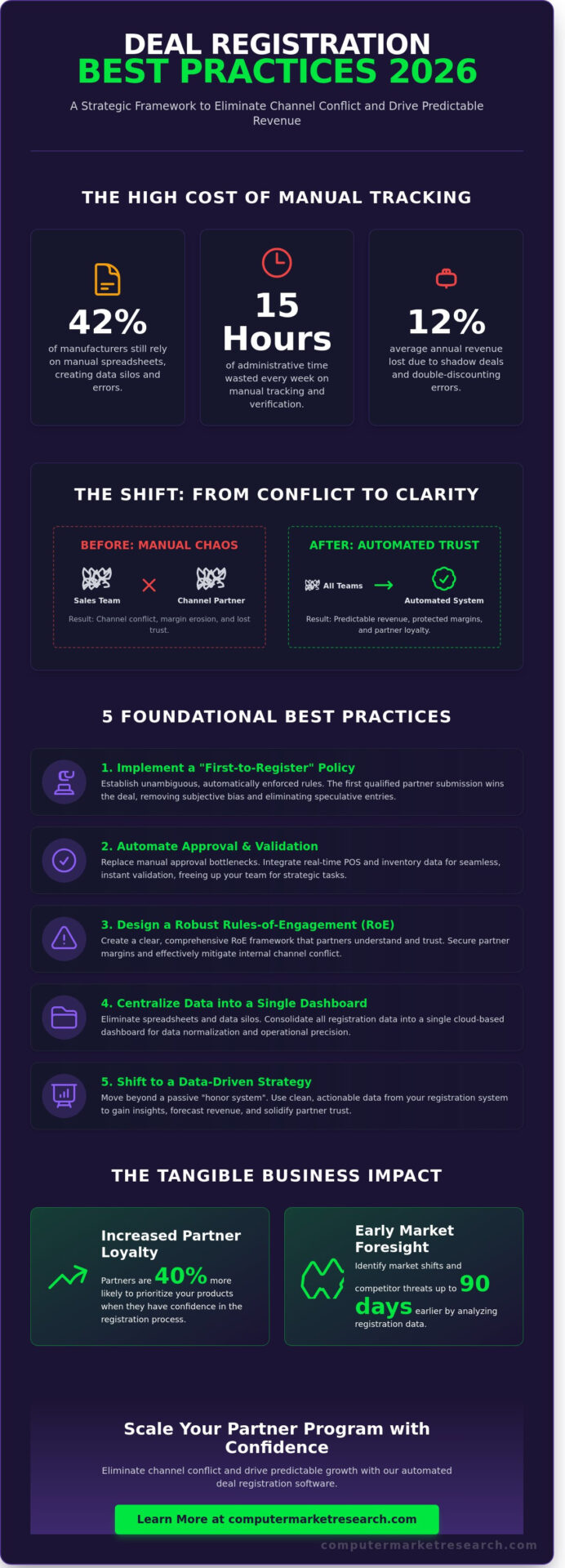
If your sales team and your channel partners are battling over the same lead, your current registration process has already failed. Industry research indicates that 42% of manufacturers still rely on manual spreadsheets to track deals, which leads to an average of 15 hours of wasted administrative time every week. By adopting deal registration best practices 2026, you can eliminate these operational headaches and restore order to your ecosystem. You likely feel the strain of frequent channel conflict and the lack of visibility into your partner-led pipeline; it’s a common friction point that stalls market momentum and erodes trust.
This guide provides a strategic framework to automate your approval workflows, ensuring you protect partner margins and drive predictable revenue. You’ll learn how to replace fragmented data silos with a streamlined system that delivers clean, actionable insights for executive reporting. We will examine the transition from manual entry to a cloud-ready infrastructure that fosters partner loyalty through technical precision and absolute transparency. This is the definitive path to achieving a scalable, conflict-free channel strategy that prioritizes accuracy over administrative burden.
Key Takeaways
- Shift from a manual “honor system” to a data-driven strategic commitment that solidifies trust between manufacturers and partners.
- Implement a high-performance framework using deal registration best practices 2026 to establish unambiguous “First-to-Register” policies and eliminate speculative entries.
- Replace manual approval bottlenecks with automated validation by integrating real-time POS and inventory data for seamless channel operations.
- Master the creation of a robust Rules-of-Engagement (RoE) framework that secures partner margins and effectively mitigates internal channel conflict.
- Scale your partner program by centralizing registration data into a single cloud-based dashboard to ensure data normalization and operational precision.
Why Deal Registration is the Foundation of Channel Trust in 2026
Deal registration is the primary mechanism for establishing trust between manufacturers and their indirect sales force. It’s a strategic commitment where a manufacturer grants price protection to a partner in exchange for early visibility into a sales opportunity. By 2026, the industry has moved past the “honor system” of the early 2000s. Modern programs rely on data-driven automated validation to ensure fairness. Without a reliable system, manufacturers often face significant channel conflict, which occurs when multiple partners or internal teams compete for the same customer, ultimately destroying profit margins.
A well-executed program serves as a primary defense against margin erosion. It prevents the “race to the bottom” where partners cut prices to compete against one another rather than focusing on the value of the solution. When a partner knows their investment in a lead is protected, they’re more likely to commit resources to closing the deal. In contrast, “shadow deals” and unregistered activities can cost organizations an average of 12% in lost revenue annually due to misaligned incentives and double-discounting errors.
To better understand the mechanics of these programs, watch this helpful video:
The Business Case for Modern Deal Registration
Quantifying the ROI of partner loyalty is straightforward when margins are protected. Data from 2024 industry reports indicates that partners are 40% more likely to prioritize a manufacturer’s products when they have confidence in the registration process. This loyalty translates into more predictable revenue streams. Furthermore, registration data acts as an early-warning system. By analyzing the flow of new registrations, channel managers can identify market shifts or emerging competitor threats up to 90 days before they appear in final sales reports. This visibility reduces the administrative headache for internal teams by automating the approval workflow and eliminating manual verification steps.
The Death of the Spreadsheet in Channel Operations
Manual tracking fails the moment a program scales beyond 20 active partners. Relying on spreadsheets creates dangerous data silos where information is trapped in static documents rather than being integrated into a broader channel management strategy. For Global 2000 companies, automation isn’t a luxury; it’s a requirement for operational stability. Automated systems ensure that deal registration best practices 2026 are baked into the workflow, providing clean, actionable data that drives growth. Transitioning from manual entry to a cloud-based infrastructure eliminates the risk of human error and ensures that every partner operates on a level playing field.
5 Foundational Best Practices for High-Performance Deal Registration
Implementing effective deal registration best practices 2026 requires a shift from passive monitoring to active, automated enforcement. Vendors often struggle with channel conflict because their rules of engagement are either too vague or inconsistently applied. To eliminate friction, manufacturers must establish a predictable, consistent set of guidelines that rewards partner investment while protecting the vendor’s bottom line. This begins with an unambiguous “First-to-Register” policy. When two partners pursue the same opportunity, the system must automatically grant protection to the first qualified submission, removing subjective bias from the equation.
High-performance programs also utilize a tiered incentive structure. For example, a partner who registers a deal during the discovery phase might receive a 15% margin advantage, while a partner who registers late in the cycle only receives 5%. This financial carrot encourages early visibility. To maintain system integrity, vendors must also implement a transparent dispute resolution process. If a conflict arises, a dedicated channel ombudsman should resolve the issue within a strict 48-hour SLA, ensuring that internal sales teams and external partners don’t lose momentum over administrative hurdles.
Setting Clear Eligibility and Expiry Rules
Defining a qualified deal is the first step toward eliminating “speculative” registrations where partners claim every logo in a territory. A qualified submission should require a verified budget, a specific project scope, and a timeline for completion. Most successful programs in 2026 utilize a 90-day protection window. If the deal hasn’t progressed within this timeframe, the registration expires. Automated renewal alerts should trigger 10 days before expiration, allowing partners to provide status updates to maintain their status. This creates a clear distinction between lead registration, which captures top-of-funnel interest, and deal registration, which tracks committed sales opportunities.
Standardizing Data Collection
Clean data is the foundation of accurate forecasting. Partners must provide “Decision-Grade” insights, including end-customer contact details, estimated deal size, and specific product SKUs. Relying on fragmented information leads to operational headaches and missed revenue targets. This is why channel data management is the secret to scaling a global program. By using mandatory fields in a web-based portal, you ensure that every submission meets your data standards before it reaches your CRM. This automated approach marks the death of the spreadsheet and allows sales operations to focus on strategy rather than data cleanup. If you’re struggling with messy partner submissions, it’s time to streamline your registration workflow with a specialized automation tool.
Strategic Shift: Moving Beyond Manual Approval to Automated Validation
Manual approval processes represent the single greatest bottleneck in modern partner programs. By 2026, the window for securing a competitive advantage has narrowed to the point where waiting 48 hours for a Channel Manager to review a submission is no longer viable. Implementing deal registration best practices 2026 requires a move away from human intervention toward algorithmic precision. When manual review is the default, data silos thrive and duplicate entries often go unnoticed until a conflict arises during the final sales stage. High-performing organizations have transitioned to automated validation to eliminate the friction that leads to partner churn and lost revenue.
Adopting an “Exception-Based” management model allows systems to instantly approve 85% of registrations that meet pre-defined criteria, such as territory alignment and account exclusivity. Channel Managers then focus their expertise solely on the 15% of complex cases that require human nuance. This shift reduces administrative overhead by approximately 60% and ensures that partners receive the immediate confirmation they need to commit their resources to a lead. Effective deal registration best practices now prioritize this speed to maintain partner loyalty and secure the “first-look” advantage in competitive markets.
The Role of CRM Integration
Your Partner Relationship Management (PRM) platform must function as the definitive “Source of Truth” for every partner-led opportunity. A robust bi-directional sync between the partner portal and internal instances like Salesforce or Microsoft Dynamics ensures that sales teams and partners don’t work against each other. When a partner registers a deal, the system should automatically check the internal CRM for active opportunities. If a match is found, the system flags the territorial or account conflict instantly. Automating this lead distribution prevents registered deals from falling through the cracks and ensures that the first partner to register a legitimate opportunity is protected from internal poaching or double-registration.
Validating Against POS and Inventory
Reliability in 2026 depends on cross-referencing registered deals with actual POS data management protocols to confirm sales as they happen. This integration allows manufacturers to verify that a registered deal actually resulted in a transaction before paying out incentives or MDF. Additionally, inventory visibility provides a critical reality check for the channel. If a partner registers a high-volume deal but lacks the stock or credit line to fulfill it, the system can trigger an alert for proactive support. Automated validation serves as the functional bridge between partner promises and actual revenue realization. Organizations integrating these data streams have seen a 22% increase in deal closing rates by ensuring that supply chain realities align with sales forecasts. Following these deal registration best practices 2026 ensures your data remains clean, actionable, and free from the “death of the spreadsheet” mentality.
Designing a Rules-of-Engagement (RoE) Framework That Partners Love
A Rules-of-Engagement (RoE) framework acts as a legal and ethical contract between a manufacturer and its channel. It isn’t a mere suggestion. It’s the blueprint for trust. By 2026, successful vendors will move beyond vague promises to documented, enforceable protocols. This framework directly addresses the primary partner fear: direct sales teams “poaching” leads once they’ve been registered. When a partner registers a deal, they’re handing over their most valuable intellectual property. If your internal sales team uses that data to bypass the partner, your channel program will fail. Effective deal registration best practices 2026 prioritize a “Neutrality Zone.” This ensures that if multiple partners submit bids for the same account, the manufacturer remains a neutral arbiter, rewarding the partner who truly created the value rather than the one who offered the deepest discount.
Centralizing these rules within a partner relationship management portal eliminates ambiguity. It provides a single source of truth where partners can review the terms of protection before they ever submit a lead. This transparency reduces friction and accelerates the sales cycle by 15% on average, according to 2024 channel performance benchmarks.
Protecting the Partner of Record
The “Partner of Record” status must be ironclad. Establishing a 90-day “Lock-out” period is a standard requirement. During this time, your direct sales team cannot engage with the registered account without the partner’s explicit consent. In co-sell scenarios, define exactly when internal teams can step in to provide technical support. If an unsolicited bid arrives from a competing partner on a registered deal, your RoE should dictate an automatic “Denied” status for the latecomer. This protects the original partner’s margins and prevents a race to the bottom that devalues your product.
Transparent Communication and Feedback Loops
Trust disappears in the silence between submission and approval. Automating status updates is mandatory for deal registration best practices 2026. Partners shouldn’t have to email a channel manager to find out if a deal is “Pending” or “Approved.” If a registration is denied, providing a clear “Reason Code” is vital. Whether it’s a duplicate entry or an existing house account, partners deserve to know why. You can also use your portal to host on-demand training modules. These short videos teach partners how to submit high-quality data, which reduces rejection rates and streamlines the entire pipeline.
Stop losing channel revenue to avoidable internal conflicts. See how automated data management can secure your partner relationships today.
Scaling Your Program with CMR’s Automated Deal Registration Software
Spreadsheet-based tracking is often the primary obstacle to sustainable channel growth. CMR’s PartnerPortal™ eliminates this friction by centralizing deal registration into a single, cloud-based dashboard. This shift provides a single source of truth for both vendors and partners, replacing the “death by spreadsheet” manual culture that plagues many sales operations. Manual data entry typically results in a 25% error rate in channel reporting, but our built-in data cleansing and normalization tools remove these inaccuracies automatically. This ensures that the data entering your system is reliable from the start.
Executives gain immediate, real-time visibility into the indirect sales pipeline, which is vital for accurate quarterly forecasting. By implementing these deal registration best practices 2026, you create a seamless connection between registration data and your channel incentive programs. When registration data is clean and automated, incentive payouts become precise. This synergy protects your margins from double-dipping or unauthorized claims, ensuring that your budget is only spent on high-value partner activities.
Customizable Workflows for Global Enterprises
Actionable Insights and Reporting
Streamline your channel operations with CMR’s Deal Registration module today.
Future-Proofing Your Channel Strategy
Success in the upcoming year requires moving beyond the friction of manual approvals. When you implement deal registration best practices 2026, you replace operational headaches with a framework of absolute trust. You’ve seen how clear Rules of Engagement and automated validation are no longer optional extras. They’re the baseline for high-performance programs. Computer Market Research has supported Fortune 500 and Global 2000 companies since 1984, providing the stability needed in a volatile market. Our cloud-based PartnerPortal™ eliminates the manual spreadsheet errors that compromise data integrity. You gain real-time visibility into channel data and inventory, ensuring every decision is backed by facts rather than guesses. This level of technical precision ensures your partners remain loyal and your incentive programs stay profitable. It’s time to move past the limitations of legacy systems and embrace a more disciplined approach to channel management. You can reclaim your team’s productivity and scale your revenue with confidence.
Request a Demo of CMR’s Automated Deal Registration Software
Frequently Asked Questions
What is deal registration in channel management?
Deal registration is a formal process where a partner notifies a manufacturer about a potential sales lead to secure exclusive rights and financial incentives for that opportunity. It serves as a critical mechanism to protect partner investments in pre-sales activities. By implementing deal registration best practices 2026, manufacturers ensure the first partner to surface an opportunity receives a 10% to 15% margin advantage. This structure prevents internal sales teams or other partners from undercutting the original lead source.
How long should a registered deal stay active before it expires?
A standard deal registration should remain active for 90 days to align with typical B2B sales cycles. If the deal hasn’t closed within this period, the partner must request an extension or the opportunity returns to the general pool. Data from the 2024 Channel Outlook report indicates that 65% of enterprise software deals require at least one 30 day extension. Automated systems track these timelines to ensure your pipeline remains accurate and free of stale data.
What are the most common causes of channel conflict in deal registration?
Channel conflict primarily arises from “double-dealing” where a manufacturer accepts registrations from two different partners for the same end-user. This occurs in 22% of manual tracking systems due to data silos and delayed entry. Other triggers include direct sales teams competing against partners or a lack of clear rules of engagement. Eliminating these friction points requires a single source of truth that provides real-time visibility into every registered opportunity across the network.
Can multiple partners register the same deal?
No, a robust channel program only allows one partner to hold an active registration for a specific opportunity at any given time. Allowing multiple registrations for one lead creates a “race to the bottom” on pricing and destroys partner trust. If a second partner attempts to register an existing lead, the system should automatically flag the conflict. This policy protects the 20% to 30% time investment partners spend on technical discovery and solution architecting.
How does deal registration software integrate with my CRM?
Deal registration software integrates with CRMs like Salesforce or Microsoft Dynamics through bi-directional API connectors that sync data every 5 to 15 minutes. This connection ensures that lead status, contact details, and deal values are consistent across both platforms. By removing manual data entry, companies reduce administrative errors by 40% and provide sales operations with actionable insights. This seamless flow of information is a core component of deal registration best practices 2026 for high-growth manufacturers.
What are the benefits of automating the deal approval process?
Automating deal approvals reduces the average response time from 48 hours to less than 2 hours. Rapid feedback keeps partners engaged and prevents them from losing momentum with the end-user. Automation also applies business rules consistently, which eliminates the perceived bias of manual reviews. Programs using automated workflows report a 15% increase in partner satisfaction scores according to recent industry benchmarks. It’s the most efficient way to scale a global channel program.
How do I prevent “speculative” registrations from cluttering my pipeline?
You can prevent speculative or “junk” registrations by requiring mandatory discovery milestones, such as a confirmed budget or a scheduled meeting date. Research shows that requiring just 3 specific data points about the buyer’s intent reduces low-quality submissions by 28%. If a partner fails to provide these details, the registration is automatically rejected or moved to a pending status. This discipline ensures your sales forecast reflects genuine opportunities rather than optimistic guesses.
What information should I require from partners during the registration process?
You should require the end-user company name, the primary decision-maker’s contact information, the estimated close date, and the projected deal value. Including a field for the “customer pain point” helps your internal teams provide better support during the sales cycle. Standardizing these 5 to 7 key fields ensures data cleanliness across your entire ecosystem. This structured approach allows channel managers to identify trends and optimize resource allocation based on verified partner activity.

Article by
Del Heles
Del Heles is the founder and CEO of Computer Market Research (CMR), a channel management software company he launched in 1984. With more than 40 years of experience, he’s known for helping manufacturers and distributors simplify complex partner programs through practical, customer-focused technology solutions.