

What if the lowest PRM subscription quote leads to the highest overall investment? The total cost of ownership for prm software includes more than the recurring fee. Implementation, integrations, data migration, configuration, and the time your team spends managing the platform can all shape the full cost.
It’s reasonable to start with subscription pricing, but that figure alone doesn’t make vendor proposals comparable. Costs depend on your partner workflows, systems, user needs, and the work required to move from manual processes to a centralized platform. Potential business benefits matter too, but they should be assessed separately from software expenses rather than treated as guaranteed savings.
This guide will help you build a comparable, assumption-led TCO model and identify cost drivers before selecting a PRM platform. You’ll learn how to account for implementation, integration, ongoing administration, and eventual data migration, then weigh those costs against the operational value of centralized partner workflows, reporting, and data management. The result is a clearer basis for deciding whether a platform such as PartnerPortal fits your organization’s needs and investment priorities.
Key Takeaways
- The total cost of ownership for prm software measures relevant costs across a chosen period; assess potential business outcomes separately as part of ROI.
- Build a complete cost view that accounts for subscriptions, implementation and integration, managed data services, and internal effort.
- Compare PRM software with spreadsheets or fragmented tools using the same time horizon, partner assumptions, scope, and workflow requirements.
- Use a consistent formula: one-time costs plus recurring costs plus internal effort over the selected period.
- Map PartnerPortal’s documented onboarding, deal registration, performance tracking, and channel-program management capabilities to the workflows in your model.
What Total Cost of Ownership for PRM Software Really Measures
Total cost of ownership for PRM software is the sum of relevant costs to acquire, implement, operate, and eventually replace or retire a platform over a defined evaluation period. It gives buyers a fuller cost model than a subscription quote alone. The period and scope matter: a comparison is only useful if each option includes the same workflows, partner population, systems, and ownership timeframe.
A subscription fee may not account for project work such as configuration and data migration, or the internal effort needed to maintain partner records and workflows. The Total Cost of Ownership (TCO) concept provides a useful foundation, but PRM buyers need to apply it to the partner-management work their organization plans to support. For broader context on how these workflows fit together, explore channel sales management software.
This overview introduces the concept before you define your model:
Which costs belong in a PRM ownership model?
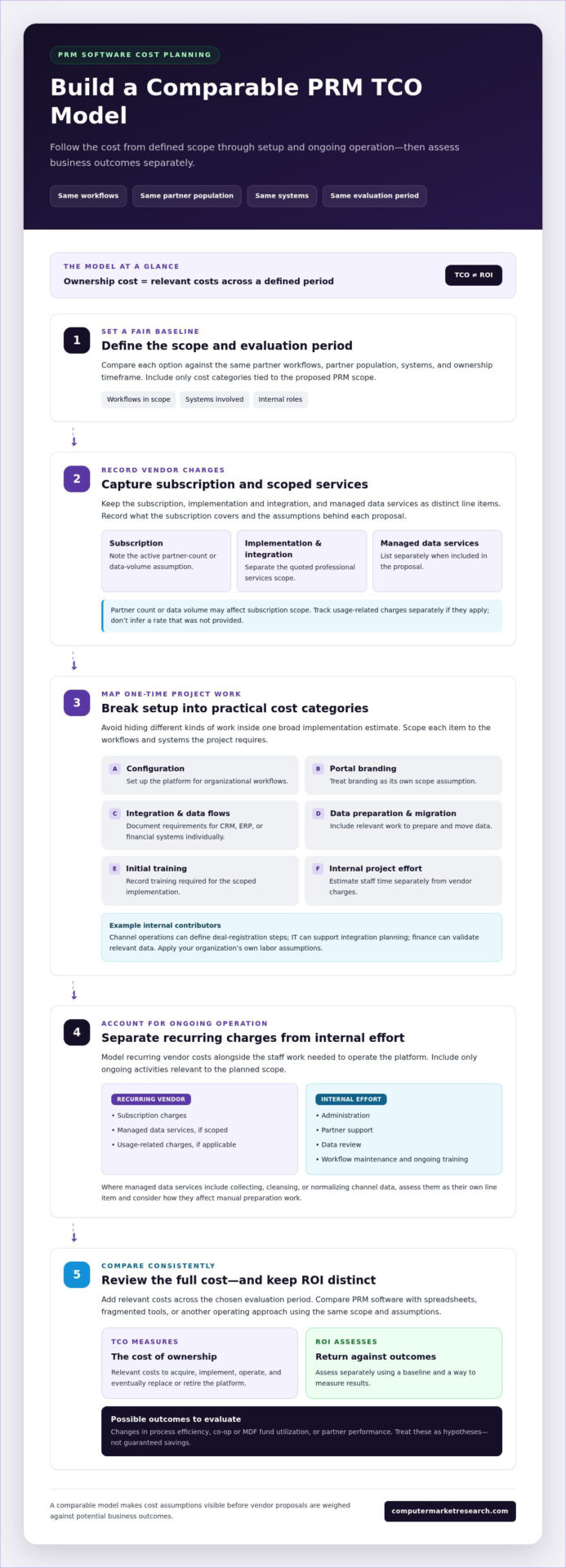
Group relevant items so the model shows when and how each cost arises. Vendor charges may include the subscription and any scoped services. One-time project costs can include implementation, data preparation, migration, configuration, and initial training. Recurring internal effort includes administration, partner support, workflow updates, and ongoing training. Usage-related charges, if applicable to the proposal, should be tracked separately.
Include only categories tied to the proposed PRM scope. For example, if the project covers deal registration and partner onboarding, estimate the work and systems needed for those workflows rather than adding unrelated modules. A consistent scope prevents one option from appearing cheaper simply because its estimate leaves out work included in another.
TCO versus ROI: keep the measures distinct
TCO totals the costs of ownership over the selected period. ROI compares those costs with measured business outcomes, such as changes in process efficiency, co-op or MDF fund utilization, or partner performance. These outcomes belong in a separate assessment, supported by a baseline and a way to measure results. Treat them as hypotheses to evaluate, not savings that a platform guarantees.
TCO describes the lifecycle cost; ROI assesses the return against measured or expected outcomes. Keep the measures separate when reviewing a proposal, so projected benefits don’t conceal cost assumptions or get mistaken for realized results.
Before comparing a PRM platform with spreadsheets, fragmented tools, or another operating approach, set the same evaluation period and scope for each. Define the partner workflows, internal roles, and systems in scope, then record assumptions consistently. This creates a defensible baseline for the detailed cost model and makes trade-offs visible.
Which PRM Software Costs Should Buyers Include?
A useful PRM cost model separates vendor charges from the work your organization must perform. For each line item, record whether it is one-time, recurring, internal, or usage-related, then identify the assumption behind the estimate. This makes the total cost of ownership for prm software easier to review and helps prevent internal labor from being mistaken for a vendor fee.
For Computer Market Research, the stated commercial components are SaaS subscriptions, implementation and integration, and managed data services. Keep each distinct in your comparison. Subscription pricing may scale with factors such as active partner count or data volume, so note the quantity and scope used in each proposal. Don’t infer a rate where one hasn’t been provided.
One-time setup, implementation, and integration
Separate initial project work into practical planning categories rather than recording it as one broad implementation estimate. Configuration covers how the platform is set up for the organization’s workflows; portal branding is a separate scope assumption. Technical integration should reflect the systems and data flows the project requires. A CRM, ERP, or financial system may involve different stakeholders, data fields, and validation work, so document each integration requirement individually.
Track professional service charges separately from internal time. For example, estimate the hours needed from channel operations to define deal-registration steps, from IT to support integration planning, and from finance to validate relevant data. Apply your organization’s own labor assumptions to those hours. This keeps a vendor’s quoted project work distinct from the staff effort needed to make the implementation usable.
Recurring subscription, data, and operating effort
Record what the subscription covers and the partner-count or data-volume assumption attached to it. If scope changes as participation or data volume grows, model that as a usage-related factor, not as an assumed fee. Keep recurring vendor charges separate from internal administration, partner support, data review, and ongoing workflow maintenance.
Assess managed data services as their own line item where the proposed scope includes work such as collecting, cleansing, or normalizing channel data. These activities can affect the operating model by changing how much manual preparation your team needs to do. If data quality is central to the work, the channel data management systems overview offers relevant context for scoping those requirements.
- One-time: Configuration, branding, migration, integration, and initial training.
- Recurring: SaaS subscription, managed data services, administration, and ongoing training.
- Internal: Staff time for requirements, testing, data review, partner support, and maintenance.
- Usage-related: Partner counts, data volumes, or other proposal-specific scaling assumptions.
To test how a defined workflow scope maps to a platform, buyers can use PartnerPortal’s 90-day free trial as an opportunity to evaluate fit, not as evidence of guaranteed savings.
How to Compare PRM Options Beyond the Subscription Quote
A fair comparison puts each option against the same partner-program requirements, not just a software label. Include a PRM platform, your current spreadsheets and disconnected tools, or another realistic operating approach. Set one evaluation period, partner-count assumption, and workflow scope for every scenario. Otherwise, a proposal that excludes work handled by your current team may look less expensive without representing the full operating model.
For each alternative, map how partner onboarding, deal registration, claims, reporting, and channel data are handled. Record which steps are automated, which remain manual, and who owns them. A platform may centralize information, but don’t assume it eliminates data review, approvals, or partner support unless the documented workflow and assigned responsibilities show how that work changes.
Compare the operating models, not just the software labels
Trace each workflow from submission to completion. For deal registration, note who receives a submission, reviews it, updates its status, and communicates with the partner. For claims and reporting, identify data sources, review steps, and the people responsible for resolving exceptions. Apply the same level of detail to spreadsheets and existing tools; manual processes still have labor and maintenance requirements.
This view helps distinguish a change in tools from a change in responsibilities. If a task remains with channel operations after implementation, include that effort in the PRM scenario. If the current approach relies on staff to reconcile data across systems, record that work in the baseline too. The aim is to compare documented tasks, not presume savings.
Create like-for-like vendor scenarios
Use each vendor’s proposal to identify what is included for the workflows in scope. Compare modules, implementation, integration, support, and data services on the same basis. For example, if one proposal includes a workflow or service that another lists separately, show the difference as a scope gap or an unpriced assumption rather than treating the quotes as equivalent.
CMR’s PartnerPortal channel management platform documents capabilities such as partner onboarding, deal registration, performance tracking, and channel-program management. Match those capabilities to your requirements, then record which assumptions still need proposal-level detail.
Use a comparison worksheet to keep the scenarios consistent. Mark whether each amount is documented, estimated internally, or still unknown:
- One-time costs: List proposed implementation and integration charges, plus any organization-estimated setup effort.
- Recurring costs: Record the quoted subscription scope and any stated ongoing services or support.
- Internal effort: Estimate staff time for workflow ownership, data handling, partner support, and administration in each scenario.
- Unpriced assumptions: Flag unclear modules, partner or data limits, integration scope, and service responsibilities without inserting market averages.
Keep unknowns visible. Request comparable proposals that address the same partner assumptions and workflows, and preserve unanswered items as open assumptions in the model. That makes the total cost of ownership for prm software easier to assess without disguising uncertainty as a precise estimate.
How to Build a Defensible PRM TCO Model
A defensible model is transparent about its inputs. It shows which figures come from vendor proposals, which reflect your organization’s own labor assumptions, and which remain unknown. This lets finance, IT, and channel operations review the same calculation and revise assumptions without obscuring the effect on the total cost of ownership for prm software.
Build the worksheet from documented inputs
Start by defining the evaluation period and the work the PRM is expected to support. Record partner and internal-user assumptions, data scope, required workflows, and systems involved. Use those boundaries consistently for each option. Then populate the worksheet with documented proposal figures and organization-specific estimates. Label unknowns for follow-up rather than replacing them with industry averages.
- Set the scope. Specify the evaluation period, partner population, users, data sources, and workflows included in the model.
- Enter one-time costs. Add documented implementation, configuration, migration, and integration charges. Keep internal project hours separate.
- Enter recurring costs. Record subscription and ongoing service figures for the same period. Note any partner-count or data-volume assumptions that affect the proposal.
- Estimate internal effort. List the roles and hours required for implementation, administration, data handling, and partner support. Apply your organization’s own labor assumptions, and make them visible for review.
- Flag open items. Mark any unknown fee, scope boundary, or responsibility that could change the result. Assign an owner to resolve each item before treating the comparison as final.
Use a consistent calculation: PRM TCO = one-time costs + recurring costs over the chosen period + internal effort over that period. If internal effort is converted into a monetary estimate, show the hours and the organization’s labor-rate assumption separately. This makes the calculation traceable and easier to update when a stakeholder revises an input.
Then run a sensitivity scenario. Keep the base case tied to the current partner, data, and workflow assumptions; create an alternate case with a clearly stated change, such as planned partner growth, higher data volume, or added workflow scope. Use your organization’s own planning assumptions, not an invented growth rate. Compare how the changed input affects subscription assumptions, service requirements, integration scope, and internal workload.
Separate cost estimates from business outcomes
Track possible outcomes, such as less manual processing or improved fund utilization, in a separate view. Choose a baseline measure and assign an owner to collect it before implementation; otherwise, it’s difficult to distinguish a measured change from an expectation.
Modeled benefits are assumptions to test against a baseline, not guaranteed returns. Keep that distinction clear when presenting the model to decision-makers. To evaluate PartnerPortal against your documented workflows, start the 90-day free trial and assess fit against those assumptions.
Evaluate PartnerPortal’s Fit and Take the Next Step
A cost model is only useful if its scope reflects the partner work your organization intends to support. Compare the proposed workflows with PartnerPortal’s documented capabilities, then separate required functions from optional or out-of-scope needs. This keeps your baseline focused and gives stakeholders a practical way to assess platform fit alongside the assumptions in the total cost of ownership for prm software.
Match platform scope to the cost model
Start with the processes that prompted the evaluation. PartnerPortal’s documented areas include partner onboarding, deal registration, performance tracking, and channel-program management. Map each required process to the relevant capability, and identify the roles, data, and systems involved. CMR also states that its solutions integrate with CRM and ERP systems, so record which connections and reporting requirements matter to your proposed scope.
Keep the baseline disciplined. If a workflow isn’t required for the initial decision, don’t add its associated services, data requirements, or staff effort to the core scenario. You can model it separately if stakeholders expect it to become part of the program. This distinction helps decision-makers see the cost implications of expanding scope rather than blending possible future needs into today’s estimate.
- Workflow fit: Identify the partner processes the evaluation must support and map them to documented capabilities.
- Integration scope: List relevant CRM or ERP connections and the data each workflow depends on.
- Reporting needs: Define which partner or channel-program information the team needs to review.
- Scope boundaries: Mark optional requirements separately so they don’t distort the baseline comparison.
Use the trial to test decision-critical assumptions
CMR offers a 90-day free trial of PartnerPortal as an opportunity to evaluate fit. Before the evaluation begins, agree on what the team needs to learn. Include channel operations and other stakeholders responsible for partner workflows, reporting, data, and connected systems. A focused plan makes observations more useful than an informal review of the platform.
Use the evaluation to examine representative workflows and record findings against the assumptions in your cost model. Note where a process fits, what information the team needs, and which implementation questions remain open. The trial can inform the buying decision, but it doesn’t establish guaranteed savings or ROI. Keep business outcomes separate and measure them against a baseline after implementation.
- Assess whether onboarding and deal-registration steps align with team requirements.
- Review whether performance tracking and channel-program reporting address decision needs.
- Record usability feedback and unresolved workflow or data questions.
- Update cost assumptions only when new information supports a change.
With scope, responsibilities, and open questions documented, your stakeholders can make a more grounded platform decision. Start the 90-day PartnerPortal trial to evaluate its fit against your organization’s defined workflows and TCO assumptions.
Turn Your Cost Model Into a Confident Decision
A useful TCO model should do more than support a vendor comparison. It can help your team make deliberate choices about which partner workflows to centralize, what to keep out of scope, and which assumptions need validation before a commitment. Treat it as a decision tool that can evolve as partner needs and operating priorities change.
Computer Market Research, founded in 1984, brings more than 40 years of experience in channel management. Use that perspective as you assess whether PartnerPortal aligns with your documented requirements, while keeping your own cost assumptions and success measures visible. The goal is not to predict a guaranteed return, but to make the total cost of ownership for prm software clear enough to support a sound, informed next step.
Ready to evaluate PartnerPortal against your organization’s partner workflows? Start your PartnerPortal trial and use the evaluation to determine whether the platform fits your needs.
Frequently Asked Questions
What is the difference between PRM software TCO and ROI?
PRM TCO estimates the costs of owning and operating a platform; ROI evaluates those costs against business outcomes. Keep the figures in separate parts of your decision model. For example, record staff time spent processing partner submissions as an operating input, then track any change in processing effort as an outcome against a baseline. This helps distinguish what the organization expects from what it later measures.
How long should a PRM software TCO model cover?
Choose a period that matches your organization’s planning and purchasing decisions, then apply it consistently to every option. A budget cycle may suit an initial approval, while a longer period can help reveal recurring costs and future needs. Include the period’s start and end points, and state how you handle costs that fall outside it, such as a later renewal or a potential platform transition.
Can we estimate PRM TCO before receiving vendor pricing?
Yes. You can define scope, inventory current workflows, estimate internal effort, and identify required integrations before a proposal arrives. Build the model with separate fields for vendor-provided figures, buyer estimates, and unknowns. For the total cost of ownership for prm software, leave subscription and service charges as open inputs rather than substituting market averages. Update the model when comparable proposal details become available.
Should internal employee time be included in PRM TCO?
Yes, include the staff effort that is directly tied to selecting, implementing, and operating the PRM. Identify roles such as channel operations, IT, finance, and partner support, then estimate the hours each contributes to specific activities. Apply your organization’s chosen labor assumptions and keep them visible. Avoid counting the same work twice, especially when a vendor service and an internal team share responsibility.
How should a company model partner growth in a PRM cost estimate?
Create an additional scenario using partner-growth assumptions approved by your organization, rather than presenting growth as a certain outcome. For each scenario, record the partner count and note any related changes in data volume, support workload, and workflow scope. If proposal pricing scales by active partners or data volume, use the vendor’s stated terms to assess the effect; leave that impact open until you have them.
Can a 90-day PRM trial establish the platform’s full TCO?
No. A 90-day trial can help your team assess workflow fit and identify questions about usability, reporting, and implementation scope, but it can’t establish every cost across a longer ownership period. Use the evaluation to refine your assumptions, then incorporate proposal details for subscription, services, and integrations. Treat any operational benefits as outcomes to measure over time, not as proof of savings from the trial itself.
Who should contribute to a PRM TCO assessment?
Bring together the people who understand partner processes, connected systems, data quality, and budget assumptions. Channel operations can map daily workflows; IT can describe integration requirements; finance can review cost inputs; and partner-facing staff can identify support tasks. Assign an owner to consolidate assumptions and resolve gaps. This cross-functional view helps prevent a model from overlooking work that sits outside the software team.

Article by
Del Heles
Del Heles is the founder and CEO of Computer Market Research (CMR), a channel management software company he launched in 1984. With more than 40 years of experience, he’s known for helping manufacturers and distributors simplify complex partner programs through practical, customer-focused technology solutions.