

A partner tier is useful only when its label reflects measurable contribution or capability. If teams use different criteria or rely on disconnected spreadsheets, managing partner tiers and levels becomes difficult to compare, slow to review, and hard for partners to trust.
Partners need to understand what each level requires and what progress earns them. Adding more tiers or attaching larger benefits to a title won’t solve unclear rules. A practical framework uses consistent criteria, relevant evidence, and rewards tied to the outcomes and capabilities your program values.
This article explains how to choose tier criteria, design a clear progression, and review partner performance consistently. It also covers how centralized workflows and partner relationship management software can bring onboarding, deal registration, performance tracking, and incentive activity into view. A system can support the process, but your program’s rules determine what fair progression looks like.
Key Takeaways
- Use managing partner tiers and levels to distinguish program categories from the progression partners make over time.
- Assess sales contribution, engagement, capability, and operational readiness. Activity indicators alone don’t prove business outcomes.
- Compare criteria-led, progression, and hybrid models to find an approach that fits your program and administrative capacity.
- Test draft thresholds against historical partner records before using them to make live tier decisions.
- Use connected partner data to support consistent reviews, while keeping tier rules and final decisions under clear team governance.
What Managing Partner Tiers and Levels Actually Mean
Partners need to know what the program expects, and internal teams need a consistent basis for evaluating contribution. Without shared definitions, one team may view a partner as strategic while another considers the same partner inactive. Benefits and support can then depend on interpretation rather than evidence.
A partner tier framework is a set of defined program categories that connects demonstrated contribution and capability to consistent requirements, support, and benefits, not simply a status label. A label alone doesn’t explain why a partner earned it, what they should do next, or what the organization will provide in return. Clear rules make the status useful for program decisions.
The phrase “partner level” can mean different things in different business contexts. For example, Partner (business) covers uses of the term across fields such as law, accounting, and finance. In a channel program, define the terms you use so partners and employees understand exactly what each status represents.
How partner tiers differ from partner levels
A tier usually groups partners into distinct program categories. Each category can have its own criteria, benefits, or support model, with labels and ranking logic set by the organization. A level often describes a stage in a progression, such as a partner developing from initial participation toward greater capability or contribution.
Programs may use “tier” and “level” interchangeably, or assign them different meanings. State the distinction in program materials, then use the terms consistently in reviews, communications, and internal systems. If partners can move between categories, explain whether movement reflects performance at a point in time, development over time, or both.
When a tier structure helps a partner program
A structured approach is useful when partners differ in capability, engagement, sales contribution, or need for support. For example, a program might reserve advanced enablement resources for partners who demonstrate relevant expertise, while setting clear onboarding expectations for newer participants. The criteria should explain why those requirements and benefits differ.
Unclear status can lead to inconsistent expectations. One team may approve additional support while another applies a different standard. A defined framework gives teams shared decision rules and gives partners a clearer view of how to qualify and progress.
More categories don’t automatically create more precision. Add a tier or level only when it changes a meaningful program decision, such as eligibility, support, recognition, or development goals. If two categories have the same requirements and receive the same treatment, separating them may add review work without adding clarity. Managing partner tiers and levels effectively starts with a simple test: can teams explain what each category means and what action follows from it?
Choose Partner Tier Criteria That Reflect Real Performance
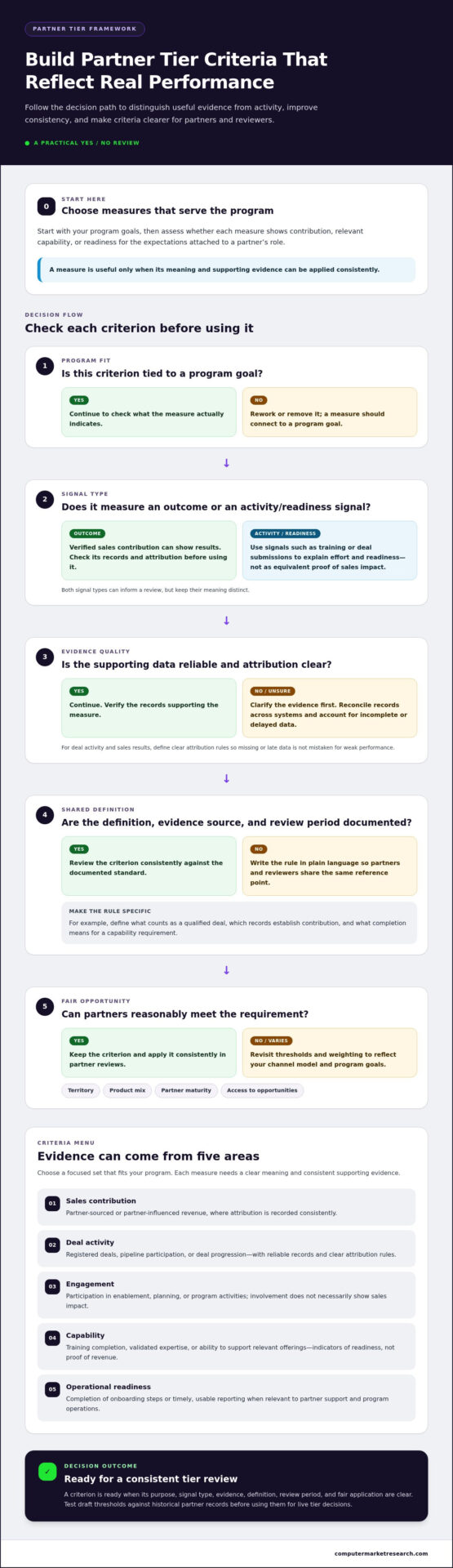
Criteria should make tier decisions more consistent, not turn every partner activity into a score. Start with the program’s goals, then choose a focused set of measures that show whether partners are contributing, building relevant capability, and meeting the expectations attached to their role. A measure is useful only when its meaning and evidence can be applied consistently.
A practical criteria menu can include:
- Sales contribution: Partner-sourced or partner-influenced revenue, where attribution is recorded consistently.
- Deal activity: Registered deals, pipeline participation, or deal progression, provided the program has reliable records and clear attribution rules.
- Engagement: Participation in enablement, planning, or program activities. This can show involvement, but not necessarily sales impact.
- Capability: Training completion, validated expertise, or ability to support relevant offerings. These are indicators of readiness, not proof of revenue.
- Operational readiness: Completion of onboarding steps or timely, usable reporting when relevant to partner support and program operations.
Which partner performance signals are useful?
Separate outcomes from activity indicators. Outcomes, such as verified sales contribution, show results. Activity signals, such as training attendance or deal submissions, can help explain partner effort and readiness, but shouldn’t be treated as equivalent evidence of business impact.
Before applying a measure, check whether the supporting channel data is verified, incomplete, or delayed. If deal activity is recorded in one system but sales results arrive through another reporting process, define how those records will be reconciled. Otherwise, missing or late data may look like weak performance.
How to make criteria measurable and fair
For each criterion, document its definition, evidence source, and review period in plain language. Specify what counts as a qualified deal, which records establish contribution, or what completion means for a capability requirement. For example, if a tier depends on registered deals, state what makes a registration eligible and which reporting period applies. This gives partners and reviewers a common reference point.
Then test whether partners have a reasonable opportunity to meet each requirement. Differences in territory, product mix, partner maturity, or access to opportunities may affect what a measure represents. Thresholds and weighting should reflect your company’s channel model and program goals, not a universal template. Record exceptions with their rationale, and avoid changing thresholds mid-cycle without clear communication.
Keep the scorecard focused. If a criterion doesn’t inform a decision or support a program goal, remove it. A well-defined set of measures is easier to explain, validate, and maintain than a long list of loosely related metrics. Managing partner tiers and levels becomes more reliable when each decision can be traced to relevant evidence rather than subjective impressions.
If centralized partner records would help your team review onboarding, deal activity, and performance evidence, explore a 90-day free trial.
Compare Partner Tier Models Before Setting Levels
The right model depends on what the program needs to decide. Some teams need to distinguish partners by current contribution or capability. Others want to recognize development over time. Compare the decision logic, evidence requirements, and administrative effort before choosing a structure, so the model stays practical to operate.
The comparison below describes illustrative approaches, not universal standards. Tier names such as bronze or gold are optional labels. The underlying model determines how partners are grouped, how they progress, and what program decisions follow.
Criteria-led tiers
Decision logic: Group partners by current contribution, capability, or another defined set of criteria.
Suitable context: Programs where partner differences should determine support, benefits, or eligibility.
Administrative demands: Requires consistent evidence and review of the selected criteria.
Likely limitation: A current category may not show how a partner is developing or what milestone comes next.
Progression levels
Decision logic: Track movement through defined stages as partners meet development milestones.
Suitable context: Programs focused on onboarding, enablement, or building partner capability over time.
Administrative demands: Requires clear milestones, records of completion, and a process for reviewing progress.
Likely limitation: Progress through milestones may not, by itself, indicate current sales contribution or business impact.
Hybrid model
Decision logic: Combine categories based on current performance with a separate view of development or readiness.
Suitable context: Programs where these dimensions lead to distinct decisions, such as different recognition and enablement paths.
Administrative demands: Requires teams to maintain and explain both sets of rules.
Likely limitation: Overlapping criteria can make the model difficult to interpret and maintain.
Criteria-led tiers versus progression levels
Criteria-led tiers answer, “What has this partner demonstrated?” A program could group partners according to verified contribution or capability, then align relevant benefits to those differences. Progression levels answer, “What milestone has this partner reached?” They can make development expectations visible, but shouldn’t imply that completing a milestone automatically proves commercial results. A hybrid model makes sense when each view serves a distinct program purpose.
When a simple or hybrid model makes sense
Choose fewer distinctions if partner data is incomplete or the team lacks capacity to apply additional rules consistently. More categories can create extra review work without improving decisions. A hybrid is useful only if its separate dimensions affect real program actions; otherwise, it adds complexity without clarity.
Before settling on a structure, map each category or milestone to the decision it informs. Then check whether partner records can support that decision consistently. This connects tier design to partner relationship management, where reliable information supports program evaluation and administration. Managing partner tiers and levels is easier to govern when the model is understandable to partners and practical for the teams applying it.
Build and Launch a Partner Tier Program Step by Step
A tier framework becomes operational only when its rules can be applied consistently and explained clearly. Before launch, test the proposed criteria against real partner records, assign responsibility for decisions, and document how requirements connect to benefits. This preparation can uncover unclear definitions or data gaps before they affect partner status.
- 1. Define program goals. Decide what the structure should support, such as recognizing contribution, developing partner capability, or allocating program resources.
- 2. Select criteria. Choose measures that directly support those goals and specify what evidence will count for each one.
- 3. Validate the data. Check that information is complete, consistently defined, and available for the partners being assessed. Identify delayed reports or gaps that could distort a decision.
- 4. Set and test thresholds. Draft eligibility requirements, then apply them to historical partner records. Look for unexpected outcomes, inconsistent treatment, and thresholds that too few or too many partners would meet. Adjust the rules before they affect live decisions.
- 5. Communicate the framework. Explain requirements, benefits, evidence sources, and review timing before evaluating partners. Partners should know how status is determined and what progression requires.
- 6. Review and refine. After each review cycle, assess whether the criteria still serve program goals and whether the process worked as intended. Document approved changes and communicate them before they take effect.
Historical testing is a practical way to check whether rules behave as intended. For example, compare a proposed contribution threshold with past records and investigate cases where attribution is missing or reporting arrived late. This won’t predict future performance, but it can reveal whether the measure is usable and whether partners have comparable opportunities to qualify.
Transparent requirements make tier decisions easier to explain, apply consistently, and repeat across review cycles. Document eligibility, the benefits attached to each status, review timing, decision ownership, and how exceptions are handled. Tie each benefit to a program purpose and a clearly stated requirement, rather than relying on informal precedent.
Set requirements, benefits, and review ownership
Assign roles for maintaining data quality, assessing evidence, approving decisions, and communicating outcomes. Review timing should fit the program’s reporting cycles and partners’ planning needs. Define who can authorize an exception and what rationale must be recorded, so similar cases receive consistent treatment.
Communicate decisions and manage progression
Share criteria and evidence sources before the first evaluation. When a partner doesn’t meet a requirement, explain which measure fell short and what progress would look like at the next review. Keep a record of decisions, supporting evidence, and exceptions so future reviewers can understand the rationale rather than reconstruct it from scattered notes.
For centralized workflows and performance visibility to support partner program administration, try the partner management platform for 90 days.
Manage Partner Tiers Consistently with Connected Data and Workflows
A tier decision is only as dependable as the information behind it. If onboarding records sit in one system, deal activity in another, and performance reviews in separate spreadsheets, teams can spend time reconciling versions instead of applying the program’s criteria. A shared partner record can give reviewers a consistent view of relevant activity and its source, while making gaps easier to identify before a decision is finalized.
Connect partner activity to reliable performance evidence
Consistent partner records matter when multiple teams or regions contribute to an evaluation. If one group records a deal as registered while another reports it as closed, reviewers need a shared definition and traceable evidence before treating the activity as a performance result.
Use channel data that directly supports the criteria, and distinguish verified information from incomplete, delayed, or differently categorized records. Data quality affects interpretation: missing activity could indicate a reporting gap rather than low engagement. A disciplined channel data management approach can help teams maintain visibility into the information used in reviews.
Use PRM workflows to support ongoing tier administration
Partner onboarding and deal registration workflows create records that can inform program visibility over time. Onboarding information can establish participation context, while deal records can provide evidence for criteria tied to deal activity. Centralized channel partner management software can reduce reliance on spreadsheet handoffs and help keep review materials and decision records together.
PartnerPortal™ centralizes partner onboarding, deal registration, and performance tracking. These connected workflows can help teams access relevant program information for reviews without treating a platform record as a decision in itself. Software can organize evidence and support repeatable processes, but it doesn’t determine which criteria are fair, how they should be weighted, or what exceptions are appropriate.
Keep governance explicit. Program owners should define tier rules, assign responsibility for maintaining source data, and decide who reviews and approves status changes. Reviewers should be able to trace a decision from the stated requirement to its supporting record, note data limitations, and preserve the rationale for future reference. That record helps maintain continuity when responsibilities change or a partner’s status is reviewed again.
Managing partner tiers and levels with connected workflows is an operating discipline, not a software setting. Agree on definitions across teams, use shared evidence, and review whether the process is being followed as designed. When a record is incomplete, flag the limitation rather than treating an assumption as a confirmed result. This preserves the distinction between workflow visibility and strategic judgment, while giving partners and internal teams a clearer basis for decisions.
See how centralized partner workflows can support program administration. Claim your 90-day free trial.
Make Your Partner Framework Ready to Grow
A tier program shouldn’t become fixed simply because its first version is in place. As your channel strategy changes, revisit whether the framework still supports the decisions it was designed to guide. Use each review cycle to identify friction, clarify ambiguous rules, and determine whether partners understand how to develop within the program. Keep changes deliberate and communicate them clearly so the framework can evolve without eroding trust.
Managing partner tiers and levels is an ongoing discipline. The structure needs to remain useful to partners and workable for the teams administering it. PartnerPortal™ brings partner onboarding, deal registration, and performance tracking together, while Computer Market Research provides cloud-based channel management solutions and has operated since 1984.
When you’re ready to put a more connected approach into practice, claim your 90-day free trial. A clear framework and dependable workflows can help your team move forward with greater consistency and confidence.
Frequently Asked Questions
How many partner tiers should a channel program have?
There’s no fixed number that suits every channel program. Use enough categories to distinguish partners who receive meaningfully different treatment, but keep the structure easy to explain and administer. Before adding a category, ask whether it represents a distinct partner group with a clear program purpose. If it creates no practical difference for partners or program owners, the added label may create complexity without useful distinction.
Can partner tiers be based on more than sales revenue?
Yes. A program can consider measures beyond revenue, especially when partners contribute through different roles. For example, a partner focused on customer support might be assessed partly on service quality or customer retention, while a sales-focused partner may be evaluated on attributable deals. Supporting measures should fit the partner’s responsibilities and shouldn’t be treated as direct proof of revenue if they don’t measure sales outcomes.
How often should a company review partner tiers and levels?
Set the review cadence to match the program’s reporting cycle and the time partners need to act on feedback. There’s no universal schedule. A dependable approach to managing partner tiers and levels is to publish review dates and data cutoffs in advance, then use them consistently. Consider a separate review when a material program change or verified data correction could affect a partner’s status.
What should happen when a partner no longer meets tier requirements?
First check that the result reflects accurate, current information and that the partner was assessed under the correct rules. Then follow the program’s stated process for a shortfall. Explain which requirement wasn’t met, what status or benefit changes may follow, and when those changes take effect. Give the partner a way to flag missing or incorrect evidence, and record the final decision and its rationale.
Should partner tier requirements and benefits be visible to all partners?
Yes, partners should be able to understand the requirements and benefits that apply to their program. Make the relevant criteria, measurement period, eligibility rules, and consequences of a status change accessible in clear language. Transparency doesn’t require sharing another partner’s performance, commercial terms, or confidential information. A partner-specific status summary can show each organization how its standing relates to the published framework.
Can a partner qualify for different tiers across regions or business units?
Yes, if regional or business-unit programs use different, clearly defined criteria that reflect distinct markets, offerings, or partner responsibilities. Specify the scope of each status so teams know where it applies. For example, document whether a partner holds separate regional standings or one overall status, and how shared deal activity is attributed. This prevents overlapping records from creating conflicting decisions or duplicate credit.

Article by
Del Heles
Del Heles is the founder and CEO of Computer Market Research (CMR), a channel management software company he launched in 1984. With more than 40 years of experience, he’s known for helping manufacturers and distributors simplify complex partner programs through practical, customer-focused technology solutions.