

Nearly one in three companies spends the equivalent of a full workweek every month on manual payment tasks like data entry and claim reconciliation. For manufacturers, this inefficiency often manifests as margin leakage and strained distributor relationships. You likely recognize the frustration of managing a complex ship and debit process flow through fragmented spreadsheets that are prone to human error. It’s a heavy operational burden that slows down payouts and creates constant disputes over point-of-sale data accuracy.
We understand that stability and accuracy are the foundations of a successful channel strategy. This guide provides a clear path to master your workflows, allowing you to eliminate financial leaks and automate partner claims with confidence. You’ll learn how to replace legacy tracking methods with a modernized, data-driven approach. We will examine the essential steps to build a modern infrastructure that provides real-time visibility into channel inventory and sales, ensuring your incentive programs drive growth rather than administrative headaches.
Key Takeaways
- Define the strategic role of a ship and debit process flow in protecting distributor margins within high-velocity B2B markets.
- Break down the four essential stages of the claim lifecycle to identify where your current manual processes might be failing.
- Differentiate between ship and debit agreements and Special Pricing Agreements to maintain precise financial control.
- Quantify the risks of manual spreadsheet tracking and how legacy methods lead to significant margin leakage.
- Explore how PartnerPortal™ automates claim validation and integrates with existing ERP systems for faster, more accurate payouts.
Understanding the Ship and Debit Process Flow
A ship and debit process flow acts as a vital financial bridge between manufacturers and their distribution partners. It’s an agreement that empowers distributors to meet aggressive local market pricing, even if that price falls below their original purchase cost. By allowing the distributor to sell at a discount and “debit” the difference back to the manufacturer, companies can maintain a competitive edge without sacrificing partner loyalty. This system is particularly prevalent in high-velocity sectors like electronics and semiconductors, where margins are thin and pricing changes by the hour.
To see how these transactions function within a sales environment, watch this helpful video:
Why Traditional Rebate Models Fail
Standard rebate programs often involve significant lag times that disrupt the entire supply chain. When a manufacturer relies on manual data entry or outdated legacy systems, the weeks spent waiting for reimbursement can cripple a distributor’s cash flow. This administrative delay often leads to “margin leakage,” where small errors in spreadsheet tracking result in unclaimed funds or costly disputed amounts. For companies looking to optimize their broader supply chain efficiency, you can learn more about reliable freight forwarding. Manual tracking methods are the primary obstacle to this efficiency. Ship and debit serves as a precision mechanism for market-responsive pricing that minimizes these financial gaps and ensures the channel remains profitable.
The Economic Impact on the Channel
Beyond simple price adjustments, these agreements serve as a safeguard for inventory value across the channel. When market prices drop suddenly, a robust ship and debit process flow prevents distributors from being stuck with overvalued stock that they cannot move. It’s also a primary tool for clearing end-of-life (EOL) products, allowing OEMs to move older generations of hardware quickly to make room for new releases. Financial transparency is the ultimate goal here; both parties need a single source of truth to maintain trust and operational stability. Using dedicated ship and debit management software helps ensure these transactions are recorded accurately and settled without delay.
The 4 Stages of a Modern Ship and Debit Workflow
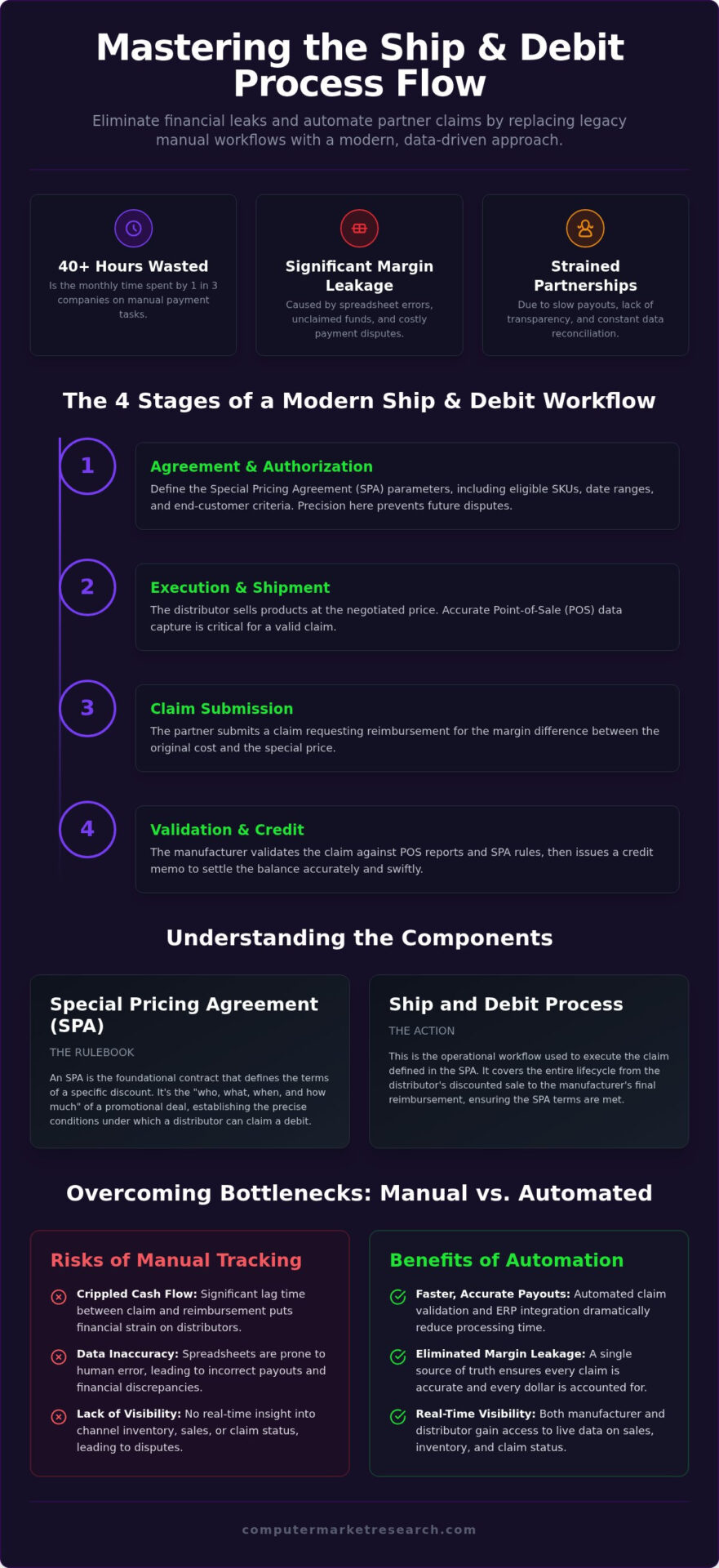
A modern ship and debit process flow isn’t just a financial transaction; it’s a precisely governed lifecycle that ensures every discount is accounted for and every claim is valid. Legacy systems often treat these stages as isolated events, but a SaaS-driven approach connects them to create a seamless loop of information. This connectivity is what prevents margin leakage and keeps distributors engaged in your programs.
The workflow consists of four critical phases:
- Agreement and Authorization: Defining the Special Pricing Agreement (SPA) parameters, including eligible SKUs and end-customers.
- Execution and Shipment: The distributor fulfills orders at the negotiated lower rate and captures the transaction data.
- Claim Submission: The partner requests reimbursement for the margin difference based on actual sales.
- Validation and Credit: The manufacturer verifies the claim against POS reports and issues a credit memo to settle the balance.
Stage 1 & 2: Setting the Foundation
Precision starts before the first unit is sold. During the authorization phase, manufacturers must clearly define which SKUs qualify, the specific date ranges for the promotion, and the eligible end-customer criteria. Vague terms lead to disputes later. Once the SPA is active, the distributor executes the sale. It’s vital to capture accurate point-of-sale (POS) data at this moment. If the shipment details don’t match the authorization criteria, the claim will likely fail. High-performing channels ensure distributors have real-time visibility into their authorized debitable amounts so they don’t over-extend their margins blindly.
Stage 3 & 4: Claim Management and Reconciliation
The real technical challenge begins when claims hit the manufacturer’s desk. Matching thousands of distributor claim lines to internal ERP records is a monumental task if done manually. Modern workflows automate this validation process by cross-referencing POS reports with the original SPA terms. This automation reduces dispute cycles from weeks to hours. When a claim is validated, the manufacturer issues a credit memo to close the financial loop. This isn’t just about moving money; it’s about maintaining trust through predictable payouts. If you want to see how these automated systems can transform your operations, you can test these automated workflows yourself to explore the impact of real-time claim validation.
Refining your ship and debit process flow through automation doesn’t just save time; it protects the integrity of your entire channel strategy. By using a centralized platform, manufacturers can see exactly where claims stand and why certain lines were rejected. This level of transparency prevents the spreadsheet trap and allows both parties to focus on sales rather than administrative friction.
Ship and Debit vs. SPAs: Navigating Complex Agreements
Distinguishing between a Special Pricing Agreement (SPA) and a ship and debit process flow is essential for maintaining a clean ledger. While industry professionals often use these terms interchangeably, they represent different layers of the channel relationship. An SPA is the contractual framework that establishes the rules of engagement, such as which end-customers qualify for a discount. In contrast, ship and debit is the actual financial mechanism used to execute that agreement and reconcile the margin difference. One is the “what,” and the other is the “how.”
A hybrid approach is often the most effective way to manage these relationships. In this model, the manufacturer creates a “parent” SPA that covers a specific project or customer segment. Every individual sale made by the distributor then becomes a “child” transaction that triggers the ship and debit workflow. This hierarchy allows for better tracking of total program performance. It also ensures that every claim is tied back to a pre-authorized contract, which significantly reduces the risk of unauthorized margin giveaways.
Industry-Specific Applications
The choice between an SPA and a broader volume-based rebate often depends on market velocity. High-tech and semiconductor manufacturers rely heavily on individual ship and debit transactions because product values erode quickly. They need to adjust pricing on a per-deal basis to stay competitive. Conversely, building materials and industrial distribution sectors typically use SPAs to lock in project-based pricing for long-term construction contracts. These markets require stability over a longer period, making the granular tracking of every price fluctuation less critical than in the electronics sector. Regardless of the industry, the necessity for a streamlined ship and debit process flow remains constant to avoid administrative bottlenecks.
Documentation and Audit Readiness
Financial transparency is the bedrock of channel trust. To pass internal and external audits, every agreement must include specific data points: authorized price, effective dates, and end-customer identifiers. Manufacturers must demand a “proof of sale” for every claim to defend against potential double-dipping or fraudulent submissions. This data integrity isn’t just a compliance requirement; it’s a strategic asset. For a deeper look at how to maintain high-quality information across your network, read our guide on Channel Data Management (CDM): The Definitive Guide. Decision-grade insights start with clean data, and clean data is only possible when your agreements are clearly documented and strictly enforced.
Overcoming Manual Bottlenecks in Claim Processing
Manual tracking isn’t just slow; it’s expensive. The “Spreadsheet Trap” is a reality for many manufacturers who haven’t yet modernized their ship and debit process flow. Industry data indicates that manual tracking methods lead to a 10-15% error rate in claims. These aren’t just administrative typos. They represent actual margin leakage where manufacturers silently drain corporate profits by overpaying on rebates due to duplicate entries, incorrect price calculations, or mismatched date ranges.
The primary friction point lies in fragmented data. Matching distributor POS reports with internal ERP records is a monumental task when done line-by-line in Excel. One of the most common objections we hear is that automation is too difficult to integrate with a legacy ERP. In reality, modern SaaS solutions act as an intelligent bridge. They sit alongside your existing infrastructure, removing the need for a total system overhaul while providing the precision needed to stop profit drain immediately.
The Role of POS Data Normalization
Raw POS data is notoriously “dirty” and unusable for immediate claim validation. One distributor might list a product as “Model-X,” while another uses a proprietary SKU or an abbreviated part number. Cleansing this data involves mapping these disparate partner entries to your internal SKUs to ensure accuracy. PartnerPortal™ serves as the central hub for this normalization. It standardizes incoming data formats automatically, allowing your team to validate claims against a single source of truth rather than a mountain of inconsistent files.
Ensuring Financial Compliance and ASC 606
Financial compliance requires a rigorous, transparent audit trail for revenue recognition, particularly under ASC 606 standards. Tracking rebates through a mix of email and Excel creates a significant risk of non-compliance and makes internal audits unnecessarily painful. Automated systems provide a permanent record of every authorization, sale, and payout. By implementing a standardized ship and debit process flow, you ensure that every credit memo is backed by verifiable data. Automated validation also significantly reduces the risk of duplicate or fraudulent claims by cross-referencing every line item against historical transactions and active agreements.
Don’t let manual errors compromise your channel profitability. Start your 90-day free trial to see how automated claim processing can secure your margins and restore order to your data.
Automating Your Flow with CMR PartnerPortal™
Modernizing your ship and debit process flow requires moving beyond the limitations of local files and disconnected databases. PartnerPortal™ provides a centralized, cloud-based environment where every stage of the rebate lifecycle is tracked in real time. By consolidating these workflows, manufacturers can eliminate the friction of manual entry and provide a single version of the truth for both internal finance teams and external distribution partners. This transparency is the foundation of a stable channel ecosystem.
Integration is often the most significant hurdle for organizations using legacy infrastructure. PartnerPortal™ is designed to connect seamlessly with existing enterprise systems, including various CRM platforms, SAP, and Oracle. This connectivity ensures that your rebate data isn’t siloed. Instead, it flows directly into your ERP for accurate financial reporting and revenue recognition. You don’t need to replace your current systems to achieve specialized channel control; you simply need a platform that speaks their language.
Key Features for Ship and Debit Management
Efficiency in rebate management depends on proactive oversight. The platform includes automated SPA tracking and expiration alerts, ensuring that outdated agreements don’t lead to unauthorized claims. Once a claim is submitted, the system performs instant validation against normalized POS and inventory data. This eliminates the need for manual line-item reviews. Additionally, configurable workflows allow you to define multi-level approval cycles that match your internal corporate governance, ensuring that high-value credits receive the necessary oversight without slowing down the entire queue.
The Business Outcome: Scalability and ROI
The shift to automation yields measurable financial returns. Research indicates that companies using business automation operate with 22% lower costs and significantly faster response times. For many organizations, the median ROI for automation reaches between 300-330% over a three-year period. These gains aren’t just internal. By accelerating reimbursement cycles, you improve partner satisfaction and build a level of trust that manual systems can’t replicate. Partners who receive accurate, timely payouts are more likely to prioritize your products over competitors who are still trapped in spreadsheet-based workflows. Explore our Ship & Debit Management Software page for a complete breakdown of how these tools drive channel scalability.
Securing Your Channel Margins Through Automation
A modernized ship and debit process flow is no longer a luxury for manufacturers; it’s a financial necessity. Transitioning from fragmented spreadsheets to a centralized system prevents the significant margin leakage caused by manual data entry errors. By ensuring real-time visibility into channel inventory and POS data, you can build a more resilient and transparent partnership with your distributors. Since 1984, we’ve helped Fortune 500 and Global 2000 companies replace obsolete legacy methods with high-performance infrastructure. Our cloud-based PartnerPortal™ provides the technical precision required to normalize dirty data and automate complex validation cycles instantly.
This shift doesn’t just protect your profits; it creates a predictable, scalable environment where your channel partners can thrive. Take the first step toward total operational control and eliminate the administrative bottlenecks that hold your business back. We’re ready to help you transform your data into a strategic asset that drives long-term growth.
Optimize your channel margins with CMR’s Ship and Debit Software
Frequently Asked Questions
What is the primary difference between a rebate and a ship and debit agreement?
Standard rebates are typically volume-based incentives paid out after a specific period, such as a quarter or a year. In contrast, ship and debit is a transaction-specific price adjustment. It allows a distributor to sell a product at a lower price for a specific deal and then claim the difference back from the manufacturer. This mechanism provides immediate pricing flexibility for competitive bidding without waiting for long-term volume targets.
How does a ship and debit process flow benefit distributors?
A structured ship and debit process flow protects distributor margins during periods of rapid market price erosion. It enables partners to stay competitive on large-scale deals without losing money on inventory that was originally purchased at higher standard costs. When this flow is optimized, it ensures faster reimbursement cycles. This improvement in cash flow builds stronger trust between the distributor and the manufacturer while reducing administrative friction.
What are the most common challenges in ship and debit claim processing?
Most challenges originate from a reliance on manual spreadsheet tracking and fragmented information systems. Manufacturers often find it difficult to match distributor point-of-sale reports with their internal ERP records. These manual bottlenecks lead to high error rates, frequent disputes, and significant margin leakage. Such delays in processing not only slow down payouts but also frustrate channel partners and damage the overall health of the business relationship.
How does automation reduce margin leakage in the channel?
Automation removes the human errors that are common in manual data entry and spreadsheet reconciliation. By centralizing data within PartnerPortal™, manufacturers can execute instant validation against pre-authorized agreements and normalized POS data. This precision prevents overpayments, duplicate claims, and unauthorized price adjustments. These errors often go unnoticed in legacy systems, silently draining corporate profits and complicating financial reporting across the entire channel network.
What documentation is required for a valid ship and debit claim?
A valid claim requires several specific data points to pass rigorous financial audits. These include the authorized price, the effective date range of the agreement, and clear end-customer identifiers. Manufacturers also require a verifiable “proof of sale” for every transaction. All shipment data must be cross-referenced against the original Special Pricing Agreement to ensure the claim meets all contractual criteria before a credit memo is issued.
Can ship and debit software integrate with my existing ERP system?
Under ASC 606, manufacturers must estimate and record rebate liabilities at the time of the initial sale to the distributor. Automated systems provide the necessary audit trail for accurate revenue recognition by tracking variable consideration in real time. Without this level of transparency, companies face a higher risk of non-compliance or financial restatements. Automated validation ensures that all recognized revenue reflects the actual net price after all incentives are applied.
Why is POS data accuracy critical for ship and debit success?
Point-of-sale data is the primary foundation for every claim validation cycle. If distributor reports are inconsistent or “dirty,” matching them to internal SKUs requires labor-intensive manual intervention. Accurate and normalized data ensures that every claim is linked to a legitimate transaction. This level of precision prevents fraudulent submissions and ensures that partners are reimbursed correctly for their actual sales performance, maintaining the financial integrity of the entire program.

Article by
Del Heles
Del Heles is the founder and CEO of Computer Market Research (CMR), a channel management software company he launched in 1984. With more than 40 years of experience, he’s known for helping manufacturers and distributors simplify complex partner programs through practical, customer-focused technology solutions.