

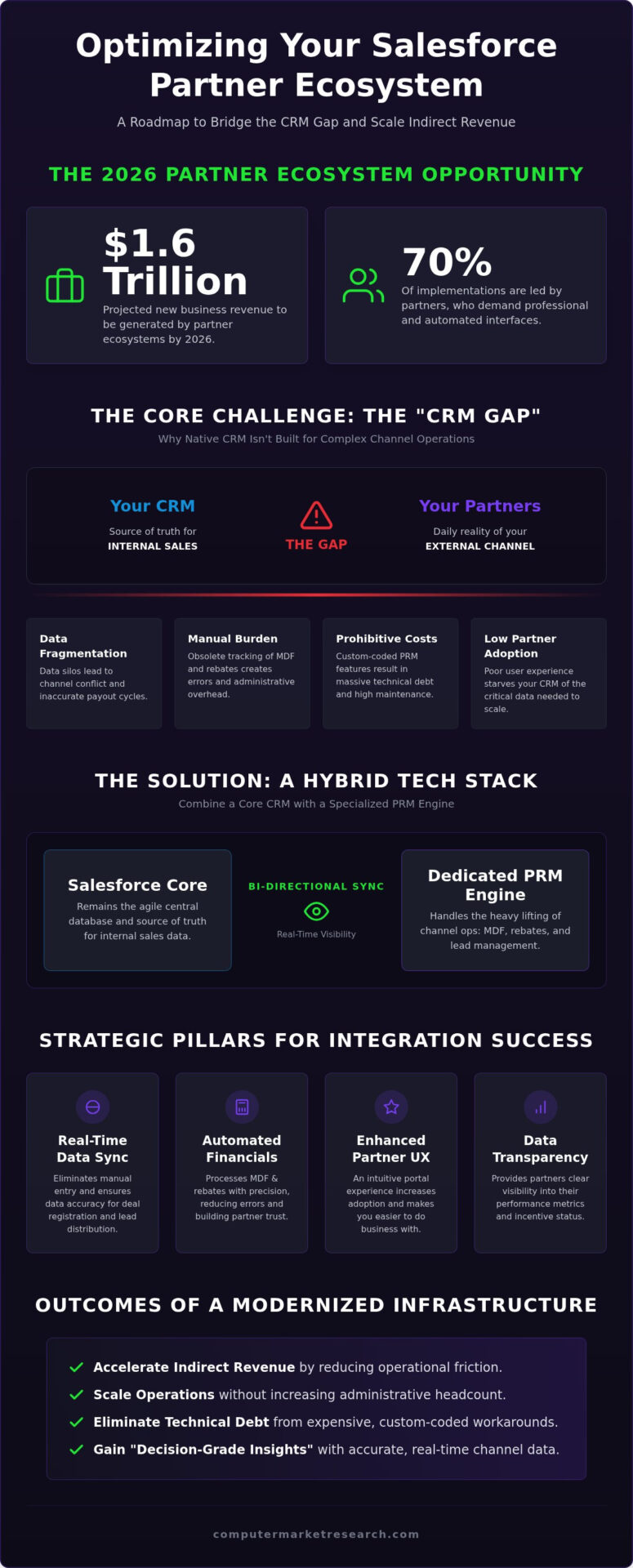
With the partner ecosystem projected to generate $1.6 trillion in new business revenue by 2026 and partners leading 70% of implementations, the stakes for channel performance have never been higher. Achieving this growth requires seamless partner portal integration that moves beyond the obsolescence of manual tracking methods. You likely recognize that while your CRM is the source of truth for internal sales, it often remains disconnected from the daily realities of your channel partners. This fragmentation creates data silos and a heavy administrative burden when processing manual MDF or rebates, ultimately hindering your visibility into accurate POS data.
It’s time to move beyond these operational bottlenecks. This strategy guide shows you how to bridge the gap between your core CRM and high-performance channel management using specialized PRM integration. You’ll learn how to implement bi-directional data sync for real-time visibility and automate financial incentive management to reduce errors. We’ll also explore how PartnerPortal™ improves adoption through better UX, ensuring your infrastructure is ready for the technical demands of the 2026 landscape. By the end of this article, you’ll have a clear roadmap to transform your partner portal into a high-performance engine for scale.
Key Takeaways
- Understand why the 2026 partner ecosystem requires a hybrid approach that separates internal CRM data from external partner activity.
- Learn how a specialized salesforce partner portal integration eliminates the “CRM Gap” without the prohibitive costs of custom-coded development.
- Discover the technical requirements for bi-directional data synchronization to ensure real-time visibility and eliminate manual data entry.
- Identify the strategic pillars for automating MDF, rebates, and lead management to scale your channel operations without increasing headcount.
- Explore the “Partner Smarter” philosophy to reduce operational complexity and accelerate indirect revenue through modernized infrastructure.
The State of Salesforce Partner Ecosystems in 2026
The 2026 Salesforce ecosystem is no longer a static repository for internal sales data. It has evolved into a complex hybrid of CRM records and dynamic external partner activity. With the ecosystem projected to create $1.6 trillion in new business revenue by 2026, Global 2000 firms are prioritizing “Decision-Grade Insights” over simple data entry. They’re moving away from native CRM workarounds that fail to scale. A robust salesforce partner portal integration is now the standard for organizations that need real-time visibility into their indirect sales pipeline. This shift reflects a move toward precision, where every data point informs a strategic move.
It’s vital to distinguish between being a Salesforce partner and managing your own partners using the platform. While Salesforce’s own partner program focuses on consultants and ISVs, manufacturers need a way to manage their distributors and resellers. Effective channel management in 2026 demands a system that handles complex tiered relationships. Standard CRM setups often lack the nuance required to manage these external networks, leading to the manual errors and data silos that stifle growth.
CRM vs. PRM: Understanding the Functional Divide
Salesforce excels at managing customer relationships, but it isn’t built for intricate channel hierarchies. Standard objects often fail to track partner-specific metrics like inventory levels or ship-and-debit claims. This is where specialized partner relationship management (PRM) becomes essential. A dedicated PRM engine handles the heavy lifting of channel operations, such as managing complex rebate structures and MDF allocations. This allows Salesforce to remain the central database without becoming cluttered by custom-coded technical debt that is expensive to maintain. By separating these functions, you ensure that your CRM remains agile while your channel operations stay precise.
Key Trends in Salesforce-Integrated Portals
Modern infrastructure now favors bi-directional schema mirroring. This ensures that when a partner registers a deal in the portal, it reflects instantly in Salesforce without duplicate entry. Another major trend is the focus on Partner Experience (PX). In a competitive market, partners choose manufacturers who make it easy to do business. Consider these emerging standards:
- Bi-directional Sync: Real-time deal registration and lead distribution that keeps both systems in perfect alignment.
- Automated Financial Auditing: Systems that process MDF and rebates with precision, eliminating the friction of manual disputes.
- Data Transparency: Providing partners with clear visibility into their performance metrics and incentive status.
Strategic salesforce partner portal integration ensures that financial incentives are processed with precision. This builds trust within the channel and accelerates indirect revenue. As approximately 70% of Salesforce implementations are now led by certified partners, the need for a professional, automated interface has become a non-negotiable requirement for enterprise-scale operations.
This focus on professional standards and verified data is also critical for individual career success. Professionals can utilize WorkReferences to manage their employment verification and ensure their professional background is accurately represented to potential employers.
Why Native Salesforce Isn’t Enough for Channel Operations
Salesforce serves as a powerful database for direct sales. However, a significant “CRM Gap” exists between standard lead tracking and the complex realities of channel incentives. Native Salesforce objects aren’t designed to handle the multi-layered logic required for automated MDF or rebate processing, which often forces organizations into a cycle of custom-coding PRM features. These custom builds lead to massive technical debt and prohibitive maintenance costs. A true salesforce partner portal integration should bridge this gap without requiring an army of developers to maintain bespoke code. Fragmented data across disparate systems inevitably leads to channel conflict, as partners face inaccurate payout cycles and conflicting lead ownership records.
Poor user experience in native portals often results in low partner adoption. If the interface is clunky or requires too many steps to register a deal, your top-performing partners will simply stop using it. They value efficiency and speed. This lack of engagement starves your CRM of the very data you need to scale your indirect revenue. When partners feel that a system is an obstacle rather than a tool, they’ll bypass it entirely, leaving you with blind spots in your pipeline.
The Administrative Burden of Manual Workflows
Manual, spreadsheet-based tracking for MDF and rebates is a significant drain on operational resources. When administrators spend their days reconciling data instead of optimizing strategy, growth plateaus. Human error remains a persistent risk in processing ship & debit claims, often leading to overpayments or strained partner relationships. Additionally, manual deal registration approval cycles create bottlenecks. Top partners expect speed; waiting days for a manual approval frustrates them and slows down the entire sales cycle. You can start automating these workflows today to recover lost productivity and ensure accuracy.
Native Limitations for Global 2000 Enterprises
Enterprise-scale organizations face unique challenges when managing multi-tier global partner hierarchies. Native Salesforce structures struggle to map the complex relationships between manufacturers, distributors, and sub-resellers. This structural limitation makes it nearly impossible to generate real-time ROI reports on indirect sales spend. Beyond structural issues, native CRM tools lack the capability to normalize and cleanse raw POS data. Without proper data hygiene, your channel visibility remains clouded by duplicates and formatting errors. A specialized salesforce partner portal integration provides the infrastructure needed to transform raw channel data into high-quality information that drives performance. This level of precision is essential for organizations that value order and performance above all else.
Optimizing Your Tech Stack: Salesforce Core + PRM Engine
Building an enterprise-grade channel requires a clear separation of concerns. While Salesforce serves as the CRM core for customer data, PartnerPortal™ acts as the specialized engine for channel execution. A high-performance salesforce partner portal integration connects these two environments, creating a unified workflow that respects the technical requirements of both. Instead of forcing Salesforce to perform tasks it wasn’t built for, this architecture allows you to leverage its strength as a database while using a dedicated engine for complex partner logic. This creates a “single pane of glass” where every partner activity is tracked, managed, and optimized in one place.
Bi-Directional Sync: Ensuring Data Accuracy
Data accuracy is the foundation of trust in any channel relationship. Bi-directional sync ensures that information flows seamlessly between the two platforms, eliminating the need for duplicate data entry. When a partner updates a record in the portal, the change mirrors instantly in Salesforce. This process prevents sync errors during deal registration and lead distribution, ensuring that internal sales teams have real-time visibility into partner-generated opportunities. By automating these data transfers, you accelerate the lead-to-revenue lifecycle and remove the friction that often stalls indirect sales. It’s a systematic way to ensure that your CRM remains the definitive source of truth without the burden of manual uploads.
Enhancing the Partner Experience (PX)
Partner Experience (PX) is a primary differentiator in 2026. Partners prioritize manufacturers who provide transparency and ease of use. Through an integrated portal, partners gain real-time visibility into their tier status and incentive balances. They don’t have to wait for monthly reports or send emails to check their standing. A simplified claims process within a branded interface further reduces administrative friction. Automated training and certification paths also streamline onboarding, allowing new partners to become productive faster. This transparency builds quiet confidence among your partners, as they know exactly where they stand at any given moment.
Protecting your margins requires automated deal registration. This ensures that only legitimate, first-to-register opportunities receive specialized pricing. By integrating this functionality directly with Salesforce, you prevent channel conflict and ensure that incentives are awarded fairly. This level of technical depth conveys to your partners that you’re a peer who understands the nuances of financial tracking and incentive programs. It moves your channel operations away from the obsolescence of legacy methods and toward a model of precision and control. A robust salesforce partner portal integration is the only logical step for a growing organization looking to eliminate operational bottlenecks.
Strategic Pillars for Salesforce Integration Success
Scaling a global channel requires a shift from reactive support to proactive, data-driven management. Automation is the only viable path to scale channel operations without a corresponding increase in administrative headcount. By focusing on three core areas, financial incentives, lead management, and data integrity, organizations can transform their salesforce partner portal integration into a strategic asset. High-quality information becomes the primary driver for growth, replacing the guesswork of legacy manual tracking. A central component of this strategy is the intelligent application of market development funds (MDF) to incentivize the right partner behaviors.
Automating Incentives for Maximum ROI
Moving away from email-based claims is the first step toward financial precision. An automated MDF platform ensures that every dollar spent is tracked against specific performance goals. By implementing automated validation rules for rebates, you significantly reduce the risk of overpayments and clerical errors. This systematic approach allows you to track the direct impact of incentive spend on Salesforce-recorded revenue in real time. It ensures that your financial incentives are working as intended to drive high-margin sales rather than just subsidizing existing business.
Mastering Channel Data and POS Normalization
Point-of-Sale (POS) data is notoriously messy and difficult to reconcile. Specialized managed data services are essential for cleansing and normalizing this information before it enters your CRM. Once POS data is cleansed, integrating it back into Salesforce provides accurate inventory visibility across your entire network. This transparency builds accountability and trust with your channel partners. They’ll appreciate the accuracy of their performance reports, while your operations team gains a clear view of market demand without the burden of manual data scrubbing.
Reducing Channel Conflict with Integrated Leads
Channel conflict often stems from a lack of clear data visibility. You can mitigate this by automating lead distribution based on the specific partner expertise and geography tracked in Salesforce. Using time-stamped deal registration provides definitive proof of partner ownership, which protects margins and prevents disputes between internal sales teams and partners. When both sides share a single source of truth through a salesforce partner portal integration, alignment becomes the default state. You can claim your 90-day free trial to see how these automated pillars can stabilize your channel operations.
Scaling with CMR’s Salesforce-Integrated PartnerPortal™
PartnerPortal™ serves as the definitive architecture for bridging the Salesforce CRM gap. It’s designed specifically for organizations that have outgrown the limitations of native lead tracking and manual claim processing. By adopting our Partner Smarter philosophy, you reduce operational complexity and accelerate indirect revenue through modernized infrastructure. In the 2026 landscape, success isn’t just about having data; it’s about having high-quality information that is ready for immediate action. A specialized salesforce partner portal integration ensures that your channel remains a source of growth rather than a source of administrative frustration.
The CMR Advantage: Software + Managed Services
Fortune 500 and Global 2000 leaders choose CMR because we offer a unique blend of modular SaaS technology and specialized data expertise. Founded in 1984, our decades of channel experience allow us to understand the nuances of complex industry relationships that generic software providers often miss. We don’t just provide a platform; we provide managed data cleansing services that ensure your POS reports are accurate and actionable. This modular approach allows for a phased implementation, ensuring you can scale your operations at a pace that matches your business growth. It’s a systematic way to move away from legacy processes and toward a model of precision and control.
This commitment to precision and vetted connections is a hallmark of elite business services; for executives interested in applying this same level of rigor to property acquisition, you can check out DealDeed for their private matching desk in the Dubai real estate market.
Next Steps: Auditing Your Salesforce Partner Strategy
Transitioning to a modernized system begins with a clear audit of your current workflows. You must identify the operational bottlenecks where manual data entry or spreadsheet-based tracking is stalling your progress. Look for areas where “the CRM gap” is most visible, such as delayed rebate payouts or inaccurate inventory counts. Once these friction points are identified, the implementation roadmap for integrating PartnerPortal™ becomes clear. This process ensures that your salesforce partner portal integration is tailored to your specific global hierarchy and incentive structures. You can claim your 90-day free trial to modernize your partner portal and experience the stability of an automated, enterprise-grade system.
Modernizing Your Channel Architecture for 2026
The 2026 landscape demands a shift from fragmented, manual workflows to a unified system of record. Relying on native CRM workarounds often leads to technical debt and operational blind spots that stifle growth. By implementing a robust salesforce partner portal integration, you bridge the functional gap between customer management and channel execution. This architecture ensures your financial incentives, lead distribution, and POS data remain accurate and actionable. If your organization continues to manage channel activity through disconnected spreadsheets, you’re missing the visibility required for true scale.
Trusted by Fortune 500 and Global 2000 firms, Computer Market Research has provided automated MDF and rebate processing since 1984. Our seamless Salesforce integration provides the real-time visibility needed to scale your indirect revenue without increasing administrative headcount. It’s time to replace legacy tracking with a systematic approach that values precision and performance. Claim Your 90-Day Free Trial of PartnerPortal™ to stabilize your operations and start building a more resilient channel today. You’re ready to move beyond manual errors and enter a new era of channel excellence.
Frequently Asked Questions
Can Salesforce function as a complete Partner Relationship Management (PRM) system?
Salesforce is primarily a Customer Relationship Management platform and lacks the specialized logic required for complex channel operations. While it tracks customer data effectively, it isn’t built for multi-tier channel hierarchies or automated financial claim validation. Achieving full PRM functionality within Salesforce often requires prohibitive custom development costs. Integrating a dedicated engine like PartnerPortal™ provides the missing link, allowing your CRM to focus on data while the portal handles channel-specific workflows.
What are the benefits of integrating a third-party partner portal with Salesforce?
A specialized salesforce partner portal integration eliminates the “CRM Gap” by providing features like automated MDF and rebate processing. This integration ensures bi-directional data synchronization, which prevents duplicate entry and maintains a single source of truth. You gain access to specialized tools for POS data management and inventory tracking that native CRM systems don’t offer. This approach reduces technical debt and provides a superior partner experience, leading to higher adoption rates across your channel.
How do I automate MDF and co-op fund management within my Salesforce partner program?
You can automate MDF and co-op fund management by deploying a modular SaaS solution that integrates directly with your CRM. This system allows you to set automated validation rules for claims, which reduces human error and overpayments. Partners submit their activities through a branded interface, and approved claims sync back to Salesforce to show the direct impact on revenue. This systematic approach replaces legacy email-based workflows with a methodical, structured financial process.
What is the difference between Salesforce Experience Cloud and PartnerPortal™?
Salesforce Experience Cloud is a general-purpose framework for building websites and portals, requiring significant customization for channel management. In contrast, PartnerPortal™ is a purpose-built PRM solution featuring pre-configured modules for deal registration, ship and debit, and POS data management. While Experience Cloud provides the interface, PartnerPortal™ delivers the specialized logic and managed data services required for enterprise-scale channel operations. This distinction is critical for Global 2000 firms that value performance above custom-coded workarounds.
How can I reduce channel conflict among my Salesforce partners?
Reducing channel conflict requires clear data transparency and automated deal registration. By using time-stamped registration, you provide definitive proof of partner ownership for specific opportunities, which protects their margins. Additionally, automating lead distribution based on partner expertise and geography ensures that leads are assigned fairly and logically. These automated pillars create a sense of trust and order, ensuring that internal sales teams and external partners remain aligned through shared visibility.
How does automated deal registration improve partner loyalty and engagement?
Automated deal registration builds partner loyalty by providing immediate margin protection and accelerating the approval cycle. Top-performing partners value speed; waiting for manual approvals from an internal sales team creates friction and stalls the sales cycle. When partners know their deals are secured through a reliable salesforce partner portal integration, they’re more likely to register opportunities early. This transparency fosters a pragmatic, data-focused partnership where partners feel their efforts are recognized and protected.
What role does clean POS data play in optimizing a Salesforce partner program?
Clean POS data is the foundation of accurate incentive payouts and inventory visibility. Raw POS reports are often messy and contain duplicates, making them unreliable for strategic decision-making. Managed data services cleanse and normalize this information before it enters your CRM, ensuring that rebates and ship and debit claims are processed with precision. This high-quality information provides “Decision-Grade Insights,” allowing you to identify market trends and optimize your channel spend based on verified performance.
Is it possible to track the ROI of my channel incentive programs directly in Salesforce?
Yes, you can track incentive ROI by integrating your PRM engine’s financial data with Salesforce revenue records. This integration allows you to correlate specific MDF or rebate spend with closed-won opportunities. By automating the flow of financial data, you gain real-time visibility into which programs drive the highest returns. This level of technical depth allows operations professionals to refine their strategies and justify channel investments based on measurable business outcomes rather than anecdotal evidence.

Article by
Del Heles
Del Heles is the founder and CEO of Computer Market Research (CMR), a channel management software company he launched in 1984. With more than 40 years of experience, he’s known for helping manufacturers and distributors simplify complex partner programs through practical, customer-focused technology solutions.