

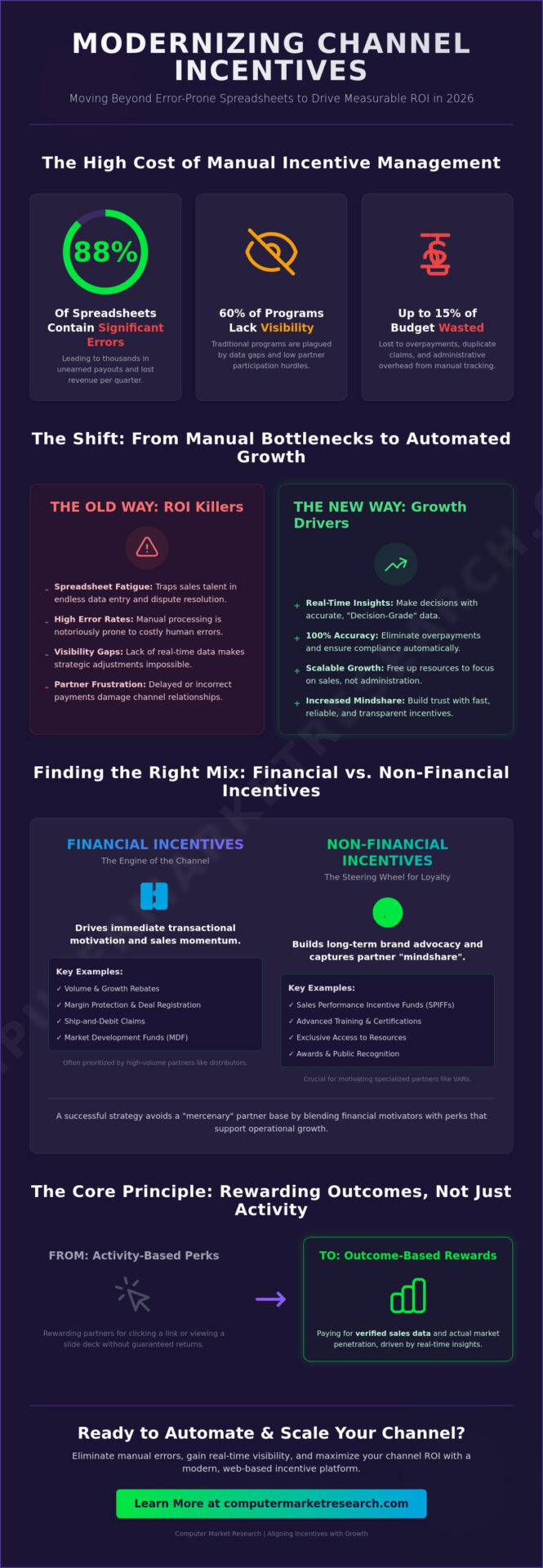
Research from F1F9 indicates that 88% of spreadsheets contain significant errors; this is a reality that costs manufacturers thousands in unearned incentive payouts every quarter. If you’re still managing MDF and rebates through manual data entry, you’re likely dealing with the same visibility gaps and participation hurdles that plague 60% of traditional channel programs. This guide moves past the “death of the spreadsheet” to provide a curated list of high-impact channel incentive program examples designed for the 2026 market.
Modern programs reward more than just the final transaction. Manufacturers now incentivize technical certifications to ensure partners can support complex 2026 hardware-as-a-service models. Providing a 2% rebate for every technician who completes a specialized training module creates a more capable, self-sufficient channel. For partners operating in high-tech sectors like semiconductors or digital infrastructure, this might include training on specialized network tools like the Flash BTC Core Network Basic License to ensure secure and efficient transaction processing.
You’ve probably realized that throwing more funds at a problem doesn’t guarantee a boost in sales or partner loyalty. We’ll show you how to automate these processes to ensure every dollar spent drives a specific, measurable behavior. You’ll discover a framework for choosing the right incentives for your unique partner ecosystem and learn how a web-based infrastructure can streamline your entire administrative workflow. By the end of this guide, you’ll have a clear path to reducing manual errors, increasing real-time visibility, and ultimately maximizing your overall channel ROI.
Key Takeaways
- Learn why aligning incentives with specific behavioral objectives is more effective for driving manufacturer goals than simply offering generic rebates.
- Identify the optimal mix of financial rewards and non-financial perks to maximize long-term loyalty across different partner tiers, such as distributors and VARs.
- Explore 10 high-impact channel incentive program examples for 2026 that utilize data visibility to ensure measurable ROI and partner engagement.
- Discover a structured framework for defining KPIs and segmenting your partner base to provide more relevant and motivating rewards.
- Understand how to eliminate manual spreadsheet errors and scale your growth by automating complex rebate, MDF, and ship-and-debit processes.
Understanding Channel Incentive Programs: Beyond the Basic Rebate
Channel incentives aren’t just financial kickbacks; they’re tactical tools designed to align partner behavior with a manufacturer’s specific growth objectives. While many managers search for generic channel incentive program examples, most lists fail because they lack a clear behavioral objective. If you don’t define the “why” before the “what,” you’re simply spending budget without a guaranteed return. A well-structured Incentive program should serve as a roadmap for partner success, not just a reward for existing business.
To better understand how these programs function in a modern sales environment, watch this helpful video:
The industry has moved away from simple activity-based perks. In 2026, the standard has shifted toward outcome-based rewards. This means paying for verified sales data and market penetration rather than just rewarding a partner for clicking through a slide deck. Success relies on “Decision-Grade Insights.” These are accurate, real-time data points that allow manufacturers to adjust their strategy based on what’s actually happening in the field. Without this foundation, your program is essentially flying blind.
The Strategic Role of Incentives in Channel Management
Incentives act as the bridge between high-level manufacturer strategy and local partner execution. Without them, your goals remain abstract concepts that your partners might ignore in favor of easier sales. Effective incentives capture “mindshare,” ensuring your brand stays top-of-mind when a partner faces a choice between competing products. This alignment is a core component of modern channel management, where every dollar spent must drive a measurable action that supports the broader sales framework.
Why Manual Incentive Tracking is the “ROI Killer”
Managing complex rebate programs in Excel spreadsheets creates hidden costs that erode profit margins. Manual entry is notoriously prone to human error, often leading to overpayments and duplicate claims that can consume up to 15% of a program’s total budget. These administrative bottlenecks prevent scalability and frustrate partners who face delayed payments or rejected claims. Spreadsheet fatigue is the primary obstacle to channel scalability because it traps valuable sales talent in a cycle of data entry and dispute resolution. Moving to automated systems ensures that channel incentive program examples like volume rebates or ship-and-debit claims are processed with 100% accuracy and speed.
Financial vs. Non-Financial Incentives: Finding the Right Mix
Successful manufacturers don’t treat all partners as a monolith. Achieving a high ROI requires a calibrated strategy that distinguishes between immediate transactional motivation and long term brand advocacy. Cash is the engine of the channel, but non-financial perks serve as the steering wheel. While distributors often prioritize high volume throughput and inventory commitment, Value-Added Resellers (VARs) focus on the technical depth of the solution stack. If you rely solely on cash, you risk creating a “mercenary” partner base that switches to a competitor for a 1% higher margin. Conversely, ignoring financial fundamentals leads to a lack of sales momentum. Research from the Incentive Research Foundation in their report on Effective Design Patterns for Channel Programs indicates that the most resilient programs blend these elements to address both the partner’s balance sheet and their operational growth.
Margin protection remains a non-negotiable financial motivator in 2026. It ensures that partners who invest time in pre-sales engineering aren’t undercut by “box-shifters” at the final hour. By securing the partner’s profitability, you build the trust necessary for them to prioritize your roadmap over others. Balancing these short term sales spikes with long term advocacy requires clean data and visibility into every transaction. Transitioning to a centralized channel data management platform allows you to monitor these performance metrics in real time, ensuring that incentives are always aligned with actual sell-through data.
Core Financial Incentives: Rebates, SPIFFs, and Discounts
Financial rewards are the most direct channel incentive program examples used to influence behavior. Volume-based rebates remain the standard for encouraging distributors to maintain healthy inventory levels. These are typically structured as a percentage of total sales, often ranging from 2% to 5%, triggered once specific quarterly thresholds are met. Sales Performance Incentive Funds (SPIFFs) provide a more surgical approach. These are short term, flat-rate payments made directly to a partner’s sales reps to drive focus on a specific product launch or to clear end-of-life inventory. Tiered discounts further reward growth; as a partner moves from “Silver” to “Gold” status through increased certifications and revenue, their baseline acquisition cost drops, naturally increasing their potential ROI.
Non-Financial Incentives: Enablement and Recognition
Non-financial incentives build the infrastructure for a partner’s future success. Providing exclusive access to through channel marketing automation tools allows partners to scale their lead generation without increasing their internal marketing headcount. These tools are often more valuable than a small cash bonus because they directly lower the partner’s cost of customer acquisition. Other high-value perks include:
- VIP technical support with guaranteed 4-hour response times.
- Early access to product roadmaps, allowing partners to plan their service offerings 12 months in advance.
- “Partner of the Year” awards that provide social proof and co-branding opportunities for the partner’s website.
Additionally, lifestyle-oriented rewards, such as access to high-definition live sports streaming for partner teams, are becoming a popular way to differentiate a brand’s incentive package; read more.
When you provide these resources, you move from being a vendor to a strategic ally. This shift is critical for 2026, where 68% of B2B buyers now prefer partners who demonstrate deep technical specialization over broad product availability.
10 High-Impact Channel Incentive Program Examples for 2026
Effective channel incentive program examples in 2026 prioritize data visibility over gut feeling. Manufacturers are moving away from blanket rebates and toward surgical, performance-linked rewards that solve specific operational headaches. By automating the flow of Point of Sale (POS) data, brands can reward the specific behaviors that drive long-term ROI rather than just short-term volume spikes.
Advanced Financial Models: Ship & Debit and MDF
In high-volume manufacturing, price volatility can erode a distributor’s 10% or 15% margin in a matter of days. Ship & Debit programs act as a critical safety net. When a partner must lower their price to win a competitive bid, the manufacturer provides a credit to cover the difference. This protects the partner’s profitability while ensuring the manufacturer captures the market share. Success here requires real-time visibility to prevent overpayments or fraudulent claims.
Strategic growth also relies on Market Development Funds (MDF). These are discretionary funds manufacturers provide to partners for forward-looking marketing activities, such as webinars or localized digital campaigns. Unlike Co-op funds, which partners earn based on historical sales volume to spend on brand-approved advertising, MDF is a proactive investment in future potential.
Behavioral Incentives: Training, Certification, and Data Sharing
Modern programs reward more than just the final transaction. Manufacturers now incentivize technical certifications to ensure partners can support complex 2026 hardware-as-a-service models. Providing a 2% rebate for every technician who completes a specialized training module creates a more capable, self-sufficient channel.
Accuracy is the new currency. Leading brands now offer “Data Cleanliness Bonuses” for partners who submit timely, error-free channel data management reports. This eliminates the manual “spreadsheet death” that plagues sales operations. Deal Registration remains a staple, granting higher margins to partners who register new opportunities first, which prevents channel conflict and protects the partner’s pre-sales investment.
To stay competitive, consider these 10 channel incentive program examples as you build your 2026 strategy:
- Ship & Debit Credits: Protecting margins during market price shifts.
- MDF for Lead Gen: Co-investing in partner-led digital marketing.
- Co-op Funds: Rewarding past performance with future brand-building budgets.
- Technical Certification Rebates: Paying for partner expertise and competency.
- CDM Reporting Incentives: Rewarding the submission of clean, automated POS data.
- Deal Registration: Offering margin protection for newly identified leads.
- Green/Sustainability Incentives: Providing rebates for partners meeting carbon-neutral or “Z-Mode” efficiency targets.
- Customer Success/Renewal Bonuses: Rewarding partners for high retention rates in subscription models.
- Inventory Turnover Rewards: Bonuses for partners who maintain optimal stock levels without over-ordering.
- Multi-tier Referral Fees: Incentivizing non-transactional influencers who bring buyers to the ecosystem.
Automation is the bridge between these complex models and actual ROI. Without a centralized system to track these moving parts, manufacturers often lose 5% to 10% of their incentive budget to “leakage” or administrative errors. Transitioning to cloud-based tracking ensures every dollar spent on an incentive directly correlates to a verified business outcome.
How to Design and Automate Your Incentive Strategy
Effective incentive design requires moving beyond static spreadsheets toward a dynamic, data-driven framework. Success begins with a structured four-step approach that prioritizes precision over guesswork. First, define specific, measurable KPIs. If your goal for 2026 is market expansion, focus on new customer acquisition metrics. If you need to protect your base, prioritize renewal rates. Second, segment your partner base. A Tier 1 distributor with high volume requires different financial triggers than a specialized boutique reseller. Third, establish a “Clean Data First” policy for all Point of Sale (POS) reporting to prevent overpayments. Finally, implement an automated platform to replace manual claim processing, which often carries a 10% error rate in traditional B2B environments.
The Critical Role of POS Data Normalization
Raw data from partners is frequently unusable for immediate incentive calculation. One distributor might report a SKU as “PROD-100” while another uses “P100,” creating a fragmented view of performance. Normalization is the process of cleansing, validating, and matching this incoming stream against your master product list. This removes duplicates and corrects formatting errors that lead to financial discrepancies. Decision-Grade Data is the only reliable basis for financial payouts. Without this level of accuracy, manufacturers often lose 5% to 8% of their incentive budget to “vampire spend” caused by duplicate or invalid claims.
Transitioning from Spreadsheets to a Centralized Portal
Managing complex programs via email and Excel is a primary obstacle to scalability. Integrating a centralized partner relationship management system reduces friction by providing a single source of truth for both the vendor and the partner. When you automate the claim-to-payment lifecycle, you can reduce payout windows from 60 days to fewer than 15 days. This speed directly impacts partner satisfaction and loyalty.
Real-time dashboards allow partners to track their own progress toward specific channel incentive program examples, such as volume rebates or certification bonuses. When partners see exactly how close they’re to the next reward tier, their engagement increases. These channel incentive program examples show that visibility creates a self-service environment where partners spend less time on administrative disputes and more time selling your products. Automation ensures that every transaction is audited against program rules in milliseconds, providing the stability and control required for modern channel growth.
Ready to eliminate manual errors and gain full visibility into your program performance? Streamline your channel data management with our automated solutions.
Scaling Your Channel Growth with the CMR PartnerPortal™
While the previous sections explored various channel incentive program examples, implementing them effectively requires more than just a strategy; it requires a robust technical foundation. Computer Market Research (CMR) specializes in automating these complex workflows through the modular PartnerPortal™. Whether your organization needs to manage high-volume Volume Rebates, Market Development Funds (MDF), or Ship & Debit claims, the platform adapts to your specific channel structure. Most manufacturers struggle with fragmented data silos that lead to overpayments. CMR’s Managed Data Services eliminate this burden by cleansing and validating partner data before it enters your system. This ensures your team isn’t bogged down by manual errors or the “death of the spreadsheet.”
The PartnerPortal™ is designed for scalability. It allows you to start with one module and expand as your partner network grows. By centralizing your channel data management, you gain the visibility needed to identify which partners are truly driving ROI. It’s about moving away from reactive, manual processes toward a proactive, data-driven future where every incentive dollar is accounted for and optimized.
Automated Ship & Debit and Rebate Processing
Manual claim processing is a primary source of revenue leakage and partner frustration. By automating these workflows, global enterprises often reduce claim processing time by up to 80%. This efficiency doesn’t just save administrative hours; it ensures financial compliance through audit-ready reporting that satisfies internal and external stakeholders. CMR handles the technical heavy lifting of integrating disparate Point of Sale (POS) data from various distributors. This creates a single source of truth. It’s a systematic approach that eliminates the friction inherent in the manufacturer-distributor relationship, allowing sales operations to focus on strategy rather than spreadsheet reconciliation.
Ready to Optimize Your Channel ROI?
Transitioning from manual “headaches” to a scalable, automated system is the only logical path for brands targeting growth in 2026. You’ve seen the channel incentive program examples that drive results. Now it’s time to deploy the infrastructure that makes those results sustainable and measurable. Moving beyond manual data entry allows your team to focus on building stronger partner relationships and identifying new market opportunities. Stop letting data silos hinder your growth. Request a consultation to see how clean data and automated incentives can transform your channel performance.
Modernize Your Channel Performance for 2026
Designing a high-performance channel strategy for 2026 requires a shift from manual oversight to automated precision. Success doesn’t rest on basic rebates alone. It depends on a balanced mix of financial and non-financial rewards that drive specific partner behaviors. Implementing these channel incentive program examples effectively requires a foundation of clean, actionable data. If your team’s still trapped in spreadsheet-based tracking, you’re likely facing the operational headaches of manual errors and delayed visibility.
Computer Market Research brings over 40 years of experience in channel data management to solve these specific frustrations. Trusted by Fortune 500 and Global 2000 companies, our platform utilizes a proprietary data normalization engine to ensure 100% payout accuracy. This level of technical competence eliminates the friction between manufacturers and distributors; it allows you to focus on scaling ROI rather than fixing data silos. You can transform your incentive management from a cost center into a strategic growth engine. Request a Demo of the CMR PartnerPortal™ to Automate Your Incentives and start building a more reliable partner network today.
Frequently Asked Questions
What is the most effective channel incentive for new partners?
Training and enablement-based rewards are the most effective incentives for new partners during their first 90 days. Research from 2024 indicates that 73% of partners prioritize technical proficiency over immediate margin increases. By offering channel incentive program examples like certification bonuses, you ensure the partner is equipped to sell your product correctly. This approach builds long-term loyalty and reduces the risk of early churn.
How do SPIFFs differ from standard sales rebates?
SPIFFs target individual sales representatives for short-term performance bursts, while standard rebates are paid to the partner company based on volume or growth. Most SPIFF programs operate on 30-day windows to clear specific inventory. Rebates typically follow quarterly or annual cycles and focus on the overall health of the manufacturer-distributor relationship. It’s a distinction between motivating a single person and rewarding an entire organization.
What are the biggest risks of manual incentive management?
The biggest risks of manual incentive management include a 10% average overpayment rate and the total loss of data visibility. Relying on spreadsheets creates a “black hole” where errors go unnoticed for months. Automated systems eliminate these headaches by processing claims against real-time data. This transition marks the death of the spreadsheet in modern channel operations, ensuring every dollar spent is accounted for and verified.
How can I measure the ROI of my channel incentive program?
You measure ROI by comparing incremental sales growth against the total cost of program administration and payouts. A high-performing program should aim for a 3:1 return on investment ratio. Track specific KPIs like partner participation rates and the speed of claim redemptions to gauge effectiveness. If your data silos prevent you from seeing these numbers, you can’t accurately determine if your incentives are driving genuine growth or just subsidizing existing sales.
What is Ship & Debit and which industries use it most?
Ship & Debit is a financial claim process where a manufacturer reimburses a distributor for the difference between the standard wholesale cost and a discounted price for a specific contract. This mechanism is most prevalent in the electronics, semiconductor, and industrial component industries. It allows distributors to remain competitive in markets where prices change daily. Automated tracking ensures these claims are processed within 48 hours, maintaining distributor cash flow.
How do I prevent “channel conflict” when offering incentives?
You prevent channel conflict by implementing an automated Deal Registration system that protects partner leads. Industry data shows a 60% reduction in conflict when manufacturers provide clear, time-stamped ownership of a sales opportunity. This transparency ensures that multiple partners aren’t competing for the same end-customer with different incentive structures. It’s about creating a fair environment where partners feel their investment in a lead is secure.
Can I automate my MDF and Co-op funds in the same platform?
Yes, unified channel management platforms consolidate MDF and Co-op funds to eliminate data silos and streamline approvals. Integrating these funds into one system leads to a 25% improvement in fund utilization rates because partners find it easier to submit claims. A cloud-ready infrastructure allows both the manufacturer and the partner to see available balances in real time. This visibility reduces administrative friction and ensures marketing dollars are spent before they expire.
What data do I need from partners to run an automated rebate program?
To run an automated rebate program, you need clean Point of Sale (POS) data and validated inventory reports from your partners. This includes specific fields such as the transaction date, SKU number, quantity sold, and end-customer zip code. Without this granular detail, your program will suffer from inaccuracies and potential fraud. Centralizing this data provides the actionable insights required to optimize your channel incentive program examples for 2026 and beyond.

Article by
Del Heles
Del Heles is the founder and CEO of Computer Market Research (CMR), a channel management software company he launched in 1984. With more than 40 years of experience, he’s known for helping manufacturers and distributors simplify complex partner programs through practical, customer-focused technology solutions.