

What if the fastest way to simplify partner incentives is to clarify the rules before automating the process? When requirements vary by partner, manual eligibility checks pile up and incentive records sit across disconnected systems. Partners may struggle to understand what they’ve earned, while teams lose time managing exceptions. Reducing complexity in partner incentives starts with making participation clear, not removing the controls that protect the program.
You can simplify administration without weakening oversight or losing sight of results. A practical framework helps you streamline incentive rules, claims, approvals, and reporting while preserving partner visibility and program control.
This guide shows how to identify sources of friction, standardize the steps that can be consistent, and retain flexibility where partner needs differ. It also explains how centralized processes and software capabilities, such as configurable approval rules and real-time reporting, can support clearer administration. Use the framework to decide what to improve first and how to evaluate software against your program’s needs.
Key Takeaways
- Trace incentive friction across eligibility, claims, approvals, payments, and reporting to find where rules and handoffs create extra work.
- Start reducing complexity in partner incentives by reviewing program rules, removing duplication, and preserving only purposeful exceptions.
- Compare spreadsheets, disconnected tools, and centralized workflows to assess consistency, claim visibility, approval traceability, and partner self-service.
- Use a sequenced improvement plan to map processes, prioritize changes, pilot updates, and review results against documented baseline measures.
- Assess how centralized channel software, configurable approvals, ERP and CRM integrations, and real-time reporting could support simpler incentive administration.
Why Partner Incentives Become Complex, and Where the Friction Starts
Partner incentive complexity isn’t measured by the number of programs alone. It builds as rules accumulate, exceptions multiply, work passes between teams, and records are maintained in separate places. Even a single program can become difficult to administer when eligibility depends on several conditions, claim requirements vary, and approval decisions aren’t recorded consistently.
Incentive complexity is the operational burden created by rules, workflows, and disconnected information. Friction can appear at every stage: a partner checks eligibility, submits a claim, waits for review and approval, tracks payment, and later tries to understand the reported result. If requirements or claim status aren’t clear, questions and disputes can follow. Reducing complexity in partner incentives starts with identifying where extra steps and uncertainty enter the process.
For a related perspective on simplifying partner enablement, watch this video:
Which parts of an incentive program create the most work?
Separate program-design complexity from administrative and data-management complexity. Design complexity comes from the rules themselves: overlapping eligibility conditions, different earning thresholds, or exceptions that apply only to certain partners or transactions. Some distinctions serve a clear program purpose. Others may have been added over time and never reviewed.
Administrative complexity emerges when people must interpret and apply those rules manually. For example, a claim may require someone to compare partner records, sales data, and program terms before deciding whether it qualifies. If approval ownership is unclear, the claim can move between teams without a clear next step. Each exception adds a decision point: staff must determine which condition applies, record the reasoning, and explain the outcome if the partner asks. Even inconsistent status terms, such as “under review” in one system and “pending” in another, create avoidable uncertainty.
How does complexity affect partners and internal teams?
For partners, unclear requirements make it harder to know which activity qualifies, what information a claim needs, and whether a submitted claim is progressing. If earnings and payment status aren’t visible or use inconsistent labels, partners may need to request clarification or challenge a result. That creates friction even when the underlying decision is correct.
The impact crosses team boundaries. Channel teams interpret program rules and respond to partner questions. Finance teams need consistent claim details and approval records to review amounts and payment status. Operations teams may maintain eligibility data, reconcile records, or prepare reports from multiple sources. When groups rely on different records or definitions, staff spend time aligning information instead of assessing program performance. Map the handoffs and terminology to pinpoint whether the root cause is a rule, an unclear owner, or a disconnected record.
How to Simplify Partner Incentive Rules Before Automating Them
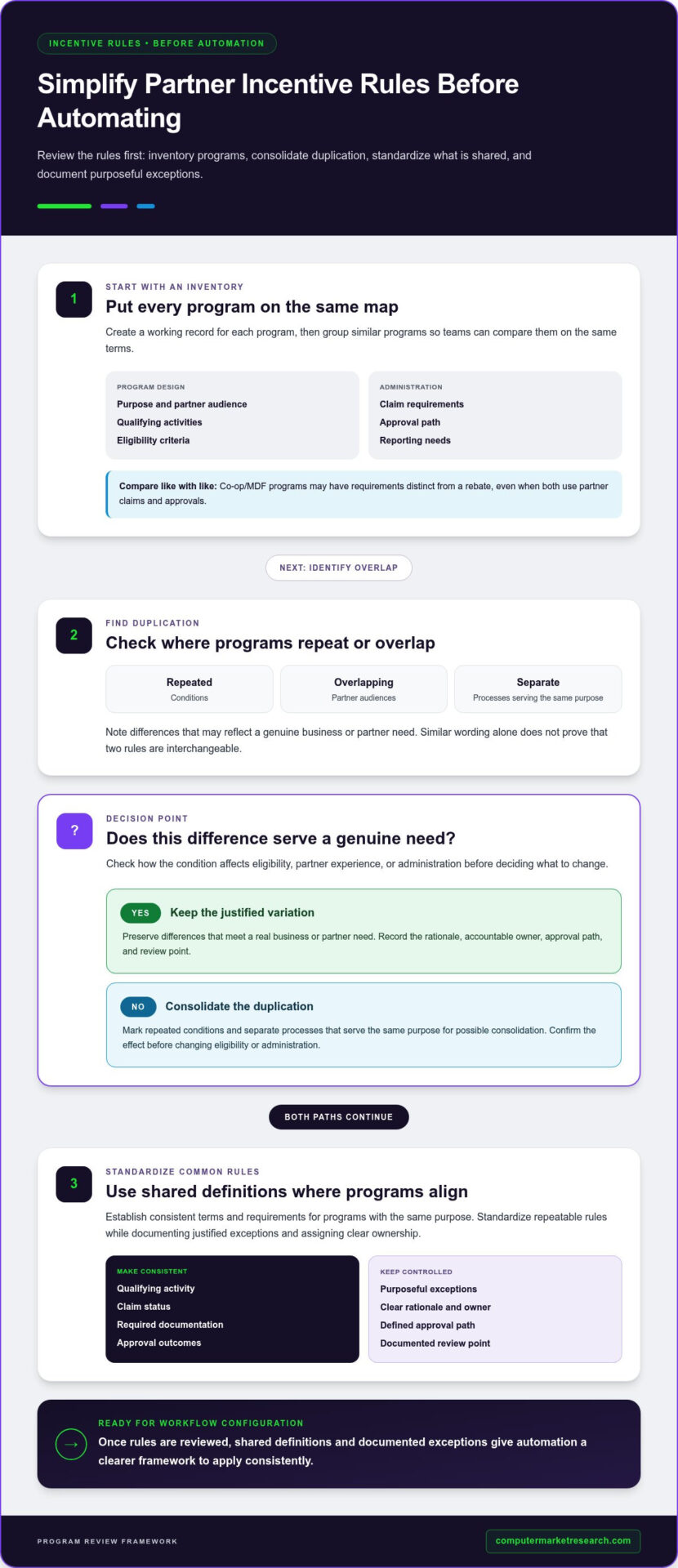
Automation can apply a rule consistently, but it can’t determine whether that rule still makes sense. Before configuring workflows, review the program design. Separate essential eligibility criteria from conditions that persist only because they were added in the past. A useful framework moves from inventory to consolidation, then standardization and controlled exceptions. This makes reducing complexity in partner incentives a rules exercise first and a technology exercise second.
- Inventory programs. Create a working record of each program’s purpose, partner audience, qualifying activities, eligibility criteria, claim requirements, approval path, and reporting needs. Group similar programs so teams can compare them on the same terms. For example, Co-op/MDF incentive program management may involve requirements distinct from a rebate, even if both rely on partner claims and approvals.
- Identify duplication. Look for repeated conditions, overlapping audiences, and separate processes that serve the same purpose. Note differences that reflect a genuine business or partner need. Similar wording doesn’t always mean two rules are interchangeable, so confirm how each condition affects eligibility and administration before proposing a consolidation.
- Standardize common rules. Establish shared definitions and requirements wherever programs have the same purpose. Use consistent terms for qualifying activity, claim status, required documentation, and approval outcomes. Standardize repeatable rules while documenting justified exceptions and assigning clear ownership.
- Document exceptions. For every retained variation, record its rationale, accountable owner, approval path, and review point. This gives staff a clear reference and makes it easier to reassess whether the exception still serves its intended purpose.
How should teams review overlapping incentive rules?
Compare programs by purpose, partner audience, qualifying activity, and claim requirements. A difference in partner type may justify a variation; a difference in terminology alone may not. Mark repeated conditions for consolidation and identify unique requirements that affect the partner experience or control process. As a design principle, the U.S. government’s guidance on performance incentives and contract complexity connects incentive design with measurable results in its federal contracting context. Partner programs have their own requirements, but the principle is useful: each rule should have a clear purpose.
How can teams preserve flexibility without adding needless exceptions?
Keep a variation only when it addresses a defined business or partner requirement. Write its rationale in plain language, identify who owns it, and specify how it is approved and reviewed. Then explain the requirement to partners directly and consistently: what qualifies, what to submit, and how decisions are communicated. Clear language reduces interpretation work for partners and administrators alike.
What governance makes simpler rules sustainable?
Assign responsibility for rule changes, partner communications, and final approvals. Set a regular review cadence, and use one controlled process to publish new requirements and retire outdated ones. This prevents teams from applying different versions of a rule across documents or workflows. You can also evaluate CMR’s platform with a 90-day free trial as part of assessing how software may support consistent administration.
Compare Manual, Disconnected, and Centralized Incentive Workflows
Choosing a workflow is less about labeling one approach “good” and another “bad” than understanding how each handles information as programs grow. A spreadsheet may suit a limited process with few owners. Separate tools can serve distinct functions but make it harder to see the full claim journey. A centralized channel workflow can bring processes and records together, provided the underlying incentive rules are clear.
These are practical tendencies, not guarantees. Centralized software can organize workflows, approvals, and information, but it won’t resolve contradictory eligibility rules or unclear program goals on its own. Reducing complexity in partner incentives requires sound program design alongside suitable technology.
When can spreadsheets remain workable, and when do they create friction?
A spreadsheet can be a reasonable starting point for a straightforward process with few owners and stable requirements. Friction tends to emerge when partners need access, files pass between teams, or multiple versions circulate. That doesn’t make every spreadsheet ineffective; it means maintenance, ownership, and visibility deserve regular review as the process changes.
What should a centralized incentive workflow make easier?
Assess whether partners can submit claims and check status without relying on repeated staff updates. Internally, teams should be able to review current program requirements, manage approval steps, and understand a claim’s progress. Fund-based programs may have distinct documentation and approval needs. Co-op/MDF management workflows provide relevant context for evaluating those processes.
Which software criteria matter across multiple programs?
Evaluate configurable approval rules, notifications, reporting, and partner-facing processes against the workflows you actually need. Consider how ERP and CRM integrations fit existing channel data practices and whether the system supports consistent administration across incentive types. Broader partner lifecycle needs matter too, but software should reinforce a well-defined process, not automate complexity that hasn’t been reviewed.
A Step-by-Step Plan to Reduce Complexity in Partner Incentives
A practical improvement plan makes the current process visible before changing it. Map how each incentive works, identify where effort or confusion recurs, then make a focused change and evaluate it against your objectives. This turns reducing complexity in partner incentives into a managed process rather than a broad technology project.
- Map current programs. Record participants, rules, data inputs, claim steps, approval owners, and reporting outputs for each program.
- Locate friction. Mark duplicate reviews, unclear handoffs, manual data transfers, and gaps in the information partners receive.
- Prioritize fixes. Rank issues by recurring workload, partner confusion, and operational importance.
- Pilot a change. Define the scope, owners, and intended outcome, then test the revised process with relevant internal and partner stakeholders.
- Review results. Compare observations with a documented baseline and program objectives. Resolve persistent issues before extending the change.
How do you map the current incentive process?
Trace a representative claim from the partner’s first eligibility check through submission, review, approval, payment status, and reporting. Note who handles each transition and what data they rely on. Mark where information is re-entered, where ownership becomes unclear, and where partners lack a useful update. Separate recurring process problems from exceptions with a documented purpose, so necessary flexibility isn’t removed along with avoidable steps.
Include the people who operate and experience the workflow. Channel operations can explain program administration; finance can clarify review and payment handoffs; sales can identify how incentives relate to partner activity; and partner-facing teams can surface recurring questions. The aim is a shared view of the process, not a search for individual fault.
How should teams prioritize and pilot simplification?
Choose a change that addresses a clearly defined source of friction. For example, if the same information is reviewed by multiple teams, clarify the review owner and what each approval must verify. Scope the pilot around a specific program or process, identify the teams and partners involved, and record the expected change in practical terms. Gather feedback during the pilot and log unresolved issues before applying the approach more broadly.
What should teams monitor after changing a process?
Document baseline measures before the pilot, using information your organization can collect consistently. Measures might include whether partners can see claim status, how approval steps progress, and the questions partners raise about requirements or earnings. Compare observations with your own baseline and program objectives, not an assumed industry benchmark. If the same confusion or handoff remains, adjust the workflow or guidance and review the process again.
Once you’ve identified a workflow to assess, evaluate CMR’s platform with a 90-day free trial to see how channel software may support your improvement plan.
How Centralized Channel Software Supports Simpler Incentive Management
Once program rules and ownership are clear, centralized channel software can help teams apply them consistently across claims, approvals, and reporting. Computer Market Research offers PartnerPortal, Co-op/MDF Management, Rebate Management, and SPIFF Management. These solutions address different parts of channel incentive administration, while PartnerPortal centralizes channel program management.
Centralization organizes the process; it doesn’t replace sound program design. If eligibility terms conflict or exceptions lack a clear purpose, software can make those rules easier to apply without making them more useful. For reducing complexity in partner incentives, assess how the platform’s capabilities align with the rules and workflows your team has reviewed.
Where can PartnerPortal fit into a channel incentive process?
PartnerPortal provides a central context for channel program administration, connecting partner activity with internal processes. As you assess a workflow, consider how partner submissions move to review, how configurable approval rules support decisions, and how reporting gives teams visibility into program activity. For a broader view of the lifecycle, explore channel partner management software in relation to your incentive processes.
Each program still has specific needs. Co-op/MDF, rebates, and SPIFFs may involve different qualifying activities, claim information, and approval requirements. A centralized approach should help teams manage those distinctions while keeping requirements clear for partners.
How should buyers assess platform fit and implementation needs?
Start with the process map from your review. Compare priority workflows with current program rules, partner-facing steps, approval ownership, and reporting needs. Then consider how ERP and CRM integrations fit your organization’s data practices. Implementation timelines vary with business requirements and integrations, so include those dependencies in planning rather than assuming every workflow can move at the same pace.
What can teams evaluate during the 90-day free trial?
Use the trial to assess fit against defined priorities. Review whether the platform’s configurable approval rules, notifications, and reporting align with selected incentive workflows. Consider how ERP and CRM integration requirements relate to the data used in those processes. You can also assess whether partner-facing processes provide the visibility your program requires. Keep the evaluation focused on actual rules, users, and handoffs, and record open questions about fit before deciding on next steps.
Centralized channel software is most useful to evaluate against a specific operational need, not an abstract promise of simplicity. Match the workflow, data, and oversight requirements to the platform’s capabilities, then determine whether the fit supports your program objectives. Start your 90-day free trial to assess CMR’s platform for your incentive management needs.
Make Your Next Incentive Improvement Deliberate
Choose one priority workflow and use it to put your program changes into practice. A clear starting point helps teams test whether revised rules, partner communications, and approval steps work together before extending the approach. Keep the review grounded in your program objectives, and adjust where partner or staff feedback reveals remaining friction.
Reducing complexity in partner incentives is an ongoing discipline, not a one-time cleanup. As programs change, revisit the rules and processes that support them so administration remains aligned with partner needs and internal controls.
Start your 90-day free trial to assess how CMR’s platform fits your incentive workflows. A focused evaluation can help you take the next step with clarity and confidence.
Frequently Asked Questions
How can companies reduce complexity in partner incentives?
Companies can reduce complexity by treating incentive rules as governed program assets, not scattered instructions. Maintain one current version of each program’s eligibility terms, claim requirements, and approval authority, then retire superseded guidance after communicating the change. For example, if a partner agreement and a claim form describe different qualifying activities, resolve that mismatch before adjusting the workflow. This prevents automation from reinforcing inconsistent instructions.
What causes partner incentive programs to become difficult to manage?
Programs become harder to manage when rules and operational records evolve separately. A partner roster may define eligibility one way, while a sales system uses a different status or product identifier. Local edits to forms, spreadsheet copies, and unclear decision ownership can add further variation. The result isn’t necessarily a flawed incentive, but a process where teams must reconcile definitions before confidently assessing a claim.
Can partner incentive rules be standardized without losing flexibility?
Yes. Standardize rules that serve a common purpose and preserve intentional variations. Define shared terms and core claim evidence across programs, then retain an exception only if it meets a clear business or partner need. A useful test is whether the owner can explain why the variation exists, which partners it applies to, and who approves it. Documented answers help keep flexibility controlled rather than arbitrary.
How does automation help reduce incentive administration?
Automation can handle repeatable administrative steps, such as applying configured approval paths, sending notifications, and consolidating program information for reporting. Relevant ERP or CRM integrations can also reduce the need to re-enter data. Automation still depends on sound rules and reliable source information. Define how unusual claims or disputed eligibility decisions should be escalated rather than assuming every case can be resolved automatically.
What should a company compare when choosing incentive management software?
Compare software against your partner lifecycle, not a feature checklist alone. Assess whether it supports your incentive types and partner-facing processes, allows teams to configure approval rules and notifications, and provides reporting that meets oversight needs. Review ERP and CRM integration requirements, data ownership, and access to claim records. Testing a representative workflow can show how well the system fits the way partners submit information and follow progress.
Does CMR offer a free trial for evaluating channel management software?
Yes. Computer Market Research offers organizations a 90-day free trial to evaluate its channel management software. Use it to assess a priority incentive workflow against documented requirements, including approvals, partner-facing processes, reporting, and relevant data integrations. Focus on how well the platform fits your program rules and oversight needs. The trial helps evaluate fit; it doesn’t promise a particular efficiency or financial result.

Article by
Del Heles
Del Heles is the founder and CEO of Computer Market Research (CMR), a channel management software company he launched in 1984. With more than 40 years of experience, he’s known for helping manufacturers and distributors simplify complex partner programs through practical, customer-focused technology solutions.