

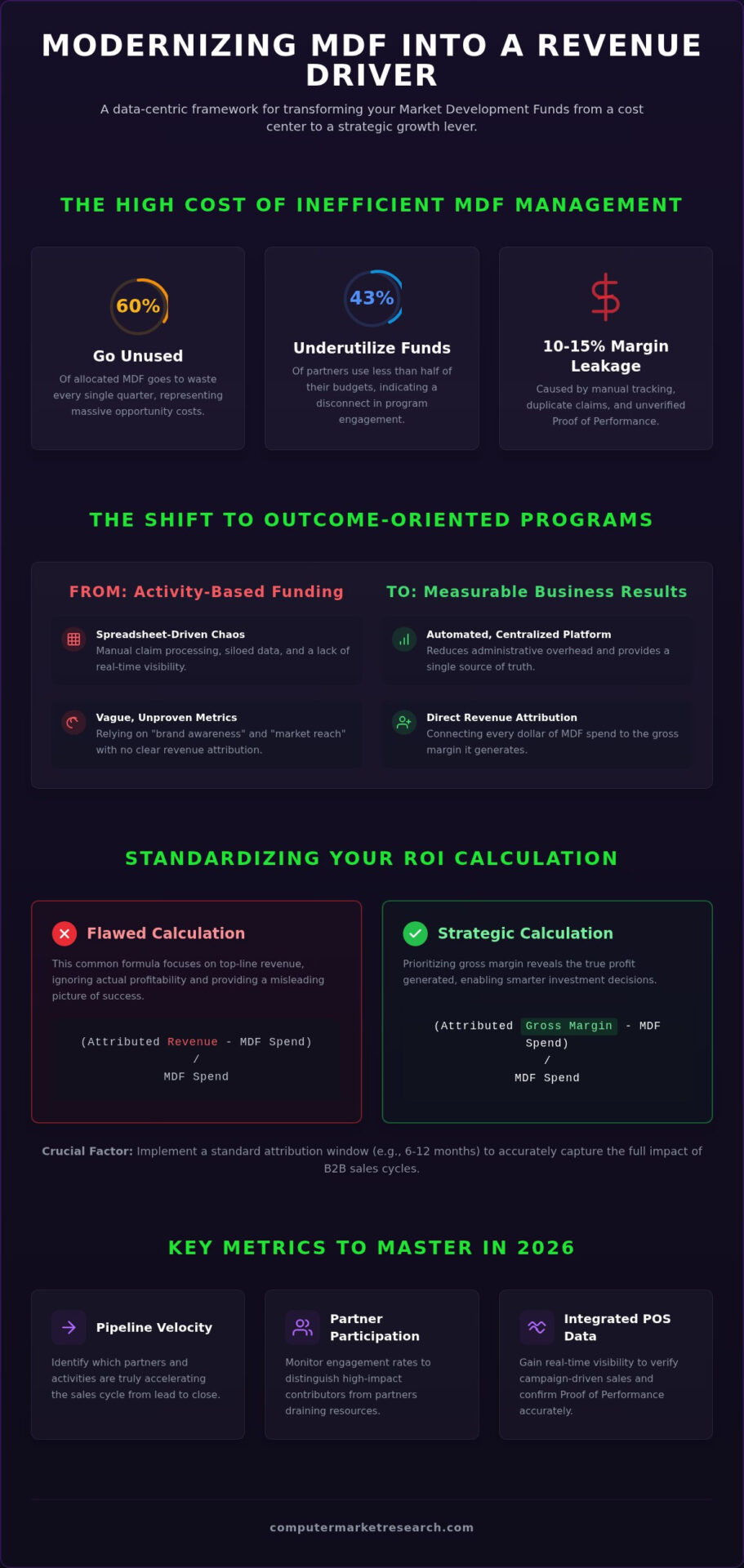
60% of allocated Market Development Funds go unused every single quarter, while 43% of partners utilize less than half of their allotted budgets. It’s a frustrating reality for channel leaders who see MDF as a massive line item representing nearly 50% of their marketing spend yet offers very little clarity on actual returns. You likely feel the weight of manual claim processing and the constant struggle to verify accurate Proof of Performance data. It’s difficult to justify budget increases when you can’t definitively prove your market development funds roi to the executive team.
This guide provides a clear path out of spreadsheet-driven chaos and into a modernized, data-centric framework. You’ll learn how to transform your MDF program into a measurable revenue driver by mastering the metrics that matter most in 2026. We’ll explore how automation through systems like PartnerPortal™ reduces administrative overhead and provides the real-time visibility needed for precise channel growth. From standardized ROI measurement to integrating POS data, this article outlines the exact steps to turn your incentive programs into high-performance assets.
Key Takeaways
- Standardize your market development funds roi calculation by prioritizing gross margin over top-line revenue to achieve a more accurate picture of program profitability.
- Identify high-impact contributors by monitoring pipeline velocity and partner participation rates to see which investments truly accelerate the sales cycle.
- Shift from activity-based funding to outcome-oriented models to ensure that every dollar allocated drives measurable business results.
- Reduce administrative overhead and eliminate margin leakage by centralizing the claim and approval process within an automated platform like PartnerPortal™.
- Leverage integrated POS data to gain the real-time visibility required to transform your MDF program from an opaque cost center into a strategic growth lever.
Why Measuring MDF ROI is Critical for Modern Channel Success
For decades, vendors viewed Market Development Funds (MDF) as a necessary tax for channel participation. This “cost of doing business” mindset is obsolete. In a data-driven economy, every dollar must act as a strategic growth lever. Global 2000 companies are moving away from opaque spending. They want precision. Without a clear view of market development funds roi, budget discussions become defensive rather than strategic.
When you rely on manual processes, you’re essentially flying blind. Siloed spreadsheets and fragmented email chains make it impossible to connect spend to specific revenue outcomes. This lack of transparency doesn’t just frustrate marketing teams; it erodes executive confidence. If you can’t prove the value of your channel investments, those budgets are the first to be cut during economic shifts.
To better understand the shift toward automated management and improved visibility, watch this helpful video:
Manual spreadsheet tracking is more than just a nuisance. It often leads to a 10-15% margin leakage through duplicate claims or unverified proof of performance. When Proof of Performance (POP) data is missing or inaccurate, the financial integrity of the entire program is compromised. Modern channel success requires a transition to systems that offer real-time visibility and decision-grade data.
The Hidden Costs of Inefficient MDF Management
Administrative overhead is a silent profit killer. Manual claim verification requires hundreds of man-hours every quarter. It’s not just about the time spent; it’s about the risk. Non-compliant claims and “lazy” fund usage, where funds are spent on activities with zero revenue impact, drain resources. Consider these operational bottlenecks:
- Opportunity Costs: Research shows 60% of allocated MDF goes unused every quarter. This represents capital that could have fueled high-growth campaigns.
- Data Fragmentation: When POS data isn’t integrated, you can’t verify if a partner’s campaign actually resulted in sales.
- Administrative Fatigue: Manual processing slows down reimbursements, which can strain partner cash flow and damage relationships.
From Brand Awareness to Revenue Attribution
Vague metrics like “brand awareness” or “market reach” are no longer sufficient for Global 2000 firms. Finance leaders now demand direct revenue attribution. They want to know exactly how much gross margin was generated for every dollar of MDF spent. Establishing a clear framework for market development funds roi allows you to identify which partners drive conversions and which are simply draining resources. Fostering a culture of accountability ensures that high-performing partners are rewarded with more resources. You can learn more about the strategic role of MDF and how to modernize your approach to ensure every campaign contributes to the bottom line.
How to Calculate Market Development Funds ROI Effectively
Calculating market development funds roi requires more than a simple subtraction of costs from sales. While many organizations use a basic formula like (Attributed Revenue – MDF Spend) / MDF Spend, this often provides a surface-level view that ignores actual profitability. Precision-focused firms prioritize gross margin over top-line revenue. This adjustment ensures you’re measuring the actual profit generated after the cost of goods sold is subtracted. A high-revenue campaign with thin margins might actually result in a negative return once the MDF spend is factored in.
Attribution windows also play a critical role in this calculation. In complex B2B sales cycles, the influence of an MDF-funded activity often spans six to twelve months. Setting a standard window ensures that your ROI data reflects the reality of the buyer’s journey. If you cut off attribution too early, you risk underreporting the value of long-term lead generation efforts. Consistency across these windows allows for better year-over-year comparisons.
Defining Attributed Revenue in the Channel
Accurate attribution depends on your ability to link specific marketing activities to closed-won deals. Direct attribution is straightforward; it tracks a lead from a specific funded event like a webinar or trade show. Indirect attribution is more complex, requiring you to look at how MDF activities influenced existing accounts within a specific territory. Utilizing Stop channel conflict with deal registration software is essential here. It creates a verified paper trail that connects partner efforts to specific opportunities, preventing disputes and ensuring data integrity throughout the sales cycle.
Calculating the Total Cost of the Program
Your “Spend” variable must account for the total cost of ownership to produce an accurate net ROI. This includes the partner reimbursement check, software licensing fees for platforms like PartnerPortal™, and the internal headcount required for management. Global enterprises must also standardize payout currencies to maintain consistency across different regions. If you ignore these operational costs, your market development funds roi will be artificially inflated and won’t stand up to executive scrutiny.
Modernizing these calculations doesn’t have to be a manual burden. You can start optimizing your channel data today to see where your margins are truly leaking. By accounting for managed services and data cleansing, you transform your ROI from a rough estimate into a precise financial metric that drives better investment decisions.
Key Metrics for Tracking MDF Performance and Revenue Impact
Pipeline velocity is a primary indicator of campaign health. It measures the speed at which leads generated through funded activities progress through the sales funnel. If your MDF spend isn’t shortening the time from lead to deal, the strategy is likely misaligned with the buyer’s journey. You must also track the conversion between Cost Per Lead (CPL) and Cost Per Opportunity (CPO). A low CPL can be deceptive if the leads are poor quality and fail to reach the opportunity stage. High-performing programs prioritize CPO because it reflects the actual pipeline value created for every dollar of the budget.
Partner participation and fund utilization reveal the level of friction within your program. High utilization typically signals that your partners find the claim process accessible and the activities profitable. Conversely, low participation among your top-performing partners indicates that your administrative requirements might be too burdensome. Monitoring these ratios allows you to refine your market development funds roi by identifying which partners are truly engaged and which are simply sitting on allocated capital. This oversight helps you reallocate resources to those who demonstrate the highest growth potential.
The Role of POS Data in ROI Verification
Point-of-Sale (POS) data provides the definitive evidence needed for accurate revenue attribution. It allows you to link specific SKU movement to the timeframe of a funded marketing campaign. However, raw reports are often inconsistent and require significant normalization to be useful. Implementing robust channel data management systems ensures that this information is cleansed and ready for analysis. This process removes the guesswork from your market development funds roi by providing decision-grade insights based on actual market transactions rather than partner estimates.
Proof of Performance (POP) and Compliance Metrics
Standardizing digital Proof of Performance requirements is essential for reducing the time spent on manual audits. Tracking compliance rates across your partner base helps you identify high-risk accounts that consistently submit incomplete documentation. By utilizing automated workflows to verify POP, you can flag issues instantly rather than waiting until the end of a quarter. This proactive approach ensures that your program remains audit-ready while rewarding partners who adhere to the established framework. It also builds a culture of accountability where partners understand that funding is contingent on providing transparent, verifiable results that support the overall corporate strategy.
Best Practices for Optimizing Your MDF Program ROI
Optimization begins with a fundamental shift in perspective. You shouldn’t view MDF as a pool of money to be distributed, but as a strategic asset to be deployed. Aligning partner activities with your overall corporate Go-To-Market (GTM) strategy ensures that channel efforts amplify your internal marketing goals. When partners utilize pre-approved marketing playbooks, they maintain brand consistency while reducing the time spent on creative development. This alignment is foundational for maximizing your market development funds roi and ensuring that every campaign serves a specific business objective.
Implementing tiered performance audits allows you to focus your limited resources on high-growth partners who consistently deliver results. By analyzing partner performance in segments, you can identify which organizations require more support and which deserve larger allocations. This data-driven approach prevents you from spreading funds too thin across underperforming accounts. It creates a merit-based ecosystem where resources are directed toward the partners most likely to generate a measurable return.
Funding Outcomes, Not Just Activities
Strategic deployment often includes enabling partners through expert consultancy and technical training. For example, organizations frequently partner with Insoft Services to ensure their channel possesses the networking and cybersecurity expertise necessary to convert marketing activities into measurable revenue.
Transitioning from activity-based to outcome-based funding is the most effective way to eliminate waste in your channel. Move away from reimbursing for generic expenses like a partner lunch. Instead, focus on funding specific lead-generation events that have measurable targets. You must set clear performance benchmarks before any funds are approved. Use historical data to predict which activities yield the highest returns in specific regions. This systematic approach ensures that capital flows toward verified results rather than just well-intentioned effort. It forces a level of accountability that is often missing in traditional, manual programs.
Improving Partner Engagement and Adoption
For organizations looking to elevate their lead-generation events with world-class production value, you can check out Lar&Co to see how they specialize in delivering high-profile live entertainment experiences.
Low participation rates often stem from administrative friction. If the claim process is too difficult or slow, your best partners will simply ignore the funds. Centralizing the request and reimbursement process in a user-friendly platform like PartnerPortal™ removes these barriers. Speeding up the reimbursement cycle is also critical for maintaining partner loyalty. When you improve partner cash flow by processing claims faster, you encourage repeat engagement and higher utilization. You can explore our co-op/MDF management platform to see how automation simplifies these complex workflows and reduces the burden on your team.
Optimizing your market development funds roi is a continuous process of data refinement and partner enablement. By moving toward outcome-based models and reducing friction, you transform your channel from an opaque cost center into a predictable revenue engine. If you’re ready to see how modernized data management can improve your bottom line, start your 90-day free trial today and gain real-time visibility into your channel marketing performance.
Automating MDF Management with CMR PartnerPortal™
Managing complex global programs requires a fundamental shift from manual spreadsheets to a centralized cloud interface. PartnerPortal™ acts as the definitive hub for requests, approvals, and claims, ensuring that every stakeholder has access to the same information. By automating these repetitive workflows, organizations often reduce their administrative burden by up to 50%. This efficiency gain allows channel managers to focus on partner strategy instead of chasing missing receipts or verifying manual entries. It transforms the management process from a reactive chore into a proactive business discipline.
Accuracy remains the primary obstacle to a reliable market development funds roi. PartnerPortal™ addresses this by integrating POS data cleansing directly into the claim process. This eliminates the errors inherent in manual data entry and provides normalized, verified sales data for every transaction. Having a single source of truth for global channel spend ensures that your financial reporting is beyond reproach. It creates a stable foundation for scaling incentive programs without increasing operational risk or compromising the integrity of your performance data.
Seamless Integration with Your Existing Tech Stack
Modern channel management requires a platform that talks to your entire business. Connecting PartnerPortal™ with your CRM and ERP systems provides end-to-end tracking from the initial lead to the final payout. This connectivity automates financial reconciliations and simplifies multi-currency payouts for global partners. Our Managed Data Services provide a critical layer of oversight by cleansing and normalizing POS reports before they enter your system. This process ensures that your data is accurate, consistent, and ready for audit at any time. You’ll no longer struggle with fragmented information or manual reconciliations that slow down your growth.
Scaling Your Channel with Decision-Grade Insights
Visibility is the antidote to wasted spend. Real-time dashboards within the platform allow you to identify underperforming campaigns and reallocate funds to high-growth opportunities immediately. Instead of waiting weeks for manual reports, you can generate executive-ready insights in minutes. These reports demonstrate your market development funds roi with granular detail, linking specific spend to verified revenue outcomes. This level of transparency builds trust with leadership and justifies ongoing investment in the channel. To see how these tools can modernize your workflow, you can Schedule a demo of PartnerPortal™ today.
Modernizing Your Channel Strategy for Measurable Growth
Transforming your channel from a cost center into a strategic revenue engine requires a shift from manual oversight to automated precision. You’ve seen how standardizing calculations and prioritizing gross margin provides a clearer view of your actual returns. By moving toward outcome-based funding models and utilizing real-time POS data, you eliminate the ambiguity that often plagues legacy programs. A modernized approach ensures that every dollar spent is an investment in verified performance rather than just a hope for brand awareness.
Computer Market Research has managed complex channel data for over 40 years. Our cloud-based SaaS is designed specifically for Global 2000 enterprises that need expert cleansing of POS and inventory reports to maintain a single source of truth. Implementing these systems allows you to master your market development funds roi and gain the visibility needed to scale with confidence. Don’t let fragmented spreadsheets limit your organization’s potential. Optimize your channel ROI with CMR’s PartnerPortal™ and start building a more accountable, high-performance partner ecosystem today. You’ve got the roadmap; now it’s time to execute.
Frequently Asked Questions
What is the typical ROI for a well-managed Market Development Fund program?
Typical ROI for a well-managed program is measured by the incremental revenue generated relative to the specific funds deployed. Measuring market development funds roi accurately requires you to subtract the total cost of program management, including administrative overhead and software fees. Since MDF makes up nearly 50% of the average supplier’s total channel marketing budget, even small improvements in visibility can result in substantial financial gains. Precision-focused firms use cleansed data to ensure their reported returns reflect actual market movement.
How do I calculate MDF ROI if I don’t have direct access to partner sales data?
You can calculate ROI by utilizing cleansed Point-of-Sale (POS) and inventory reports provided through Managed Data Services. These reports act as the “ground truth” when direct access to a partner’s internal CRM is unavailable. By normalizing this data, you link specific SKU movement to the timing of funded marketing campaigns. This systematic approach allows you to verify sales impact without relying on manual partner self-reporting, which is often prone to errors and fragmented information.
What is the difference between MDF and co-op marketing funds in terms of ROI?
MDF is a discretionary investment aimed at future market growth, while co-op funds are earned based on past purchase volumes. Because MDF is strategic, its ROI is measured by long-term pipeline velocity and new customer acquisition. Co-op ROI is typically focused on short-term inventory turnover. Tracking market development funds roi is more complex because it requires longer attribution windows to account for the influence of strategic activities on the buyer’s journey across multiple channel touchpoints.
Why do many companies struggle to prove the impact of their MDF spend?
Most organizations struggle because of fragmented data and manual tracking methods. Relying on siloed spreadsheets often leads to a 10-15% margin leakage and inaccurate Proof of Performance (POP) data. When there’s no automated link between spend and sales, proving revenue attribution becomes impossible. This lack of visibility prevents channel leaders from identifying which activities drive results, leaving them unable to justify budget increases to executive stakeholders who demand decision-grade financial insights.
How can automation software like PartnerPortal™ improve my program’s ROI?
PartnerPortal™ improves ROI by eliminating the manual errors that lead to financial leakage. Automated workflows reduce the administrative burden by up to 50%, allowing your team to focus on strategic partner enablement rather than data entry. By centralizing the claim process and integrating cleansed POS data, the platform provides a single source of truth for all spend. This transparency ensures that funds are only reimbursed for compliant activities that have a verified, measurable impact on revenue growth.
What constitutes valid ‘Proof of Performance’ for an MDF claim in 2026?
Valid Proof of Performance now focuses on digital evidence that is easily verifiable through automated systems. This includes lead lists with CRM timestamps, digital marketing analytics, and verified POS reports showing SKU-level movement. Standardizing these requirements within a central portal reduces audit friction and ensures compliance. Automated workflows instantly flag non-compliant or duplicate documentation, protecting your budget from “lazy” fund usage and ensuring every dollar supports a legitimate marketing outcome that drives growth.
Should I fund partner activities upfront or use a reimbursement model?
A reimbursement model is the industry standard for protecting your investment and ensuring accountability. Funding activities upfront carries a high risk of unallocated funds that never drive revenue. Using an automated platform like PartnerPortal™ allows you to speed up the reimbursement cycle, which mitigates the cash flow concerns partners often have with this model. This balance ensures that you only pay for verified performance while maintaining strong, trust-based relationships with your most productive and high-growth channel partners.
How often should I audit my MDF program for ROI performance?
You should conduct performance audits quarterly to ensure that your tactical activities align with your Go-To-Market strategy. Research shows that 60% of allocated MDF goes unused every quarter, so regular audits help you reallocate stagnant funds to high-performing partners. While quarterly deep dives are essential, real-time visibility through automated dashboards is the modern gold standard. This constant oversight allows you to adjust campaigns immediately, ensuring your total budget is always optimized for the highest possible revenue impact.

Article by
Del Heles
Del Heles is the founder and CEO of Computer Market Research (CMR), a channel management software company he launched in 1984. With more than 40 years of experience, he’s known for helping manufacturers and distributors simplify complex partner programs through practical, customer-focused technology solutions.