

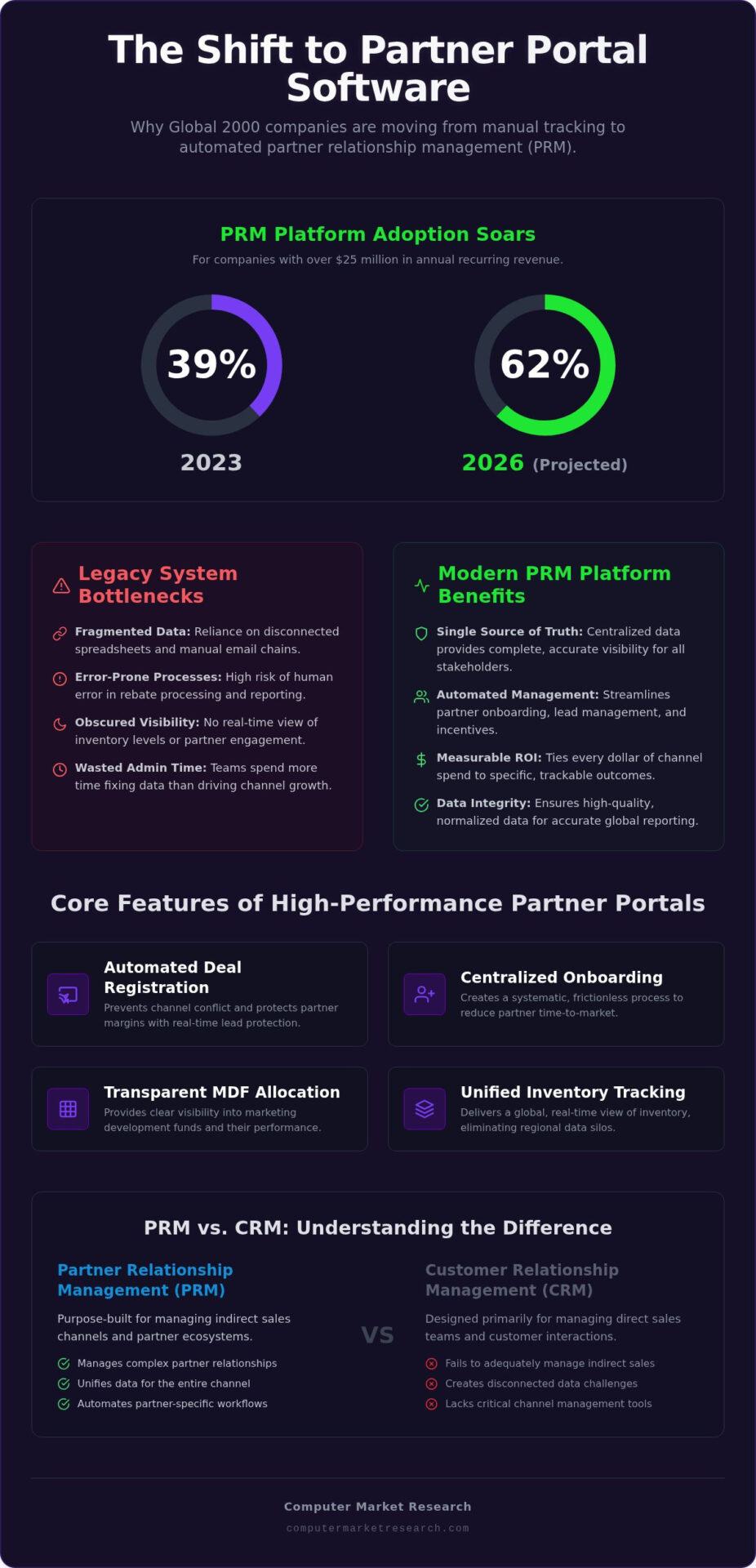
By 2026, approximately 62% of companies with over $25 million in annual recurring revenue have transitioned to a PRM platform, a sharp rise from just 39% in 2023. You likely recognize the pressure behind this shift. Managing a global channel through fragmented spreadsheets and manual email chains isn’t just tedious; it’s a liability that invites error-prone rebate processing and obscured inventory levels. Relying on legacy methods often means your team spends more time fixing data than driving growth. Implementing a robust partner portal software solution is no longer a luxury for the Global 2000; it’s the only way to maintain a competitive edge in an increasingly automated ecosystem.
This strategic guide details how modern infrastructure eliminates operational bottlenecks and automates complex global channel management. You’ll discover how to establish a single source of truth for all partner activity while automating incentive and lead management. We will examine the transition from manual tracking to high-quality, real-time information systems that deliver measurable ROI on channel spend. By the end of this article, you’ll understand why shifting to a systematic, data-focused approach is the logical step for any organization aiming for 2026 performance targets.
Key Takeaways
- Learn why manual tracking methods act as primary obstacles to growth and how to identify the hidden costs of fragmented channel data.
- Discover the critical modules of high-performance partner portal software, from automated deal registration to transparent MDF allocation.
- Understand why traditional CRM systems fail to manage indirect ecosystems and how to resolve the resulting disconnected data challenges.
- Identify the essential criteria for selecting a global-scale platform, including the necessity of data cleansing and normalization for accurate reporting.
- Explore how centralizing partner onboarding and inventory tracking creates a pragmatic, automated engine for driving indirect sales performance.
Beyond Spreadsheets: Why Partner Portal Software is Essential
Global 2000 organizations often struggle with the limitations of legacy processes that rely on manual spreadsheets. This approach introduces significant risks, including data fragmentation and human error. These manual methods aren’t just inefficient; they’re expensive. They hide the true cost of administrative labor and the revenue lost to slow response times. Transitioning to modern partner portal software allows leaders to shift from reactive firefighting to proactive, data-driven partnerships. By eliminating the reliance on static files, companies can finally achieve a level of operational clarity that was previously impossible.
This transition is fundamentally rooted in the discipline of Partner relationship management (PRM). By centralizing all channel activity, businesses gain the transparency needed to scale global operations. Legacy systems act as the primary obstacle to achieving a high ROI on channel spend because they lack the technical capability to normalize data from diverse regions. High-quality information is the foundation of any successful expansion strategy.
To better understand how these systems transform channel operations, watch this helpful video:
Eliminating Operational Bottlenecks
Manual partner onboarding often creates friction points that delay time-to-market. When data is trapped in regional silos, global visibility vanishes, leaving executives with an incomplete picture of channel health. This fragmentation makes it impossible to see real-time inventory or track partner engagement accurately across different territories. Moving toward a centralized “Single Source of Truth” ensures that every stakeholder accesses the same high-quality information. This order replaces the chaos of disparate tracking methods with a systematic framework. It allows for a more disciplined approach to managing complex industry relationships, ensuring stability and accuracy at every level.
The ROI of Automated Partner Management
Automation directly reduces the heavy administrative overhead associated with manual data entry and reconciliation. By accelerating the deal registration cycle, companies can capture revenue faster while protecting partner margins from channel conflict. Implementing partner portal software ensures that every dollar spent on the channel is measurable and tied to specific outcomes. To achieve these results, organizations must adopt channel partner management software that prioritizes data integrity. This shift not only improves efficiency gains but also fosters trust through technical competence. It creates a clear path out of operational bottlenecks, making growth a predictable outcome rather than a logistical challenge.
Core Features of High-Performance Partner Portal Software
High-performance partner portal software acts as the central nervous system for modern indirect sales operations. It provides the technical infrastructure needed to move beyond simple document hosting toward an automated data engine. According to Gartner’s definition of PRM, these systems automate the activities and processes required for companies to manage partner relationships effectively. This automation is essential for maintaining control over complex global networks while ensuring data accuracy remains high.
Deal Registration and Conflict Mitigation
Automated deal registration is the primary safeguard against internal and external channel conflict. When a partner registers a lead, the system provides immediate protection, ensuring that multiple partners aren’t competing for the same opportunity. This process protects partner investments in pre-sales activities and maintains healthy margins for all stakeholders. By utilizing PartnerPortal™, organizations gain real-time visibility into the pipeline, which helps reduce “gray market” sales. Improved inventory visibility ensures that products are sold through authorized channels, maintaining brand integrity and pricing stability across diverse regions.
MDF and Co-op Fund Optimization
Managing Marketing Development Funds (MDF) and Co-op programs requires precision and transparency to prevent waste. Fragmented tracking often leads to unspent budgets or non-compliant spending that risks financial audits. A robust Co-op/MDF platform for distributors streamlines the entire claim and reimbursement process. This eliminates the manual back-and-forth typical of legacy systems that rely on email and spreadsheets. Auditing fund usage becomes a background task rather than a manual burden, ensuring every dollar aligns with marketing compliance standards. This level of control allows for a measurable return on marketing investment across the global channel.
Lead management within the portal ensures that high-quality opportunities are distributed fairly and tracked in real time. It’s not enough to simply hand off a lead; managers need to see the progression from initial contact to a closed sale. Similarly, driving partner loyalty requires accurate incentive and rebate processing. Automated payouts remove the friction of manual calculations and the frustration of delayed rewards. When partners trust the accuracy and speed of their payouts, they’re more likely to prioritize your brand over competitors. This systematic approach builds a foundation of reliability and performance that scales with the business. If you’re ready to see how these automated modules can transform your operations, consider exploring a 90-day evaluation of the system.
Partner Portal Software vs. CRM: Understanding the Difference
Beyond financial rebates, many organizations use their portals to manage experiential rewards that foster deeper connections. For example, if you are looking to offer competitive racing events as a partner incentive, you can explore Verkauf von Startplätzen über Saisonpakete und Tagestickets with Kart Masters Deutschland to provide a unique and engaging experience for your top-performing teams.
In addition to sporting events, high-quality dining remains a cornerstone of corporate hospitality and partner appreciation. For teams seeking a refined venue in the UK, Valentino’s Italian Restaurant at valentinoswakefield.co.uk provides an authentic setting that is perfect for celebrating successful channel milestones.
A common misconception in B2B operations is that a CRM can effectively manage a global channel. While a CRM is indispensable for direct sales, it isn’t designed for the nuances of indirect ecosystems. Partner portal software serves a specific, specialized purpose; it manages relationships where the final transaction happens outside your immediate view. Attempting to use a standard CRM for this often results in “Disconnected Data,” where partner activities aren’t aligned with internal financial goals. This fragmentation creates blind spots in your pipeline and leads to friction between channel managers and partners. Global 2000 enterprises require a dedicated system that understands multi-tier distribution and specialized incentive structures to maintain order.
The Limitations of Standard CRM Systems
CRM modules often fail when faced with the complexity of global channel management. They typically struggle with multi-tier visibility, making it difficult to see how products move from distributors to resellers and finally to end users. Managing complex rebates and Ship & Debit claims within a CRM is nearly impossible without heavy, expensive customization that often breaks during updates. These systems aren’t built for the technical depth required to process high-volume POS data accurately. They lack the logic needed to normalize disparate data sets from hundreds of global partners. To move beyond basic reporting, leaders need “Decision-Grade Insights” that reflect the reality of the channel, not just a filtered view of direct sales activity.
Seamless Technical Integration
A specialized portal shouldn’t exist in a vacuum. It must integrate seamlessly with your existing ERP and CRM infrastructure to ensure a unified data flow across the enterprise. This connection allows for the synchronization of Channel Data Management (CDM): The Definitive Guide principles with your broader business strategy. Connecting POS data management directly with financial reporting ensures that incentive payouts are based on verified sales rather than optimistic estimates. High-performance partner portal software also provides the multi-user access control necessary for global security. It allows different regions to access their specific data without compromising the security of the entire network. This technical competence builds a stable environment where data accuracy is the focal point of every strategic decision. By bridging the gap between your CRM and your partners, you create a systematic path to measurable growth.
Selecting the Right Partner Portal Software for Global Scale
Scaling a global channel ecosystem requires more than just adding user licenses. It demands a technical infrastructure capable of handling thousands of partners across different time zones, currencies, and languages. When evaluating partner portal software, the primary question for Global 2000 leaders is whether the system can normalize high volumes of disparate data. Without this capability, your reporting remains reactive and prone to the manual errors that hinder enterprise growth. Selecting the right partner portal software requires a shift in perspective, viewing the platform as a dynamic data engine rather than a static repository.
Scalability and Data Normalization
Clean POS data is the indispensable foundation of channel success. If your system cannot reconcile inconsistent naming conventions or varying SKU formats, your global visibility will remain obscured. High-performance platforms must automate the cleansing process to ensure that information from a distributor in Tokyo matches the data from a reseller in Berlin. Decision-Grade Data is the definitive goal of any successful 2026 PRM implementation. This level of precision allows for reliable financial tracking and prevents the costly overpayment of incentives. It ensures that every stakeholder, from regional managers to executive leadership, operates from the same high-quality information.
Evaluating Managed Service Models
Many organizations eventually realize that software alone cannot solve deep-seated data quality issues. There is a fundamental difference between software-only platforms and managed data services that provide active oversight of the information flow. Implementing specialized Channel Data Management Systems allows your internal operations team to focus on strategy rather than manual data entry. This model reduces the administrative burden by outsourcing the technical heavy lifting of data normalization to experts. It ensures that the information entering your portal is accurate, validated, and ready for executive-level analysis without requiring internal manual intervention.
Security and compliance are non-negotiable for enterprise-scale operations. Your chosen platform must meet rigorous data privacy standards while providing granular access controls for global users. Stability is built on technical competence and a deep understanding of complex industry relationships. If your current processes are failing to provide the clarity you need, it’s time to consider a more systematic approach. You can begin this transition by requesting a 90-day evaluation of the system to see how managed data services can transform your channel reporting and operational efficiency.
CMR PartnerPortal™: Automating Your Indirect Sales Engine
CMR PartnerPortal™ provides a comprehensive suite for automating the entire channel lifecycle. It centralizes partner onboarding, deal registration, and inventory tracking into a single, cohesive environment. For Fortune 500 companies, the primary challenge isn’t just finding a platform; it’s finding one that can handle the complexity of global data. CMR addresses this through its unique Managed Data Services. Unlike software-only providers, this approach ensures 100% data accuracy by actively cleansing and normalizing incoming reports. By using this specialized partner portal software, organizations eliminate the operational bottlenecks that typically plague indirect sales engines. The result is a stable, scalable framework that drives consistent revenue growth across all regions.
Decision-Grade Channel Intelligence
Transforming raw POS reports into actionable business outcomes requires more than just a dashboard. It requires a system that can validate sell-through data and verify inventory levels in real time. This visibility allows channel leaders to make informed decisions about stock allocation and market demand. Optimizing channel ROI often hinges on the accuracy of financial claims. By implementing Ship & Debit Management Software, companies can automate complex reimbursement workflows. This automation prevents the margin erosion caused by manual processing errors and ensures that partners are compensated fairly and promptly. It replaces the chaos of regional spreadsheets with a disciplined, technical approach to financial tracking and incentive programs.
The Path Forward for Channel Leaders
The transition from legacy manual workflows to modernized systems is a strategic necessity for the 2026 market. Building a sustainable, high-performing partner ecosystem requires a foundation of high-quality information and reliable infrastructure. Modern partner portal software acts as the catalyst for this change, providing the transparency needed to manage complex industry relationships. Channel leaders must move away from reactive tracking and embrace a systematic methodology that prioritizes data integrity. As you modernize your infrastructure, you’ll find that technical depth is the only way to ensure long-term stability. CMR acts as a pragmatic, data-focused partner who values order and performance above all else. This path forward ensures that your organization remains competitive, agile, and fully in control of its global channel performance.
Future-Proofing Your Global Channel Strategy
Modernizing your indirect sales engine is a strategic necessity for maintaining a competitive edge through 2026. This guide has detailed how transitioning from manual spreadsheets to automated systems eliminates the operational bottlenecks that hinder Global 2000 growth. By centralizing partner activity and utilizing specialized POS and Ship & Debit automation, organizations can finally achieve decision-grade clarity. The CMR advantage lies in combining robust partner portal software with expert-led data normalization services. This dual approach ensures that your channel reporting is based on verified, high-quality information rather than fragmented estimates.
Optimizing ROI for Fortune 500 enterprises requires this level of technical competence and systematic order. It’s time to replace legacy obstacles with a stable, scalable infrastructure that supports long-term performance. Take the first step toward a more efficient, data-driven ecosystem by evaluating our platform in your own environment. Request a Demo of PartnerPortal™ and begin your 90-day evaluation today. We look forward to helping you build a more transparent and profitable channel.
Frequently Asked Questions
What is the primary benefit of partner portal software?
The primary benefit is the centralization of all channel activities into a single source of truth. This software eliminates the manual errors associated with legacy spreadsheets and fragmented data across regions. By automating global channel management, organizations achieve real-time visibility into partner performance and inventory. This systematic approach allows leaders to scale their operations without increasing administrative overhead, ensuring that every dollar spent on the channel is trackable and yields a measurable return.
How does partner portal software differ from a CRM?
While a CRM focuses on direct customer relationships, partner portal software is specifically engineered for indirect ecosystems. CRMs often lack the technical depth required to manage multi-tier distribution or complex incentive structures like Ship & Debit. Dedicated portal systems normalize data from diverse external partners who operate outside your immediate sales environment. This specialization ensures that your channel managers have decision-grade insights that standard CRM modules simply aren’t built to provide for global partner networks.
Can partner portal software integrate with my existing CRM instance?
Yes, technical integration with your existing CRM or ERP infrastructure is a standard component of enterprise-level implementations. These systems are designed to connect directly to your central database to ensure a unified data flow across the entire organization. This synchronization allows for the seamless exchange of lead information and financial reporting. By bridging these platforms, you create a cohesive environment where direct and indirect sales data are synchronized for a holistic view of total market performance.
How does automated deal registration prevent channel conflict?
Automated deal registration prevents channel conflict by providing immediate protection to the first partner who registers a specific opportunity. The system flags duplicate entries and ensures that multiple partners aren’t competing for the same business. This transparency protects partner investments in pre-sales activities and maintains healthy margins. By utilizing automated workflows, you eliminate the delays of manual approval, giving your partners the confidence that their registered leads are secure from internal or external competition.
What are Market Development Funds (MDF) in partner portal software?
Market Development Funds (MDF) are discretionary resources allocated to partners to support their local marketing and sales activities. Within a portal, MDF management involves streamlining the entire claim and reimbursement process to ensure transparency and compliance. The software tracks fund allocation and usage in real time, allowing for rigorous auditing of marketing spend. This automation prevents budget waste and ensures that all co-op activities align with your brand’s global strategic objectives and financial standards.
Is partner portal software suitable for small businesses or just enterprises?
While basic versions exist for smaller organizations, high-performance partner portal software is a strategic necessity for Global 2000 and Fortune 500 enterprises. These larger organizations face complex data challenges, such as regional silos and multi-tier distribution, that require specialized normalization. Computer Market Research focuses on these enterprise-scale needs, providing the technical competence required to manage thousands of global partners. For businesses with high-volume channel data, a systematic, automated platform is the only way to ensure operational stability.
How does partner portal software improve data accuracy for POS reports?
The software improves data accuracy by utilizing managed data services for the collection, cleansing, and normalization of incoming reports. Raw POS data from different partners often contains inconsistent SKU formats or naming conventions. The portal automates the reconciliation of this information, transforming disparate files into high-quality, actionable intelligence. This process ensures that your financial tracking and incentive payouts are based on verified sales figures rather than the manual estimates typical of legacy tracking methods.
What is the typical implementation time for an enterprise partner portal?
Implementation time for an enterprise-level system varies based on the complexity of your channel and the depth of required integrations. The process involves initial configuration, branding, and technical synchronization with your existing CRM or ERP systems. One-time professional service charges cover this setup to ensure the platform is tailored to your specific operational workflows. Most Global 2000 companies can expect a structured rollout that prioritizes data integrity and partner onboarding to ensure a stable transition from manual processes.

Article by
Del Heles
Del Heles is the founder and CEO of Computer Market Research (CMR), a channel management software company he launched in 1984. With more than 40 years of experience, he’s known for helping manufacturers and distributors simplify complex partner programs through practical, customer-focused technology solutions.