

Did you know that 45% of small and mid-sized businesses now rank technology integration as one of their top three operational challenges? Achieving a seamless partner portal erp integration is often the primary hurdle for channel leaders struggling with manual spreadsheet errors and a lack of inventory visibility. You’ve likely spent hours reconciling fragmented data; it’s an operational bottleneck that prevents true strategic growth.
This guide will show you how to eliminate manual data silos and automate your channel operations through a direct connection between your ERP and PartnerPortal™. You’ll learn the steps to achieve real-time transparency and automated MDF workflows that don’t require adding headcount. We’ll examine the technical architecture needed for bi-directional data flows and the specific ways automation can transform your ship and debit processes. By the end, you’ll have a clear roadmap to turn your portal into a high-velocity hub for performance and accuracy.
Key Takeaways
- Discover how moving away from manual spreadsheet tracking reduces administrative overhead and eliminates the friction caused by fragmented data.
- Learn why a successful partner portal erp integration is the foundation for automating complex financial reconciliations for MDF, rebates, and incentives.
- Evaluate the technical differences between direct API connections and middleware solutions to determine the most scalable architecture for your enterprise.
- Follow a structured five-step audit and implementation process to ensure your data remains clean, consistent, and actionable across all systems.
- Understand how centralizing global channel operations into a single pane of glass allows you to measure the true ROI of your incentive spend.
The Strategic Importance of Partner Portal ERP Integration
High-growth organizations often view their channel as a vital extension of their sales force. Despite this, many still manage these complex relationships through disconnected spreadsheets and manual data entry. This reliance on legacy methods creates a significant gap in data integrity and operational speed. While an Enterprise Resource Planning (ERP) system manages internal business functions, it remains blind to external channel activities without a formal partner portal erp integration.
Relying on manual tracking isn’t just slow; it’s expensive. Hidden costs manifest as administrative overhead, where employees spend hours reconciling disparate reports rather than focusing on strategy. When data is fragmented, friction naturally arises in partner relationships. Deal registration becomes a point of contention rather than a source of growth, as partners lose trust in systems that can’t provide instant confirmation or accurate status updates.
Strategic maturity in channel management is defined by the ability to anticipate market shifts before they impact the bottom line. Real-time visibility across global enterprises isn’t a luxury; it’s a requirement for maintaining a competitive edge in 2026. When your systems talk to each other, you can adjust incentive structures on the fly to respond to competitor moves or inventory surges. This level of agility is only possible when you bridge the gap between your back-office financial records and your front-facing partner interactions.
Identifying the Operational Bottlenecks of Legacy Systems
Manual rebate processing is a primary culprit for financial leakage. Without automated verification, companies often overpay on incentives or fail to catch duplicate claims. Similarly, inaccurate inventory reporting in multi-tier distribution channels leads to “stock-outs” or excess capital tied up in slow-moving products. It’s nearly impossible to calculate the true ROI of MDF programs when the marketing spend lives in one system and the resulting sales data is buried in another. These silos don’t just hinder growth; they actively obscure the path toward it.
Defining the Integrated Channel Ecosystem
A modernized channel ecosystem requires a seamless bridge between your Partner Relationship Management (PRM) system and your ERP. This connection ensures that every transaction, lead, and inventory update flows bidirectionally. For channel leaders, this unified data flow supports better decision-making by providing a single version of the truth. PartnerPortal™ serves as this central hub, allowing global enterprises to transition from reactive troubleshooting to a proactive channel strategy driven by real-time visibility.
Core Benefits of Synchronizing ERP and Partner Data
Synchronizing your financial back end with your channel front end transforms the partner portal from a static repository into a dynamic engine for growth. A robust partner portal erp integration ensures that the data driving your business decisions is accurate, timely, and actionable. By creating a single source of truth, organizations eliminate the risk of duplicate entries that often plague manual data transfers. This structural alignment allows for enhanced data accuracy across the entire channel, providing leadership with a reliable foundation for scaling operations without expanding administrative headcount.
Modern inter-organizational systems (IOS) facilitate this level of collaboration by bridging the gap between independent business entities. When these systems are synchronized, compliance and audit readiness become inherent features rather than manual tasks. Financial transactions, including complex international currency conversions or tax calculations, are recorded directly into the ERP. This minimizes the risk of human error and ensures that every dollar spent in the channel is accounted for and verifiable.
Accelerating the Incentive Claim Lifecycle
The traditional claim-to-payment cycle for partner rebates is often bogged down by manual verification steps that can take weeks. Integrating your ERP with a co-op/MDF management platform automates these validation checks. The system cross-references claim data against actual sales records stored in the ERP to prevent overpayments or fraudulent submissions. This automation reduces the administrative burden on your team while providing partners with the fast, predictable payouts they need to maintain healthy cash flow. If you want to see these efficiency gains firsthand, you might consider how to optimize your incentive workflows.
Real-Time Inventory and POS Visibility
Stockouts and overstock situations represent significant lost revenue opportunities. Integration allows you to synchronize warehouse levels with partner portals in real time, ensuring that partners only sell what is actually available. Leveraging integrated POS data allows manufacturers to drive more accurate production forecasting based on actual sell-through rather than just sell-in figures. Integrated POS data enhances supply chain agility by providing a direct feedback loop that allows manufacturers to adjust production schedules in response to immediate market demand. This visibility ensures that your supply chain remains lean and responsive to the actual needs of the market.
Choosing the Right Integration Method for Your Enterprise
Selecting the right architecture for your partner portal erp integration depends on your transaction volume and the technical maturity of your channel. A direct API integration offers the most robust path for real-time, high-volume data exchange. It allows for instantaneous updates between systems, which is critical for time-sensitive tasks like deal registration or inventory checks. Middleware and iPaaS solutions offer a different advantage by providing a flexible layer that can connect multiple disparate systems. While these platforms simplify the connection process, they often introduce additional complexity in maintenance and troubleshooting.
For many established enterprises, legacy formats like EDI or flat files still play a role. You shouldn’t abandon these methods if your partner base relies on them, but they shouldn’t be the ceiling for your digital transformation. The most significant mistake organizations make is assuming their ERP data is inherently “clean.” Most competitors focus solely on the pipe connecting the systems, ignoring the quality of the information flowing through it. The CMR Managed Data Services approach addresses this by cleansing and normalizing data before it ever touches your ERP, ensuring that your financial records remain accurate and reliable.
API vs. EDI: Which Fits Your Partner Network?
Evaluating the technical capabilities of your partner base is the first step in choosing a method. API-led strategies favor real-time synchronization, which is ideal for modern SaaS environments. To see how these connections can be enhanced with external data validation, you can visit SOAWebServices to explore API hubs that query official sources. In contrast, EDI remains a staple for batch processing in traditional distribution. You must ensure that whichever path you choose maintains strict security and data privacy standards. This involves encrypting data in transit and at rest to protect sensitive financial and partner information while maintaining a clear audit trail for every transaction.
Raw data from partners is rarely ready for immediate use. Inconsistent formatting, missing fields, and duplicate records can corrupt your ERP’s integrity if ingested without oversight. This is where Channel Data Management (CDM) becomes essential. By utilizing managed services to normalize POS and inventory reports, you offload a massive administrative burden from your IT teams. This ensures that your leadership makes decisions based on high-quality insights rather than messy, unverified data. It’s the difference between having a simple connection and having a strategic asset that drives revenue.
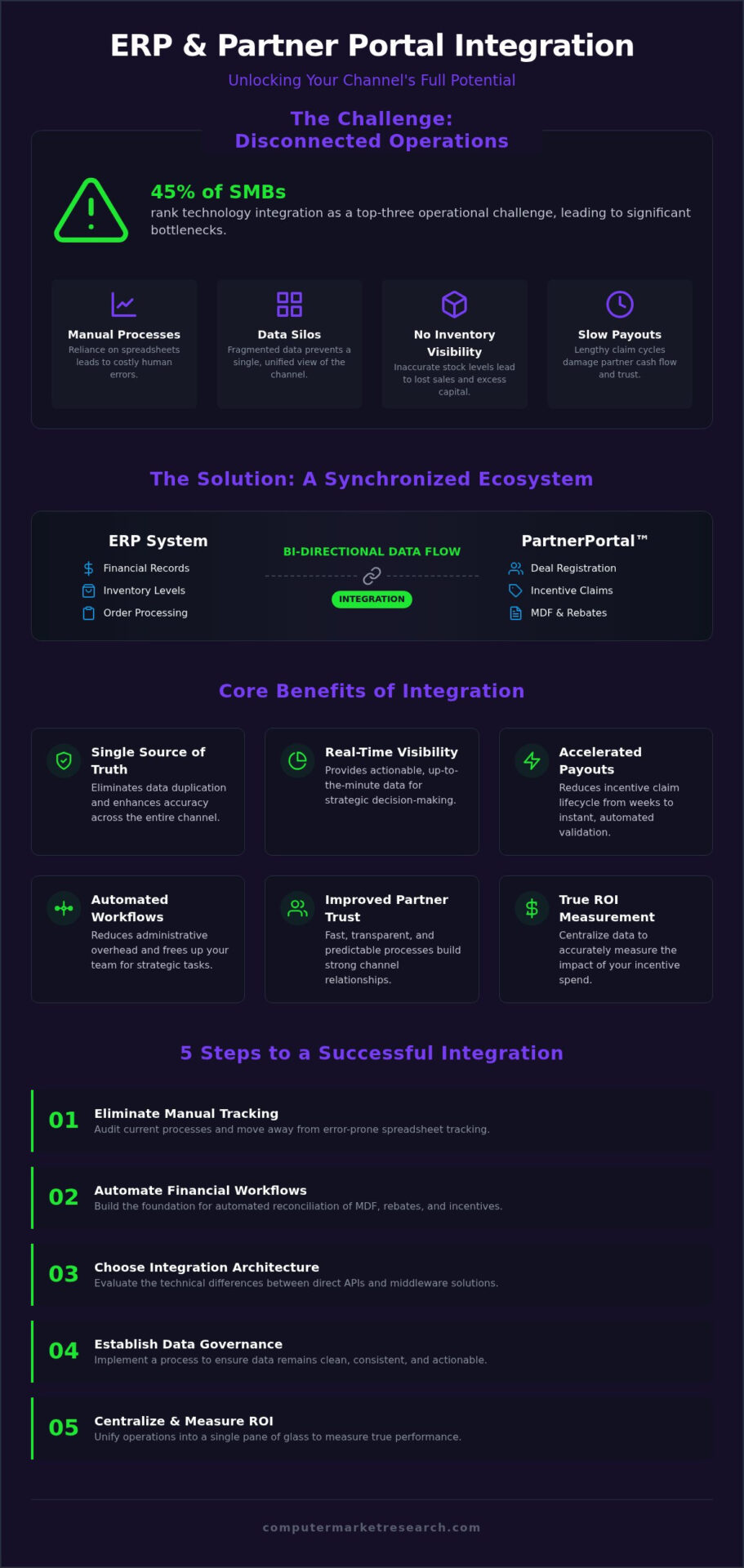
5 Steps to a Successful Partner Portal ERP Integration
Successful implementation requires a methodical approach that prioritizes data integrity over deployment speed. A partner portal erp integration is a multi-stage lifecycle that begins long before the first line of code is written. For the developers building these integrations, having access to tools like C++ Here allows for quick logic testing and skill maintenance in a convenient web-based editor. It’s about aligning your business logic with your technical infrastructure to ensure a seamless flow of information. Without a structured framework, even the most advanced tools can fail to deliver the expected ROI.
- Define clear business objectives: Identify exactly which manual processes, such as rebate processing or lead distribution, you intend to automate.
- Audit existing data: Scan your ERP and CRM for duplicate records or inconsistent naming conventions. This step ensures that your product catalogs and price books are standardized across all regions.
- Select a scalable architecture: Choose a framework that can handle a significant increase in partner activity as your channel grows.
- Execute a phased rollout: Start with a pilot group of trusted partners to identify edge cases and execute rigorous User Acceptance Testing (UAT).
- Establish governance: Designate data owners to manage ongoing synchronization health and establish automated alerts for sync failures.
Data Mapping and Field Alignment
Precise field alignment is the backbone of a functional channel ecosystem. You must identify critical data points like SKUs, pricing tiers, and unique partner IDs to ensure information remains consistent across platforms. Bidirectional synchronization is particularly vital for deal registration and lead management, as it allows updates in the field to reflect immediately in your financial records. This flow also triggers essential back-office actions, such as credit checks or account creation, without manual intervention. Leveraging specialized channel partner management software simplifies this mapping process by providing pre-configured schemas designed for complex B2B relationships.
Testing and Performance Optimization
Rigorous testing prevents system failures during critical business windows like quarter-end processing. You should simulate high-volume transaction periods to test for system latency and potential data bottlenecks. Gathering direct partner feedback on portal responsiveness ensures the user experience matches the technical performance. UAT should include partners with varying levels of technical expertise to ensure the interface is intuitive for everyone. In 2026, the gold standard for integration uptime is 99.9%, ensuring that global channel operations remain functional regardless of time zone or traffic spikes. If you’re ready to modernize your infrastructure, you can start your automation journey today with a professional implementation assessment.
Optimizing Channel ROI with CMR PartnerPortal™
Centralizing channel operations into a single pane of glass transforms how global enterprises interact with their networks. With PartnerPortal™, you aren’t just connecting systems; you’re creating a unified environment where every transaction and incentive claim is visible in real time. A successful partner portal erp integration allows you to move beyond basic order management to measure the true ROI of your MDF and incentive spend. While many platforms stop at the point of sale, our approach ensures that financial reconciliation for rebates and co-op funds is automated and verifiable.
By leveraging Computer Market Research’s professional implementation and managed services, you significantly reduce the administrative burden on your internal IT teams. Since 1984, we’ve specialized in the complex needs of Global 2000 organizations, ensuring that our infrastructure meets the highest standards of accuracy. Our managed data services normalize POS and inventory reports before they ever enter your financial system, ensuring that your data remains a high-quality asset. This stability positions your brand as a “Partner of Choice” by providing a seamless, reliable digital experience that eliminates the friction of manual error correction.
Actionable Insights from Integrated Data
Integrated data does more than record history; it predicts the future. By using performance tracking, you can identify high-growth partners and reward them with targeted incentive programs that drive further expansion. Predictive analytics for channel inventory allow you to anticipate market demand shifts, preventing stockouts and optimizing production schedules across your entire distribution network. PartnerPortal™ provides the decision-grade insights necessary to transform raw channel data into a competitive advantage.
Future-Proofing Your Channel Infrastructure
Scaling a global partner network usually requires a corresponding increase in administrative staff to handle the influx of data. However, an automated ecosystem allows you to grow your partner base without adding headcount. The next generation of integrated portals will increasingly rely on AI to automate routine validation tasks and provide deeper insights into partner behavior. By investing in modern infrastructure today, you ensure your channel remains resilient against market volatility. If you’re ready to move away from legacy manual tracking, it’s time to Partner Smarter with Computer Market Research and build a foundation for sustainable growth.
Future-Proof Your Channel with Integrated Automation
Transitioning from fragmented legacy systems to a unified digital infrastructure is no longer optional for organizations aiming to scale. A successful partner portal erp integration eliminates the hidden costs of manual data entry while providing a single version of the truth for global operations. By prioritizing comprehensive POS data cleansing and seamless ERP/CRM integration, you ensure that your financial reconciliations for rebates and MDF are both accurate and automated.
Computer Market Research remains a Fortune 500 trusted partner because we understand that technical connectivity is only half the battle; high-quality, normalized data is what actually drives strategic growth. You don’t have to manage these complexities alone. Our team provides the expertise needed to navigate the integration lifecycle without disrupting your existing workflows. It’s time to replace administrative bottlenecks with a high-velocity automation hub that empowers your partners and protects your bottom line.
Scale your channel operations with CMR’s PartnerPortal™ and start building a more resilient, data-driven channel today.
Frequently Asked Questions
What is the primary benefit of partner portal ERP integration?
The primary benefit is the elimination of manual data silos and the automation of channel operations. By connecting your systems, you achieve real-time transparency across your entire network. This automation reduces administrative overhead and prevents common spreadsheet errors in rebate processing. A seamless partner portal erp integration ensures that your back-office financial records always match front-line partner activity, allowing you to scale management without adding headcount.
How long does it typically take to integrate a partner portal with an ERP system?
Implementation timelines vary based on the complexity of your multi-system environment and the volume of data processed. For Global 2000 enterprises, a professional integration often involves discovery, configuration, and rigorous testing phases. Research indicates that data migration is the top challenge for 62% of organizations, which can extend projects. Computer Market Research focuses on systematic implementation to ensure stability, accuracy, and a clear path out of operational bottlenecks during the transition.
Can I integrate a partner portal with legacy ERP systems?
Yes, you can integrate modern portals with legacy ERP systems through various technical methods like middleware or custom APIs. Computer Market Research has provided channel expertise since 1984, helping companies bridge the gap between older financial records and modern SaaS platforms. We specialize in professional implementation that respects your existing infrastructure while adding a layer of automation for tasks like Ship & Debit processing and POS data management.
Is it safe to share internal ERP data with external partners through a portal?
Security is a foundational component of any professional channel ecosystem. You don’t share your entire database; instead, you use controlled, bi-directional data flows to expose only necessary information. Modern partner portal erp integration uses role-based access and encryption to protect sensitive financial data. This ensures that partners see the inventory and pricing tiers relevant to them while your core internal records remain secure and isolated from unauthorized access.
What is the difference between API and EDI in the context of partner portals?
API and EDI represent different methods of data exchange between your portal and ERP. API, or Application Programming Interface, allows for real-time, bi-directional communication, which is ideal for instant deal registration and inventory checks. EDI, or Electronic Data Interchange, is a legacy format often used for batch processing in large distribution networks. Both methods have their place in 2026, depending on the technical capabilities of your specific partner base.
Does ERP integration help with MDF and rebate management?
Integration is essential for effective MDF and rebate management because it automates financial reconciliation. By pulling sales data directly from the ERP, the system can validate incentive claims against actual transaction records. This prevents financial leakage and duplicate payments that often occur in manual systems. Computer Market Research helps Fortune 500 companies use these automated workflows to measure the true ROI of their incentive spend without manual intervention.
What data should I synchronize between my ERP and partner portal?
You should synchronize data points that directly impact transaction accuracy and partner performance. This includes SKUs, tiered pricing, partner IDs, and real-time inventory levels. Additionally, synchronizing deal registration and lead management data ensures that your sales pipeline is visible to both your internal teams and your partners. Normalizing this information through managed data services ensures that the data ingested by your ERP is clean, consistent, and ready for financial reporting.
How does integration improve the partner experience?
Integration improves the partner experience by providing a self-service environment with accurate, real-time information. Partners gain instant visibility into their incentive status, which reduces the friction of waiting for manual claim approvals. When you provide reliable inventory data and faster rebate payments, you position your brand as a “Partner of Choice.” This seamless digital experience builds trust and encourages partners to prioritize your products over competitors who rely on slower, legacy processes.

Article by
Del Heles
Del Heles is the founder and CEO of Computer Market Research (CMR), a channel management software company he launched in 1984. With more than 40 years of experience, he’s known for helping manufacturers and distributors simplify complex partner programs through practical, customer-focused technology solutions.