

With vendor incentives like ship and debit programs exceeding $600 billion annually in North America, the financial stakes of administrative errors are staggering. Understanding how to handle ship and debit disputes is no longer just an accounting task; it’s a strategic necessity. You’ve likely felt the weight of this through high claim rejection rates and the exhausting hours spent on manual data reconciliation. It’s a common frustration for operations leaders who see margins erode due to unrecovered debits. This friction with key channel partners doesn’t just cost money; it damages the trust required for long term growth.
Resolving these issues requires a fundamental shift in perspective. Instead of viewing disputes as inevitable clerical hurdles, you must treat them as symptoms of a fragmented data infrastructure. This guide provides the exact steps to resolve friction and move toward proactive channel data management. We’ll show you how to achieve higher claim approval rates and reduced resolution cycle times. By leveraging automated data validation through systems like PartnerPortal™, you can gain real-time visibility into channel margins and replace legacy manual tracking with a modernized, systematic approach to profitability.
Key Takeaways
- Identify the hidden costs of manual reconciliation and how resolving administrative friction directly protects your channel ROI.
- Master a systematic workflow for how to handle ship and debit disputes by validating claim data against original Special Pricing Agreements.
- Transition from fragmented email threads to centralized dashboards to ensure data integrity and prevent margin leakage.
- Adopt proactive measures like standardized partner onboarding and real-time POS data collection to stop disputes before they occur.
- See how PartnerPortal™ provides a unified module to automate claim management and provide clear visibility into your indirect sales operations.
The Impact of Ship and Debit Disputes on Channel ROI
Ship and debit disputes represent much more than just a line item of missing revenue; they act as severe operational bottlenecks that paralyze channel efficiency. When a claim is rejected, the resolution process often devolves into a series of manual interventions. High-value employees find themselves trapped in endless email chains and spreadsheet reconciliations rather than focusing on market growth. Learning how to handle ship and debit disputes effectively is essential because these friction points don’t just drain labor hours. They erode the foundational trust between manufacturers and distributors. If a partner feels that claiming their earned incentives is an uphill battle, they’ll likely shift their focus to competitors with more streamlined processes.
The consequences of these disputes also ripple through your financial planning. Inaccurate data from unresolved claims leads to flawed financial forecasting, making it impossible to see the true health of your channel margins. To gain a deeper perspective on managing commercial claims and protecting your bottom line, watch this helpful video:
Why Ship and Debit Disputes Occur in 2026
Even in a technologically advanced landscape, data silos remain the primary culprit behind claim rejections. Many organizations still struggle with a lack of synchronization between their partner portals and internal ERP systems. This disconnect creates a lag in POS reporting, which frequently causes claims to fall outside of expired agreement windows. When you rely on manual data entry across disparate spreadsheets, human error is inevitable. These small mistakes in part numbers or pricing tiers snowball into significant disputes that take weeks to untangle.
The Financial Risk of Unresolved Claims
Unresolved claims create direct margin leakage that can quietly devastate a distributor’s profitability. This often begins with a misunderstanding of what is a debit note and how it must be documented to satisfy manufacturer audits. Beyond the immediate loss of funds, these disputes tie up distributor cash flow and negatively impact inventory turnover rates. Without a modernized ship and debit management software, you also face substantial audit risks. Poorly documented resolutions leave a trail of financial ambiguity that can lead to even larger penalties during year-end reviews. Understanding how to handle ship and debit disputes with precision is the only way to ensure every dollar of earned incentive is actually collected.
A Step-by-Step Workflow for Resolving Claim Disputes
Managing ship and debit programs is inherently complex, yet resolving rejections doesn’t have to be a chaotic exercise in guesswork. To truly understand how to handle ship and debit disputes, you must implement a rigorous, repeatable workflow that prioritizes data accuracy over manual intervention. This structured path ensures that every rejected claim is either recovered or identified as a legitimate exclusion, preventing the cycle of recurring errors that plague manual systems. A single incorrect SKU can trigger a chain reaction of rejections. It’s frustrating. It’s also avoidable.
Step 1: Root Cause Analysis of Rejections
The moment a rejection notification arrives, you must identify the root cause. Don’t simply resubmit the same data. Categorize rejections into three main buckets: data errors, timing issues, or eligibility gaps. Verification is key here. You need to ensure the end-customer matches the authorized customer listed in the original Special Pricing Agreement (SPA). Often, disputes arise because of SKU mismatches or incorrect pricing tiers applied at the point of sale. If the data doesn’t align with the agreement terms, the claim will fail every time. High-performing teams use this stage to spot patterns in partner reporting errors before they become systemic failures.
Step 2: Data Normalization and Validation
Data normalization is the process of ensuring that your partner’s reporting language matches your internal systems. Distributors who successfully Manage “Ship and Debit” Rebate Agreements often cite data consistency as their primary challenge. You must cross-reference POS data with internal inventory records to ensure accuracy. Utilizing channel data management systems allows you to cleanse partner reports automatically, standardizing date formats and currency codes. This step eliminates the human error inherent in manual spreadsheets and ensures that the data you resubmit is technically beyond reproach.
Step 3: Formal Re-submission and Tracking
Once you’ve corrected the underlying data, the re-submission must be formal and well-documented. Draft a concise dispute summary that explicitly highlights the specific correction made. You should always attach proof of shipment and the original authorization code to provide an undeniable audit trail. It’s vital to log the dispute in a centralized system of record to prevent duplicate rejections or double-counting. Tracking the resolution status in a centralized partner portal ensures that both parties have real-time visibility into the progress. If your current process feels overwhelmed by rejection notices, you might want to explore an automated claim management trial to see the difference in resolution speed. Moving from reactive emails to a proactive system is the only way to maintain healthy margins.
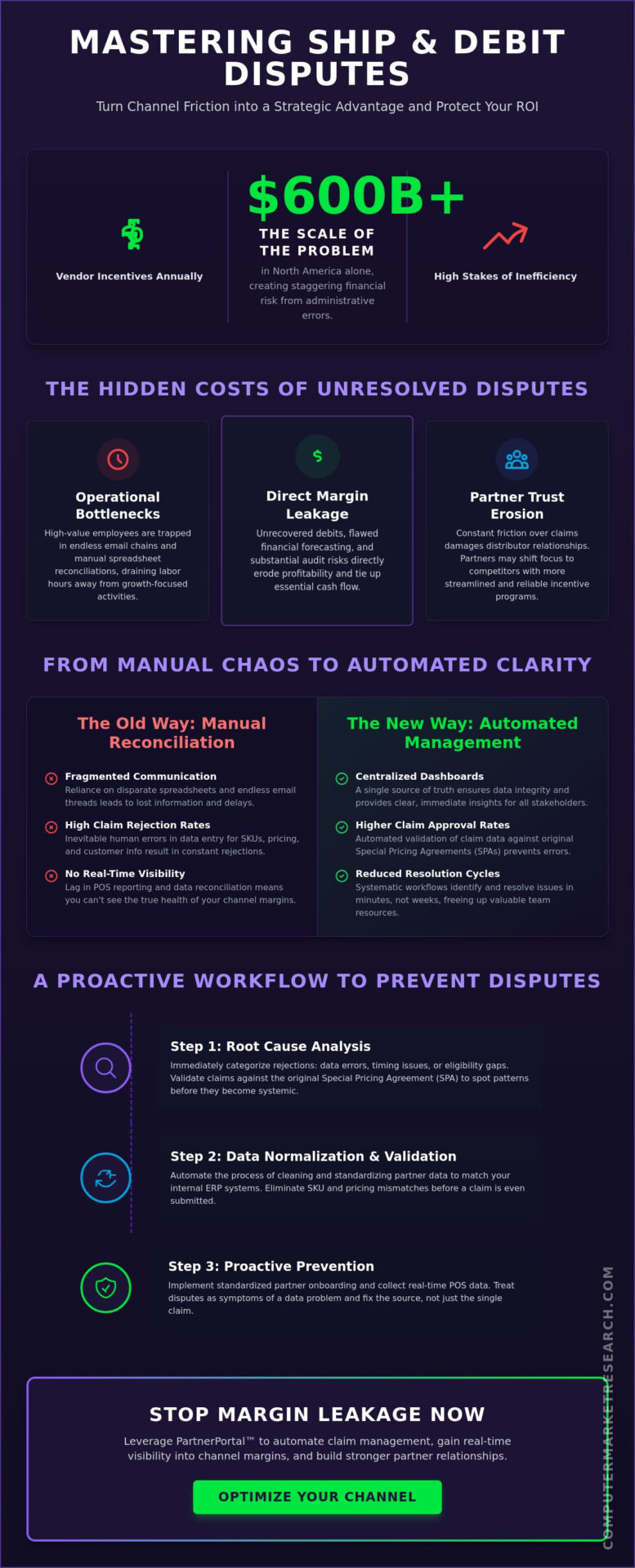
Manual vs. Automated Dispute Resolution Frameworks
Choosing between legacy manual processes and modern automated infrastructure is a defining decision for any growing organization. When evaluating how to handle ship and debit disputes, the contrast between these two frameworks becomes clear: one is built on fragile, fragmented communication, while the other relies on a foundation of data integrity. Manual resolution cycles often depend on a chaotic mix of email threads and local spreadsheets. This environment lacks the version control required to manage complex, multi-partner disputes, leading to inevitable data conflicts and unrecovered revenue.
The Efficiency Gap in Manual Tracking
Finance departments frequently experience what we call “dispute fatigue.” This occurs when the sheer volume of unvalidated claims and administrative overhead overwhelms the team’s capacity to respond. In a manual setup, a single rejection can trigger weeks of back-and-forth communication as both parties hunt for the correct documentation. It’s a slow, reactive process that often results in missed claim deadlines. Additionally, legacy manual dispute handling offers no reliable audit trail. If a resolution isn’t logged in a centralized system, it essentially doesn’t exist for future financial reviews, creating significant compliance risks.
Strategic Benefits of Automated Resolution
Transitioning to an automated framework replaces guesswork with precision. These systems provide real-time validation at the moment of claim submission, identifying errors before they even reach the manufacturer. This proactive approach is a core feature of high-quality ship and debit management software, which ensures all partner data remains normalized and accurate. By automating the validation logic, you reduce the resolution cycle from weeks to just a few minutes of processing time.
The strategic value goes beyond mere speed. Automation provides visibility into dispute trends, allowing you to pinpoint problematic partners or specific SKUs that consistently trigger rejections. This level of transparency transforms the dispute resolution process from a defensive accounting task into a source of actionable business intelligence. Instead of struggling with fragmented information, you gain a clear path out of operational bottlenecks. This ensures that your channel margins are protected and your partner relationships remain stable through high-quality, reliable information.
Best Practices to Prevent Ship and Debit Friction
Preventing friction before it manifests as a rejected claim is the most effective way to protect your channel ROI. While understanding how to handle ship and debit disputes is necessary for recovery, a proactive strategy focuses on eliminating the data discrepancies that cause rejections in the first place. This requires a shift from retroactive reconciliation to real-time data integrity. By establishing a single source of truth for all channel pricing data, you ensure that both manufacturers and distributors are operating from the same information. This alignment significantly reduces the reporting lags that often lead to expired agreement windows and missed incentives.
Data normalization serves as your primary defense against administrative errors. When partner reports are standardized and validated at the point of entry, the likelihood of a dispute drops dramatically. High-performing organizations don’t wait for the end of the quarter to address mismatches. Instead, they implement systems that provide instant feedback on claim validity. If your team is currently buried in manual data entry, you can start a 90-day free trial to see how automated validation cleanses your channel data before it enters your ERP.
Standardizing Agreement Documentation
Clear communication begins with standardized agreement terms. During partner onboarding, you must define the specific data fields required for every ship and debit claim to avoid ambiguity later. Creating a shared library of Special Pricing Agreements (SPAs) accessible to all parties ensures everyone is aligned on current pricing tiers. These documentation standards should be directly linked to your broader what is channel management strategies. When agreements are structured logically and shared transparently, the administrative overhead associated with verifying authorizations is virtually eliminated.
Leveraging AI for Dispute Prevention
Modern infrastructure now allows for AI-powered reconciliation that identifies potential rejections before they happen. Machine learning models can analyze historical data to predict which claims are likely to be disputed based on customer identifiers or SKU mismatches. By automating the matching of POS lines to specific agreement authorizations, you remove the human error inherent in legacy processes. This technology also helps identify patterns in rejections, allowing you to refine future agreement structures. This continuous improvement loop ensures that your ship and debit programs become more efficient over time, moving your operations from a reactive struggle to a state of controlled, data-driven performance.
Optimizing Ship and Debit with CMR’s PartnerPortal™
PartnerPortal™ provides a unified module designed to handle the complexities of end-to-end claim management. When you modernize your approach to how to handle ship and debit disputes, you move away from fragmented spreadsheets and toward a centralized system of record. This transition allows you to automate the collection and cleansing of complex channel POS data, ensuring that every claim is validated against real-time agreement parameters. By replacing manual workflows with automated validation, organizations can dramatically accelerate their dispute resolution cycles and eliminate the administrative friction that leads to margin erosion.
Decision-grade insights are the natural result of this structured data environment. Instead of reacting to rejections after the fact, you gain clear visibility into your indirect revenue streams as they happen. This transparency allows you to identify which programs are driving growth and which are being hampered by data failures. It’s a shift from defensive accounting to strategic channel optimization. You’ll no longer guess why a claim failed; you’ll have the technical depth to prevent the error before submission.
Unified Data for Dispute-Free Claims
Modernizing your infrastructure means integrating ship and debit workflows directly with your existing ERP. This integration eliminates the heavy administrative burden of manual data normalization, allowing your team to focus on high-value tasks instead of data entry. PartnerPortal™ provides your distributors with a transparent view of claim status and history, reducing the volume of status-check inquiries. When both parties have access to the same high-quality information, trust is rebuilt and operational bottlenecks disappear. It’s about creating a reliable journey from shipment to reimbursement without the legacy obstacles that slow down your growth.
Drive Revenue Growth with Accurate Data
Accurate data turns your ship and debit program into a competitive advantage rather than a financial hurdle. It ensures that your partner relationship management strategy is backed by verifiable performance metrics and precise financial tracking. If you’re ready to move beyond legacy tracking methods and reclaim your lost margins, you can request a demo of PartnerPortal™ to see how we streamline claims. Managing how to handle ship and debit disputes shouldn’t be a drain on your resources; with the right tools, it becomes a predictable, high-performance part of a profitable channel strategy. This systematic approach ensures your organization remains stable and accurate in even the most complex B2B environments.
Mastering Your Channel Data Strategy for 2026
Transitioning from a reactive to a proactive strategy is the only logical step for organizations looking to scale their indirect sales. By implementing a systematic workflow and moving away from legacy manual tracking, you eliminate the data silos that frequently trigger rejections. We’ve explored how to handle ship and debit disputes by prioritizing data normalization and real-time validation, ensuring that every claim is backed by decision-grade accuracy. This methodical approach doesn’t just resolve existing friction; it builds a foundation for more resilient partner relationships and predictable financial forecasting.
Trusted by Global 2000 companies since 1984, CMR provides the specialized infrastructure necessary to cleanse complex POS data and protect your channel ROI. It’s time to stop letting administrative friction erode your margins and start leveraging automated systems that offer stability and precision. These tools replace fragmented information with high-quality, actionable insights that drive long-term growth and operational order. To see these results in your own operations, Request a Demo of CMR’s Ship & Debit Module and begin your 90-day trial today. You have a clear path out of operational bottlenecks; taking this step ensures your organization remains a definitive leader in your field.
Ship and Debit Dispute FAQ
Why are ship and debit claims rejected?
Rejections primarily stem from data discrepancies between manufacturer records and distributor POS reports. Common triggers include using an unauthorized SKU, claiming against an expired agreement, or mismatching the end-customer name. These errors often occur because manual data entry lacks the validation checks required to catch inconsistencies before submission. Identifying these patterns is the first step in learning how to handle ship and debit disputes more effectively.
How can I resolve disputes faster?
Accelerating resolution requires moving from reactive email threads to a centralized data environment. You can reduce cycle times by implementing immediate root cause analysis upon receiving a rejection notification. Standardizing your data formats ensures that corrections are processed in minutes rather than weeks. Providing partners with real-time visibility into claim status further eliminates the administrative overhead of manual follow-ups and status inquiries.
Why is POS data accuracy critical?
POS data accuracy is critical because it serves as the primary evidence for every ship and debit claim. If the quantities, prices, or dates reported by the distributor don’t align perfectly with the manufacturer’s internal records, the claim will be automatically rejected. High-quality POS data management ensures that every line item is cleansed and normalized, providing the decision-grade information necessary to protect your channel margins from erosion.
Can my ERP manage these disputes?
Most ERP systems lack the specialized logic required to manage complex multi-partner incentive programs effectively. While they handle general financial transactions, they don’t typically offer the automated validation or data cleansing features found in specialized ship and debit management software. To optimize your existing setup, you might explore SAP Consulting Services to ensure your enterprise data is correctly synchronized with your channel workflows. Relying solely on an ERP often leads to manual workarounds in spreadsheets, which introduces the risk of version control errors and administrative bottlenecks.
What documents are needed for disputes?
Resolving a dispute successfully requires a complete audit trail that includes the original authorization code and proof of shipment. You must also provide a detailed POS report that matches the specific terms of the Special Pricing Agreement. Having this documentation organized in a centralized system of record prevents the loss of information and ensures that resubmissions are technically beyond reproach during manufacturer audits.
How does automation reduce friction?
Automation software reduces friction by validating claims against agreement parameters at the moment of submission. This technology identifies errors like SKU mismatches or pricing tier conflicts before they become formal disputes. By automating the collection and cleansing of channel data, systems like PartnerPortal™ eliminate the “dispute fatigue” that often overwhelms finance departments. This shift ensures that how to handle ship and debit disputes becomes a streamlined, data-driven process.
What is the role of SPAs in disputes?
Special Pricing Agreements (SPAs) act as the foundational contract that governs the entire ship and debit lifecycle. They define the specific pricing tiers, eligible SKUs, and authorized end-customers for every transaction. During a dispute, the SPA is the definitive reference point used to validate or reject a claim. Maintaining a shared library of these agreements ensures that both manufacturers and distributors stay aligned on current incentive structures.

Article by
Del Heles
Del Heles is the founder and CEO of Computer Market Research (CMR), a channel management software company he launched in 1984. With more than 40 years of experience, he’s known for helping manufacturers and distributors simplify complex partner programs through practical, customer-focused technology solutions.