

What if you could track every opportunity sent to your channel partners with the same precision as your direct sales pipeline? For many organizations, leads simply disappear into a black hole once they’re assigned, leaving channel managers to guess at conversion rates while wrestling with manual spreadsheet entries. Implementing robust partner lead management software is no longer optional if you intend to eliminate these blind spots. With the global partner relationship management market projected to reach $116.2 billion in 2026, you’ve likely felt the pressure to resolve the operational bottlenecks and channel conflicts that directly impact your bottom line.
We recognize that fragmented information and legacy tracking methods are the primary obstacles to scaling a global channel program. This strategic guide promises to show you how to automate lead distribution and secure real-time visibility into your partner sales pipeline. You’ll learn how to transition from disorganized data to decision-grade reporting that satisfies executive requirements. We’ll explore the essential features of modern infrastructure, including how tools like PartnerPortal™ facilitate a systematic approach to deal registration and maximize your partner-led revenue.
Key Takeaways
- Understand why manual spreadsheets are the primary obstacle to growth and how automated systems prevent leads from disappearing after assignment.
- Identify the essential features of modern partner lead management software, including centralized portals and rules-based distribution that ensure fair routing.
- Learn the critical distinction between vendor-originated distribution and partner-originated registration to protect partner margins and eliminate internal sales conflict.
- Follow a structured implementation roadmap that begins with auditing current bottlenecks and cleansing legacy data for a seamless migration.
- Discover how combining SaaS automation with managed data normalization provides the decision-grade data needed for high-level executive reporting.
Why Manual Lead Tracking Fails in 2026
Partner lead management is the structured methodology of distributing, tracking, and optimizing sales opportunities within an indirect channel ecosystem. Unlike direct sales, these Lead management methodologies must account for the complexities of third-party relationships and disparate data systems. Real-time visibility is now a baseline operational requirement. Organizations that continue to rely on manual processes find themselves unable to compete with the speed and accuracy of automated systems. They lose ground daily.
The financial impact of “blind leads” is staggering. When opportunities are sent to partners without a closed-loop system, they often fall into a black hole. Many channel professionals report that a significant percentage of partner-sent leads are never followed up, primarily because there’s no accountability or automated reminder system in place. High-performance partner lead management software eliminates this waste by providing a clear audit trail for every opportunity. Without this infrastructure, you risk not only lost revenue but also severe channel conflict. When multiple partners unknowingly chase the same prospect due to poor record-keeping, trust in the vendor relationship quickly erodes. Trust is hard to rebuild.
The Hidden Costs of Spreadsheet Management
Legacy tracking methods rely on a patchwork of static documents held by various regional managers. This data fragmentation makes it impossible to gain a global view of channel health. The administrative burden of manual data entry and subsequent cleansing consumes hours of productivity. These are hours that should be spent on strategic partner development. Perhaps most critically, “spreadsheet chaos” prevents you from calculating true Channel ROI. If you can’t tie a specific lead to a final invoice through a unified system, your executive reporting remains based on guesswork rather than clean, decision-grade data. This drive for visibility is mirrored in other sectors; for instance, domiciliary care providers can discover CareOps Command Centre to overlay their existing software and highlight operational risks that spreadsheets often miss.
Defining the Modern Lead Management Lifecycle
A modernized lifecycle moves beyond simple hand-offs to a collaborative framework. It creates a predictable flow of information.
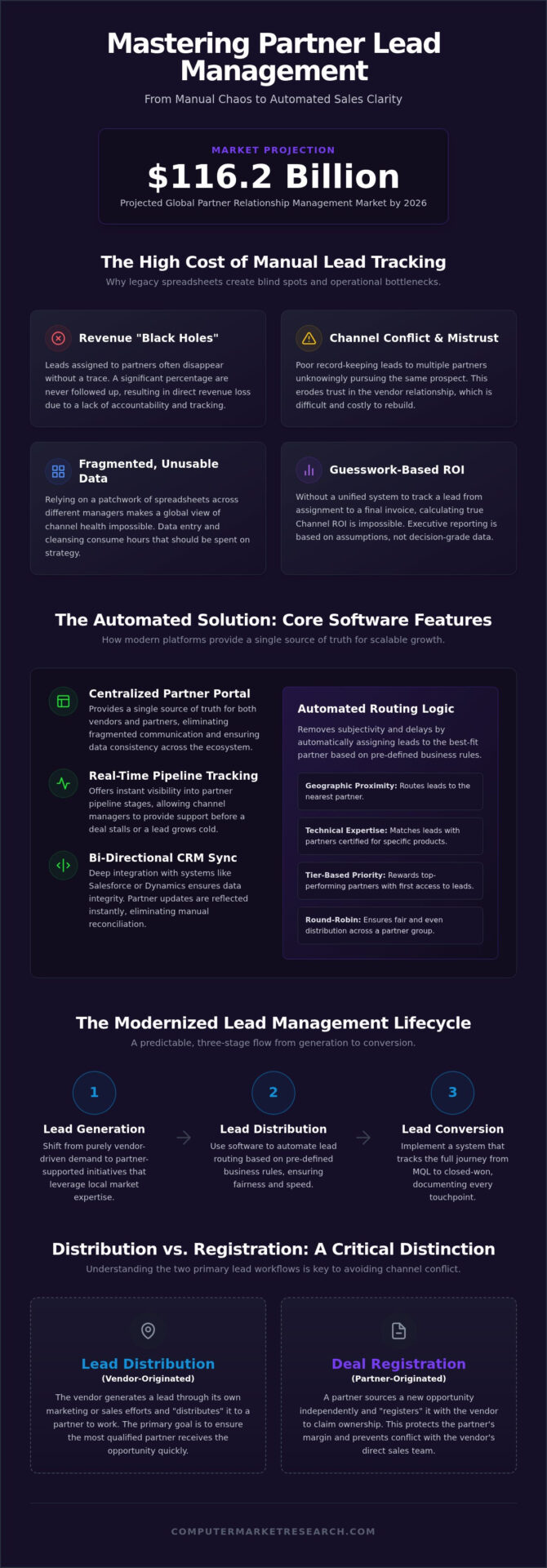
- Lead Generation: Shifting from purely vendor-driven demand to partner-supported initiatives that leverage local market expertise and regional presence.
- Lead Distribution: Using partner lead management software to automate routing based on pre-defined business rules like partner tier, technical certification, or geographic proximity.
- Lead Conversion: Implementing a system that tracks the journey from Marketing Qualified Lead (MQL) through to the closed-won deal, ensuring every touchpoint is documented and visible.
By centralizing these stages within a tool like PartnerPortal™, organizations can replace manual bottlenecks with a streamlined, scalable workflow that actually supports growth.
Key Features of Partner Lead Management Software
Modern partner lead management software serves as the operational backbone for high-growth channel programs. It replaces fragmented communication with a centralized PartnerPortal™, providing a single source of truth for both vendors and their partners. This infrastructure ensures that lead data remains consistent across the entire ecosystem. Real-time tracking capabilities offer instant visibility into partner pipeline stages, allowing channel managers to intervene before a deal stalls or a lead grows cold.
Deep technical integration with existing CRM systems like Salesforce, Microsoft Dynamics, or Oracle is essential for data integrity. A bi-directional sync ensures that when a partner updates a lead status in the portal, the change reflects immediately in the vendor’s primary database. This level of synchronization is a cornerstone of professional Distribution Partnerships, where speed and accuracy define success. It eliminates the need for manual data reconciliation and reduces the risk of human error.
Lead Distribution and Routing Logic
Automated routing logic removes the subjectivity and delays associated with manual distribution. You can configure business rules to prioritize geographic proximity or specific technical expertise, ensuring the most qualified partner receives the opportunity. Tier-based prioritization rewards your high-performing partners by giving them first access to premium leads. While round-robin distribution ensures fairness across a broad network, expertise-based routing often yields higher conversion rates for complex products. It’s important to avoid “cherry-picking” models that can lead to partner frustration and perceived favoritism.
Lead Analytics and Performance Dashboards
Effective dashboards within your partner lead management software visualize the “leaky bucket” in your sales funnel, pinpointing exactly where leads drop off. You can measure partner performance with precision, identifying which organizations are merely accepting leads and which are actually converting them into revenue. Decision-grade data allows channel sales leaders to track customizable KPIs, such as lead-to-opportunity ratios and average time-to-conversion. These metrics are vital for justifying channel marketing spend and refining future incentive programs.
Implementing these features provides the stability and accuracy required to scale a global channel. If you’re ready to eliminate spreadsheet chaos and see these tools in action, modernizing your partner portal is the logical next step toward operational excellence.
Lead Distribution vs. Deal Registration
Understanding the direction of lead flow is fundamental to a successful indirect sales channel strategy. Lead distribution involves “pushing” vendor-originated opportunities out to the partner network. Conversely, deal registration is a “pull” mechanism where partners notify the vendor of an opportunity they discovered independently. High-performance partner lead management software must handle both directions within a single, unified workflow to ensure data integrity and partner alignment.
The transition from a distributed lead to a registered deal is a critical execution step. When a partner accepts a lead and begins the qualification process, they invest significant time and resources. Transitioning that lead into a registered deal within your Deal Registration Software protects the partner’s margins. It ensures that their efforts aren’t undercut by internal sales teams or competing partners. This synergy creates a closed-loop system where every opportunity is protected. Without this technical execution loop, data decays quickly. Vendors often struggle to see the connection between the leads they send and the revenue that eventually returns. A unified system bridges this gap, providing the granular visibility required to optimize the entire sales cycle.
Preventing Channel Conflict
Conflict often arises when the boundaries between direct and indirect sales are blurred. Robust partner lead management software enforces clear “Rules of Engagement” automatically. The system uses automated conflict detection to flag duplicate leads before they cause friction. Time-stamping serves as the ultimate arbiter in “who found it first” disputes, providing an objective record of entry. This transparency builds partner confidence. It proves that the vendor values fair play and operational integrity above all else. By automating these checks, you remove the administrative burden from channel managers. They no longer have to act as referees in every dispute. Instead, they can focus on strategic growth.
Incentivizing Accurate Reporting
Partners are more likely to provide high-quality data when they see a direct benefit. You can link lead conversion milestones directly to Market Development Funds (MDF) or other performance-based rebates. This creates a tangible reason for partners to update lead statuses promptly. Beyond financial rewards, providing partners with decision-grade insights helps them sell more effectively. When partners see that accurate reporting leads to better support and more resources, they become active participants in the data ecosystem. Stability and accuracy become shared goals rather than administrative chores.
Implementation Steps for Partner Lead Systems
Deploying partner lead management software requires a methodical transition from manual chaos to automated precision. Success isn’t found in the software alone; it’s found in the preparation. Begin by auditing your current lead flow to pinpoint exactly where opportunities stall. This audit often reveals that manual bottlenecks, such as waiting for a regional manager’s approval, are the primary cause of lead decay. Once these friction points are identified, you can design a digital workflow that bypasses them entirely. It’s a shift toward stability.
The Critical Role of Data Normalization
Raw partner data is notoriously unreliable. It’s often riddled with duplicates, inconsistent formatting, and outdated contact information. Importing “dirty” data into a new system only scales your existing problems. This is why data normalization is a non-negotiable step. Many organizations choose to utilize Managed Data Services to offload the administrative burden of cleansing these reports. This ensures that your POS and inventory data align perfectly with your lead conversion reports, providing a foundation of high-quality information that executives can actually trust.
With clean data as your foundation, you can define your distribution rules and deal registration workflows. Don’t attempt a “big bang” rollout across your entire network. Instead, execute a phased rollout starting with a group of “Champion Partners.” These are your high-performing, tech-savvy partners who can provide valuable feedback and serve as internal advocates for the new system. Their success will drive broader adoption during the final stages of the project. It builds confidence across the network.
Partner Onboarding and Adoption
Your system must provide a frictionless experience. If the portal is difficult to navigate, partners will simply revert to their old ways of communicating. Provide concise training resources directly within the PartnerPortal™ to reduce the learning curve. Measure adoption rates as a primary success metric during the initial months. A high adoption rate indicates that the system is adding value to the partner’s daily routine, which is the ultimate goal of any channel automation project.
The final step is the technical integration with your CRM or ERP. This connects your channel activities to your broader business ecosystem, enabling the real-time visibility discussed earlier in this guide. If you’re ready to move away from spreadsheet management and start your implementation journey, you can claim your 90-day free trial to test these workflows in a live environment.
Scaling Sales with CMR PartnerPortal™
Scaling a global channel requires more than just a portal; it requires a system that handles the inherent complexity of international data sets. CMR PartnerPortal™ addresses this by centralizing every aspect of the sales cycle into a single, cloud-based environment. Unlike standard partner lead management software that leaves the administrative burden on your team, CMR combines SaaS automation with Managed Data Services. This unique approach ensures that the information entering your system is normalized and accurate from the start. Global 2000 enterprises have utilized this methodology to significantly improve lead conversion rates, moving away from fragmented spreadsheets and toward a unified source of truth. It’s a shift that provides immediate stability.
Partners gain real-time access to their co-op funds, incentives, and marketing assets, which fosters a sense of transparency and trust. When partners can see their rewards and lead statuses in one place, they’re more engaged and productive. The CMR advantage lies in offloading the technical burden of data cleansing, allowing your channel managers to focus on partner relationships instead of administrative errors. This visibility is not a luxury. It’s the foundation of a scalable program that can adapt to changing market demands without losing data integrity.
A Holistic Approach to Channel ROI
Effective management means linking every distributed lead to a measurable outcome. By centralizing onboarding, deal registration, and performance tracking, PartnerPortal™ provides a comprehensive view of your channel’s health. You can directly link your lead management activities to your Channel Incentive Programs, ensuring that every dollar spent is tied to a specific result. This level of precision allows you to achieve “Decision-Grade” visibility into your channel spend, enabling more strategic allocations of marketing and sales resources. Integrating advanced partner lead management software into your broader strategy ensures that incentive payouts are always based on verified performance data.
Next Steps: Modernizing Your Infrastructure
Legacy systems often become the primary obstacle to growth as they fail to keep pace with modern data requirements. Fortune 500 companies rely on CMR for Channel Data Management because they require stability and technical competence at scale. Moving away from manual tracking is the only logical step for organizations looking to secure their competitive position in 2026. If you’re ready to see how a structured, automated approach can transform your sales pipeline, Request a demo of PartnerPortal™ today to begin your transition toward operational excellence.
Securing Your Channel Revenue for 2026
Transitioning from legacy spreadsheet management to a modernized infrastructure is the only logical step for organizations looking to scale. By implementing robust partner lead management software, you replace “blind leads” with decision-grade data that proves your channel’s ROI. We’ve explored how centralized portals and automated distribution rules eliminate the manual bottlenecks that stifle growth. Stability in your partner ecosystem depends on the accuracy of your reporting and the fairness of your lead routing.
CMR has provided this level of technical competence since 1984. Our specialized Managed Data Services ensure 100% accurate reporting by cleansing raw partner data before it enters your pipeline. It’s why Fortune 500 and Global 2000 brands trust us to manage their most complex industry relationships. This expert-led approach promises stability and a clear path out of operational bottlenecks.
Ready to eliminate spreadsheet chaos? You can streamline your channel sales with CMR’s PartnerPortal™ and gain the real-time visibility your program deserves. Your path to optimized performance starts with a single, systematic upgrade.
Frequently Asked Questions
What is partner lead management software?
This is a specialized category of PRM software designed to automate the distribution, tracking, and conversion of sales opportunities within a channel network. Unlike internal sales tools, this software provides a secure environment for vendors to pass leads to third-party partners while maintaining full visibility into the pipeline. It replaces manual spreadsheet tracking with a structured, digital workflow that ensures every lead is accounted for and followed up on promptly.
How does PRM software differ from a standard CRM?
A standard CRM is designed for direct sales teams to manage internal customer relationships. In contrast, PRM software focuses on the unique requirements of indirect sales channels. It includes external-facing portals, multi-partner lead routing, and co-op fund management features that CRMs lack. While a CRM tracks what your employees do, PRM infrastructure provides the oversight and incentives needed to manage independent businesses that sell your products on your behalf.
Can partner lead management software integrate with Salesforce?
Professional-grade systems offer bi-directional synchronization with major platforms like Salesforce, Microsoft Dynamics, and Oracle. This integration ensures that when a partner updates a deal status in the portal, the information reflects immediately in your primary CRM. This connectivity eliminates manual data entry and prevents the data decay that occurs when sales teams work in siloed environments. It creates a unified data ecosystem for your entire organization and supports better decision-making.
How do I prevent partners from fighting over the same leads?
You can prevent channel conflict by establishing automated “Rules of Engagement” within your software. Modern systems use time-stamping to verify which partner registered an opportunity first, serving as an objective arbiter in disputes. Additionally, automated conflict detection flags duplicate entries before they are approved. By setting clear geographic or expertise-based routing rules, you ensure that leads are distributed fairly and transparently across your entire partner network, which builds long-term trust.
What are the benefits of automating deal registration?
Automating deal registration protects partner margins by providing a formal record of their involvement in a sales opportunity. It prevents internal sales teams or other partners from undercutting the originating partner’s efforts. This automation also streamlines the approval process, reducing the administrative burden on channel managers. For the vendor, it provides early visibility into the indirect pipeline, allowing for more accurate revenue forecasting and better resource allocation across the entire global channel.
How much does it cost to implement a partner portal?
Implementation costs vary significantly based on the size of your partner network and the complexity of your existing technology stack. Factors such as custom integrations, the number of active users, and specific module requirements like MDF or inventory management will influence the final investment. Organizations should evaluate the total cost of ownership against the potential efficiency gains and the elimination of manual data errors that typically plague legacy spreadsheet tracking methods.
Does CMR provide data cleansing services for partner reports?
CMR specializes in Managed Data Services that offload the administrative burden of POS and inventory report cleansing. Raw partner data is often inconsistent or incorrectly formatted, making it unsuitable for executive reporting. Our team normalizes this information to ensure 100% accuracy in your channel analytics. By combining SaaS automation with manual data verification, we provide decision-grade insights that allow you to track the true performance of your incentive programs with confidence.
How do I ensure my partners actually use the lead management system?
Partner adoption depends on creating a frictionless user experience. If the system is easier to use than sending an email or updating a spreadsheet, partners will naturally migrate to it. You can further encourage usage by linking lead conversion milestones to financial incentives like co-op funds or rebates. Providing partners with training resources and real-time access to their own performance data turns the portal into a valuable tool for their own business growth.

Article by
Del Heles
Del Heles is the founder and CEO of Computer Market Research (CMR), a channel management software company he launched in 1984. With more than 40 years of experience, he’s known for helping manufacturers and distributors simplify complex partner programs through practical, customer-focused technology solutions.