

Research from Deloitte shows that 86% of companies reported higher sales in 2026 due to increased collaboration with their partners. Utilizing a structured partner business planning template is the first step toward capturing this growth, yet many channel leaders still struggle with fragmented information and marketing spend that lacks a transparent ROI. It’s nearly impossible to drive performance when you’re forced to track real-time progress against a static, manual document. You need a system that moves as fast as your market does.
We’ve developed this guide to help you replace legacy workflows with a modernized framework for joint business planning. You’ll learn how to standardize your QBRs and create a roadmap for automated channel success that eliminates operational bottlenecks. By the end of this article, you’ll have the tools to secure better returns on incentives and build a predictable path for indirect sales growth. We’ll explore the technical precision required to turn your channel strategy into a scalable, high-performance discipline.
Key Takeaways
- Learn how to leverage a partner business planning template to transition from transactional interactions to a strategic “sell-through” model that drives mutual growth.
- Identify the essential components of a high-performing plan, including clearly defined value propositions and realistic financial targets that align both parties’ expectations.
- Understand the operational risks of relying on static spreadsheets for channel management and why real-time data integration is necessary to prevent misalignment.
- Master a two-step execution process that combines historical data discovery with collaborative goal setting to secure partner buy-in for the upcoming year.
- Discover how to centralize MDF management and performance tracking by moving from manual documents to a dynamic cloud-based dashboard in PartnerPortal™.
What is a Partner Business Planning Template?
A partner business planning template acts as a structured, collaborative framework designed to align manufacturers and their channel partners on specific sales targets, marketing strategies, and resource allocations. Unlike traditional business models that focus on transactional “selling to” a partner, modern channel management prioritizes “selling through” them. This shift transforms the relationship into a Strategic alliance where both parties share the burden of market expansion and the rewards of revenue growth.
To better understand the fundamental structure of a professional plan, watch this helpful video:
As we move through 2026, the demand for integrated, living documents has replaced the era of static PDFs. A modern partner relationship management strategy relies on real-time data visibility. A Joint Business Plan (JBP) is no longer a document you file away after a signature; it’s a dynamic system that allows for mid-course corrections. Research from Deloitte indicates that 73% of companies have increased collaboration with retail partners over the last five years. This trend highlights the necessity of using shared data and AI-enabled decision-making to ensure every dollar of investment is backed by a clear performance metric.
The Difference Between a Startup Plan and a Partner Plan
While general business guides often define plans as foundations for securing funding, a partner plan focuses strictly on shared revenue and market penetration. Startup plans are introspective. They look at a single company’s structure. In contrast, your partner business planning template must account for external variables like co-marketing efforts and incentive alignment across a diverse ecosystem. Modern channel programs have shifted away from one-size-fits-all models toward tier-based planning. This ensures that high-performing partners receive the specific resources they need to scale, while emerging partners are given a clear roadmap to move up the ranks.
Why Manual Planning Often Stalls Growth
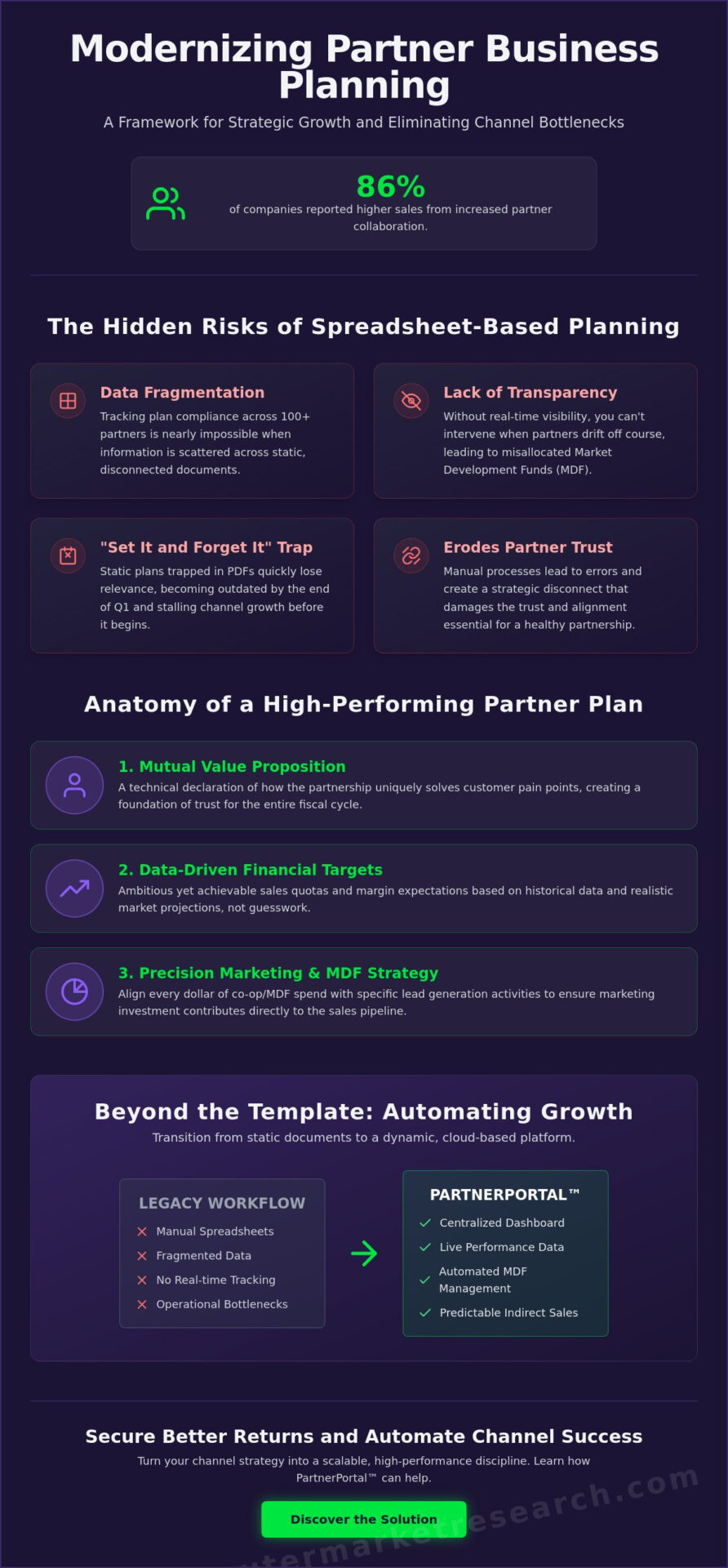
The most common failure in channel management is the “set it and forget it” trap. When plans are trapped in static documents, they lose relevance by the end of the first quarter. Data fragmentation makes it nearly impossible to track plan compliance across a network of 100 or more partners. If you can’t see how a partner is performing in real-time, you can’t intervene when they drift off course. This lack of transparency often leads to misallocated market development funds (MDF). Without a modernized tracking system, marketing spend becomes a sunk cost rather than a growth engine. Manual errors in these legacy processes don’t just slow you down; they create a disconnect that erodes trust between you and your partners.
Essential Components of a High-Performing Partner Plan
A robust partner business planning template requires more than just a list of revenue goals. It must serve as a comprehensive blueprint that details how both entities will navigate the complexities of the market. The executive summary sets the tone by defining a mutual value proposition. This isn’t just a mission statement; it’s a technical declaration of how the partnership solves specific customer pain points more effectively than the competition. When both parties agree on this value from the start, it creates a foundation of trust that carries through the entire fiscal cycle.
Financial targets form the backbone of the plan. You shouldn’t simply guess at quotas. Instead, use historical data to set ambitious yet achievable sales targets and margin expectations. When these numbers are transparent and based on realistic market projections, it’s easier to maintain alignment. Marketing and MDF strategy must be equally precise. By aligning co-op/MDF funds with specific lead generation activities, you ensure that every dollar spent contributes directly to the pipeline. This level of granular planning prevents the common issue of “random acts of marketing” that fail to produce a measurable ROI.
Operational requirements are often overlooked but are critical for maintaining service standards. Your partner business planning template should outline specific needs for training, certification, and technical support. In sectors involving heavy equipment or vehicle logistics, this might also include coordinating with specialized service providers like Done Wright Towing & Transport to ensure operational continuity. This ensures the partner’s team is fully equipped to represent your brand and handle complex customer queries. Finally, performance metrics must be clearly defined. These KPIs should be tracked within a centralized partner portal to provide a single version of the truth, allowing both teams to monitor progress without the friction of manual data reconciliation.
Aligning Incentives with Performance Goals
Incentives shouldn’t be viewed as arbitrary bonuses; they’re strategic tools used to reward plan compliance and specific high-value behaviors. When you structure rebates and incentives during the planning phase, partners gain a clear understanding of the financial rewards tied to their performance milestones. In 2026, dynamic incentive models ensure that partner actions remain strictly aligned with the manufacturer’s long-term strategic objectives. This transparency eliminates the ambiguity that often leads to partner frustration and ensures that rewards are directly proportional to the value delivered.
Resource and Support Mapping
Successful execution requires identifying the human capital necessary from both sides. This includes dedicated channel managers and technical architects who can facilitate complex integrations. Planning for quarterly business reviews (QBRs) from the outset allows for necessary mid-year adjustments, ensuring the plan remains relevant as market conditions shift. Technical integration between partner systems and your CRM is the final piece of the puzzle, providing the data transparency needed for real-time decision-making. To see how these components function in a live environment, you can test a modernized channel management platform to streamline your operations.
How to Execute Joint Business Planning (JBP) Successfully
Executing a successful JBP requires moving beyond the initial setup of a partner business planning template. It’s a four-step cycle that turns a static document into a living strategy. First, you must conduct a data-driven discovery. This involves a technical analysis of the previous year’s performance to identify where the partner succeeded or stalled. You can’t set realistic goals if you don’t understand the historical baseline of your channel ecosystem. Next, move to collaborative goal setting. If a partner feels a target is forced upon them, they won’t commit their best resources. True buy-in happens when both parties agree on what’s achievable and mutually beneficial.
Leveraging Historical Channel Data
Reliable channel data management is the technical foundation of this entire process. Without it, you’re planning in the dark. By analyzing point-of-sale (POS) and inventory data, you can identify specific market gaps or areas where stock isn’t moving as expected. This visibility allows you to pivot your strategy before a minor issue becomes a major revenue leak. Real-time data also prevents channel conflict by ensuring everyone is working from the same set of facts regarding territory and customer ownership.
Building Accountability into the Plan
Accountability is where most plans dissolve into “best efforts.” To prevent this, every strategic initiative must have a dedicated owner on both the vendor and partner sides. You can use deal registration data to validate plan progress in real-time. If a partner isn’t registering deals at the expected rate, it’s an early warning sign that the plan isn’t being executed. By integrating your partner business planning template with live sales data, you create a system of transparency where performance is visible to all stakeholders, making it much harder for objectives to slip through the cracks.
The Hidden Risks of Spreadsheet-Based Planning
Many organizations still rely on a legacy partner business planning template built in Excel or Google Sheets. While these tools are familiar, they create significant operational bottlenecks that hinder growth. Version control becomes an immediate nightmare when multiple stakeholders attempt to edit files like “Plan_Final_v2_Updated.xlsx” simultaneously. This leads to a fragmented view of the truth where the vendor and the partner are working from different sets of numbers. Misalignment isn’t just an administrative headache; it’s a strategic failure that prevents you from hitting revenue targets as 2026 approaches.
Static plans become obsolete the moment a sale is recorded. Without real-time integration into your sales pipeline, your business plan remains a historical artifact rather than a guide for future action. Security is another major concern that many leaders overlook. Sensitive channel data, including protected pricing and end-customer lists, should never live in unsecured files that can be easily shared, leaked, or lost. As your partner network grows beyond 20 entities, manual planning fails to scale. The effort required to aggregate data from dozens of disparate spreadsheets consumes time that your channel managers should be spending on strategic relationship building.
The High Cost of Inaccurate Channel Data
Inaccurate data leads to the overpayment of rebates and incentives, which directly erodes your company’s margins. When manufacturers rely on manual tracking, ship and debit errors can result in thousands of dollars in lost revenue due to duplicate claims or unverified price protections. Automated cleansing and normalization are the only ways to achieve “decision-grade” planning. You need high-quality information to make informed choices about where to allocate your market development funds. Without this technical precision, you’re essentially guessing where your next dollar of growth will come from.
Overcoming the “Administrative Burden” Objection
Partners often view the planning process as a chore. They hate paperwork and the friction of manual data entry. To ensure high levels of engagement, you must make planning feel like a benefit rather than a burden. Transitioning from a one-time “planning event” to a continuous “planning process” keeps objectives relevant throughout the year. By using an automated portal, you reduce the time partners spend on data entry through automated updates. This allows them to focus on selling while the system handles the administrative heavy lifting. To see how you can modernize these workflows and eliminate manual errors, you can start a 90-day free trial of a digital partner portal today.
Beyond the Template: Automating Growth with PartnerPortal™
While a partner business planning template provides the necessary structure for alignment, achieving growth at scale requires a transition from manual documentation to automated execution. You can’t manage a modern channel ecosystem using static files that require constant manual updates. PartnerPortal™ transforms your planning framework into a dynamic, cloud-based performance dashboard. This shift allows you to centralize partner onboarding, MDF management, and performance tracking within a single, authoritative environment. By replacing fragmented spreadsheets with a centralized system, you eliminate the operational bottlenecks that typically stall channel progress.
Fortune 500 companies utilize these modernized systems to optimize their channel ROI through real-time visibility. When you have an immediate view of partner activities and sales data, you can make informed decisions that drive revenue rather than reacting to outdated reports. This technical precision ensures that your strategic objectives remain aligned with actual market performance. Moving beyond a simple partner business planning template means building a scalable infrastructure that supports complex industry relationships without the risk of manual error.
Seamless Integration with Existing CRM and ERP
Your partner planning shouldn’t live in a silo. For a joint business plan to be effective, it must be integrated with your existing CRM and ERP systems. Automating the flow of POS and inventory data into your strategic plans ensures that your quotas and targets are always based on the most current market realities. This level of integration removes the friction of data reconciliation. Professional implementation and managed data services further enhance this process, providing you with “decision-grade” information that is cleansed, normalized, and ready for analysis. When your systems talk to each other, your planning becomes a proactive sales motion rather than an administrative burden.
Scaling Your Channel Without Increasing Headcount
One of the primary challenges of channel expansion is the proportional increase in administrative work. Automation allows you to handle the heavy lifting of partner management, such as tracking deal registrations and processing rebate claims, without adding more staff. This efficiency enables your channel managers to move away from data entry and focus their energy on “high-impact” partners who drive the majority of your indirect revenue. Real-time data transparency ensures that resources are allocated where they will generate the highest return. It’s time to move past legacy methods and embrace a systematic approach to growth. You can Partner Smarter with CMR’s Suite of Channel Solutions to build a more predictable and profitable channel ecosystem.
Modernizing Your Path to Channel Growth
Transitioning from a manual partner business planning template to an integrated digital ecosystem is the most critical step you can take to secure your channel’s future. By prioritizing data transparency and real-time visibility, you replace administrative friction with a scalable sales motion. We’ve explored how legacy spreadsheets introduce risks that modern enterprises can no longer afford to ignore. Success in 2026 requires a shift toward technical precision where every incentive is backed by verifiable performance data.
PartnerPortal™ provides the infrastructure needed to manage complex industry relationships with quiet confidence. Trusted by Fortune 500 and Global 2000 companies, our platform delivers real-time POS and inventory visibility while ensuring automated MDF and rebate processing. This systematic approach allows your team to focus on strategic growth rather than manual data reconciliation. It’s time to eliminate operational bottlenecks and build a predictable roadmap for your indirect sales. To transform your channel operations, you can Request a Demo of PartnerPortal™ and Automate Your Planning today. Your journey toward a more efficient and profitable partnership starts with a single, data-driven step.
Frequently Asked Questions
What is the most important part of a partner business plan?
The mutual value proposition is the most critical element of any partner business plan. It clearly defines why the two entities are collaborating and how their combined resources solve specific customer pain points more effectively than a solo effort. Without this foundational alignment, sales targets and marketing activities lack a strategic anchor. Establishing a shared vision ensures that both the manufacturer and the partner are working toward the same market penetration objectives.
How often should a partner business plan be updated?
A partner business plan should be reviewed quarterly at a minimum, though high-growth environments often require monthly adjustments. While the overarching strategy might be set annually, market conditions in 2026 shift too rapidly for static documents to remain relevant. Regular Quarterly Business Reviews (QBRs) allow both parties to analyze performance data and pivot strategies as needed. This iterative approach ensures that the partnership remains agile and responsive to changing customer demands.
Can a lean startup plan format work for channel partners?
A lean startup plan format is generally unsuitable for channel partners because it focuses on internal validation and funding rather than shared market execution. Channel partnerships require a specialized partner business planning template that accounts for external variables like co-marketing, technical certifications, and tiered incentive structures. While lean principles of agility are useful, the actual framework must prioritize the “sell-through” relationship and the technical integration necessary to track mutual success across the ecosystem.
What KPIs should be included in a partner business planning template?
Essential KPIs include total sales revenue, deal registration volume, lead conversion rates, and the number of certified technical staff. You should also track inventory turnover and the utilization rate of market development funds. Including these specific metrics in your partner business planning template provides a data-driven baseline for measuring performance. By monitoring these indicators in real-time, you can identify which partners are meeting their commitments and which require additional support or training.
How do you align MDF spend with partner business goals?
Aligning MDF spend requires tying every dollar of investment to specific lead generation activities outlined in the joint business plan. Rather than providing broad, undifferentiated funds, you should allocate resources to projects that directly contribute to the partner’s agreed-upon revenue targets. This ensures that marketing spend is viewed as a strategic investment rather than a sunk cost. Tracking the ROI of these activities through a centralized portal provides the transparency needed to refine future spend.
What is the difference between a partnership agreement and a business plan?
A partnership agreement is a formal legal document that outlines the terms, conditions, and liabilities of the relationship. In contrast, a business plan is an operational roadmap that details the specific strategies and actions required to achieve shared growth. While the agreement provides the legal structure, the plan provides the tactical execution. One establishes the rules of engagement, while the other defines the path to revenue and market expansion.
How does a PRM system improve the joint business planning process?
A PRM system improves joint business planning by providing real-time visibility into sales pipelines, inventory levels, and marketing performance. It eliminates the friction of manual data entry and ensures that both parties are working from a single version of the truth. Automation handles the administrative heavy lifting of tracking rebates and deal registrations, allowing channel managers to focus on strategic initiatives. This modernization transforms planning from a static annual event into a dynamic, data-driven process.
Is a partner business plan legally binding?
Most partner business plans are not legally binding documents; they are strategic commitments intended to guide performance and resource allocation. However, the achievement of specific goals within the plan is often tied to financial incentives, rebates, or tier status defined in the legally binding partnership agreement. While failing to hit a target might not result in legal action, it can lead to reduced financial rewards or a loss of preferred partner status within the program.

Article by
Del Heles
Del Heles is the founder and CEO of Computer Market Research (CMR), a channel management software company he launched in 1984. With more than 40 years of experience, he’s known for helping manufacturers and distributors simplify complex partner programs through practical, customer-focused technology solutions.