

Did you know that nearly 60% of market development funds sit idle or disappear into activities with zero measurable impact? You likely recognize the frustration of staring at a complex spreadsheet while trying to reconcile partner claims against actual sales figures. It’s a manual process that creates data silos and leads to constant disputes over fund eligibility. If your team spends more time auditing receipts than analyzing growth, your current system is a primary obstacle to scaling your channel operations. Manual data entry is the death of meaningful channel insights.
Learning how to manage market development funds effectively is no longer about better manual oversight; it’s about shifting to a model of automated precision. This 2026 strategic guide provides the tactical framework you need to eliminate the manual headache and establish a clear correlation between spend and POS data. We’ll show you how to leverage automation secrets to turn your MDF program into a high-ROI growth engine that offers real-time visibility for both you and your partners. We will explore the specific integration steps required to sync your CRM with financial systems for a single source of truth.
Key Takeaways
- Transition from outdated “slush funds” to strategic growth assets by aligning your MDF program with the economic performance requirements of 2026.
- Master how to manage market development funds effectively by replacing manual spreadsheet tracking with automated visibility and real-time data auditing.
- Apply a structured 5-step framework to define clear KPIs and streamline proposal workflows, ensuring higher partner engagement and measurable ROI.
- Strengthen program integrity through robust governance pillars that eliminate fraudulent claims and the hidden costs of manual operational oversight.
- Learn how to scale your indirect sales efforts by integrating modular automation that evolves from fund management into a holistic channel data strategy.
Why Managing Market Development Funds (MDF) is a 2026 Growth Priority
Market Development Fund (MDF) management is the systematic process of allocating, tracking, and auditing marketing funds provided to channel partners. It is no longer an optional administrative task; it is a core operational requirement. In 2026, knowing how to manage market development funds effectively distinguishes market leaders from those stuck in legacy workflows. This discipline ensures that every dollar granted to a distributor or reseller serves a specific, measurable purpose within the broader sales strategy.
To better understand the mechanics of these programs, watch this helpful video:
The economic shift toward high-accountability models has transformed MDF from “slush funds” into strategic assets. For years, manufacturers treated these funds as a cost of doing business rather than an investment. This lack of oversight is expensive. Industry data suggests that manual errors and “breakage” (unspent or misallocated funds) can waste up to 20% of channel marketing budgets. When visibility is low, funds often expire or get spent on activities that don’t align with corporate goals. Optimizing these workflows provides a clear blueprint for how to manage market development funds effectively without the usual administrative headaches.
Effective fund management also serves as a powerful lever for partner loyalty. Partners gravitate toward manufacturers that provide a frictionless experience. If your system is plagued by data silos and slow reimbursement cycles, partners will take their business elsewhere. A streamlined, automated approach builds trust through technical competence and financial transparency.
The Core Objectives of Modern MDF Programs
- Driving demand generation: Empowering partners to execute local marketing campaigns that reach prospects the manufacturer cannot access directly.
- Improving brand visibility: Ensuring the brand remains prominent in niche or regional markets through co-branded collateral and events.
- Incentivizing specific behaviors: Using funds to reward partners who complete new product certifications or adopt lead registration protocols.
MDF vs. Co-op Funds: Why Management Styles Differ
Understanding the distinction between MDF and Co-op funds is vital for governance. Co-op funds are typically earned based on past sales performance, often referred to as accruals. They are the partner’s “earned” money. MDF, however, is discretionary and proposal-based. Because MDF is forward-looking and tied to future potential, it requires more robust governance. You aren’t just verifying a sale; you’re evaluating a business case. This discretionary nature demands strict ROI tracking and clean data to ensure the investment pays off.
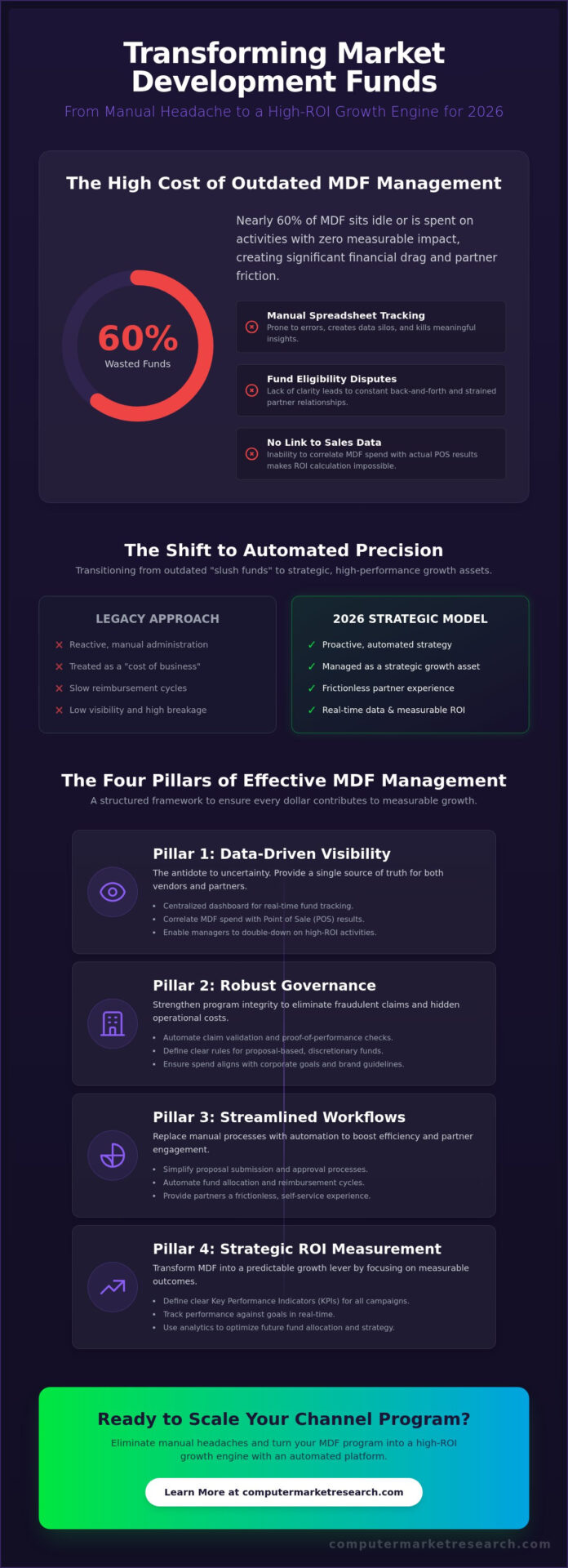
The Four Pillars of Effective MDF Management
Learning how to manage market development funds effectively requires a shift from reactive administration to proactive strategy. As we look toward 2026, manufacturers must move beyond the “death of the spreadsheet” to embrace a structured framework. This framework rests on four essential pillars that ensure every dollar spent contributes to measurable growth rather than disappearing into administrative black holes. By focusing on these core areas, sales operations professionals can transform MDF from a complex headache into a high-performance engine.
Pillar 1: Data-Driven Visibility
Visibility is the antidote to uncertainty. A centralized dashboard provides both the vendor and the partner with a real-time view of fund availability and utilization rates. By integrating your fund management with channel data management, you gain the ability to correlate spend with actual Point of Sale (POS) results. In the context of fund allocation, decision-grade insights are defined as validated, real-time datasets that allow managers to stop funding underperforming campaigns and double down on high-ROI activities. This level of transparency ensures that 100% of your budget is accounted for at any given moment.
Pillar 2: Robust Governance and Compliance
Governance shouldn’t be a bottleneck; it’s a safeguard. Automated auditing tools now prevent common issues like “double-dipping,” where a partner might claim the same expense across multiple vendors. By standardizing proof-of-performance (PoP) requirements, you create a level playing field for all partners. Clear, pre-defined rules of engagement are essential for improving your channel performance because they reduce the friction often found in the reimbursement phase. When partners know exactly what documentation is required, dispute rates typically drop by as much as 25%, fostering a relationship built on trust rather than administrative conflict.
Pillar 3: Strategic Alignment
MDF is often wasted when partner activities don’t mirror the manufacturer’s global strategic goals. If your 2026 focus is on cloud migration, but your partners are using funds for legacy hardware promotions, the misalignment drains resources. Alignment ensures that localized marketing efforts support the broader corporate narrative. Effective managers use pre-approved campaign templates to guide partners toward strategic priorities, ensuring that 85% or more of fund usage directly supports primary product launches or specific market entries.
Pillar 4: End-to-End Automation
Manual data entry is a primary obstacle to scale. Automation removes the human error factor from the claim and reimbursement cycle; it’s the difference between a 30-day payout and a 5-day payout. According to 2024 industry benchmarks, manual MDF processing carries an average error rate of 15%, leading to significant financial leakage. If you’re ready to eliminate spreadsheet fatigue, exploring automated incentive platforms can provide the necessary infrastructure to scale. By digitizing the workflow, you ensure that how to manage market development funds effectively becomes a matter of clicking a button rather than chasing paperwork.
Overcoming the ‘Headache’ of Manual Spreadsheet Tracking
The Risks of Inaccurate Data in MDF Auditing
Manual auditing is prone to errors that directly impact the bottom line. A single data entry mistake can lead to a 5% overpayment on a claim or trigger partner frustration when reimbursements are delayed by 45 days. There’s also the persistent danger of “zombie funds.” These are budgets allocated to specific partners that sit unspent for months. Without real-time visibility, this capital can’t be redeployed to higher-performing activities. Clean Point of Sale (POS) data acts as the definitive record. It validates marketing claims by matching them against actual inventory movement. This level of scrutiny is vital when navigating the challenges of marketing through major mass retailers, where promotional spending must be tied to clear, verifiable outcomes.
Moving Toward the ‘Death of the Spreadsheet’
Spreadsheets are the number one obstacle to scaling a channel. They are static, siloed, and inherently unreliable for high-stakes financial auditing. They represent a legacy mindset that prioritizes “getting by” over actual optimization. The solution lies in moving to a centralized partner relationship management (PRM) system. This shift replaces disconnected files with a cloud-based platform that ensures “one version of the truth.” When every stakeholder views the same real-time data, the audit process becomes a strategic review rather than a forensic investigation. This infrastructure provides the stability and accuracy required to ensure that every dollar spent is a dollar accounted for. It’s the only way to maintain control as your partner ecosystem expands.
- Eliminate Data Silos: Centralize all partner claims and sales data in one location.
- Reduce Audit Time: Automate the validation of receipts and proof of performance.
- Reclaim Capital: Identify unspent funds early to reallocate them to top-tier partners.
- Improve Accuracy: Use POS data to ensure claims reflect actual market activity.
A 5-Step Framework for Executing High-ROI MDF Campaigns
Transitioning from manual oversight to an automated system is the only way to ensure your marketing spend delivers measurable results. To understand how to manage market development funds effectively, manufacturers must adopt a rigorous, five-step framework that prioritizes data integrity and partner accountability. This structured approach eliminates the “black hole” of marketing spend, replacing it with a transparent, results-driven lifecycle.
Step 1 & 2: Planning for Success
Success begins by moving beyond generic brand awareness. You must define SMART KPIs before a single dollar is allocated. For example, focus on generating a specific lead volume, such as 50 qualified leads per $5,000 spent, rather than vague engagement metrics. High-performing programs in 2026 utilize tiered fund allocation, where 65 percent of the budget is reserved for top-tier partners who consistently hit a 3x return on spend. This incentivizes performance while protecting your capital.
- Define Eligibility: Establish clear, non-negotiable rules on what activities qualify for funding.
- Streamline Proposals: Replace fragmented email chains with a centralized partner portal. A user-friendly interface reduces administrative friction, often leading to a 40 percent increase in partner participation rates.
During the campaign lifecycle, you must implement real-time performance tracking. If a partner’s digital campaign fails to reach 50 percent of its registration target halfway through the cycle, your team has the data to intervene or reallocate the remaining budget to more productive channels. This agility prevents wasted spend and keeps your channel strategy on track.
Step 4 & 5: Closing the Loop with ROI
The final stages of the framework focus on financial accuracy and long-term strategy. Automating the claims and reimbursement cycle is critical for partner retention. Partners lose interest when payouts take months; aim for 48-hour ACH processing to maintain high levels of engagement. It is also vital to correlate these expenditures with other channel incentive programs to determine the total partner cost of sale across all initiatives.
Conduct a thorough post-mortem analysis by integrating Ship & Debit data. This allows you to verify that discounted inventory actually moved during the campaign period. By comparing Point of Sale (POS) data against MDF claims, you can eliminate up to 15 percent of fraudulent or “lazy” fund usage. This level of technical visibility transforms MDF from an opaque expense into a strategic growth lever. When you master how to manage market development funds effectively, your channel data becomes your most valuable asset.
Ready to eliminate spreadsheet errors and gain full visibility into your channel spend? Automate your MDF management with our specialized solutions today.
Scaling Your Program with CMR’s Automated MDF Platform
Manual management often turns market development funds into a logistical nightmare of fragmented spreadsheets and audit risks. Computer Market Research (CMR) eliminates this friction through PartnerPortal™, a web-based environment built to automate the entire lifecycle of fund allocation. Manufacturers often struggle with how to manage market development funds effectively when they rely on manual data entry. CMR provides a clear path out of that operational headache by centralizing all partner activities in a single, secure cloud-ready infrastructure.
Flexibility is a core component of the CMR philosophy. The platform’s modularity allows you to start by solving your most immediate MDF challenges and later expand into full channel management as your indirect sales volume grows. As a reliable specialist with over 40 years of experience in channel data, CMR handles the heavy lifting of data cleansing and normalization. This process removes the “noise” from distributor reports, ensuring your team works with clean, actionable insights rather than corrupted data sets that lead to overpayments.
Key Features of the CMR Co-op/MDF Module
The module is designed to replace the “death by spreadsheet” culture with structured, automated workflows. Key technical capabilities include:
- Automated Claim Submission: Partners submit claims through a standardized interface, triggering multi-level approval workflows that ensure compliance without manual follow-ups or lost emails.
- Real-Time Tracking: Both manufacturers and partners gain instant visibility into fund balances, pending claims, and expiration alerts. This transparency prevents “use it or lose it” fund waste at the end of the fiscal year.
- POS Data Integration: By connecting fund usage directly to Point of Sale data, the platform generates automated ROI reporting. You’ll see exactly which activities drive revenue and which partners deserve higher allocations.
The Business Outcome: Accuracy, Speed, and ROI
The transition to an automated system isn’t just about software; it’s about reclaiming your team’s bandwidth. Implementing CMR’s platform can reduce administrative overhead by up to 50%, allowing your sales operations team to focus on high-level strategy. This shift ensures that your program remains scalable and audit-ready at all times. When you understand how to manage market development funds effectively through automation, you replace operational chaos with a disciplined system of order and performance. CMR acts as the pragmatic partner that bridges the gap between raw data and profitable channel relationships.
Ready to eliminate manual errors and gain total visibility into your channel spending? Schedule a demo of CMR’s MDF Management Platform today.
Future-Proof Your Channel Strategy for 2026
Transitioning from manual tracking to an automated framework isn’t just a convenience; it’s a requirement for 2026 growth. You’ve seen how the four pillars of fund management and a structured five-step execution plan can transform your channel’s performance. Learning how to manage market development funds effectively means moving beyond the “spreadsheet headache” that causes human error and data silos. By prioritizing clean data and automated workflows, you eliminate the friction that holds back distributor relationships.
Computer Market Research has been processing channel data for Fortune 500 companies since 1984. Our cloud-based PartnerPortal™ replaces fragmented workflows with real-time visibility into fund utilization and ROI. By centralizing your data, you gain the actionable insights needed to scale your program without the operational friction of manual entry. It’s time to replace outdated habits with a system built for technical precision and stability. You can gain total control over your channel spending starting today.
Request a demo of our automated MDF management platform to start optimizing your channel performance.
Frequently Asked Questions
How do I calculate the ROI of my market development funds?
ROI is calculated by dividing the net profit generated from a specific partner campaign by the total MDF investment. For instance, a 2025 industry benchmark suggests that top-tier vendors target a 5:1 return ratio. To ensure accuracy, you must track lead conversion rates and closed-won revenue directly linked to the funded activity. Automated tracking eliminates the 20% margin of error often found in manual spreadsheets.
What are the most common mistakes in MDF management?
The most frequent error is relying on manual spreadsheets, which leads to a 10% to 15% discrepancy in fund tracking. Other mistakes include failing to set clear KPIs before fund approval and allowing funds to expire unused. These operational gaps often result in underutilized budgets. If you want to know how to manage market development funds effectively, you must replace these fragmented processes with a centralized, automated system.
Can MDF management platforms integrate with my existing CRM?
Yes, modern MDF platforms integrate directly with leading CRM systems through secure API connections. This integration allows for real-time data synchronization between partner activities and your sales pipeline. By connecting these systems, 90% of manual data entry is eliminated. This ensures that every dollar spent is visible within your primary system of record, providing a single source of truth for channel performance.
What is the difference between proposal-based and performance-based MDF?
Proposal-based MDF requires partners to submit a marketing plan for approval before any funds are committed. In contrast, performance-based funds are earned as a percentage of sales, typically ranging from 1% to 3% of total revenue. Proposal-based models offer more control over strategic alignment. Performance-based models reward high-volume partners automatically. Most 2026 channel strategies utilize a hybrid approach to balance growth and brand consistency.
How can I prevent fraud in my partner marketing fund program?
Preventing fraud requires a strict Proof of Performance verification process for every claim. Implementing automated auditing can flag duplicate invoices or suspicious claims, which account for roughly 5% of all channel fund requests. You should require digital copies of all marketing collateral and third-party receipts. Standardizing these requirements ensures that 100% of disbursements are backed by legitimate, verified marketing activities.
How much of my channel budget should be allocated to MDF vs. Co-op?
A typical channel budget allocates 60% to MDF for proactive market growth and 40% to Co-op funds for ongoing brand maintenance. MDF focuses on future-looking activities like lead generation webinars or new product launches. Co-op funds are usually accrual-based and support localized advertising. Adjusting this ratio based on partner tiering ensures that high-growth partners receive the strategic support they need to expand market share.
What are ‘Proof of Performance’ (PoP) requirements for MDF?
Proof of Performance requirements are the mandatory documents partners must submit to prove a marketing activity occurred. This includes items like screenshots of digital ads, attendee lists from events, or copies of direct mailers. Without these 3 specific pieces of evidence, claims shouldn’t be approved. Standardizing PoP requirements reduces audit risk and ensures that your organization remains compliant with internal financial controls.
How does automation speed up the partner reimbursement process?
Automation reduces the partner reimbursement cycle from an average of 45 days to under 10 days. By using a cloud-based portal, partners submit claims digitally, and the system validates them against pre-set rules immediately. This rapid turnaround increases partner satisfaction scores by 30% or more. Learning how to manage market development funds effectively involves prioritizing these speed gains to keep your partners engaged and motivated.

Article by
Del Heles
Del Heles is the founder and CEO of Computer Market Research (CMR), a channel management software company he launched in 1984. With more than 40 years of experience, he’s known for helping manufacturers and distributors simplify complex partner programs through practical, customer-focused technology solutions.