

Most organizations treat their partner onboarding process as a simple administrative checklist, yet this narrow view is exactly why high-potential channel relationships often stall before they ever generate a single lead. In an era where regulatory shifts like the 2026 EEOC National Enforcement Plan and state-level pricing transparency laws demand absolute data accuracy, relying on manual workflows is a liability. You likely recognize the frustration of managing fragmented spreadsheets and the slow time-to-market that occurs when new partners are left waiting for access to critical sales tools.
It’s clear that the traditional, manual approach to integration is no longer sustainable for firms aiming for serious scale. This article promises to help you master a framework for integrating high-performing channel partners through automated workflows and data-driven integration. We will examine how to replace legacy tracking methods with standardized systems that reduce onboarding time, eliminate manual errors, and provide seamless visibility into partner readiness. By the end of this guide, you’ll have a clear path to higher partner retention and more reliable financial data through a modernized infrastructure.
Key Takeaways
- Transition from traditional training methods to a data-first integration strategy to meet the rigorous compliance and transparency standards of 2026.
- Identify and resolve common operational friction points that lead to partner drop-off by implementing automated deal registration and lead management workflows.
- Establish a scalable partner onboarding process using tier-based requirements and self-service environments to reduce manual errors and accelerate time-to-market.
- Centralize administrative compliance and legal documentation to ensure a standardized, audit-ready experience for every new collaborator.
- Leverage integrated platforms like PartnerPortal™ to unify onboarding, incentive management, and performance tracking into a single, cohesive ecosystem.
What is a Partner Onboarding Process in 2026?
In 2026, a partner onboarding process is no longer a simple orientation session or a series of generic training videos. It’s the rigorous, end-to-end integration of a third-party collaborator into your operational sales and data ecosystem. While legacy models focused on “training-first” education, modern market demands require a “data-first” approach. This shift ensures that every member of your strategic alliances is operationally ready to handle complex compliance requirements, such as the 2026 “All-In” pricing mandates or shifting EEOC enforcement priorities. Organizations that fail to prioritize this structural integration often find themselves managing a network of inactive partners rather than a productive sales engine.
To better understand the nuances of building a modern integration workflow, watch this helpful video:
The Shift from Manual to Automated Integration
Key Stakeholders in the Onboarding Journey
Effective integration requires clear role definition across several internal and external teams. Channel managers oversee the relationship, while operations teams ensure the technical plumbing is functional. By utilizing a centralized partner relationship management strategy, organizations can align marketing and sales goals from day one. This alignment is critical for setting up functional deal registration and lead management systems. When everyone understands their role, the transition from a prospect to a high-performing partner becomes a predictable, repeatable journey.
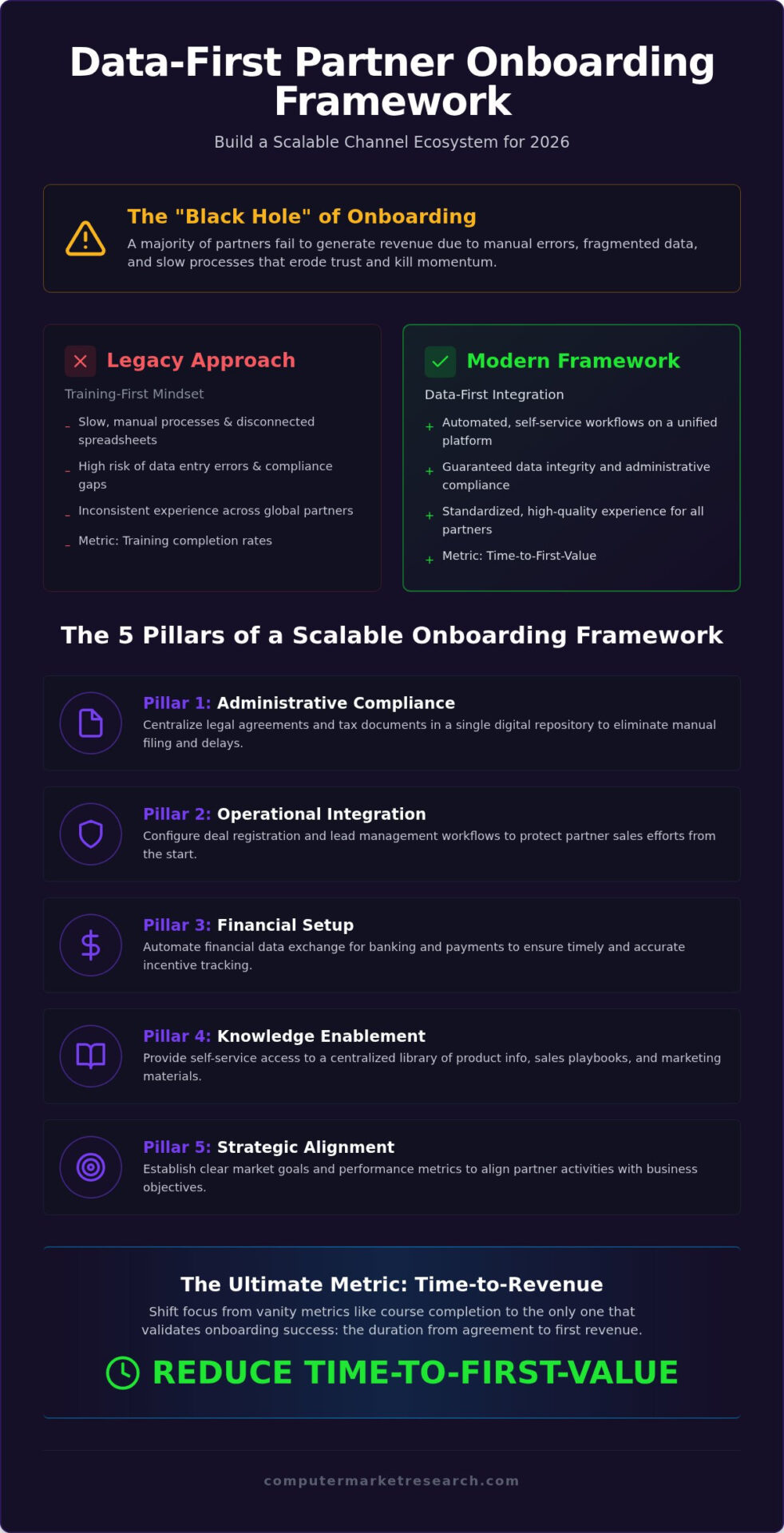
The 5 Pillars of a Scalable Onboarding Framework
Building a scalable partner onboarding process requires a transition from ad-hoc checklists to a structured, data-driven framework. This approach ensures that every new relationship begins with a clear operational foundation, minimizing the friction that often kills momentum in the early stages of a partnership. By focusing on these five pillars, organizations can create a predictable path to revenue that remains stable even as the channel grows in complexity.
- Administrative Compliance: Centralizing legal agreements and tax documentation is essential for navigating the complex regulatory landscape of 2026. This includes ensuring partners are prepared for state-specific requirements, such as Connecticut’s “All-In” pricing mandates that took effect on July 1, 2026.
- Operational Integration: Establishing clear workflows for deal registration and lead management ensures that partners can interact with your systems without constant manual intervention.
- Financial Alignment: Configuring market development funds (MDF) and rebate structures from day one provides the immediate financial incentive necessary to drive early engagement.
- Performance Baseline: Establishing KPIs and data reporting standards during the initial setup allows you to track progress against benchmarks and intervene if a partner falls behind.
Operational Integration and Deal Protection
Deal registration is the primary tool for protecting partner investments and is often the first system a partner must master. When automated rules of engagement are clear, you significantly reduce channel conflict and build long-term trust. Integrating this onboarding data directly with your existing CRM and ERP systems creates a single source of truth. This technical cohesion ensures that sales opportunities are tracked accurately from the moment they are registered, providing the visibility needed to forecast channel revenue with confidence.
Financial Readiness: MDF and Incentives
Setting up co-op and MDF accounts during the initial stages of the partner onboarding process is a powerful way to drive immediate marketing activity. Partners who see an active balance and a clear path to earning rebates are far more likely to commit their own resources to your brand. Automated co-op/MDF management reduces administrative overhead by 40%. This efficiency allows your operations team to spend less time on paperwork and more time on strategic growth. To see how these systems can streamline your financial workflows, you can explore these automated workflows as part of your modernization strategy.
Overcoming Operational Friction in Partner Onboarding
Even a well-structured training program cannot prevent a partner onboarding process from stalling if the technical friction is too high. Many organizations identify a “Black Hole” in their channel journey, which is the specific period immediately following orientation where partner engagement often plummets. This usually occurs because the administrative burden of reporting and data entry outweighs the perceived value of the partnership. To sustain momentum, you must remove these operational barriers by focusing on the underlying data hurdles that prevent immediate productivity.
Data normalization is a persistent challenge for global channels where partners utilize disparate reporting standards and formats. If your infrastructure cannot ingest and cleanse this information automatically, your team will likely remain buried in manual corrections. Inaccurate point-of-sale (POS) and inventory data are particularly damaging during these early stages. When new partners cannot see real-time stock levels or receive accurate credit for their sales, they lose confidence in the relationship. High-quality information provides the necessary foundation for brand consistency across decentralized teams, ensuring that every partner operates with decision-grade accuracy.
Data Transparency as a Relationship Builder
Trust is a byproduct of transparency. Providing partners with real-time access to their performance data fosters a sense of accountability that manual spreadsheets cannot replicate. By implementing robust channel data management, you can identify early success patterns and replicate them across the network. Eliminating the manual reporting burden is essential for driving adoption. When partners are freed from the task of formatting complex reports, they can focus entirely on market expansion and customer acquisition.
Managed Data Services for Global Channels
Step-by-Step Guide to Automating Your Onboarding Workflow
- Step 1: Define Partner Personas: Segment your partners by type, such as distributors, resellers, or service providers. This ensures the workflow only presents relevant requirements and documentation to each group.
- Step 3: Automate Compliance Workflows: Use digital signature tools and automated document collection to handle legal and tax filings. This is critical for managing the regulatory shifts seen in 2026, such as the new EEOC enforcement priorities.
- Step 4: Deploy Trigger-Based Enablement: Deliver training modules based on specific milestones. If a partner completes their profile, the system automatically unlocks the next level of technical training.
- Step 5: Launch Automated Incentives: Connect onboarding completion directly to your financial systems to grant immediate access to MDF and rebate programs.
Configuring the Self-Service Portal
A branded partner portal software serves as the digital front door to your brand. It must offer more than just a document repository. A high-performing portal includes a personalized dashboard, a searchable resource library, and an automated help desk to resolve technical issues instantly. In 2026, mobile accessibility is non-negotiable. Partners in the field require immediate access to deal registration and lead data to remain competitive. You can start building your automated portal today to see how these features eliminate manual bottlenecks.
Measuring Onboarding Success
Tracking the right metrics is the only way to ensure your automation strategy is working. The most critical KPI is “Time to First Deal.” This metric measures the efficiency of your entire ecosystem. If this window is too long, you likely have a bottleneck in your enablement or technical setup. Use partner feedback loops to identify where users are getting stuck in the automated workflow. Analyzing portal login frequency and module completion rates provides a clear view of partner engagement. High engagement early in the relationship is a strong predictor of long-term retention and revenue growth.
Leveraging PartnerPortal™ for Seamless Integration
Computer Market Research (CMR) addresses the fragmentation of indirect sales by centralizing the entire onboarding lifecycle within PartnerPortal™. For Global 2000 firms, the challenge isn’t just signing new partners; it’s the operational burden of integrating them into a complex data ecosystem. This unified platform consolidates deal registration, MDF management, and performance tracking into a single interface. By utilizing expert-led integration services, organizations can significantly reduce the technical implementation time that typically stalls channel growth. This systematic approach ensures that the partner onboarding process transitions from a manual hurdle to a strategic advantage.
Centralizing Indirect Sales Operations
Fragmentation is the primary enemy of accuracy. By establishing a single source of truth, PartnerPortal™ eliminates the data silos that often lead to overpayments or missed sales opportunities. The system handles complex global incentive programs automatically, ensuring that rebates and Co-op/MDF Management follow strict compliance rules without manual oversight. This level of automation is essential for maintaining margins in high-volume environments. PartnerPortal™ provides real-time visibility into channel inventory and performance, allowing managers to make data-driven decisions based on actual market movement rather than delayed reports.
Ready to Modernize Your Onboarding?
Staying with legacy manual processes in an AI-driven market creates a liability that most growing firms can’t afford. Manual errors in POS data or incentive tracking don’t just cost money; they erode the trust that is foundational to any successful partnership. Transitioning from spreadsheets to a modernized SaaS infrastructure is the only way to ensure your partner onboarding process remains scalable. Your next step should be a thorough audit of your current workflow to identify specific automation opportunities. Assessing where manual data entry causes the most friction will provide a clear roadmap for modernization. You can explore the full capabilities of PartnerPortal™ to see how a centralized system can transform your channel operations.
Future-Proofing Your Channel Strategy
Refining your partner onboarding process is more than an operational upgrade; it’s a commitment to long-term channel health. By moving from fragmented spreadsheets to a centralized, data-driven framework, you eliminate the friction that causes high-value partners to disengage. Success in 2026 depends on your ability to automate compliance, financial alignment, and technical integration from day one. As you integrate more collaborators, protecting your brand’s integrity becomes even more complex; for instance, you can check out openSquat to monitor for brand impersonation through newly registered domain threats.
Computer Market Research has served Global 2000 companies since 1984, providing a comprehensive suite for MDF, Rebates, and Deal Registration. Our expert-led technical integration ensures that your PartnerPortal™ works seamlessly with existing CRM and ERP systems, providing the stability and accuracy your operations demand. Don’t let legacy methods hinder your growth in an increasingly complex market.
Take the first step toward a more efficient sales ecosystem today. Request a Demo of PartnerPortal™ to Automate Your Onboarding and discover how modernized workflows can accelerate your time-to-revenue. Your path to a scalable, high-performing channel starts with the right infrastructure.
Frequently Asked Questions
How long should a typical partner onboarding process take?
A high-performing partner onboarding process typically takes between 30 and 90 days, though automated systems can significantly reduce this window. The exact timeline depends on the complexity of the technical integration and the partner’s specific tier. Efficiency is achieved when administrative hurdles are cleared quickly, allowing the partner to focus on their initial sales activities and technical training.
What is the difference between partner onboarding and employee onboarding?
Can we integrate partner onboarding with our existing CRM?
Modern onboarding systems are designed to integrate directly with established enterprise CRM and ERP platforms to ensure data continuity. This connection allows for the automated synchronization of lead data and deal registration records. By eliminating manual data entry between systems, organizations maintain a single source of truth for both internal sales teams and external channel partners.
What are the most important KPIs for measuring onboarding success?
Time-to-first-deal and portal engagement rates are the most critical KPIs for assessing the health of your partner onboarding process. You should also track module completion speed and the accuracy of initial POS data submissions. These metrics provide a clear indication of whether a partner is operationally ready or if they’ve stalled in the administrative bottlenecks mentioned earlier.
How do I ensure partners actually use the onboarding portal?
Tying financial incentives and lead access directly to portal activity is the most effective way to drive adoption. If partners must use the portal for deal registration or to claim MDF, they’ll naturally integrate it into their daily workflow. Providing a streamlined, mobile-accessible interface also reduces the friction that typically leads to portal abandonment in the field.
What documents are required for partner compliance during onboarding?
Compliance requirements generally include signed partnership agreements, tax documentation, and non-disclosure agreements. In 2026, you must also ensure partners acknowledge specific regional pricing mandates and labor standards. Centralizing these documents in a secure digital environment ensures that all legal requirements are met before the partner begins active selling.
How does automation improve the partner experience?
Automation removes the repetitive administrative tasks that lead to onboarding fatigue and operational frustration. It provides partners with instant access to resources and real-time visibility into their incentive status. By replacing slow email exchanges with trigger-based workflows and intelligent platforms like Rep AI, you demonstrate professional competence and respect for the partner’s time, which builds long-term loyalty and trust.
What is the cost of implementing a partner onboarding system?
The cost of implementation varies based on the scale of your channel and the depth of technical integration required with your existing infrastructure. While initial setup involves software licensing and configuration fees, the long-term return is found in reduced administrative overhead and faster time-to-revenue. Organizations should evaluate the investment against the cost of manual errors and lost productivity in legacy systems.

Article by
Del Heles
Del Heles is the founder and CEO of Computer Market Research (CMR), a channel management software company he launched in 1984. With more than 40 years of experience, he’s known for helping manufacturers and distributors simplify complex partner programs through practical, customer-focused technology solutions.