

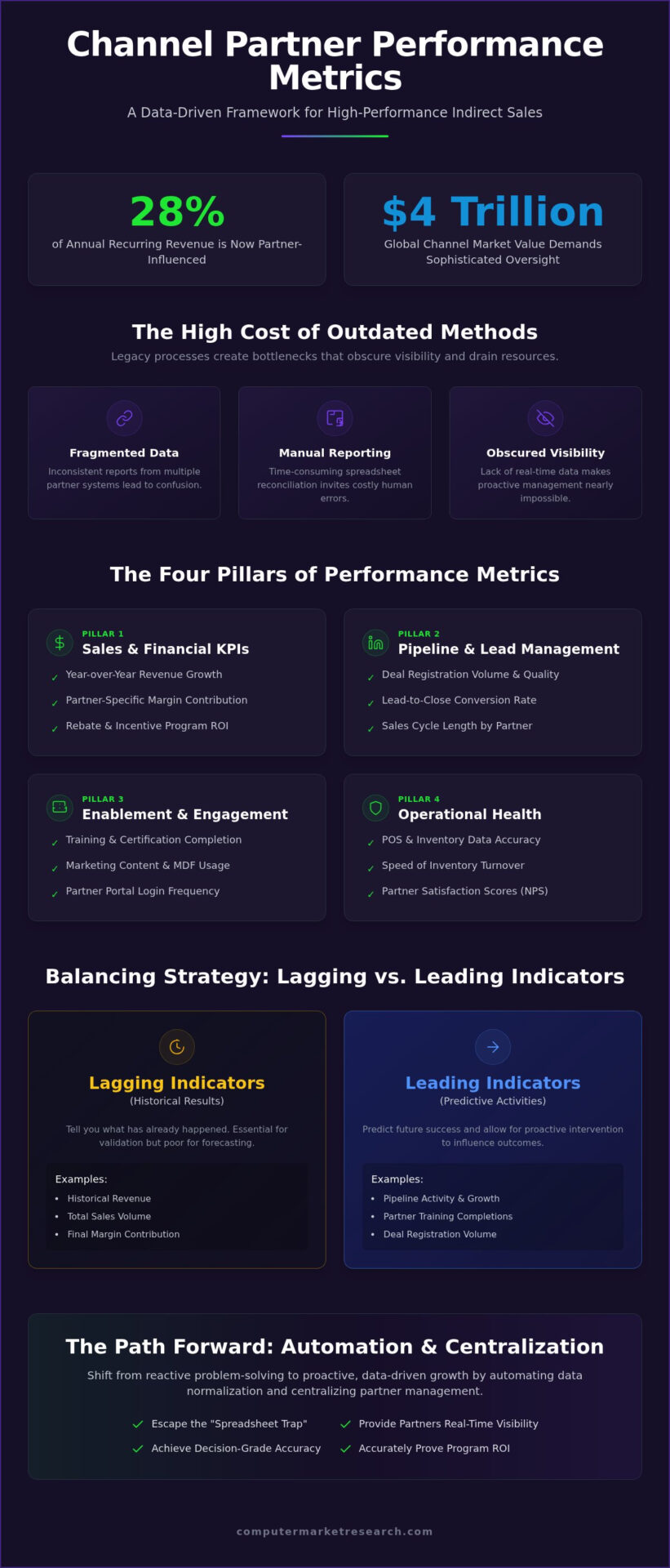
Did you know that partner-influenced attribution now accounts for up to 28% of total annual recurring revenue? Despite this massive contribution to the bottom line, many Global 2000 companies still struggle with fragmented data and manual reporting errors. Establishing a sophisticated framework for channel partner performance metrics is no longer optional if you want to maintain a competitive edge in a $4 trillion global channel market. Relying on legacy processes creates operational bottlenecks that obscure your real-time visibility and make it nearly impossible to prove the ROI of your incentive programs.
We understand the frustration of reconciling inconsistent reports from multiple partner systems. It’s a time-consuming burden that drains your team’s resources and leads to inaccurate decision-making. This guide provides a clear path out of that data chaos. You’ll learn how to master critical KPIs and implement automated tracking methods that normalize your POS and inventory data. We’ll explore the essential metrics for 2026 and demonstrate how to transform your indirect sales channel into a high-performance, accountable revenue engine that delivers measurable results.
Key Takeaways
- Shift from subjective assessments to a precise framework for channel partner performance metrics to ensure your indirect sales strategy remains grounded in objective data.
- Learn to balance lagging indicators like historical revenue with leading indicators such as pipeline activity to gain a predictive view of your partner ecosystem’s health.
- Don’t let the “spreadsheet trap” compromise your reporting; automate the normalization of complex POS and inventory data for decision-grade accuracy.
- Centralize your management efforts within PartnerPortal™ to provide partners with real-time visibility into their own KPIs and incentive progress.
- Drive higher accountability across your network by replacing manual tracking with automated systems that accurately prove the ROI of your MDF and rebate programs.
Why Channel Partner Performance Metrics Matter in 2026
In a global market where channel sales value exceeds $4 trillion, relying on anecdotal evidence to manage your indirect sales force is a liability. Understanding What is a Channel Partner? within your specific ecosystem is the first step toward optimization. By definition, channel partner performance metrics are the quantitative data points used to evaluate partner efficiency and contribution. These indicators move your strategy beyond “gut feel” and into a space of technical precision. Data wins every time. In 2026, the speed of business requires real-time visibility. Waiting for historical monthly snapshots often means you’re reacting to problems that occurred weeks ago, which is an unacceptable risk for high-growth organizations.
The Shift from Passive to Proactive Management
Modern channel management has evolved from a reactive discipline to a proactive science. When you track performance in real time, you can identify underperforming territories before they impact quarterly targets. This level of oversight is vital for Global 2000 companies managing thousands of unique relationships across diverse geographies. Decision-grade insights are accurate, normalized data ready for immediate strategic action. By utilizing channel data management systems, organizations can strip away the noise of raw data to reveal the actual performance trends that matter. This clarity enables managers to intervene early, offering targeted support or training where it’s needed most.
The Cost of Ignoring Partner Performance Data
Ignoring the granular details of partner performance leads to significant financial leakage. Wasted MDF spend is a primary culprit, as funds are often funneled toward partners who fail to convert leads or drive incremental growth. Additionally, poor visibility into deal registration creates unnecessary channel conflict, pitting partners against each other or your internal sales team. Manual data reconciliation acts as an operational bottleneck, forcing highly skilled professionals to spend hours in spreadsheets rather than focusing on strategic growth. These legacy processes are the primary obstacles to scaling a modern channel program. Without automation, the administrative burden of managing complex data becomes a ceiling on your potential ROI.
The Four Pillars of Channel Partner Performance Metrics
Measuring year-over-year revenue growth per partner segment allows you to identify which tiers of your network are truly expanding. It’s not enough to see a top-line number. You must calculate partner-specific margin contributions to understand the actual profitability of each relationship. High-volume partners with low margins may require different incentive programs for channel partners compared to niche experts. Evaluating the effectiveness of rebates & incentives on sales volume helps you fine-tune your financial investments to ensure they drive the desired behavior without eroding profit.
Pipeline and Lead Management Metrics
Forward-looking organizations prioritize lead-to-opportunity conversion rates for all distributed leads. This metric highlights which partners are actively pursuing the business you provide and which are letting leads go cold. Additionally, tracking the average time from deal registration to close provides critical insights into the velocity of your sales cycle. If a partner’s pipeline coverage ratio is low, it serves as an early warning sign for future quarterly performance dips. Maintaining this visibility prevents end-of-quarter surprises and allows for proactive territory adjustments.
Enablement and Engagement Tracking
Partner engagement is a leading indicator of future sales success. By monitoring portal login frequency and resource download activity, you can gauge the commitment level of your network. There is often a direct correlation between partner training completion and subsequent sales performance. Measuring the adoption of co-op/MDF programs reveals whether your marketing support is reaching its intended target. If you’re ready to move beyond manual tracking, you can start your 90-day free trial to automate these complex data points. These engagement metrics ensure that your partners are equipped with the technical knowledge necessary to represent your brand accurately.
Lagging vs. Leading Indicators in Channel Strategy
Distinguishing between lagging and leading indicators is essential for any resilient channel strategy. Lagging indicators tell you where you’ve been, while leading indicators show you where you’re going. Most legacy systems focus heavily on historical revenue, which is a lagging indicator. By the time a drop in revenue appears in your reports, the underlying cause has likely been festering for months. To maintain a holistic view of partner health, you must balance these results with proactive behaviors. Effective channel partner performance metrics utilize predictive data to identify “at-risk” partners before their performance impacts your quarterly bottom line.
Predicting Success with Leading Indicators
Leading indicators are the activities that drive future revenue. Training and certifications are among the most powerful predictors of success. Certified partners consistently outperform their untrained counterparts because they possess the technical depth to close complex deals. You can also use deal registration volume as a reliable 6-month revenue predictor. If registration numbers dip, a revenue shortfall is inevitable. Tracking the velocity of leads through the partner portal provides immediate feedback on partner engagement. When leads stall in the pipeline, it signals a need for intervention or additional support. High-performance teams prioritize these channel partner performance metrics to stay ahead of market shifts. This proactive stance allows managers to allocate resources to the partners showing the most promise.
Analyzing ROI with Lagging Indicators
While leading indicators predict the future, lagging indicators are necessary to evaluate the financial impact of your investments. This analysis is critical for calculating the true ROI of your market development funds. If a partner consumes significant MDF but shows no historical revenue growth, your allocation strategy requires adjustment. Similarly, evaluating the impact of ship & debit programs on market share helps you determine if your pricing concessions are yielding a competitive advantage. Historical trend analysis of partner tier migrations also reveals the long-term health of your ecosystem. Partners who consistently move up tiers demonstrate a sustainable growth trajectory, whereas those who stagnate may be poorly aligned with your brand’s evolving goals. Analyzing these historical trends ensures that your incentives remain targeted toward the partners who deliver the highest value. This retrospective view provides the evidence required to justify channel spend to executive leadership.
Overcoming the Data Burden: Automation and Normalization
The “spreadsheet trap” is a quiet killer of channel efficiency. When you rely on manual data entry, you’re essentially choosing inaccuracy. Fragmented information across multiple partner systems makes it impossible to maintain a clear view of your channel partner performance metrics. For Global 2000 companies, the challenge is compounded by the need to reconcile data across different regions, time zones, and currencies. Accuracy isn’t a luxury; it’s a requirement for global financial compliance. Technical competence in channel data management is the only way to solve this at scale. Managed Data Services take the administrative burden off your team by cleansing and normalizing raw POS reports, ensuring every line item is verified before it reaches your dashboard.
Automating POS and Inventory Data
Eliminating the manual reconciliation of partner sales reports is the first step toward operational stability. You can’t manage what you can’t see. Automation provides real-time visibility into channel inventory levels. This visibility allows you to optimize stock across the network, reducing carrying costs and improving partner satisfaction. For physical retail locations, solutions from Footfall Australia can complement this by providing real-time visitor metrics to help calculate conversion rates. Automated ship & debit tracking is equally vital. It ensures that every claim is validated against actual POS data, which prevents the expensive overpayments that often plague manual systems. This systematic approach transforms your financial tracking from a reactive chore into a disciplined strategic advantage.
The Role of SaaS in Data Normalization
Modern SaaS solutions are designed to handle the complexity of standardizing data formats from hundreds of different partner systems. Legacy data management often suffers from high error rates because it can’t scale with the diversity of partner reporting styles. “Automated data normalization turns fragmented partner reports into a single, reliable source of truth for global enterprises.” By reducing these errors, you ensure that your channel partner performance metrics are based on high-quality information. This creates a foundation of trust between you and your partners, as they see that their performance is being measured accurately. If you’re ready to modernize your infrastructure and remove the data burden, claim your 90-day free trial and experience decision-grade insights firsthand.
Optimizing Partner Performance with PartnerPortal™
Centralizing your strategy requires more than just clean data; it requires a unified interface where that data becomes actionable. Legacy systems often fail because they don’t bridge the communication gap between the manufacturer and the partner. By centralizing all channel partner performance metrics in one PartnerPortal™, you create a transparent environment where everyone works from the same set of facts. CMR automates the entire incentive and rebate lifecycle, which removes manual friction and drives long-term partner loyalty. Integrating this performance data with MDF and lead management modules provides a 360-degree view of the relationship. This ensures that your strategic decisions are based on the complete partner story rather than isolated snapshots.
Real-Time Visibility for Channel Leaders
Global enterprises need to access performance data from a single cloud-based dashboard to maintain control over diverse markets. You can’t manage thousands of partners effectively if you’re hunting for reports in different silos. With modern channel partner management software, you can set automated alerts for performance threshold breaches. These notifications alert your team the moment a partner’s pipeline velocity drops or inventory levels spike. Customizing these reports for different executive stakeholders ensures that your leadership team gets the high-level ROI data they need while operations managers get the granular details required for daily optimization. This precision is what allows a business to scale without increasing its administrative head count.
Driving Partner Accountability
Transparency is a powerful motivator for any indirect sales force. Sharing channel partner performance metrics directly with your partners through personalized dashboards encourages self-optimization. When partners can see their own progress against KPIs in real time, they’re more likely to take proactive steps to improve their standing; for example, Wildberries sellers can check out wb2 to access a smart cabinet that provides real-time visibility into net profit for every item. This data provides a clear, objective justification for tier placements and incentive eligibility, which reduces disputes and builds trust across the network. Streamlining the onboarding process through a centralized portal also helps accelerate time-to-revenue for new partners. By providing immediate access to training and lead management tools, you ensure that every new relationship starts with a focus on measurable performance and high-quality information. This systematic approach transforms accountability from a point of conflict into a shared goal for growth.
Success in the modern channel ecosystem requires a shift from reactive reporting to proactive, data-driven management. By standardizing your channel partner performance metrics across the four pillars of sales, pipeline, enablement, and operations, you remove the guesswork from your growth strategy. You’ve seen how leading indicators like training completion and deal registration velocity provide the predictive power needed to identify at-risk territories before revenue declines. Data wins every time.
Manual spreadsheets are no longer a viable option for Global 2000 enterprises seeking true scalability. CMR brings over 40 years of automated channel management expertise to help you eliminate the administrative burden of fragmented data. Our comprehensive cloud-based suite is trusted by Fortune 500 companies to deliver decision-grade insights that drive measurable ROI across global markets. It’s time to replace legacy bottlenecks with a modernized infrastructure that empowers both your team and your partners. Scalability is non-negotiable. Start your transition to accurate, real-time analytics and reclaim control over your indirect revenue streams.
Request a Demo of PartnerPortal™ to Automate Your Metrics and begin optimizing your channel performance today.
Frequently Asked Questions
What are the most important channel partner performance metrics?
The most critical metrics are categorized into four pillars: sales, pipeline, enablement, and operational health. You should prioritize revenue growth, deal registration velocity, and lead-to-opportunity conversion rates to gauge financial and activity levels. Additionally, monitoring training completion and POS report accuracy ensures your partners are both capable and transparent. High-quality channel partner performance metrics provide a 360-degree view of partner contribution, allowing you to address underperforming territories before they impact your quarterly targets.
How do you measure the ROI of a channel partner program?
You measure ROI by comparing the net revenue generated by the channel against the total cost of program administration, including MDF, rebates, and internal overhead. It’s essential to track incremental growth rather than just total volume to ensure your incentives are driving new business. By automating your financial tracking, you can accurately attribute revenue to specific marketing funds and incentive programs. This level of precision allows you to justify every dollar spent to your executive leadership team.
What is the difference between leading and lagging channel indicators?
Lagging indicators represent historical data, such as total revenue or past sales volume, which confirm what has already occurred. In contrast, leading indicators are predictive behaviors like portal engagement, certification completion, and deal registration velocity. While lagging indicators are necessary for financial reporting, leading indicators are more valuable for proactive management. They allow you to identify at-risk partners and predict future revenue shifts at least six months in advance, ensuring a resilient and predictive channel strategy.
How often should you review channel partner performance metrics?
You should review operational metrics in real time through an automated dashboard to catch threshold breaches immediately. Strategic reviews with partners typically occur on a quarterly basis during Business Reviews to align on long-term goals and tier placements. However, the administrative burden of manual reporting often forces companies into monthly snapshots. Moving to a modernized system like PartnerPortal™ allows for continuous monitoring, which is essential for Global 2000 companies managing complex sales environments across multiple regions.
Can you automate the collection of POS data from partners?
Yes, you can automate the collection and normalization of POS data using specialized channel data management systems. These tools eliminate the spreadsheet trap by cleansing raw reports from hundreds of different partner systems into a single source of truth. Automation ensures that your channel partner performance metrics are based on accurate, verified information rather than manual entries prone to human error. This process is vital for validating ship and debit claims and preventing expensive overpayments.
What is the best way to track MDF program effectiveness?
The most effective way to track MDF is to link fund allocation directly to lead conversion rates and incremental revenue. You shouldn’t just track how much was spent, but rather the quality of the opportunities generated from those activities. By centralizing MDF management within a partner portal, you can monitor the entire lifecycle from fund request to proof of performance. This visibility ensures that your marketing investments are reaching partners who consistently convert leads into closed deals.
How does a partner portal help in measuring performance?
A partner portal like PartnerPortal™ centralizes fragmented data into a unified interface, providing both manufacturers and partners with real-time visibility into KPIs. It serves as a single version of truth that drives accountability across the network. Partners can access personalized dashboards to track their own progress toward incentive thresholds, while channel leaders can set automated alerts for performance breaches. This transparency reduces conflict and streamlines the reporting process for global organizations with complex partner ecosystems.
What are the common challenges in channel data management?
The most common challenges include fragmented data across disparate partner systems and high error rates associated with manual data reconciliation. Many manufacturers struggle with inconsistent reporting formats that make it impossible to normalize information for global analysis. Additionally, a lack of real-time visibility into channel inventory and POS data creates operational bottlenecks. Overcoming these hurdles requires shifting away from legacy processes and adopting automated systems that handle the administrative burden of data cleansing and verification.

Article by
Del Heles
Del Heles is the founder and CEO of Computer Market Research (CMR), a channel management software company he launched in 1984. With more than 40 years of experience, he’s known for helping manufacturers and distributors simplify complex partner programs through practical, customer-focused technology solutions.