

A partner advisory council creates value only when the company is ready to act on what it hears. Knowing how to run a partner advisory council starts with a clear purpose, a focused group of six to ten partners, and a process for turning their input into decisions.
The council is a sounding board for partner strategy, product direction, and go-to-market plans, not simply a forum for company updates. Members should bring a useful mix of partner types, regions, and business perspectives. Meetings should focus on real questions that leadership is prepared to consider.
This guide explains how to define the council’s objectives, select members, structure sessions, and follow up on feedback. It also covers when a council can help uncover partner friction and when it may be premature, so you can build a program that supports better decisions instead of adding another meeting to the calendar.
Key Takeaways
- Define the council’s mission around strategic decisions, such as partner programs, product direction, or go-to-market plans.
- Choose six to ten members for their strategic value, engagement, and representation of different partner types, regions, and business models.
- Use focused meetings with advance materials, clear objectives, and facilitation that gives partners room to contribute.
- Record feedback, assign follow-up actions, and report back on what changed or why a suggestion wasn’t adopted.
- Start a council when partner input can shape decisions and leadership is prepared to act; begin with individual conversations if the program is still taking shape.
What Is a Partner Advisory Board?
A partner advisory board gives channel leaders a structured way to inform partner strategy, product direction, and go-to-market decisions. Members share market insight and field experience, helping the company assess choices such as roadmap priorities before communicating them more broadly.
Council Membership and Partner Representation
Build the council around partners who can offer strategic insight, not simply those with the largest sales volume. A useful group represents different regions, partner types, and business models across the ecosystem. Six to ten members keeps the council small enough for discussion while allowing varied perspectives; a typical board has about 10 partners.
Consider senior leaders from partner organizations who understand both market conditions and their organization’s priorities. C-level executives from channel partners can discuss strategic issues, while members with direct operating experience can explain how a program or roadmap affects day-to-day work. Aim for complementary viewpoints, not several members with the same role or market focus.
Set expectations in a written charter. Define the council’s objectives, member criteria, size, meeting cadence, benefits, tenure, and the company’s responsibilities. Clear expectations help members understand whether they are advising on partner programs, product direction, or another defined priority. They also keep discussions focused and help protect sensitive business information.
Selecting and Rotating Members
Choose members for their strategic value, influence in the partner ecosystem, and willingness to engage. The channel team can identify candidates through existing relationships, then consider whether each brings a distinct regional, partner-type, or business-model perspective. A respected partner who contributes candidly may offer more useful input than a larger organization with limited participation.
Plan for member rotation every 12-24 months. A defined term gives members time to build context while creating opportunities to bring in new perspectives. Use the charter to set tenure and explain how transitions work; staggered changes can preserve continuity while refreshing representation. Review the mix against the council’s objectives before inviting replacements.
Participation takes preparation, candid discussion, and follow-through. Explain the expected contribution before inviting members, including the need to share relevant market insight and respect confidentiality. Recognize their time and input through appropriate acknowledgment, awards, or incentives. When possible, consider covering travel and hotel expenses for in-person participation. Clear expectations and recognition support a productive relationship without making membership a ceremonial title.
Meeting Frequency and Format
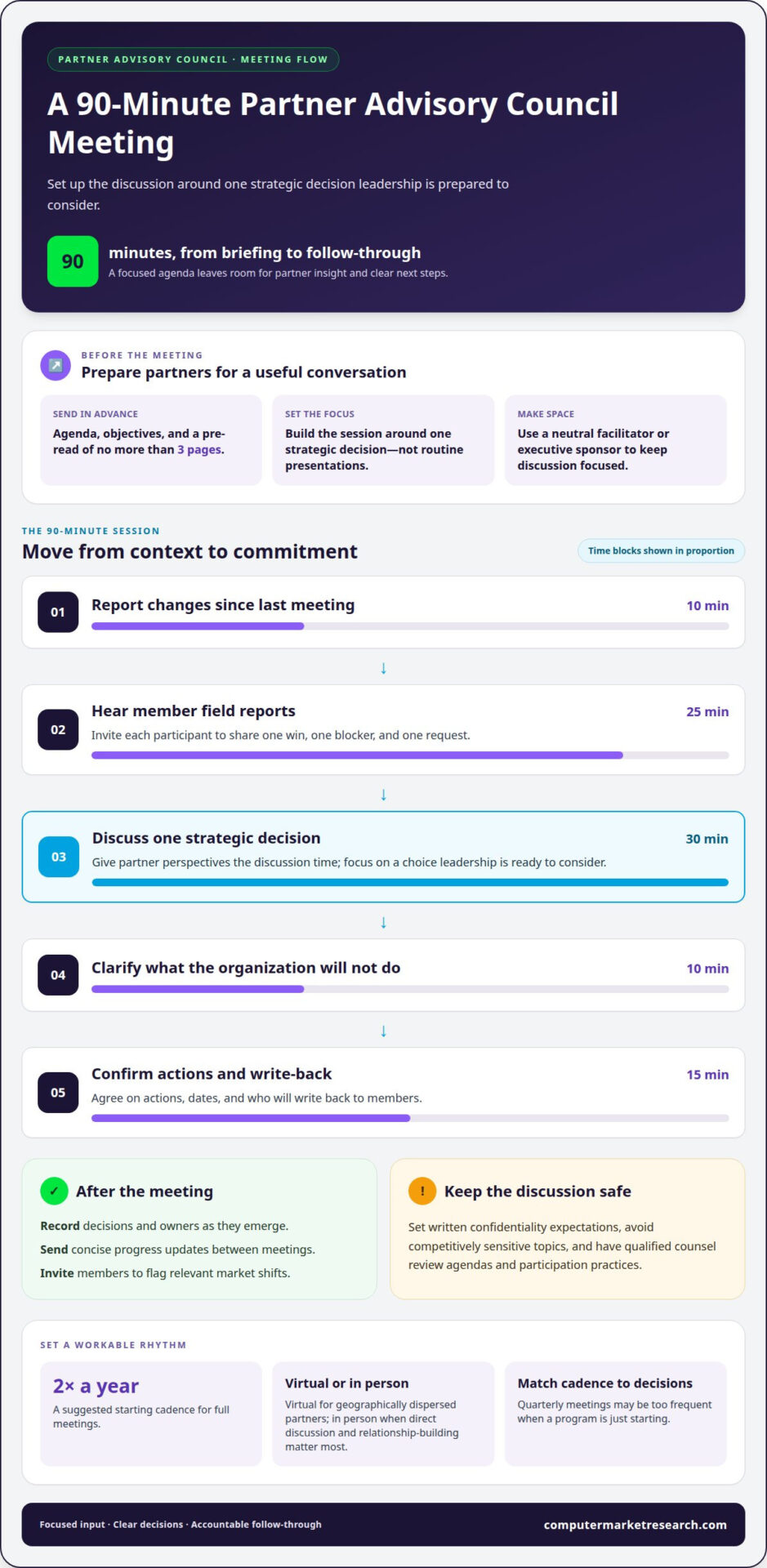
Start with two meetings a year, each lasting about 90 minutes. Choose virtual sessions when partners are geographically dispersed; use in-person meetings when direct discussion and relationship-building matter most. A consistent schedule lets members reserve time and prepare useful input.
Regional sessions can help a new council account for distinct market conditions. Quarterly meetings may be too frequent when a program is just starting, so set the cadence according to the decisions members can meaningfully influence. Between full sessions, use four quarterly check-ins per group rotation to maintain participation and track relevant changes.
Send the agenda, objectives, and a pre-read of no more than three pages before each meeting. Build the discussion around a strategic decision leadership is prepared to consider, rather than routine roadmap or enablement presentations. For a 90-minute session, allocate 10 minutes to report changes since the last meeting, 25 minutes for member field reports, and 30 minutes for one decision. Reserve 10 minutes to clarify what the organization won’t do, then use 15 minutes to confirm actions, dates, and who will write back.
A neutral facilitator or executive sponsor can keep discussions focused and give members room to contribute. Ask each participant to share one win, one blocker, and one request during the field report. Record decisions and owners as they emerge. Between meetings, send concise progress updates and invite members to flag relevant market shifts. These practices sustain engagement without creating unnecessary meetings.
In the US, legal and antitrust considerations depend on the participants and topics, so there is no universal protocol for every council. Set written confidentiality expectations, avoid discussing competitively sensitive information, and have qualified counsel review meeting agendas and participation practices.
Keep the council focused on its advisory role. Don’t combine it with customer advisory board attendees, and don’t use meeting time for presentations members can review beforehand. A short pre-read and clear decision prompt preserve discussion time for partner perspectives and strategic questions that need their input.
Partner Advisory Council Purpose
A partner advisory council gives channel leaders structured guidance on strategy, product direction, and go-to-market decisions. Measure its effectiveness by tracking whether member input informs decisions, actions, and partner-facing changes that align with its mission.
Defining the Council Mission
Write a mission statement before setting the agenda or inviting members. Identify the strategic questions the advisory board will address, such as validating roadmap decisions or shaping partner programs. A clear mission also shows leaders how to run a partner advisory council: it defines the scope of member guidance and keeps discussions tied to decisions.
Translate the mission into objectives leadership can review. For example, the council might assess a proposed partner benefit or identify how a channel program affects different business models. Ask members where they plan to invest over the next 3 years when long-term priorities are relevant. That discussion gives leadership market context for planning.
Use the mission to guide participation in both in-person and virtual sessions. If the council exists to inform go-to-market direction, focus the agenda on a decision or strategic tradeoff, not routine presentations. Review the mission as organizational priorities shift to keep member contributions relevant.
Purpose and Partner Benefits
The council serves as a sounding board for partner strategy, product direction, and go-to-market motions. Members can test assumptions, surface market insight, and help assess whether a proposed roadmap direction fits partner needs. Their experience can also help the company shape partner programs and benefits that reflect practical ecosystem conditions.
For partners, participation provides a direct forum to explain market shifts and operational concerns to decision-makers. Focused discussion lets members contribute beyond routine business reviews, while clear objectives show how their input relates to company priorities. The value comes from meaningful exchange, not simply access to a presentation.
In practice, knowing how to run a partner advisory council means connecting its guidance to the mission after every meeting. Record the input received, the decisions it informed, and the actions leadership took or declined, with reasons. Then assess whether those actions advance objectives, such as improving a partner program or refining product direction. This creates a practical record of the council’s contribution without treating every suggestion as a promised change.
Assess ROI through the traceable link between partner input and business decisions, not attendance alone. Compare documented outcomes with the council’s stated objectives, including changes made and unresolved issues that need further guidance.
Acting on Partner Feedback
Useful council feedback connects a specific partner experience to a decision the organization can consider. Discuss product concerns, program effectiveness, market shifts, and obstacles to partner engagement.
Ask questions that prompt concrete examples: Which process slows a deal? What makes a program difficult to use? What change would help partners serve customers more effectively? Invite each member to share one win, one blocker, and one request. This format keeps the conversation focused and makes feedback easier to compare across the group.
Review council comments alongside partner QBRs. If the same blocker appears in two or more partner QBRs, investigate whether it reflects shared field friction. Capture the affected process, partner context, and consequences before proposing a response. This helps distinguish an isolated experience from an issue that may warrant broader action.
Reviewing Feedback and Following Up
Knowing how to run a partner advisory council means creating a reliable path from feedback to action. After each session, group comments by theme, such as onboarding, deal processes, or program rules. Record the issue, supporting examples, decision owner, and next step. Reviewing feedback each quarter can help leadership identify patterns and bring relevant partner insight into business planning.
Close the loop by telling members what the organization will do, what it won’t do, and why. Assign an owner and date to each action, then share progress before the next conversation. If analysis is still underway, explain the next step and when members can expect an update. Acknowledging unresolved items keeps them visible instead of letting them disappear between meetings.
Product and Program Feedback
For product feedback, ask which capability or workflow creates friction and how it affects partner or customer activity. Distinguish requests for new functionality from usability concerns or gaps in existing processes. This helps product teams assess feedback against roadmap priorities without treating every request as the same issue.
Program feedback should address whether rules, benefits, and administration support the intended channel motion. For example, a member might describe confusion about an approval step or difficulty explaining a benefit to customers. Record the example, find out whether other partners report similar concerns, and route the issue to the responsible team.
For leaders deciding how to run a partner advisory council, responding to criticism is part of the process. Listen without becoming defensive, especially when feedback challenges a product decision or program design. Explain the reasoning behind accepted and declined suggestions. Specific follow-up helps maintain open engagement.
When a Partner Advisory Council Is Useful or Premature
A council is useful when channel partners materially shape revenue and leadership can act on their input. A practical signal is partner reliance: invest in a program when the business relies on channel partners for more than 25% of annual revenue. That threshold matters only alongside clear objectives and decisions partners can inform.
Readiness also depends on partner experience. A council is generally premature when fewer than four or five partners have actually run the motion under discussion. Without that field experience, members may have little evidence to share about program friction, customer needs, or execution. Start instead by speaking individually with three partner leaders to test the questions and identify recurring themes.
Leadership commitment is essential. Before invitations go out, name the executive sponsor, the decisions within scope, and the person responsible for reviewing recommendations. For example, if quarterly planning includes a partner-program change, define what input could shape that decision. If leadership cannot make time to consider feedback, postpone the council rather than create expectations it can’t meet.
A useful readiness test is whether each meeting can be tied to an objective. One objective might be to gather partner input on a planned go-to-market motion; another could be to uncover obstacles in an existing process. Tie the agenda to quarterly planning where appropriate, then document which recommendations inform plans and which do not.
Common mistakes include inviting partners before they’ve run the motion, treating meetings as one-way updates, and collecting feedback without following up. Avoid them by starting with experienced partners, asking focused questions, and assigning an owner to each action. Quarterly meetings may also be too frequent for a new program if there is little progress to discuss.
Use a clear success test after each program cycle: did partner input inform a decision or lead to a visible change? If two cycles produce no change the organization can point to, end the council or reset its objectives and format. The takeaway is straightforward: start when partners have relevant experience and leadership is ready to respond. Otherwise, use individual conversations until those conditions are in place.
Computer Market Research: PartnerPortal™
Computer Market Research helps channel organizations manage partner operations with PartnerPortal™, a cloud-based platform that centralizes partner onboarding, deal registration, and performance tracking. It complements rather than replaces a partner advisory council: the council gathers guidance, while channel management systems support the operational processes partners and internal teams use.
Consider PartnerPortal when partner information and processes are spread across disconnected workflows. A centralized view of onboarding, registered deals, and performance can give teams a clearer basis for managing channel activity. That operational context may also help leadership investigate council feedback, such as concerns about deal processes or partner engagement, without treating anecdotal comments as a complete picture.
Co-op/MDF Management is relevant when the council discusses how cooperative or market development funds are managed. It connects the platform to a specific channel function, rather than leaving fund administration as a separate manual process. For example, if partners raise questions about fund management, teams can consider whether dedicated support for that function fits the issue.
Rebates & Incentives may suit organizations reviewing incentive administration as part of their partner program. Deal Registration is relevant when partners and channel teams need a defined process for registering deals. These offerings address operational areas that advisory members may discuss, but they do not set the council’s priorities or replace leadership’s responsibility to evaluate feedback.
Choose an offering based on the operational problem behind the feedback. If the issue concerns onboarding or visibility into partner performance, consider PartnerPortal. If the discussion centers on fund management, rebates, incentives, or deal registration, focus on the corresponding offering. This keeps the next step tied to a defined need instead of adding technology without a clear purpose.
If you’re assessing channel processes raised by your council, contact Computer Market Research to discuss PartnerPortal and related offerings.
Frequently Asked Questions
Can a PAC replace partner QBRs?
No. A partner advisory council and partner QBRs serve different purposes. QBRs review an individual partner’s performance, plans, and operational needs; a council gathers broader input on shared strategy and market direction. For example, use a QBR to address one partner’s pipeline concern, then bring a recurring issue to the council if it affects the wider partner ecosystem. Keep the forums distinct and direct each topic to the right discussion.
How many people should be on it?
A focused council works best with six to ten partner members. That range supports varied viewpoints while giving each person room to contribute. Consider the partner types, regions, and business models the council needs to represent. If a segment, such as global systems integrators, has different objectives, consider a separate discussion track rather than expanding one meeting until participation becomes difficult.
What if a PAC member is underperforming as a partner?
Separate a member’s advisory contribution from their commercial performance. A partner may provide valuable market insight even if its sales results need attention, but the council shouldn’t replace the channel team’s usual performance conversations. Keep partner-specific corrective discussions in the appropriate business review, and assess council membership against agreed criteria such as strategic relevance, representation, and willingness to participate.
What is the time commitment?
Members should plan for two council meetings a year, with each meeting lasting about 90 minutes. The commitment also includes reviewing a pre-read of no more than three pages, preparing relevant examples, and contributing to follow-up between sessions. State these expectations before inviting members. If an in-person session requires travel, communicate the schedule and participation details clearly so partners can assess the full commitment.
What makes a great council member?
A strong member brings a useful perspective, understands their organization’s channel priorities, and is willing to discuss successes and obstacles candidly. They should connect market observations to practical examples rather than simply endorse company plans. Look for strategic value, influence across the partner ecosystem, and consistent engagement. A respected partner who shares constructive feedback can add more than a member who attends without contributing.
What is the purpose and ideal structure of a partner advisory council?
The council gives company leaders informed partner perspectives on strategy, product direction, and go-to-market choices. Its structure should follow a written mission: define what the group advises on, who qualifies for membership, member tenure, meeting cadence, and how the company responds. A dedicated program lead can coordinate communication and logistics, while an executive sponsor connects member guidance to leadership decisions.
How do you recruit and select members for a partner advisory council?
Start by mapping the perspectives needed to meet the council’s objectives, including partner type, region, and business model. The channel team can identify and invite prospective members through existing relationships. Before launching a formal council, speak individually with three partner leaders to test the proposed focus and learn which topics merit group discussion. Select members for strategic value and willingness to engage, not sales volume alone.
How many members should a partner advisory council have?
Plan for six to ten partner members as a practical starting range. The right number depends on the diversity of perspectives the council needs and how much discussion time each member should receive. A smaller group may miss important viewpoints; a larger group can make candid, balanced participation harder. Review representation against the mission before adding seats, and adjust membership as the council’s objectives evolve.

Article by
Del Heles
Del Heles is the founder and CEO of Computer Market Research (CMR), a channel management software company he launched in 1984. With more than 40 years of experience, he’s known for helping manufacturers and distributors simplify complex partner programs through practical, customer-focused technology solutions.