

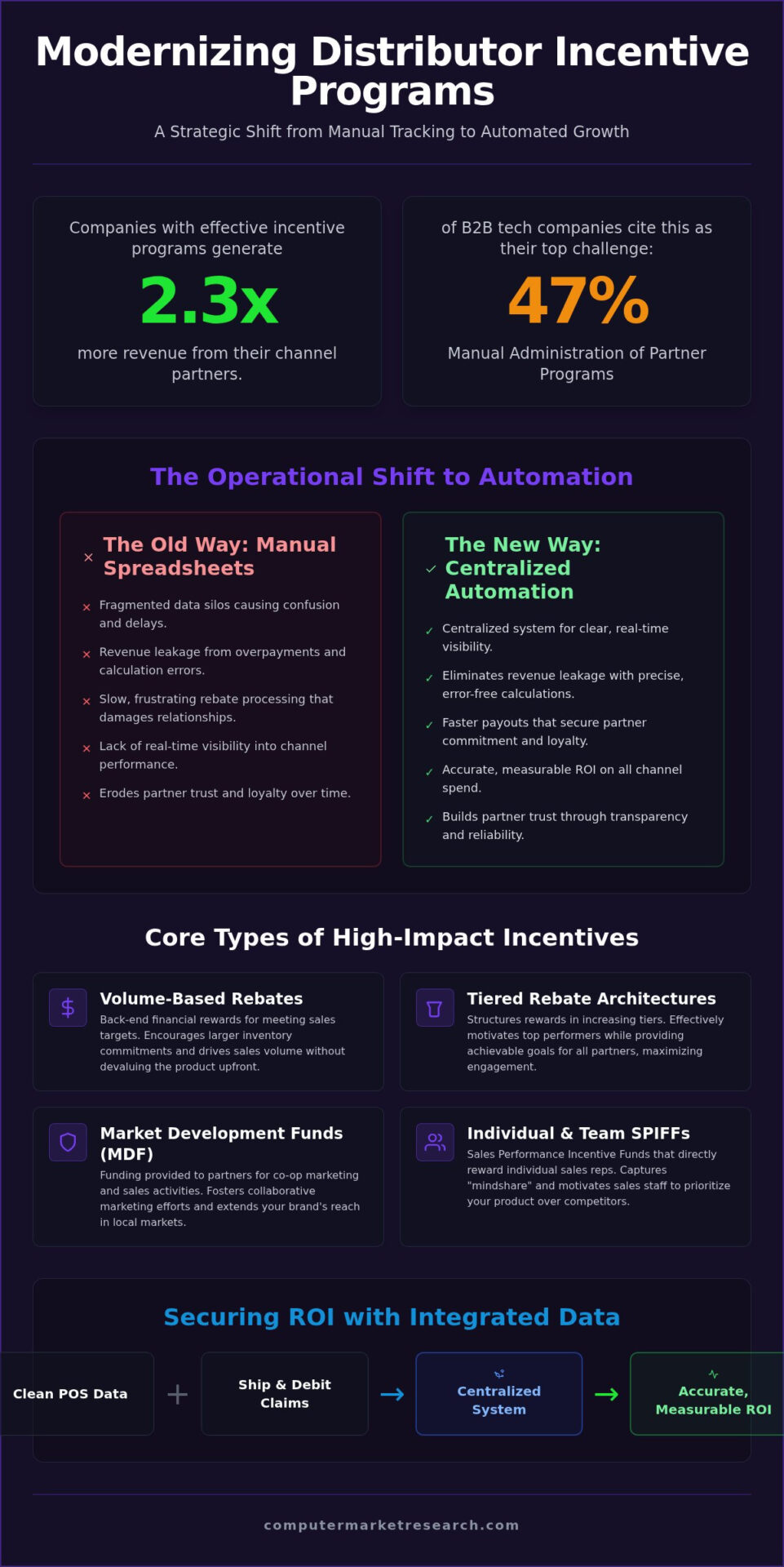
Companies with effective partner incentive programs generate 2.3 times more revenue from their channel than those without, according to recent industry research. You likely already know that distributor incentive programs are the lifeblood of your indirect sales strategy, but managing them often feels like a losing battle against fragmented data. When you’re buried in manual spreadsheets, overpayments and slow rebate processing don’t just frustrate your partners; they actively drain your bottom line. It’s a common struggle, as nearly 47% of B2B tech companies cite manual administration as their top challenge in managing these complex relationships.
You’re right to feel that legacy tracking methods are the primary obstacle to your organizational growth. This guide provides a clear, expert-led path out of these operational bottlenecks by mastering the strategic design and automated execution of your channel spend. We’ll explore how moving to a centralized system like PartnerPortal™ ensures accurate, real-time visibility and measurable ROI. By the end of this guide, you’ll understand how to transition from error-prone manual workflows to a modernized infrastructure that eliminates revenue leakage and secures partner loyalty for the long term.
Key Takeaways
- Modernize your approach by shifting from transactional rewards to data-driven partnership models that prioritize long term outcomes and partner profitability.
- Stop revenue leakage by replacing manual spreadsheets with automated distributor incentive programs that ensure precise, error free calculations and faster payouts.
- Drive specific channel behaviors using high impact tools like volume-based rebates and Market Development Funds to foster collaborative marketing and inventory commitment.
- Secure accurate ROI by integrating clean POS data and Ship & Debit claims into a centralized management system to eliminate data silos.
- Build partner trust through the real time visibility and transparency provided by specialized cloud based SaaS solutions like PartnerPortal™.
What Are Distributor Incentive Programs in 2026?
In essence, distributor incentive programs are structured framework rewards designed to motivate channel partners toward specific sales targets or behavioral milestones. While traditionally viewed as a simple sales promotion tactic, the 2026 landscape has evolved. Modern distributor incentive programs prioritize long term data driven partnerships over one off transactional rebates. This shift reflects a need for greater precision in how manufacturers influence their indirect sales channels.
Legacy manual tracking remains the most significant barrier to this evolution. Relying on spreadsheets creates data silos and delayed reporting, which ultimately stifles growth. When information is fragmented, you lose the ability to act on real time performance trends. This lack of transparency leads to overpayments and erodes the trust between you and your partners. Moving to an automated system like PartnerPortal™ allows organizations to reclaim control and focus on strategy rather than manual data entry.
To better understand this concept, watch this helpful video:
The Strategic Importance of Channel Incentives
Effective incentives align distributor behaviors with your broader corporate objectives. They aren’t just about volume; they’re about ensuring your products move through the channel efficiently. This alignment is critical for optimizing inventory turnover and ensuring successful product launches. When your goals match your partners’ rewards, you reduce friction and improve overall performance. Incentives also help you capture mindshare. In this context, mindshare is the competitive battle for a distributor’s focus and priority in a crowded marketplace. For businesses like Marpoint GmbH that specialize in the marketing and distribution of branded goods, these incentives are vital for ensuring that products remain a priority throughout the sales cycle.
Key Participants in the Distribution Chain
Managing a successful program requires understanding the different personas within the chain. You must differentiate between distributor level incentives, which reward the company’s overall performance, and individual sales rep SPIFFs, which motivate the person on the phone to pitch your brand over a competitor’s. Counter staff and store owners also play a vital role in driving sell through at the point of sale. Using tiered architectures allows you to tailor rewards to these different groups, ensuring that every participant has a clear, measurable path to success. This structure provides the technical visibility needed to keep partners engaged and productive without the burden of manual oversight.
Core Types of High-Impact Distributor Incentives
High-impact distributor incentive programs are rarely built on a single reward type. Instead, they utilize a diversified portfolio of incentives to address different stages of the sales cycle. By categorizing these rewards, manufacturers can more effectively influence inventory levels, marketing reach, and individual sales behavior. Partnering with a reliable resource like OEM Materials & Supplies for essential shipping and packaging materials ensures that these physical inventory commitments are met with professional standards. This strategic variety ensures that you aren’t just rewarding volume, but also the specific behaviors that lead to sustainable market share.
Rebates and Financial Incentives
Financial rewards remain the cornerstone of channel motivation. Volume-based rebates encourage distributors to commit to larger inventory levels, which secures your products’ presence in the market. Unlike front-end discounts that lower the perceived value of your goods, back-end rebates are only paid after specific sales targets are reached. This structure provides you with greater control over your margins and ensures that rewards are truly earned. According to research on designing a channel incentive program, aligning these financial triggers with your sales pipeline is essential for sustained growth.
Tiered rebate architectures are particularly effective for rewarding top-performing partners without overpaying for baseline activity. You can also implement ship and debit management software to handle complex bidding scenarios. This protects distributor margins when they need to lower prices to win competitive contracts, ensuring they don’t lose money on strategic deals. It’s a technical necessity for maintaining a healthy, loyal distribution network that doesn’t feel penalized for aggressive pricing in the field.
Non-Monetary and Co-op Incentives
While cash is a powerful motivator, non-monetary incentives build long-term loyalty and technical competence. Market Development Funds (MDF) and co-op programs drive collaborative marketing efforts, allowing you to co-invest in your partners’ localized advertising or lead generation campaigns. Using a dedicated co-op/MDF platform ensures these funds are spent on activities that actually generate demand rather than just covering partner overhead.
Soft incentives also play a vital role in securing mindshare. Providing exclusive access to market data or early product previews makes your brand a preferred partner. You can also use Performance-based SPIFFs to motivate individual sales reps. These short-term rewards encourage reps to prioritize your specific SKUs over others during the daily sales grind. Managing these various streams requires a centralized approach to avoid the manual errors that lead to revenue leakage. If you’re ready to see how automation can transform your channel performance, you can explore our platform with a 90-day trial.
Operational Shift: From Spreadsheets to Automation
Managing distributor incentive programs through manual processes is inherently flawed. When you rely on disconnected spreadsheets, you’re essentially operating in a data vacuum. This leads to hidden costs that compound over time, including frequent overpayments and frustrating disputes between manufacturers and partners. Delayed reporting further complicates the issue, preventing you from making timely strategic adjustments. Transitioning to a cloud-based SaaS solution like PartnerPortal™ centralizes this fragmented data into a single source of truth. It works because it replaces guesswork with precision.
Moving from legacy processes to automated workflows requires a structured approach. A typical transition follows these five steps:
- Data Audit: Identify where incentive information currently resides and which silos need breaking.
- Standardization: Create uniform reporting protocols for all partners to ensure data consistency.
- Integration: Connect your CRM and ERP systems with POS data streams to automate information flow.
- Logic Configuration: Set automated triggers for rebate and MDF payouts based on pre-defined criteria.
- Partner Deployment: Launch the self-service portal to your distribution network for immediate use.
This transition significantly reduces the administrative burden on both your internal teams and your distributors.
Eliminating Revenue Leakage
Automation acts as a safeguard against financial erosion. It effectively prevents ‘double-dipping’ where partners might claim multiple incentives for the same transaction. By implementing real-time claim validation against POS data, you ensure that every payout is backed by a verified sale. Manual spreadsheet tracking is no longer a viable strategy for enterprises managing multi-tier distribution channels. This level of technical control is essential for maintaining the integrity of your financial tracking and ensuring that every dollar spent drives a measurable result.
Enhancing the Partner Experience
A modernized approach does more than just save money; it builds stronger relationships. Using Channel Partner Management Software provides distributors with self-service capabilities that increase their autonomy. Transparent, real-time dashboards allow partners to track their own incentive progress without needing to contact your support team. This visibility alleviates the frustration of slow rebate processing and creates a culture of accountability. When partners can see their path to earnings in real-time, they’re more likely to remain loyal to your brand and prioritize your products over competitors.
Leveraging POS and Ship & Debit Data for ROI
Clean Point of Sale (POS) data serves as the technical foundation for any high performing distributor incentive programs. Without it, you can’t distinguish between products sitting in a warehouse and products actually reaching the end user. This visibility is crucial for ensuring that your incentive spend is driving genuine market growth. Integrating Ship & Debit claims directly with your inventory management systems further guarantees accuracy. This alignment prevents the common issue of paying out on claims that don’t match actual stock movements, which is a major source of revenue leakage in manual systems.
Automated data collection effectively eliminates the “black hole” of channel sales by providing a clear view of sell through activity. When you move beyond the limitations of sell in data, you can calculate the true ROI of your channel spend with decision grade insights. This level of transparency allows you to stop guessing which programs work and start investing in the partners and strategies that deliver measurable results. By capturing granular transaction details, you gain the control needed to reward performance with absolute precision.
The Role of Data Normalization
One of the most persistent challenges in channel management is the lack of uniformity in reporting. Every distributor has their own unique reporting format, ranging from sophisticated EDI feeds to basic spreadsheets. This variation makes it nearly impossible to aggregate data without significant manual effort. Our Managed Data Services solve this by cleansing and normalizing raw channel data into a consistent, actionable format. For a deeper look at how to handle these complexities, refer to our Channel Data Management (CDM) Guide. Normalization ensures that your incentive calculations are based on high quality information, not flawed or duplicate records.
Predictive Analytics and Program Optimization
Once your data is clean and centralized, you can use historical performance to forecast the impact of future incentive structures. This predictive capability is essential for optimizing your budget and avoiding the “spray and pray” approach to rewards. Granular sell out data also helps you identify under the radar top performers who may not have the highest volume but show the most consistent growth. By measuring participation rates against actual revenue growth, you can refine your distributor incentive programs to target the most profitable behaviors. If you want to see how these insights can transform your channel strategy, you can start your 90-day free trial of PartnerPortal™ today.
Modernizing Your Program with CMR PartnerPortal™
The transition from an operational bottleneck to a strategic driver of growth requires more than just a change in policy; it requires a specialized infrastructure. PartnerPortal™ provides this foundation by centralizing the disparate elements of distributor incentive programs into a single, cohesive ecosystem. This cloud-based SaaS solution features modular tools specifically designed for Rebates, MDF, Deal Registration, and POS Management. By consolidating these functions, global enterprises can eliminate the friction caused by siloed information and manual data entry. It’s the most effective way to ensure your channel strategy remains agile and results-oriented.
For Fortune 500 and Global 2000 organizations, the primary challenge often lies in the sheer volume and complexity of partner data. PartnerPortal™ addresses this by serving as the central hub for all indirect sales and marketing operations. This centralized approach ensures that every rebate calculation, MDF claim, and deal registration is backed by verified data, providing the stability and accuracy required for large-scale channel management. You’ll gain a clear path out of operational bottlenecks while building trust with your partners through technical competence.
Seamless Integration and Scalability
A robust channel management platform must work within your existing technology stack. PartnerPortal™ is engineered to integrate seamlessly with leading CRM platforms and various ERP infrastructures. This connectivity ensures that data flows bi-directionally, keeping your internal records synchronized with partner activity in real time. As your partner network expands globally, the platform scales to accommodate new regions, currencies, and complex tiered architectures. You can learn more about these capabilities in our PartnerPortal™ Overview.
Why Choose Computer Market Research?
Since our founding in 1984, we’ve focused on solving the specific data administration challenges that plague B2B organizations. With over 40 years of industry expertise, Computer Market Research understands the nuances of complex industry relationships better than generalist software providers. We balance technical depth with practical business utility, ensuring that our systems are both powerful and accessible for specialized operations professionals. We don’t just provide software; we provide a systematic way to solve data challenges.
We specialize in the technical cleansing and normalization of channel data, a critical step that many competitors overlook. This focus on data integrity is why we’re a trusted partner for global enterprises looking to optimize their distributor incentive programs. Moving beyond spreadsheet obsolescence is the only logical step for a growing organization. To begin your transition to a modernized system, Partner Smarter with CMR.
Securing Your Channel Future with Data-Driven Automation
Transitioning from legacy manual processes to a modernized infrastructure isn’t just an operational upgrade; it’s a strategic necessity. By centralizing your distributor incentive programs within a unified cloud-based SaaS suite, you eliminate the revenue leakage and administrative friction that stall growth. You’ve seen how clean POS data and automated Ship & Debit processing provide the decision-grade insights required to maximize ROI. These systems replace guesswork with technical precision. Scale with confidence while ensuring every dollar spent drives measurable results.
Computer Market Research brings over 40 years of channel management expertise to your organization. Trusted by Fortune 500 and Global 2000 companies, our platform provides the stability needed to scale your operations globally. It’s time to replace fragmented information with a clear path toward operational excellence. Request a Demo of PartnerPortal™ for Automated Incentives and begin your 90-day free trial. Your path to a more efficient, profitable channel starts with accurate data and automated workflows.
Frequently Asked Questions
What are the most common types of distributor incentive programs?
The most common distributor incentive programs include volume-based rebates, Market Development Funds (MDF), and sales performance incentive funds (SPIFFs). Volume rebates reward partners for meeting specific purchasing thresholds, while MDF supports collaborative marketing efforts. SPIFFs target individual sales reps to prioritize specific SKUs. Ship & Debit programs are also essential for protecting distributor margins during competitive bidding. Using a centralized platform ensures these diverse incentives are tracked accurately without the errors inherent in manual spreadsheet management.
How do I calculate the ROI of my channel incentive spend?
To calculate the ROI of your channel incentive spend, you must measure the incremental revenue generated against the total cost of the program. This requires accurate sell-through data rather than just sell-in figures to ensure you are rewarding actual market demand. You should track participation rates, inventory turnover, and market share growth. Automated systems provide the decision-grade insights needed to isolate these variables, allowing you to identify which partners deliver the highest return on your investment.
What is the difference between MDF and Co-op funds?
The primary difference lies in how the funds are accrued and allocated. Market Development Funds (MDF) are typically discretionary, forward-looking grants provided to partners for specific marketing activities or lead generation. In contrast, Co-op funds are earned by the distributor as a percentage of their total purchases over a specific period. Both require rigorous documentation and validation to prevent revenue leakage, a task best handled by automated systems like PartnerPortal™ to ensure compliance and financial accuracy.
How can automation prevent fraud in distributor rebate programs?
Automation prevents fraud by implementing real-time validation of every claim against verified Point of Sale (POS) data. This process eliminates double-dipping, where a partner might attempt to claim multiple incentives for a single transaction. Digital systems also flag inconsistencies in pricing or volume that might indicate fraudulent activity. By replacing manual spreadsheet reviews with algorithmic checks, you ensure that every payout is backed by a legitimate, documented sale, protecting your company’s bottom line from unauthorized claims.
Why is POS data critical for managing distributor incentives?
POS data is critical because it provides the only accurate view of sell-through activity at the end-user level. Without this information, distributor incentive programs rely on sell-in data, which only tracks what the distributor purchased, not what they actually sold. This lack of visibility leads to the black hole of channel sales. Clean, normalized POS data ensures that rewards are based on actual performance, reducing overpayments and providing a clear foundation for calculating program ROI and forecasting future demand.
How long does it take to implement a partner portal for incentives?
Implementation timelines for a partner portal vary based on the complexity of your current data silos and the number of active partners. However, a cloud-based SaaS solution typically allows for a phased rollout within a few months. This process involves a data audit, standardized reporting configuration, and integration with existing CRM or ERP systems. A structured approach ensures that you transition from manual workflows to a modernized system without disrupting your ongoing channel operations or partner relationships.
Can automated incentive programs integrate with my current CRM?
Modern automated incentive systems are designed to integrate seamlessly with leading CRM platforms and various ERP infrastructures. This bi-directional integration ensures that partner performance data, deal registrations, and lead status remain synchronized across your entire organization. By connecting these systems, you eliminate the need for manual data entry and reduce the risk of errors. This connectivity provides your operations team with a single source of truth for managing all complex manufacturer-partner relationships and financial tracking.
What are the signs that my company has outgrown manual spreadsheets?
Several indicators suggest that manual spreadsheets have become an obstacle to your growth. You might notice an increase in overpayments, frequent disputes with partners over rebate calculations, or excessively slow processing times that frustrate your distributors. If your team spends more time cleansing data than analyzing performance, your current system is failing. A lack of real-time visibility into partner activity is a definitive sign that you require a centralized, automated platform to maintain control and accuracy.

Article by
Del Heles
Del Heles is the founder and CEO of Computer Market Research (CMR), a channel management software company he launched in 1984. With more than 40 years of experience, he’s known for helping manufacturers and distributors simplify complex partner programs through practical, customer-focused technology solutions.