

With indirect sales accounting for roughly 75% of global trade, the margin for error in channel management has never been thinner. You’ve likely felt the friction of reconciling fragmented reports from various distributors, especially when using pos data for channel incentives is still a manual, spreadsheet-heavy process. This reliance on legacy methods often leads to overpaying on rebates due to duplicate claims or causing partner frustration through slow payout cycles. It’s a systemic challenge that demands a shift toward a more disciplined, technical approach to data administration.
This guide demonstrates how to transform fragmented point-of-sale information into a high-precision engine for automating and optimizing partner rewards. By moving away from manual tracking, your organization can achieve real-time visibility into sales performance and implement decision-grade processing that eliminates errors. We’ll explore the transition to modernized systems like PartnerPortal™, showing how automated workflows improve partner loyalty through transparent and timely rewards. From cleansing messy distributor data to refining ship and debit processes, you’ll find a clear path toward operational stability and improved returns.
Key Takeaways
- Understand why granular point-of-sale records are the definitive source for validating incentive eligibility and eliminating the risks of self-reported claims.
- Learn the technical requirements for using pos data for channel incentives to automate volume rebates, SPIFFs, and complex ship and debit programs.
- Discover strategies for establishing standardized data protocols that reduce friction with distributors while ensuring high-precision claim accuracy.
- Identify how to transition from manual spreadsheet tracking to an automated hub like PartnerPortal™ to accelerate payout cycles and enhance partner trust.
- Explore how Managed Data Services can offload the administrative burden of cleansing fragmented distributor reports, allowing your team to focus on strategic growth.
The Role of POS Data in Modern Channel Incentive Programs
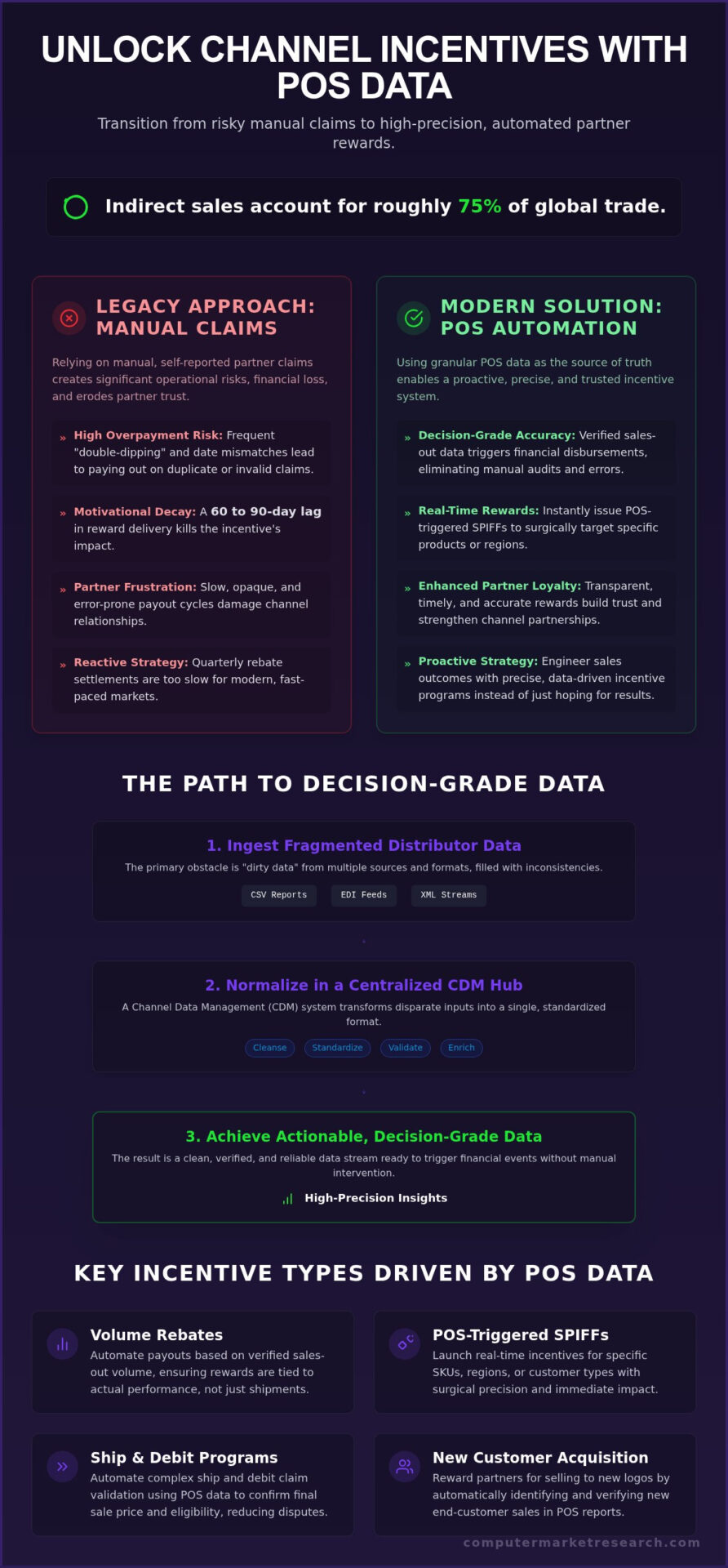
In the complex architecture of B2B distribution, point-of-sale information serves as the primary source of truth. We define Point of Sale (POS) data as the granular record of sales-out transactions occurring between your channel partners and their end-users. While inventory reports show what’s sitting in a warehouse, POS data reveals exactly what has been sold, to whom, and at what price point. For Global 2000 companies, these insights must be “decision-grade.” This means the data is clean and verified enough to trigger financial disbursements without the need for exhaustive manual audits. By using pos data for channel incentives, organizations shift from rewarding simple bulk shipments to incentivizing specific, high-value sales behaviors.
Why Self-Reported Data Undermines Incentive ROI
Relying on manual partner claims is a significant operational risk that often leads to overpayment. Partners frequently submit claims with date mismatches, using shipping dates rather than actual transaction dates, which complicates fiscal period reporting. A more costly issue is the “double-dipping” phenomenon. This occurs when a distributor and a reseller both claim the same sale, or when multiple partners involved in a complex deal submit overlapping requests. Beyond the financial loss, manual processing creates a 60 to 90 day lag in reward delivery. This delay kills the motivational impact of the incentive, as the salesperson has often forgotten the deal by the time the reward arrives. Implementing robust channel data management systems eliminates these errors at the source.
Transitioning from Reactive to Proactive Channel Strategy
Traditional channel programs are reactive, often settling rebates on a quarterly basis. This cadence is too slow for modern market demands. When you move toward using pos data for channel incentives, you gain the ability to launch real-time, POS-triggered SPIFFs. This granularity allows for “surgical” incentive strategies. Instead of a blanket rebate, you can target specific underperforming SKUs or high-growth geographic regions with precision. POS-driven incentives are the automation of rewards based on verified sales-out data. This transition ensures that your incentive budget is spent on confirmed performance rather than estimated volume. It’s a fundamental shift from hoping for results to engineering them through high-quality information and automated workflows.
Aligning POS Data Streams with Your Incentive Strategy
The technical alignment of data streams is the bridge between raw information and successful financial execution. To ensure accuracy, you must establish a standardized data collection protocol that applies to all channel partners regardless of their size. This involves mapping specific POS fields like Product ID, Customer Name, and Transaction Date directly to your incentive program rules. Without this mapping, your system cannot distinguish between a qualifying sale and a standard transaction. It’s a fundamental step that ensures every record is actionable.
Frequency is equally critical. If your rewards are designed to drive weekly behavior, receiving data on a monthly basis creates a disconnect. Aligning data frequency, whether daily or weekly, with your reward cycle ensures that payouts remain a relevant motivator for sales teams. This synchronization prevents the motivational “valley” that occurs when there is a significant lag between the sale and the reward. To start optimizing these cycles, you may want to begin your 90-day free trial of an automated solution.
Normalizing Fragmented Distributor Reports
The primary obstacle to using pos data for channel incentives is the prevalence of “dirty data.” Distributors often use varying formats, including CSV, EDI, and XML, while submitting reports with misspelled customer names or inconsistent SKU formats. This fragmentation makes manual reconciliation impossible at scale. It often leads to operational bottlenecks where channel managers spend more time fixing spreadsheets than analyzing performance.
A centralized Channel Data Management (CDM) system is necessary to ingest and normalize these disparate streams. By transforming various inputs into a standardized format, you create a single source of truth for all sales-out transactions. This technical foundation allows you to utilize channel data management systems to eliminate the errors that typically lead to overpayments and duplicate claims.
Setting Up Automated Incentive Triggers
Once data is normalized, you can establish automated incentive triggers. These are specific data conditions that must be met before the system authorizes a payout. Triggers remove the ambiguity from incentive management by following strict logic. For example, a trigger might be defined as: “Sale of SKU X to a Healthcare Customer within the Q3 promotional window.”
When these conditions are met, the system flags the transaction for payment automatically. This logic-driven approach significantly reduces the administrative burden on channel managers who would otherwise spend hours cross-referencing spreadsheets. By using pos data for channel incentives in this manner, you ensure that rewards are only distributed for verified, behavior-aligned performance. This level of precision is exactly what modern operations teams need to maintain program integrity and partner trust.
4 Key Incentive Types Driven by POS Data Insights
Effective channel management relies on the ability to differentiate between various sales motions. By using pos data for channel incentives, manufacturers can move beyond basic volume discounts and implement more sophisticated reward structures. There are four primary incentive categories that benefit most from this granular data layer.
Optimizing Rebates and SPIFFs for Sales Growth
Data transparency is the foundation of partner trust. When you utilize high-precision sales-out information, you can identify partners who are consistently underperforming in specific regions or SKU categories. This allows for the deployment of “surgical” SPIFFs designed to stimulate growth exactly where it’s needed. Providing partners with real-time visibility into their payout status via a portal reduces administrative friction and motivates sales teams to close more deals. It’s about creating a predictable environment where performance is rewarded quickly. For a deeper look at these strategies, see our Maximizing Channel ROI pillar article.
Managing Complex Ship & Debit Claims
Ship & Debit functions as a critical price protection mechanism for distributors. It allows them to remain competitive in price-sensitive markets without sacrificing their own margins. However, without accurate POS data, manufacturers often overpay on these claims due to lack of visibility into the final sale price. Automated verification ensures that the “debit” amount matches the specific terms of the deal registration. Implementing specialized Ship and Debit Management Software is the only way to manage these high-volume, high-complexity claims with decision-grade accuracy. This systematic approach eliminates the manual errors that typically drain channel budgets and cause friction with your most valuable distributors.
Overcoming Data Friction and Ensuring Claim Accuracy
Data friction represents a significant barrier to program efficiency. It often stems from the “fear of disintermediation,” where distributors hesitate to share end-user details for fear of being bypassed in future transactions. Overcoming this requires more than just a policy change; it necessitates a secure, automated data transmission infrastructure. By implementing standardized pipelines, you reduce the manual administrative burden that typically discourages partners from participating. This technical transition is essential for maintaining a clear audit trail. For organizations subject to financial regulations like Sarbanes-Oxley (SOX), having a verifiable and unalterable record of how sales-out data triggered specific payouts is a non-negotiable requirement for corporate compliance.
Building Trust Through Data Transparency
Establishing a transparent relationship is the most effective way to alleviate partner concerns. When you integrate a PartnerPortal™, you eliminate the uncertainty that often surrounds incentive programs. Partners gain immediate visibility into their submissions, seeing exactly how their data is being processed in real time. Providing “reverse feeds” is a powerful trust-building tool; it allows partners to see the direct correlation between the data they provided and the rewards they earned. To ensure long-term stability, we recommend negotiating “data-for-incentives” agreements as a standard clause in your channel contracts. This formalizes the exchange of high-quality information for timely, accurate payouts, making using pos data for channel incentives a mutually beneficial standard rather than a point of contention.
Automated Validation and Fraud Prevention
Manual claim review is incapable of catching sophisticated errors or intentional double-dipping across complex partner networks. By using pos data for channel incentives, you can implement automated cross-referencing between POS reports and reported inventory levels. If a partner claims a sale for a product that was never in their reported inventory, the system automatically flags or rejects the claim based on your pre-defined business rules. Automated validation is the only scalable way to prevent channel incentive fraud. Logic-based “sanity checks” also play a critical role, automatically rejecting claims that exceed unusually high volume thresholds for a specific region or partner tier. If you are ready to modernize your validation process and eliminate overpayments, claim your 90-day free trial to experience automated accuracy firsthand.
Automating POS-Driven Incentives with PartnerPortal™
Managing POS data in-house often creates hidden costs that far exceed the investment in specialized software. A thorough cost-benefit analysis reveals that internal teams frequently struggle with the “heavy lifting” of collecting and cleansing reports from hundreds of global partners. Computer Market Research (CMR) removes this burden through Managed Data Services. Instead of your operations team spending weeks fixing misspelled SKUs or incorrect date formats, CMR’s experts handle the data cleansing process directly. This ensures that only decision-grade information enters your incentive engine. For a technical deep dive into these processes, we recommend reviewing our Channel POS & Ship/Debit Whitepaper.
Seamless Integration with CRM and ERP Systems
The true value of automated incentive management is realized when data flows freely across your entire tech stack. PartnerPortal™ provides the technical architecture needed to sync with industry-standard systems like Salesforce, Oracle, and SAP. This connectivity ensures that verified incentive payouts flow directly into your financial reporting and ERP modules without manual intervention. It bridges the gap between sales activity and financial disbursement, maintaining the rigorous audit trails required for corporate compliance. When your incentive engine is fully integrated, you can launch new programs with the confidence that payouts are accurate, timely, and fraud-resistant. It’s time to stop struggling with fragmented information and start scaling your channel with precision. Partner Smarter with Computer Market Research to modernize your infrastructure today.
Modernizing Your Channel with Data-Driven Incentives
Transitioning to a modernized channel infrastructure is no longer optional for organizations looking to scale in 2026. By using pos data for channel incentives, you replace manual spreadsheet errors with decision-grade accuracy. This shift ensures that every dollar of your incentive spend is validated against real sales-out transactions; it effectively prevents costly issues like double-dipping and claim fraud. You move from a reactive posture to a proactive strategy that drives measurable sales growth across your partner network.
Computer Market Research brings over 30 years of channel data expertise to help you navigate these technical complexities. Our cloud-based SaaS, PartnerPortal™, is trusted by global enterprises to manage billions in incentive spend with absolute precision. By offloading the burden of data cleansing to our managed services, your team can focus on strategic partner relationships rather than administrative troubleshooting. It’s time to eliminate operational bottlenecks and build stronger partner trust through transparent, automated rewards. We look forward to helping you build a high-precision channel engine that delivers consistent results.
Request a Demo of PartnerPortal™ to Automate Your Incentives
Frequently Asked Questions
What is the difference between POS data and inventory data in channel management?
POS data records the “sell-out” transaction from a partner to an end-user, while inventory data tracks “sell-in” or current stock levels. POS data provides the specific date, price, and customer identity for every transaction. Inventory data only shows what remains in the warehouse. Using pos data for channel incentives allows manufacturers to reward actual consumption rather than simple bulk shipments. This technical distinction is vital for preventing the common industry problem of channel stuffing.
How can I convince my distributors to share their POS data for incentives?
Distributors are more likely to share data when they see a direct benefit in payout speed and accuracy. You should frame the request as a “data-for-incentives” agreement that reduces their administrative burden. By providing a secure portal, you alleviate their fears of disintermediation. Offering “reverse feeds” that show how their data directly influenced their rewards builds trust. This transparency transforms data sharing from a point of friction into a competitive advantage for the distributor.
Can POS data be used to automate SPIFF payouts for individual sales reps?
Yes, POS data provides the granularity required to attribute sales to specific individuals rather than just the partner organization. When the POS record includes a salesperson ID, the system can automatically trigger a SPIFF payout to that individual. It doesn’t require reps to submit manual claims. Automation ensures that rewards are delivered within days of the sale. Fast payouts significantly increase the motivational impact on the sales floor compared to quarterly cycles.
What are the risks of using manual spreadsheets for channel incentive programs?
Manual spreadsheets are prone to data entry errors, duplicate claims, and version control issues that result in significant overpayments. They don’t have the logic required to cross-reference records against inventory levels, making fraud detection nearly impossible. Additionally, manual processing creates a lag of 60 to 90 days in reward delivery. This delay frustrates partners and prevents accurate accrual reporting. Transitioning away from spreadsheets while using pos data for channel incentives is the only way to ensure program integrity.
How does POS data improve the ROI of Market Development Funds (MDF)?
POS data provides the “sales lift” evidence needed to prove the effectiveness of marketing activities. By comparing sales-out volume before, during, and after an MDF-funded campaign, you can calculate a precise ROI for every dollar spent. This visibility allows you to stop funding underperforming activities and redirect your budget toward partners that demonstrate the highest conversion rates. It transforms MDF from a sunk cost into a strategic, performance-based investment for growth.
What is a ‘Ship & Debit’ claim and why does it require POS data?
Ship & Debit is a price protection mechanism where a manufacturer reimburses a distributor for selling a product at a lower, pre-approved price to win a specific deal. Accurate POS data is required to verify the final end-user price and the specific transaction date. Without this verification, manufacturers risk overpaying on claims that don’t match registered deal terms. It’s the most data-intensive incentive type, requiring high-precision tracking to maintain distributor margins.
How long does it take to implement an automated POS-driven incentive system?
A typical implementation of an automated POS-driven system ranges from 30 to 90 days depending on the number of partners and data complexity. The process includes establishing data collection protocols, mapping POS fields to incentive rules, and integrating with your existing ERP systems. Managed Data Services can accelerate this timeline by handling the initial cleansing of messy historical data. This allows you to launch your first automated program cycles much faster than an in-house build.
Does PartnerPortal™ integrate with existing CRM systems like Salesforce?
PartnerPortal™ is designed with a flexible architecture that allows for seamless integration with Salesforce and other major CRM platforms. This connectivity ensures that deal registrations and POS-validated payouts are reflected directly in your sales records. By syncing these systems, you create a unified environment where sales and finance teams share the same decision-grade information. This integration eliminates the need for manual data exports and maintains a consistent, unalterable audit trail for compliance.

Article by
Del Heles
Del Heles is the founder and CEO of Computer Market Research (CMR), a channel management software company he launched in 1984. With more than 40 years of experience, he’s known for helping manufacturers and distributors simplify complex partner programs through practical, customer-focused technology solutions.