

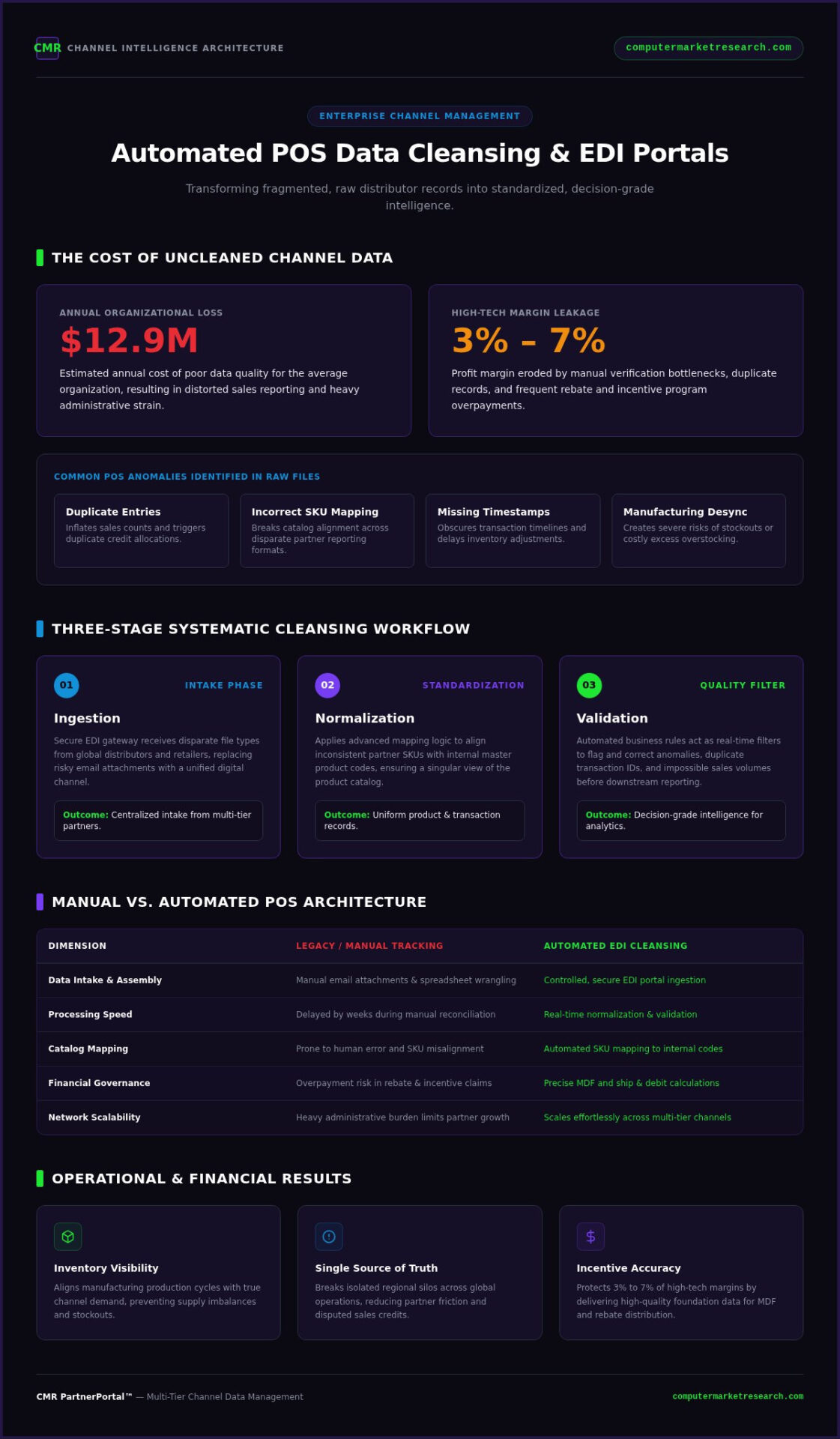
Did you know that poor data quality costs the average organization an estimated $12.9 million every year? For channel managers, this loss manifests as inaccurate sales reporting and administrative burden. Transitioning to automated POS data cleansing services & EDI portals has become the standard for those tired of reconciling “dirty” data from hundreds of partners.
Modernizing your infrastructure allows operators to reclaim operational efficiency. By automating the ingestion and normalization of partner information, you can finally move past the era of manual spreadsheet wrangling.
The Hidden Costs of Fragmented Channel POS Data
Raw Point-of-Sale (POS) data arriving from a diverse network of distributors and retailers is rarely ready for analysis. It arrives in varying formats, often riddled with inconsistencies that obscure the true state of your channel. This “dirty” data creates a dangerous ripple effect across the entire supply chain. When sales figures are inflated or underreported due to duplicate records, manufacturing cycles fall out of sync with actual demand. This leads to either costly overstocking or missed revenue opportunities from stockouts.
Relying on legacy methods to process this information is no longer sustainable. To maintain a competitive edge, manufacturers are increasingly turning to automated POS data cleansing services & EDI portals to filter out noise and extract actionable insights. These systems utilize Electronic Data Interchange (EDI) to standardize communication between disparate business systems, ensuring that every transaction is captured accurately. Without this digital filter, strategic decisions are delayed by weeks as operations teams struggle to reconcile conflicting reports.
The Reality of Manual Data Entry Errors
Human error is an inevitable byproduct of manual data management. Common POS errors include duplicate entries, incorrect SKU mapping, and missing transaction dates. They represent significant financial risks. When spreadsheets serve as the primary tool for a channel program, scaling becomes impossible. Implementing automated POS data cleansing services & EDI portals eliminates these bottlenecks, allowing teams to focus on strategy rather than data correction. The administrative burden of verifying thousands of lines of data manually leads to frequent overpayments in rebate and incentive programs, which can erode margins by 3% to 7% in the high-tech sector.
Identifying Data Silos in Global Enterprises
Fragmented data prevents organizations from establishing a “single source of truth.” In global enterprises, information often resides in isolated silos, making it difficult to monitor overall performance across different regions. This lack of transparency is a major hurdle for effective channel management, as delayed reporting prevents timely intervention when sales targets are missed. While traditional CRM systems are excellent for direct sales, they often lack the specialized logic required to ingest and normalize raw partner POS files. This gap creates friction between manufacturers and partners, often leading to channel conflict when inventory levels and sales credits are disputed.
How Automated POS Data Cleaning Services & EDI Portals Function
Automated POS cleansing is the process of converting raw channel files into standardized, error-free records. By deploying automated POS data cleansing services & EDI portals, manufacturers create a secure, high-speed gateway for partner data that replaces the risks associated with manual email attachments. This infrastructure ensures that every file submitted by a distributor or retailer enters a controlled environment where it is immediately prepared for enterprise use. Unlike generic portals, these specialized systems are designed to handle the specific complexities of multi-tier channel reporting.
The core of this technology lies in a three-stage workflow: ingestion, normalization, and validation. During ingestion, the portal accepts disparate file types from across your global network. The system then applies sophisticated mapping logic to align partner-specific SKUs with your internal product codes, ensuring a consistent view of your catalog. Finally, business rules act as a real-time filter to flag and correct anomalies, such as impossible sales volumes or duplicate transaction IDs. This systematic approach ensures that only high-quality information reaches your downstream analytics tools.
The Role of EDI in Data Connectivity
Modern data exchange relies on standardized protocols to ensure interoperability between different business systems. For point-of-sale reporting, the industry standard involves the EDI 852 (Product Activity Data) and EDI 867 (Product Transfer and Resale Report) transaction sets. These formats provide a structured language for communicating sell-through metrics and inventory levels. Implementing automated POS data cleansing services & EDI portals allows your organization to ingest these feeds at scale, mitigating the significant cost of poor data quality. Integrating these feeds into your channel data management systems creates a seamless bridge between partner activity and corporate strategy.
Normalization: The Core of Data Cleansing
Normalization is the critical process of transforming mismatched data formats into a unified enterprise standard. This involves more than just SKU matching; it includes unit-of-measure conversions and the resolution of regional reporting differences. For example, the system can automatically reconcile “cases” versus “eaches” or adjust for currency fluctuations in global programs. This layer of automation removes the technical burden from your operations team, allowing them to focus on performance trends rather than file formatting. If you’re ready to see how this technology can stabilize your reporting, you can explore our platform’s normalization capabilities in a free 90-day trial.
Manual vs. Automated POS Data Management Systems
The gap between manual data handling and automated processing is most visible in the speed-to-insight metric. Organizations relying on spreadsheets often wait weeks for data to be collected, normalized, and reviewed before it reaches a decision-maker. In contrast, automated POS data cleansing services & EDI portals provide data availability in minutes. This transition eliminates the lag time that often makes channel reports obsolete by the time they are finalized. When your team can view sell-through data as it happens, you can adjust production and marketing strategies in real-time rather than reacting to month-old trends.
Accuracy benchmarks further highlight the necessity of modernization. Research from the MIT Sloan Management Review estimates that bad data costs businesses between 15% and 25% of their total annual revenue. In manual environments, error rates are notoriously high due to the sheer volume of data being manipulated. High-tech and industrial manufacturing sectors often see a 3% to 7% margin erosion specifically from miscalculated ship-and-debit claims. Automated systems use rigorous validation rules to bring these error rates to less than 1%, ensuring that your financial reporting is built on a foundation of precision.
Integration with existing channel data management systems is another critical differentiator. Modern portals are designed to ingest data that adheres to GS1 EDI standards, ensuring global interoperability. This level of connectivity allows for seamless data flow between partners and manufacturers, removing the friction points that typically characterize manual exchanges.
Scalability and Operational Efficiency
Manual cleansing processes inevitably fail when partner networks grow beyond 20 entities. The administrative burden of chasing down missing files and fixing formatting errors becomes a full-time job for multiple employees. Automation supports 24/7 data ingestion, allowing your channel program to scale without a corresponding increase in headcount. The true ROI of automated POS data cleansing services & EDI portals lies in reallocating your staff from tedious data entry to strategic channel analysis. Instead of cleaning data, your team can spend their time identifying growth opportunities and optimizing partner performance.
Data Integrity and Audit Readiness
Maintaining a transparent audit trail is essential for financial compliance in large-scale channel operations. Manual systems lack the version control and logging necessary to satisfy rigorous audits, especially regarding complex incentive payouts. Automated systems provide a permanent record of every transaction and cleansing action taken. This transparency reduces the risk of overpayments in ship-and-debit programs. For leaders who demand decision-grade insights, establishing a robust framework for channel data management becomes the only logical step toward long-term stability and growth.
Optimizing Channel Performance with Decision-Grade Data
Decision-grade data transforms the channel from a black box into a strategic asset. By leveraging automated POS data cleansing services & EDI portals, manufacturers can finally align their production schedules with actual market demand. Clean data allows you to move beyond simple transaction tracking to sophisticated performance optimization. You’ll gain the ability to spot high-performing partners by analyzing metrics such as:
- Inventory turnover rates by SKU
- Regional demand spikes for new product launches
- Historical accuracy of partner-submitted reports
Clean data drives growth. Without it, your strategy is based on guesswork.
Maintaining visibility across partner tiers reduces the risk of stock-outs during peak seasons and prevents the margin-killing “channel stuffing” that leads to overstocking. When you have a clear view of inventory at the partner level, you can proactively manage replenishment cycles. Data quality is also the invisible thread connecting sales performance to market development funds. When you see exactly which SKUs are moving in specific regions, you can allocate co-op dollars to the partners most likely to deliver a high return.
Improving Incentive Program Accuracy
Validated POS data is the only way to eliminate disputes in rebate claims. This clean information streamlines ship and debit management software workflows, ensuring that distributors receive accurate credits without the back-and-forth typical of manual audits. Accuracy builds trust. POS data accuracy directly impacts channel partner trust by ensuring that incentive payments are predictable and based on objective performance rather than manual interpretation. When partners know their claims process correctly and quickly, your brand stands out above competitors who don’t.
Strategic Forecasting and Inventory Planning
Proactive channel management replaces reactive fire-fighting. By identifying regional sales trends before they impact the broader supply chain, OEMs can adjust their GTM strategies dynamically. The integration of automated POS data cleansing services & EDI portals ensures that these insights are based on current, validated information. This shift from “gut feeling” to data-driven forecasting ensures that your manufacturing cycles are always in sync with the end customer’s needs. To see how these insights can revolutionize your channel strategy, start your 90-day free trial today and experience the power of decision-grade data.
CMR PartnerPortal™: Your All-in-One Data Solution
PartnerPortal™ by Computer Market Research (CMR) serves as a centralized, cloud-based hub designed specifically for manufacturers managing complex indirect sales. For organizations serving Global 2000 and Fortune 500 enterprises, the reliability of data ingestion is a non-negotiable requirement. Our solution utilizes automated POS data cleansing services & EDI portals to eliminate the technical friction often associated with channel reporting. By leveraging our Managed Data Services, your operations team can offload the heavy lifting of data normalization. This ensures that every record in your system is accurate, standardized, and immediately ready for strategic analysis.
Stability and security are foundational to the platform’s architecture. Since our founding in 1984, we’ve developed a systematic approach to handling the most fragmented data environments. PartnerPortal™ integrates seamlessly with your existing CRM and ERP systems, providing a unified view of sales performance across your entire network. By integrating automated POS data cleansing services & EDI portals into your tech stack, you remove the manual silos that lead to operational bottlenecks and financial discrepancies.
Automating Your Channel with PartnerPortal™
Centralizing your channel operations starts with efficient partner onboarding and consistent performance tracking. PartnerPortal™ provides real-time visibility into inventory levels and sell-through metrics, allowing you to monitor channel health with precision. This level of transparency is essential for scaling a global program without increasing administrative headcount. You can explore the full capabilities of our channel sales management software to see how it replaces legacy tracking methods with modern, high-performance infrastructure.
Data Automation – The Key to Success
Transitioning from manual spreadsheets to a modernized system is a structured process led by CMR’s technical experts. Our team handles the initial EDI configuration and mapping, ensuring alignment between partner-specific formats and your internal product catalog. This expert-led approach reduces the risk of deployment errors and accelerates your speed-to-insight. Because PartnerPortal™ operates on a SaaS model, you benefit from rapid deployment and the ability to scale your data processing capabilities as your partner network expands.
Reliable data is the only foundation for sustainable growth. If you’re ready to eliminate manual errors and gain total control over your channel information, now is the time to act. Our platform offers a low-risk entry point to transform your fragmented partner files into a strategic advantage. Contact CMR today for your 90-day free trial to start cleansing your POS data, or managing your channel partnerships more efficiently.
Modernizing Your Channel Data Infrastructure
By implementing automated POS data cleansing services & EDI portals, you replace fragmented, error-prone spreadsheets with a secure, standardized flow of information. This shift ensures that your incentive programs and inventory forecasts are built on a foundation of decision-grade intelligence rather than guesswork. You’ll gain the real-time visibility needed to optimize partner performance and reduce margin erosion across your entire network.
Computer Market Research brings over 30 years of specialized expertise to your channel operations. Our PartnerPortal™ platform is trusted by Fortune 500 and Global 2000 companies to eliminate the administrative burden of data normalization. We focus on providing the stability and technical competence required to manage complex industry relationships without the risk of human error. It’s time to reclaim your operational efficiency and move past legacy bottlenecks that hinder your progress.
Claim Your 90-Day Free Trial today to experience how automated cleansing can transform your business results. You’ll quickly discover the clarity and strategic control that high-quality, validated information provides to your entire organization.
Frequently Asked Questions
What is the difference between an EDI portal and a standard partner portal?
An EDI portal acts as a specialized gateway for automated, computer-to-computer data exchange using standardized protocols. While a standard partner portal often requires manual logins and file uploads, an EDI portal streamlines high-volume transactions without human intervention. This distinction is critical for manufacturers who need to process thousands of records daily. It ensures that partner data moves directly into your processing engine with minimal latency and maximum security.
How does automated POS data cleansing handle non-standard partner SKU formats?
Automated systems handle non-standard SKU formats through sophisticated mapping logic and cross-reference tables. When a partner submits a unique internal code, the system automatically translates it to your master product catalog. This normalization process resolves discrepancies in naming conventions and unit-of-measure variations. It prevents the creation of duplicate entries and ensures that your inventory reports reflect a single, accurate view of product movement across the entire channel.
Can automated POS services integrate with my existing CRM or ERP system?
Yes, EDI portals integrate seamlessly with major enterprise infrastructure, including modern CRM and ERP platforms. This connectivity allows cleansed and validated channel data to sync directly with your internal business environment. By automating this flow, you eliminate the need for manual data entry and reduce the risk of synchronization errors. This integration provides your leadership team with a unified, real-time view of sales performance across all indirect channels.
What are the common EDI transaction sets used for POS data reporting?
The most frequent transaction sets for point-of-sale reporting are EDI 852 and EDI 867. The 852 set provides essential product activity data, including sell-through metrics and on-hand inventory levels at the partner location. The 867 set offers more granular resale reports, detailing transfers between locations and sales to end customers. Using these standardized formats ensures that data remains consistent and interoperable, regardless of the specific software used by your various partners.
How long does it typically take to implement?
Implementation timelines vary based on the scale of your partner network and the complexity of existing data silos. A typical deployment involves a structured phase of configuration, partner onboarding, and mapping validation. CMR’s technical consultants lead this process to ensure that proper application of your specific business rules. While some modules can be active quickly, a full enterprise integration generally takes a few months to reach peak operational efficiency and data accuracy.
What is ‘decision-grade’ data and why does it matter for channel management?
Decision-grade data is information that has been systematically cleansed of errors, duplicates, and formatting inconsistencies. It represents the highest standard of data hygiene, making it reliable enough for significant financial and strategic commitments. For channel managers, this means having the confidence to adjust production schedules or approve large rebate payouts based on validated records. Without this level of precision, your organization risks making critical business decisions on flawed or incomplete information.
How does clean POS data help reduce ship-and-debit claim errors?
Clean data reduces ship-and-debit errors by providing a validated baseline for every claim. The system automatically matches distributor claims against verified sell-through records. This instant reconciliation identifies overpayments and duplicate requests before processing. By removing the manual audit requirement, you drastically lower the risk of financial leakage and improve the overall trust between your brand and its distribution partners.
Is my partner data secure when using a cloud-based EDI portal?
Modern cloud-based portals provide robust security through multi-layered encryption and secure transfer protocols. These systems typically meet the rigorous compliance requirements of Global 2000 organizations. Data is protected both in transit and at rest, ensuring that sensitive partner information and proprietary sales figures are never compromised. Relying on a managed platform often provides higher security than manual email exchanges, which are frequently vulnerable to interception and unauthorized access.
Contact us today to claim your 90-Day free trial to transform your business. Whatever the scale is, you can trust CMR for the solution your business needs.

Article by
Del Heles
Del Heles is the founder and CEO of Computer Market Research (CMR), a channel management software company he began in 1984. With more than 40 years of experience, he helps manufacturers and distributors simplify complex partner programs through practical, customer-focused technology solutions with an undeniable expertise.