

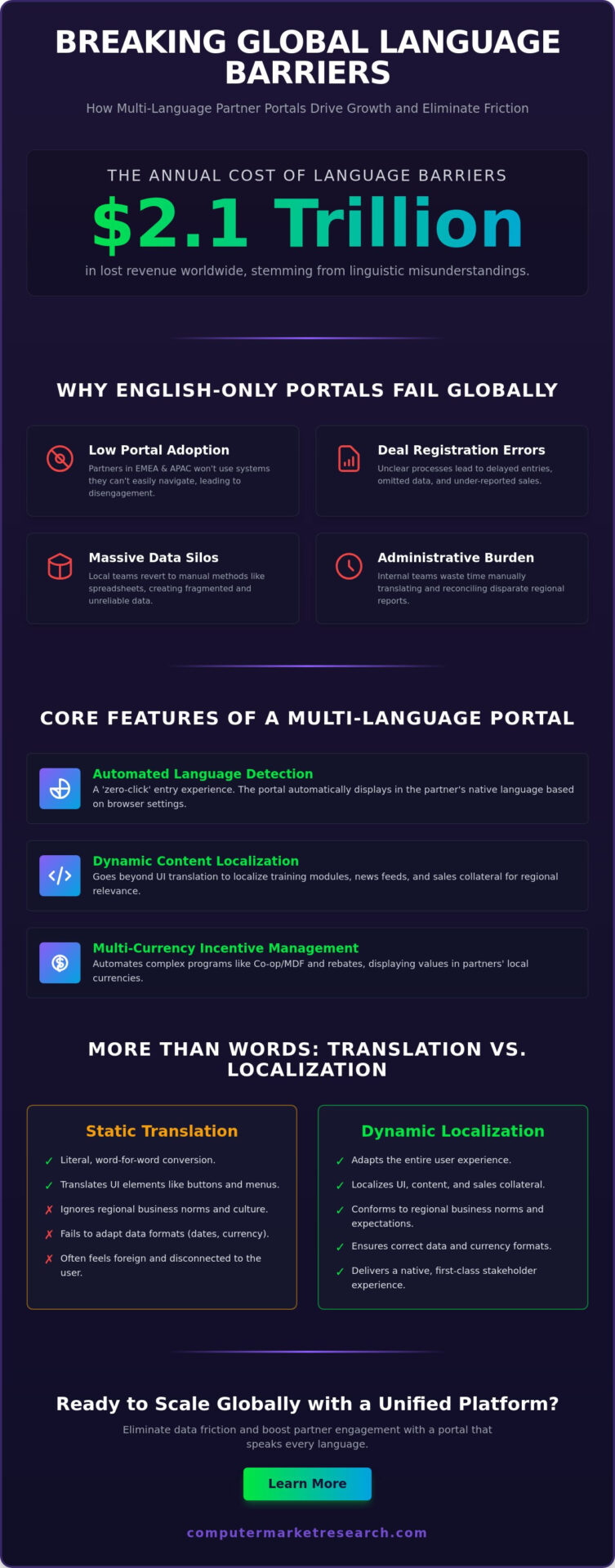
Businesses lose an estimated $2.1 trillion annually in revenue worldwide due to language barriers. It’s a staggering figure that highlights a reality many channel leaders face: if your partners in EMEA or APAC can’t easily navigate your systems, they simply won’t use them. You’ve likely seen the fallout in the form of low portal adoption rates and deal registration errors that stem from simple linguistic misunderstandings. Scaling effectively requires a multi-language partner portal that acts as a bridge rather than a barrier to regional growth.
Managing fragmented channel data from different regions often feels like a losing battle against manual errors. You need a streamlined system where information flows logically regardless of the user’s native tongue. This article demonstrates how a multi-language partner portal drives global engagement, automates localized workflows, and eliminates cross-border data friction. We’ll examine the shift from manual regional tracking to a centralized, localized intelligence approach that ensures your data remains clean and your incentive programs stay relevant across every timezone.
Key Takeaways
- Understand how a multi-language partner portal bridges the engagement gap in EMEA and APAC by removing linguistic barriers to portal adoption.
- Discover the technical difference between static UI translation and dynamic content localization for global training and sales collateral.
- Learn how to automate complex incentive programs like co-op/MDF and rebates across multiple currencies without increasing administrative overhead.
- Identify the essential steps for a successful rollout, including auditing your partner footprint and standardizing core channel processes.
- Explore how Global 2000 organizations leverage proven automation to maintain clean, centralized data while operating in diverse regional markets.
Why English-Only Portals Stunt Global Channel Growth
A multi-language partner portal serves as a localized gateway, allowing global organizations to manage diverse channel relationships through a single, unified system. While many companies attempt to scale using English-only platforms, this approach often creates a significant engagement gap in non-English speaking markets. When partners in regions like EMEA or APAC struggle to navigate complex menus or understand incentive structures, they simply stop using the system. This lack of accessibility directly impacts the effectiveness of your Partner Relationship Management (PRM) strategy, as local teams revert to manual methods that bypass corporate oversight.
To better understand how multiple languages function within a digital environment, watch this helpful video:
The Cost of Linguistic Friction in Partner Programs
Linguistic friction leads to tangible financial losses. When deal registration processes are unclear, partners often delay entries or omit critical data, resulting in under-reported sales and missed leads. This often forces local teams to engage in shadow channel operations, where business is conducted via disparate spreadsheets and email threads rather than the centralized channel partner management software. For the parent company, this creates massive data silos and an immense administrative burden for internal teams who must manually translate and reconcile regional reports. Organizations lose an estimated $2.1 trillion annually in revenue worldwide due to these language barriers, proving that localized accessibility is a requirement for high Channel ROI.
Beyond Translation: The Need for Cultural Localization
Core Features of a Multi-Language Partner Portal
A high-performing multi-language partner portal must do more than just translate buttons. It needs to provide a seamless, ‘zero-click’ entry experience through browser-based language detection. This functionality ensures that a partner in Munich immediately sees German navigation, while a partner in Tokyo is greeted with Japanese. Automated UI translation covers menus and buttons, but dynamic content localization extends this capability to training modules, news feeds, and sales collateral. This level of technical sophistication is critical for Scaling Global Channel Operations without ballooning your administrative overhead.
Clarity in financial reporting is equally vital for maintaining partner trust. Integrated multi-currency support ensures that regional teams view rebates and incentives in their local currency, tied directly to their language settings. Role-based access control further refines this experience by respecting regional and linguistic boundaries. This ensures users only interact with data, leads, and assets relevant to their specific market and permissions level. By aligning the interface with the partner’s local reality, you eliminate the friction that often stalls global initiatives.
Automated vs. Curated Translation Models
While machine-learning engines like Azure power real-time updates for high-volume content, accuracy in B2B environments requires a curated approach. Industry-specific terminology often fails when subjected to literal translation. Establishing a centralized glossary ensures that technical terms remain consistent across every region. Combining AI-driven speed with manual expert overrides for critical collateral provides the stability and precision needed for professional channel management. This hybrid model allows your portal to stay current without sacrificing the technical accuracy your partners expect.
Integrated Channel Data Management
Most portals stop at the interface, but true global scaling requires integrated POS data management. Regional data formats vary wildly between countries, often leading to manual errors during reconciliation. A robust system must normalize this fragmented information into a single, clean source of truth that reflects local sales activity accurately. Managed data services play a pivotal role here, ensuring that global reporting isn’t compromised by regional formatting errors or missing fields. This level of data transparency allows leaders to move away from obsolete manual tracking methods and toward a modernized infrastructure. If you’re ready to see how these features work in practice, you can explore a trial of our automated solutions.
Localizing Incentives: MDF and Rebates for Global Teams
Many channel leaders believe that centralizing global incentives is an impossible administrative feat. They fear that regional nuances will inevitably lead to manual workarounds and financial discrepancies. However, a robust multi-language partner portal dismantles this objection by providing a framework that’s globally consistent yet locally relevant. By automating co-op/MDF management, organizations can manage disparate budgets across various currencies without losing central oversight. This transition from manual spreadsheets to a modernized infrastructure ensures that funds are allocated accurately and used effectively in every market, regardless of geographic distance.
Localized claim forms are a critical component of this automation. When a partner in France can submit proof-of-performance in their native language using fields that match local business practices, submission errors plummet. This precision provides headquarters with real-time visibility into regional incentive spend and performance. You don’t have to wait for end-of-quarter reports to understand which markets are over-performing or where budgets are stalling. This level of transparency allows for agile budget reallocation, ensuring that marketing funds are always directed toward the highest-returning initiatives while maintaining a clear path out of operational bottlenecks.
Currency Normalization in Global Rebate Programs
Managing rebates & incentives across different regional financial standards requires more than a simple exchange rate calculator. The system must handle fluctuating rates and regional tax implications automatically. Automated currency conversion allows for unified global reporting while ensuring partners see their earnings in their local currency. To maintain financial control, localized validation rules prevent overpayments by flagging claims that exceed regional budget caps or violate local pricing policies. This programmatic approach eliminates the manual verification steps that often lead to human error and financial leakage.
Regional Compliance and Documentation
Localized portals act as a secure repository for region-specific legal agreements and tax forms, such as VAT or W-8BEN requirements. This organization creates a comprehensive audit trail for every dollar of global incentive spend. It simplifies the task of proving compliance during internal or external financial reviews. By hosting these documents within the portal, you ensure that every partner has signed the correct regional terms before accessing funds. Localized documentation ensures 100% compliance in every market by aligning portal requirements with regional legal standards. This systematic approach transforms incentive management from a source of friction into a driver of global growth.
Best Practices for Implementing a Multilingual PRM
Implementing a multi-language partner portal requires a shift from tactical translation to strategic localization. You should begin by auditing your current partner footprint to prioritize high-impact languages based on regional revenue potential and existing engagement gaps. It’s often more effective to support three languages deeply than ten languages superficially. Before you introduce localized interfaces, you must standardize your core channel processes. If your deal registration or MDF workflows are fragmented at the corporate level, localizing them will only amplify existing inefficiencies. Establishing a unified process ensures that when you finally flip the switch on a new language, the underlying logic remains sound and auditable.
Selecting the right technology is only half the battle. You need a platform that balances AI-driven speed with human-edit precision to ensure technical accuracy across specialized B2B terminology. Once the system is live, training regional ‘super-users’ is essential for long-term stability. These individuals act as local advocates and first-line validators for localized content and workflows. They provide the ground-level insights that automated systems might miss. You can then continuously monitor regional adoption rates to identify specific friction points where partners might be abandoning the portal. If you’re ready to modernize your infrastructure, you can claim your 90-day free trial to see these best practices in action.
Phased Rollout vs. Big Bang Implementation
A phased approach is almost always superior to a ‘big bang’ rollout. Start with your most critical non-English markets to prove the concept and refine your localized messaging. Pilot programs allow you to test specific UI elements and reporting structures with a small group of trusted partners before a global launch. This creates a vital feedback loop between regional offices and the corporate team, ensuring that the system meets local functional needs without compromising global data standards. This iterative process allows you to fix minor errors before they impact your entire global network.
Measuring the Success of Localization
Success must be measured through concrete performance metrics rather than anecdotal feedback. Key indicators include ‘Time to First Deal’ in localized regions compared to legacy English-only territories. Research indicates that multilingual sites convert 70% better on average, and similar engagement gains are often seen in partner ecosystems when language barriers are removed. Track partner login frequency and collateral downloads by language to see which resources resonate most in specific markets. By comparing these engagement metrics against implementation costs, you can calculate a clear ROI for your multi-language investment and justify further expansion.
Scaling Globally with CMR PartnerPortal™
For Global 2000 organizations, scaling channel operations across borders requires more than a simple translation layer. CMR PartnerPortal™ stands as the definitive solution for high-stakes channel automation. With a 40-year history in managing complex industry relationships, CMR understands that global success depends on technical competence and data stability. By deploying a multi-language partner portal that integrates directly with core operational tasks like ship and debit management, companies can maintain price protection and claim accuracy across diverse markets. This level of integration ensures that regional financial tracking remains precise while headquarters retains absolute visibility.
A centralized platform also provides real-time global inventory visibility, a critical requirement for avoiding regional stock imbalances. Instead of relying on fragmented reports from disparate regional offices, leadership can view global stock levels through a single, localized interface. This eliminates the delay associated with manual data entry and allows for more proactive supply chain management. When every partner interacts with the same source of truth in their native language, the entire ecosystem operates with a level of synchronization that legacy systems simply can’t match. It’s a voice of quiet confidence that promises a clear path out of operational bottlenecks.
Enterprise-Grade Localization Features
CMR’s approach focuses on providing ‘decision-grade’ data that leaders can trust for strategic planning. The PartnerPortal™ is designed to adapt to unique regional workflows, ensuring that local business practices aren’t sacrificed for the sake of centralization. To further alleviate the administrative burden on global teams, CMR’s managed services provide comprehensive data cleansing. This ensures that information entering the system is normalized and accurate before it ever reaches your reports. It’s a holistic discipline that combines modern infrastructure with human expertise to ensure high-quality information at every level of the organization.
The Path to Modern Channel Infrastructure
The transition from manual spreadsheets and legacy regional silos to a unified, multilingual partner ecosystem represents a significant competitive advantage. It’s the only logical step for a growing organization that values order and performance above all else. By consolidating your global operations into a single, localized intelligence hub, you eliminate the primary obstacles to growth. If you’re ready to move beyond obsolete tracking methods and build a systematic path to international expansion, we invite you to Partner Smarter and schedule a strategic consultation to modernize your channel infrastructure.
Modernizing Your Global Channel Infrastructure
Scaling a global channel requires moving past the limitations of English-only systems that alienate regional partners and create data silos. A robust multi-language partner portal ensures that your localized incentives, such as co-op/MDF and rebates, are managed with the same precision as your domestic programs. By standardizing core processes and empowering regional super-users, you create an environment where data remains clean and engagement remains high across every territory.
CMR brings over 40 years of channel expertise to the table, providing a comprehensive suite that includes POS data management and ship and debit tracking. Our systems are trusted by Global 2000 enterprises to eliminate manual errors and replace obsolete tracking methods with a unified, digital infrastructure. Request a Demo of CMR PartnerPortal™ and discover how a modernized system can drive your international growth. Taking the step toward a localized partner experience is the only logical path for organizations ready to lead in the global market.
Frequently Asked Questions
What is a multi-language partner portal?
A multi-language partner portal is a centralized digital interface that adapts its UI, content, and business logic to a partner’s native language and regional preferences. Beyond simple translation, it provides a localized experience that includes regional reporting, currency settings, and compliance documentation. This infrastructure ensures that global partners can register deals and access collateral without the friction of a language barrier, leading to higher adoption rates across EMEA and APAC.
How does automatic translation work in a PRM system?
Modern systems typically use machine learning engines to translate UI elements and dynamic content in real time. These engines process menus, buttons, and navigation labels instantly as content is updated. While automation handles the bulk of the work, the most effective systems allow for human-edit overrides to ensure technical accuracy. This hybrid approach ensures that brand consistency is maintained across different markets while significantly reducing the administrative burden on corporate teams.
Can I customize translations for industry-specific terminology?
How do multi-language portals handle different currencies for MDF?
A multi-language partner portal integrates currency normalization to handle fluctuating exchange rates and regional financial standards automatically. When a partner submits a co-op/MDF claim, the system processes the request in their local currency while providing normalized data for corporate reporting. This automation prevents manual errors in reimbursement and ensures that regional budgets are tracked with absolute transparency, allowing for better global financial control.
Does a multi-language portal help with regional data compliance?
It facilitates compliance by hosting region-specific legal agreements and tax forms, such as those required by GDPR or regional data protection acts. The portal acts as a secure repository, ensuring that partners only access incentives after signing the correct regional documentation. This systematic approach creates a clear audit trail for global spend and protects the organization from regulatory friction by aligning portal requirements with local legal standards.
How long does it take to implement a multilingual partner portal?
Implementation timelines vary depending on the complexity of your channel processes and the number of languages required. A phased rollout for 2-3 high-impact languages typically takes several weeks to a few months. This period includes auditing your partner footprint, standardizing workflows, and validating localized content with regional super-users. This structured multi-language partner portal deployment ensures the system is ready for a full-scale global launch without disrupting existing operations.
Will my partners see the localized version automatically?
Most advanced portals use browser-based language detection to provide a ‘zero-click’ entry experience. When a partner logs in, the system identifies their regional settings and automatically displays the corresponding UI and content. Users also retain the option to manually switch languages if they prefer a different setting. This flexibility ensures the portal remains accessible for diverse international teams while providing an intuitive, personalized experience from the very first interaction.
What are the most common languages supported by partner portals?
Organizations typically prioritize high-impact languages based on their largest regional markets, often starting with Spanish, French, German, and Mandarin. Japanese and Brazilian Portuguese are also frequently requested to support major hubs in APAC and Latin America. The goal is to align language support with your strategic growth areas to maximize partner engagement and reduce the administrative burden of manual regional tracking, ensuring a higher return on your channel investment.

Article by
Del Heles
Del Heles is the founder and CEO of Computer Market Research (CMR), a channel management software company he launched in 1984. With more than 40 years of experience, he’s known for helping manufacturers and distributors simplify complex partner programs through practical, customer-focused technology solutions.