

A rebate is not simply a payout to record later: under ASC 606, a seller estimates promised customer rebates at the time of sale and recognizes revenue net of the amount it expects to pay. That makes accounting for rebates and MDF a connected control issue, where sales terms, partner activity, claims, and settlement records need to line up.
It’s easy to see why rebate accounting can feel separate from channel operations. But customer rebates, supplier rebates, and market development funds (MDF) can affect different accounts and follow different approval and documentation paths. Treating them as one undifferentiated payout can obscure both the accounting treatment and the status of partner funds.
This article explains how ASC 606 treats customer rebates as variable consideration, how buyer-side rebates and IFRS compare, and how MDF and co-op funds move from program rules to approved claims and partner payouts. You’ll also see what proof of performance supports an MDF claim and how connected incentive workflows can improve visibility across finance and channel teams.
Key Takeaways
- Distinguish customer rebates, which affect a seller’s transaction price, from supplier rebates, which affect a buyer’s inventory cost or cost of goods sold.
- Estimate customer rebates using the method suited to the range of possible outcomes, then update the estimate as reporting periods close.
- Separate MDF proposal approval, proof-of-performance review, and payment execution so each claim has a clear status and audit trail.
- Understand how MDF and co-op funding differ: one is typically granted to selected partners, while the other is accrued based on partner purchases.
- Connect incentive rules and claim approvals with payout workflows to improve visibility across partner programs and finance operations.
What are channel partner payouts?
A channel partner payout transfers earned or approved program value to a partner. Depending on the program, payment may be made by check or ACH, or applied as a credit to the partner’s account. The incentive may be a rebate, co-op reimbursement, or MDF claim, so finance needs a clear record of the program rules, approvals, and settlement method.
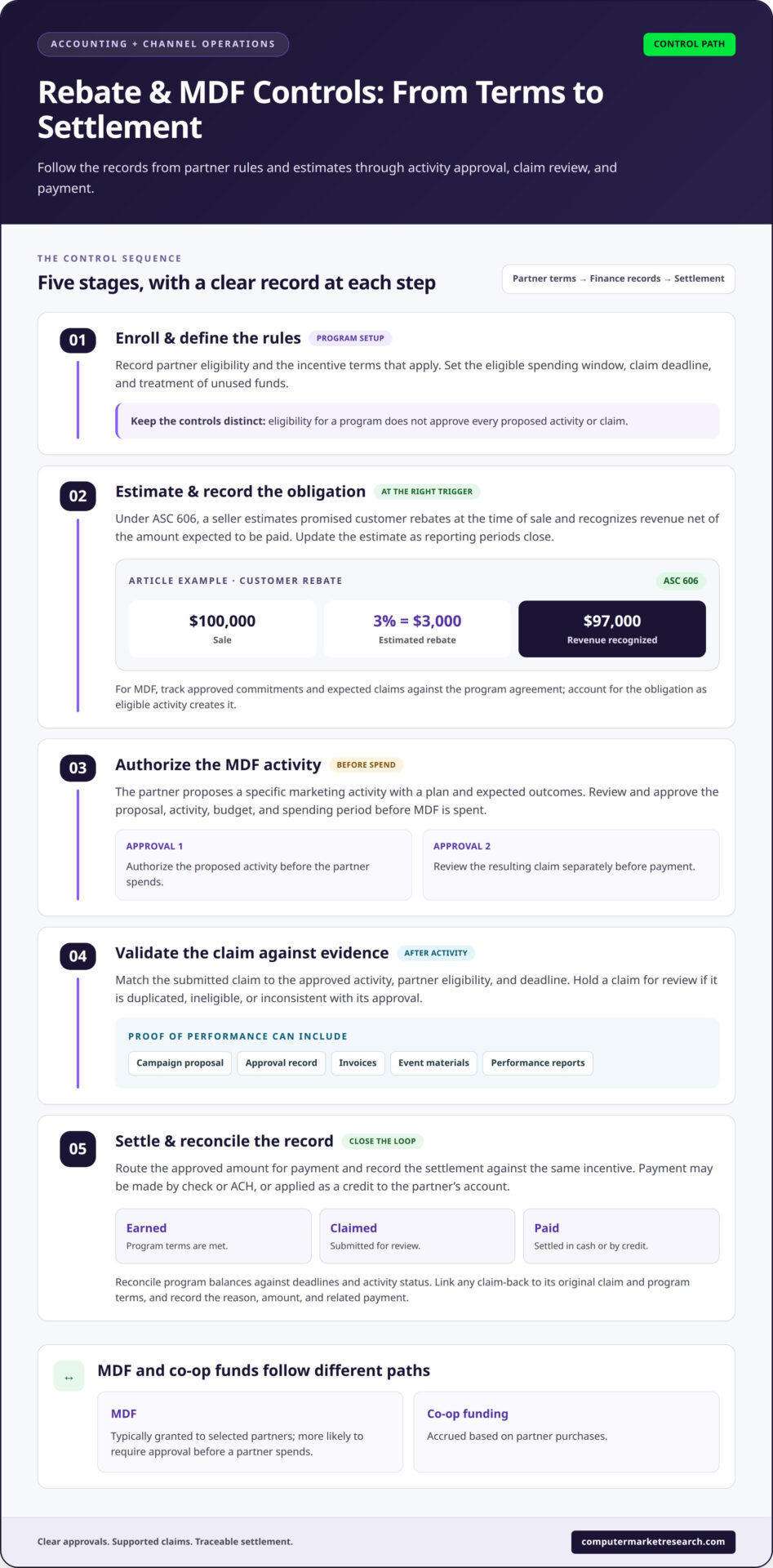
Partner eligibility and activity approval are separate controls. A vendor may first approve a partner for a program based on its eligibility criteria. The partner then proposes a specific marketing activity, with a plan and expected outcomes. The vendor reviews and approves the proposal before MDF is spent. Eligibility alone does not approve every activity or claim.
Budgets may be set for a quarter or a year. MDF is more likely than co-op funding to require approval before a partner spends money. Program terms should specify the eligible spending window, claim deadline, and treatment of unused funds. If funds expire, those terms determine whether a late claim is rejected or unused funds return to the program budget. An approved budget is not an open-ended balance.
Approval should continue after the activity, too. Once the partner completes the work, the claim can be reviewed against the approved activity, submission deadline, partner eligibility, and duplicate submissions. The MDF process described here has two approvals before payment: approval of the proposed activity and approval of the resulting claim. Keeping those decisions separate gives finance a record of both authorization and supporting evidence.
A controlled workflow can follow this sequence:
- Enroll: Record the partner’s eligibility and the incentive rules that apply.
- Authorize: Review the proposal, activity, budget, and spending period before funds are used.
- Validate and settle: Match the submitted claim to the approval, then record the payment or account credit.
Integrating payment execution with a PRM can preserve that division of responsibility. The PRM can retain the incentive rules, claim validation, and approvals, while a connected payment layer executes approved payments. This prevents the payment stage from bypassing existing controls and gives finance a clearer record from partner proposal through claim approval and settlement.
For example, a partner with an approved campaign submits a claim after completing the activity. The system can retain the original approval, compare the claim with the deadline and eligibility rules, flag a duplicate submission, and route an approved amount for payment. A check, ACH payment, or account credit can then be recorded against the same incentive, reducing reliance on disconnected spreadsheets and manual handoffs.
MDF claims and proof of performance
Claims connect approved partner activity with evidence, accounting records, and settlement. Tracking each stage separately helps finance distinguish an earned incentive from a submitted claim or completed payment.
Recognize a seller’s customer rebate liability when making the sale, based on the estimated rebate. For MDF, track approved commitments and expected claims against the program agreement, then account for the obligation as eligible activity creates it.
Claim Evidence and Documentation
Proof of performance is documentation that a partner completed an approved MDF activity and reports its results. Finance needs this evidence to match a claim to the authorized activity, while the vendor needs a clear basis for review. A campaign proposal, approval record, invoices, event materials, and performance reports can link planned spending to completed work.
Rebate documentation should connect the agreement’s terms with qualifying sales or purchases. For a volume incentive, retain transaction records that show the distributor’s qualifying volume and the calculation behind the amount earned. For example, on a $100,000 sale with an estimated 3% rebate, the seller records a $3,000 estimate and recognizes $97,000 as revenue. The agreement and calculation support that estimate.
Keep three statuses distinct: earned, claimed, and paid. An earned rebate meets the program’s terms; a claimed rebate has been submitted for review; a paid rebate has been settled in cash or by credit. For MDF, a partner reports results after completing the activity, often with supporting documentation. Recording each stage separately helps identify claims awaiting evidence or approval instead of treating every earned amount as paid.
Fund Tracking and Claim-Backs
Fund tracking records each program’s budget, approvals, partner claims, settlements, and remaining balance. It is especially important when a claim-back, meaning recovery or reversal of a previously paid or credited amount, must be linked to its original claim and program terms. A transaction history lets finance trace that link instead of reconstructing it from separate spreadsheets.
For each MDF activity, link the approved budget to invoices, proof of performance, the claim decision, and final payment. If a claim is duplicated, ineligible, or inconsistent with its approval, hold it for review before settlement. If a paid claim later requires recovery under the agreement, record the reason, amount, and related payment. This gives the partner and finance a clear transaction record.
Review fund balances against deadlines and activity status, not just payment totals. A quarterly program, for example, needs a view of approved activity, claims still awaiting evidence, and unused funds approaching expiry. Clear records help explain whether funds remain available, have been claimed, or have been paid. A structured MDF claims workflow can bring those records into a consistent process.
How do GAAP and IFRS compare on rebates?
Under U.S. GAAP, MDF accounting depends on what the vendor receives in exchange for funding. If a payment is for distinct goods or services, it may be classified as an expense under ASC 606-10-32-25.
For rebate accounting, the key distinction is whether the company is the seller granting a rebate or the buyer receiving one. That role affects whether the amount reduces revenue or inventory-related costs.
Rebates, Trade Discounts, and Cash Discounts
A trade discount reduces a stated price at the transaction, while a cash discount rewards payment within agreed terms; a rebate is generally calculated and paid or credited after qualifying activity. The distinction matters because the timing and basis of the benefit affect how companies record it.
For example, a distributor may receive a rebate after reaching a volume threshold, while a cash discount depends on paying an invoice on time. Both differ from an upfront trade discount. Reporting should preserve the agreement and identify the event that earns each amount, rather than grouping every price reduction under one label.
ASC 606 and ASC 705-20
ASC 606 addresses rebates a seller promises its customer, while ASC 705-20 addresses rebates a buyer receives from a supplier. This distinction matters because the seller’s customer rebate reduces the transaction price and revenue, whereas a supplier rebate affects the buyer’s costs.
Under ASC 606, customer rebates tied to volume thresholds or purchase milestones are variable consideration that reduces the transaction price. The estimate is constrained to amounts for which a significant reversal of recognized cumulative revenue is not probable. Under ASC 705-20, supplier rebates reduce cost of goods sold or inventory; the buyer spreads a target-based rebate over qualifying purchases when it is probable and reasonably estimable.
IFRS also treats supplier rebates as a reduction in inventory cost: IAS 2 requires rebates from suppliers to be deducted when determining that cost. Companies reporting under U.S. GAAP and IFRS should therefore track the rebate’s role, eligibility, and allocation basis, rather than assume the same account applies in every case.
MDF and co-op funds describe program structures, not automatic accounting categories. MDF is usually granted to selected partners; co-op funding is accrued based on partner purchases. A program might fund advertising or another marketing service, but the accounting depends on the substance of the arrangement. A payment for a distinct service may qualify as an expense under ASC 606-10-32-25.
For a vendor, document what the partner must deliver, how approval works, and what evidence supports the amount. Finance can then distinguish a payment for a distinct service from a customer incentive that reduces the transaction price. Under IFRS, apply IAS 2 when accounting for supplier rebates affecting inventory; under U.S. GAAP, distinguish seller rebates under ASC 606 from buyer rebates under ASC 705-20.
What are Market Development Funds (MDFs)?
Under U.S. GAAP, classify payments to distributors or retailers by what the vendor receives; payments for distinct goods or services may be expenses under ASC 606-10-32-25. Common mistakes include treating every MDF payment alike, confusing MDF with co-op funding, and recording claims without matching evidence.
Purpose of Market Development Funds
Market Development Funds are vendor funding for selected partners’ marketing activities. They may support digital advertising, co-branded email campaigns, event sponsorships, webinars, product demonstrations, promotions, or product-launch content. Defining eligible activities matters because the partner’s proposal and the vendor’s approval establish what the program will fund. A campaign outside those terms may not qualify for reimbursement.
For accounting, separate the purpose of the program from the classification of each payment. If a partner provides a distinct service to the vendor, the payment may be classified as an expense under ASC 606-10-32-25. The program record should connect the approved activity, service, and claim, so finance can assess the substance of the arrangement rather than rely on the “MDF” label alone.
Reimbursements and Future Campaigns
An MDF reimbursement repays a partner for eligible costs after the approved activity is complete and its supporting evidence has been reviewed. A vendor may instead apply funding to a future campaign. The distinction matters for tracking: reimbursement settles a completed activity, while carried-forward funding remains tied to a later campaign and its approval.
For example, a distributor completes an approved event and submits invoices and results. The vendor can match those records to the approved plan before paying or crediting the claim. If funding is applied to another campaign, record the new activity and approval separately. This prevents evidence from a prior campaign being used to support later spending.
MDFs and Co-op Funds
MDF and co-op funds both support partner marketing, but their funding basis differs. MDF is usually allocated to selected partners; co-op funds accrue based on partner purchases. That difference affects how a program tracks eligibility and balances. A selected partner’s MDF allocation should not be treated as purchase-based co-op accrual.
Maintain separate program rules and records for each type. For MDF, track the approved activity, claim evidence, and remaining allocation. For co-op, link accrued funds to the partner purchases that earned them. This helps finance identify which balance supports a specific campaign and whether the activity qualifies under that program.
Common accounting errors for both funds include recording an allocation as a settled payment, overlooking claim deadlines, and failing to reconcile a claim with its approval. A reliable record follows each amount from program terms through activity, evidence, review, and settlement. Keeping these stages distinct gives finance a clearer basis for reporting and reduces confusion between marketing budgets and earned partner incentives.
Managing MDF, co-op, and rebates together
A channel program can combine purchase-based co-op accruals, approved MDF activity, and rebates tied to sales or purchases. Managing them together means linking program rules, partner transactions, claims, and accounting records without treating every incentive as the same obligation. Effective accounting for rebates and MDF starts with shared visibility and distinct program rules.
Start with a shared partner and transaction record, then keep each funding type identifiable. A distributor’s purchase may earn a co-op balance or qualify for a rebate, while a separately approved campaign may draw on MDF. Link each record to its own program terms, eligibility basis, calculation, and status. This helps prevent the same purchase or invoice from supporting duplicate claims.
Accounting for rebates and MDF also depends on the relationship behind each amount. A seller estimates promised customer rebates and reduces revenue under ASC 606. A buyer’s supplier rebate affects inventory cost or cost of goods sold under ASC 705-20. MDF and co-op payments require their own analysis, including whether a payment is for distinct goods or services. Operational tracking can be unified, but accounting classifications should remain clear.
A coordinated process can connect these records through consistent checkpoints:
- Identify the basis: Record whether the incentive depends on purchases, sales volume, or approved marketing activity.
- Calculate and estimate: Apply the agreement’s rules, document expected amounts, and update estimates each reporting period.
- Validate the claim: Match transactions or campaign evidence against eligibility, deadlines, and prior submissions.
- Reconcile settlement: Link the approved claim to its payment, account credit, or remaining balance.
For example, a distributor may earn a purchase-based rebate while receiving MDF for an approved product campaign. The purchase record supports the rebate calculation; campaign invoices and performance evidence support the MDF claim. A shared workflow can show both beside the same partner while keeping approvals and accounting entries separate.
Software can help teams preserve these connections across channel, finance, and partner records. Useful checks include duplicate claims, mismatched partner identifiers, expired funds, and differences between expected and settled amounts. A quarter-end review can distinguish claims awaiting evidence from approved amounts awaiting payment, rather than relying on a single, undifferentiated incentive balance.
The practical takeaway is to centralize program visibility while preserving distinct rules and accounting treatment. To bring partner program records and approval workflows into a more coordinated process, start a free trial.
Computer Market Research: Rebates & Incentives
Computer Market Research helps channel teams manage rebates and incentives alongside partner program activity. Its Rebates & Incentives and Co-op/MDF Management offerings support partner funding administration, while PartnerPortal™ centralizes partner onboarding, deal registration, and performance tracking.
Consider this approach when rebate calculations, MDF claims, approvals, and partner records are spread across manual processes. A connected view of program activity helps teams trace incentives from rules and claims through partner performance, while grounding accounting decisions in the terms and evidence behind each transaction. Deal Registration can also be part of the broader partner workflow when incentive eligibility relates to registered deals.
For help managing rebate and MDF program workflows, contact Computer Market Research.
Build a More Reliable Program Workflow
The next step is to turn accounting policies into a repeatable operating model. Clear ownership of program rules, partner data, approvals, and finance records helps teams keep decisions consistent as channel programs change. A disciplined approach to accounting for rebates and MDF also gives finance and channel leaders a shared framework for reviewing program performance and refining future incentives.
Computer Market Research offers Rebates & Incentives and Co-op/MDF Management for partner funding programs. PartnerPortal™ centralizes partner onboarding, deal registration, and performance tracking. Together, these offerings support a more connected view of partner activity and incentive administration, while accounting teams retain control of financial judgments and reporting.
Choose a next step that fits your program’s priorities, whether that means improving partner data coordination or bringing funding workflows into clearer focus. Explore a next step with Computer Market Research and keep building a more controlled channel process.
Frequently Asked Questions
What Is Rebate Accounting (ASC 606)?
ASC 606 treats promised customer rebates as variable consideration that reduces the transaction price. The seller estimates the rebate when recording the sale and recognizes revenue only for the amount it expects to retain. The estimate is constrained when a significant reversal of recognized cumulative revenue is probable. For example, a volume-based incentive requires estimating whether qualifying purchase levels will be reached, then updating the estimate as facts change.
How do you handle tax and compliance for partner incentives?
Build tax information collection into partner onboarding rather than leaving it until year-end. Keep the partner’s program agreement, eligibility records, approved claims, payment details, and supporting documents together so finance can trace the purpose and recipient of each incentive. Tax treatment depends on the payment and applicable rules, so maintain clear transaction records for the organization’s tax reporting process. Keep program approval separate from payment processing.
How do you track and audit rebates?
Use a transaction-level record that links each rebate to its governing agreement, qualifying purchases or sales, calculation, approval, and settlement. During a review, reconcile the calculated amount with source transactions and identify duplicate claims, missing documentation, or changes to the expected rebate. For example, match a distributor’s purchase report to the applicable volume tier, then use the payment record to confirm whether the approved amount was settled.
Is a rebate an expense or revenue?
For a seller granting a customer rebate, it generally reduces revenue under ASC 606 rather than being recorded as a separate rebate expense. For a buyer receiving a supplier rebate, it generally reduces the cost of inventory or cost of goods sold. The classification depends on the company’s role and the arrangement’s substance. A payment for distinct goods or services may instead be classified as an expense.
Is a rebate received a debit or a credit?
The accounting entry depends on whether the company is the buyer or seller and whether it is recording the estimate or settlement. A seller accrues a customer rebate by crediting a rebate liability and recording revenue net of the estimate. When the rebate is settled, the seller debits that liability and credits cash or a customer credit. A buyer receiving a supplier rebate generally reduces inventory cost or cost of goods sold.
What activities are typically funded by MDFs?
MDF programs may support digital advertising, paid social campaigns, co-branded email marketing, event sponsorships, and trade shows. They may also fund webinars, in-store demonstrations, sales promotions, product giveaways, and SEO or content for product launches. Eligibility depends on the program’s rules and approval. A proposal should connect the planned marketing activity with the outcomes the partner expects to report.
What are the Benefits of MDFs?
MDF gives vendors a way to support selected partners’ marketing activities and helps partners promote products in their markets. Program records can show how funds were used and whether activities generated leads or sales. That information helps teams assess campaign performance and guide future funding decisions. Clear eligibility, approval, and reporting rules also give partners a defined framework for proposing activities and claiming eligible costs.
How are customer rebates accounted for under U.S. GAAP?
Under U.S. GAAP, a seller estimates a promised customer rebate at the time of sale and records revenue net of the expected amount. The seller credits a rebate liability for the estimate, then updates it as reporting periods close. If actual rebate outcomes differ from estimates, the seller records a cumulative adjustment in the current period. The estimate uses expected value or the most likely amount, depending on the possible outcomes.

Article by
Del Heles
Del Heles is the founder and CEO of Computer Market Research (CMR), a channel management software company he launched in 1984. With more than 40 years of experience, he’s known for helping manufacturers and distributors simplify complex partner programs through practical, customer-focused technology solutions.