

More channels don’t automatically create better marketing. A clear answer to what is a channel marketing plan is a framework for choosing how a business and its partners reach audiences, coordinate activity, distribute marketing resources, and measure results. Marketing channels are the pathways businesses use to communicate with target audiences and distribute products or services.
Choosing channels is only part of the work. A channel marketing plan connects channel activity to broader marketing goals, clarifies what partners will do, and sets ways to assess performance. Without that structure, campaigns, budgets, and partner efforts can become disconnected.
This article explains how channel marketing plans guide channel selection, partner activity, measurement, and distribution. You’ll also see how a channel plan fits within the broader marketing strategy and differs from an individual partner’s marketing plan.
Key Takeaways
- Choose channels based on audience, goals, and budget, then match the level of activity to where the audience engages.
- Keep the vendor’s overall channel framework distinct from each partner’s local campaign plan, while aligning their objectives.
- Use performance measures such as conversions, acquisition costs, and engagement to guide testing and scaling.
- Connect channel priorities to broader marketing objectives, campaign themes, and reporting.
- Coordinate content, partner activity, and distribution across channels to support consistent audience experiences.
What are marketing channels?
Marketing channels are the pathways a business uses to reach an audience and distribute products or services. A strategy connects those pathways to a target audience, business goals, and measurable outcomes.
Marketing Channel Strategy Purpose
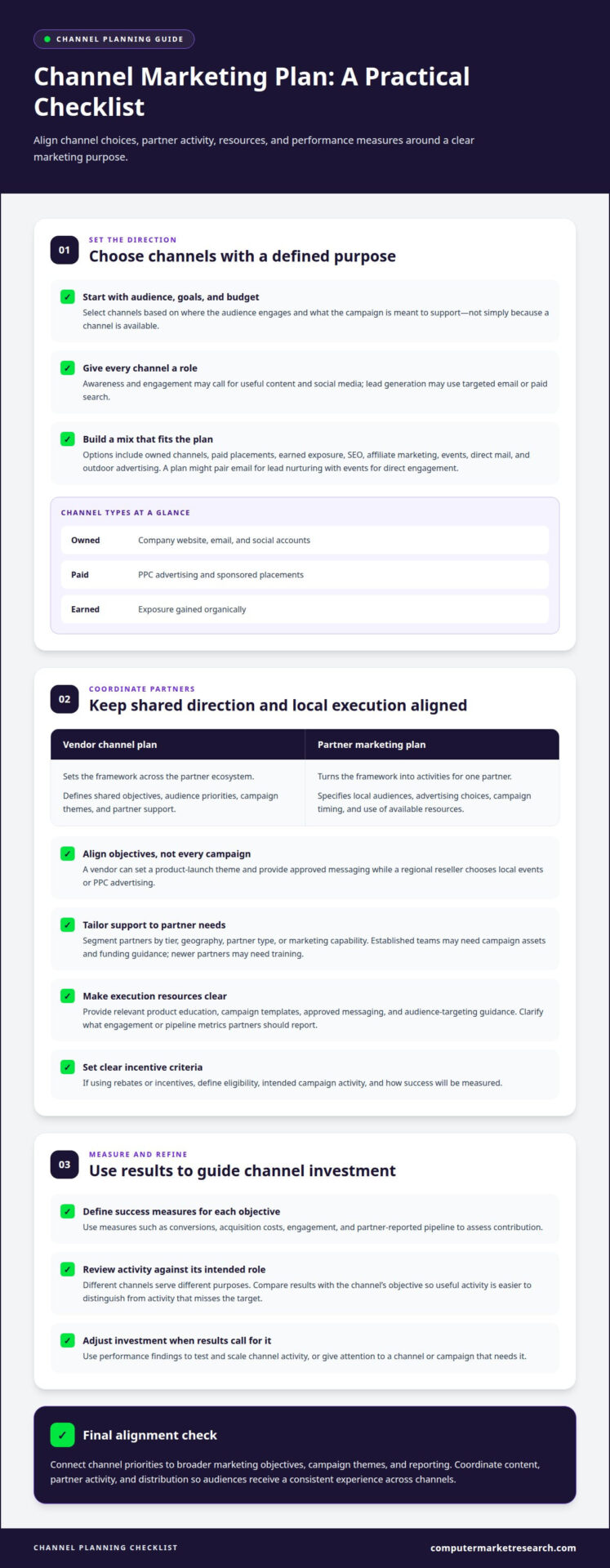
A marketing channel strategy defines how a business selects and coordinates channels to reach its target audience. It matters because audience behavior, campaign goals, and available resources vary by channel. A company pursuing awareness and engagement may prioritize useful content and social media, while a lead-generation campaign may use targeted email or paid search. Clear priorities help teams assign roles, align messages, and evaluate results instead of spreading activity without a defined purpose.
Marketing Channel Types
A plan may combine owned, paid, and earned channels, using digital and traditional options that fit the audience. Owned channels include a company’s website, email, and social accounts; paid channels include PPC advertising and sponsored placements; earned channels result from organic exposure. Other options include SEO, affiliate marketing, events, direct mail, and outdoor advertising. The Centers for Medicare & Medicaid Services identifies billboards and signs attached to transportation vehicles as examples of outdoor advertising.
What types of marketing channels should a plan include? Choose channels that match the target audience, goals, and budget instead of trying to use every available option. For example, a plan might combine email for lead nurturing with events for direct engagement. The right mix depends on where the audience is active and what action the campaign is designed to support.
Channel marketing uses business partners to promote a vendor’s products or services and generate awareness, demand, or sales. It can extend market reach through partner relationships and coordinate activity across an ecosystem. A channel marketing strategy sets the overall approach, including whether campaigns target partners, end customers, or both. Automation can help coordinate partner communications and activity, while shared metrics clarify each effort’s contribution.
What is a channel marketing plan? It’s a framework for coordinating channel selection, partner activity, marketing resources, and performance measures over a planning period. The plan can define campaign objectives, audiences, messages, and success metrics. It also gives teams a basis for assessing engagement and adjusting investment when results show that a channel or campaign needs attention.
What are common channel marketing mistakes and risks? Choosing channels without aligning them to audience or goals can waste resources, while inconsistent messages can weaken a campaign. Treating every channel as if it serves the same purpose can also obscure performance. A plan reduces these risks by assigning each channel a role, coordinating messages, and reviewing metrics against its objective. Without those controls, teams may struggle to tell useful activity from activity that supports the target.
Channel marketing plan versus partner marketing plan
A channel marketing plan sets the vendor’s framework for generating awareness, demand, and pipeline through its partner ecosystem. It defines shared objectives, audience priorities, campaign themes, and the support available to partners. A partner marketing plan translates that framework into activities for one channel partner. It specifies local audiences, advertising choices, campaign timing, and how that partner will use available resources.
The difference comes down to scope and ownership. The vendor sets consistent direction across the ecosystem, while each partner adapts campaigns to its market. For example, a vendor might set a product launch theme and provide approved messaging. A regional reseller can then choose local events or PPC advertising to reach relevant buyers. Partner plans align with the broader strategy without requiring identical campaigns in every market.
PPC advertising and partnership marketing serve different but complementary roles. A vendor may use PPC to build campaign visibility, while partners extend its reach through customer relationships, content, or events. The channel plan clarifies how these activities connect, which audiences they target, and how results will be assessed. Without coordination, paid ads may promise one message while partner materials deliver another.
Partner segmentation helps allocate attention according to business priorities. A plan can group partners by tier, geography, partner type, or marketing capability, then define suitable support for each group. For example, a partner with an established demand-generation team may need campaign assets and funding guidance. A newer partner may need more training before launching the same activity. Clear criteria make prioritization more consistent.
Training and resources turn strategy into partner-ready execution. Useful support can include product education, campaign templates, approved messaging, and audience-targeting guidance. A platform can organize these materials and help partners access relevant resources. The vendor can also set expectations for campaign reporting, so partner teams know which engagement or pipeline metrics to record. This reduces confusion across distributed marketing teams.
Incentives connect partner effort to shared commercial objectives. A vendor may use rebates or incentives to encourage campaign-supporting activities, such as promoting a product or developing qualified demand. The plan should clarify eligibility, intended activity, and how success will be measured. Clear criteria help partners understand the mutual benefit, while the vendor can assess whether the investment supports channel objectives.
When incentive activity and partner campaign records are difficult to coordinate, structured partner program management can help organize execution. The central plan remains the guide; each partner’s plan makes it actionable for its local market.
Successful execution relies on clear program parameters, recommended activities, and fund allocation across partner tiers. The channel plan defines the vendor’s overall marketing architecture; partner plans align with it, specifying the local campaign mix, audience, and budget to reinforce, not dilute, the company’s brand.
Testing, measuring, and scaling channel activity
Channel performance improves through controlled tests, comparable metrics, and evidence-based adjustments. Start with a small campaign on a limited number of channels, such as email and affiliate marketing. Define each channel’s purpose before launch. An awareness campaign may track audience reach and engagement, while a lead-generation campaign may prioritize conversions and cost per acquisition.
How do you measure and compare channel performance? Compare each channel with its objective using consistent metrics, including conversion rates, cost per acquisition, and engagement. Review results over the same campaign period and against the same audience criteria, so differences reflect channel performance rather than mismatched measurement.
Set key performance indicators for both to-partner and through-partner activity. To-partner measures show whether partners engage with campaigns, training, or supplied assets. Through-partner measures can track channel-sourced leads, pipeline, and revenue. These indicators clarify whether a campaign reaches partners effectively and whether partner activity contributes to overall demand generation.
Keep channel reporting connected to the broader demand-generation dashboard. For example, a vendor can compare channel-sourced pipeline with overall campaign pipeline while tracking partner participation and marketing development funds utilization. Shared definitions matter: if teams classify leads or campaign sources differently, reports may not support a fair comparison. Consistent data makes performance easier to interpret.
Integration also affects measurement. A potential customer may encounter a partner email, attend an event, and later respond to paid advertising. Reviewing each touchpoint helps teams understand how channels work together instead of judging every interaction in isolation. Campaign records should identify the channel, audience, objective, and outcome, giving analysts a useful basis for optimization.
Use test results to refine the campaign, not just rank channels. If an email generates engagement but few conversions, review its audience, offer, and next step. If an affiliate campaign brings qualified prospects, examine whether its partner mix or content can extend reach. Adjust messaging, timing, or investment, then measure again against the original objective.
Scale activity when results and operating capacity support it. Expand a proven campaign to additional partners or audiences while keeping its core measures consistent. Retain a smaller test for new channels or approaches, and compare those results with established activity. This balance helps teams protect effective programs while learning where future investment may contribute to awareness, engagement, or pipeline.
Keep measurement consistent as the campaign expands. Starting with a small number of channels before scaling can help businesses collect and analyze data to inform future marketing efforts. Businesses can optimize channels by integrating them, reviewing performance data, testing approaches, and adapting to audience preferences.
Channel marketing can aim to improve marketing ROI by optimizing spend per lead across the partner channel. A vendor’s channel marketing plan should align the reporting of channel-sourced marketing pipeline with its overall demand generation performance dashboard. Small campaigns can be evaluated using conversion rates, cost per acquisition, and engagement. For a concrete comparison, a business averages $2 in revenue for every $1 spent on Google Ads. Use such results alongside partner-channel performance when considering where spend may be refined, and keep the same measurement approach as activity grows.
How channel strategy fits within the broader marketing strategy
A channel marketing strategy turns broader marketing and revenue objectives into coordinated partner activity. Its role is to connect company priorities with the programs and channels that can generate demand.
The main components include objectives, target audiences, channel priorities, partner roles, investment, campaign timing, and performance measures. To create a plan, research the market, segment and target audiences, select channels, assign activities and resources, then evaluate results.
Channel Strategy and Marketing Goals
A channel strategy is the partner-focused part of a company’s broader marketing strategy, aligned with corporate marketing and demand-generation goals. That relationship matters because partner campaigns should reinforce the same positioning and revenue priorities as direct marketing. If a company aims to grow awareness for a new product, its channel programs can equip partners with compatible themes, content, and launch timing.
Keep the scope clear: the overall marketing strategy sets the direction; the channel strategy specifies how the partner ecosystem contributes. For example, a company may prioritize demand generation across its market, while its channel plan identifies partner types and campaign activity that can generate qualified pipeline. This distinction helps teams coordinate messages without treating every partner program as a separate corporate strategy.
The Six Cs of Channel Strategy
A practical planning framework can help teams think through channel fit, though the factors to consider may vary. It is a planning lens, not a substitute for market research. Customer identifies the target audience; company clarifies objectives and capabilities; channel evaluates partner reach and fit. Cost considers resource allocation, while communication checks message alignment.
Control addresses governance, reporting, and brand consistency. For example, a company launching a product can assess whether a partner reaches the intended customer, has the capacity to promote it, and can use approved campaign messaging. Applying all six Cs makes trade-offs visible before teams commit program resources.
Channel Plan Components
A channel plan records the decisions that translate strategy into coordinated execution. It identifies target markets, partner segments, campaign objectives, channel roles, investment priorities, activity schedules, and success measures. Together, these components show who the program is meant to reach, how partners contribute, and how marketing activity supports revenue goals.
Include governance and coordination details as well. For instance, specify campaign themes, partner-facing resources, funding criteria, and how channel-sourced pipeline appears in the demand-generation dashboard. Aligning these details with corporate marketing themes and the campaign calendar helps prevent conflicting messages or disconnected launches.
Use market research, segmentation, targeting, and positioning before selecting channels. Then connect each program to a defined objective, such as awareness, demand, or pipeline generation. A channel plan becomes actionable when each partner activity supports that objective and its reporting can be compared with broader marketing performance.
Multi-channel marketing and distribution
Multi-channel marketing uses several pathways to reach audiences and support product or service distribution. A plan might coordinate paid media, social media, newsletters, partner campaigns, and sales channels around one market objective. The U.S. Centers for Disease Control and Prevention describes channel plans as selecting specific channels and the messages delivered through them. Each pathway should have a defined role, such as awareness, consideration, purchase, or loyalty.
A multichannel approach gives customers distinct ways to encounter a business. For example, a manufacturer might publish product information online, send a newsletter, and support a distributor’s local event. These touchpoints can extend reach and let teams tailor content to each channel. The plan should still define how campaign messages, assets, and distribution activity fit together, so separate channels support the same business priorities.
Omnichannel marketing connects those touchpoints into a more coordinated customer journey. A buyer might first see a social post, later read an email, then speak with a distributor. With an integrated approach, messaging and next steps remain consistent across those interactions. Multichannel describes a presence across several channels; omnichannel emphasizes coordination among them. This distinction helps teams decide whether they need broader coverage, a more connected experience, or both.
Distribution planning adds an operational dimension to channel choice. The plan should clarify which routes make an offer available to the intended audience and how marketing supports those routes. For example, a campaign can direct customers to a distributor for product information or purchase, while partner materials explain the same offer. Aligning promotion with the route to market helps reduce gaps between customer interest and access.
For growth, a channel mix can reach audiences in different contexts and reinforce engagement through useful, coordinated content. Repurposing a content asset, such as a product guide, for a newsletter, partner presentation, and social post can extend reach without creating unrelated messages. Teams can then assess whether each channel contributes to its intended stage, from awareness through conversion and loyalty. Success depends on audience fit and clear execution, not channel count alone.
Plan distribution alongside campaign timing, partner responsibilities, and asset requirements. If a launch includes an email, an event, and partner content, define when each goes live and how audiences move between them. Matching activity to audience behavior helps businesses use channels effectively and create a coherent experience. It also gives teams a practical basis for adjusting the mix as market needs and campaign objectives change.
Ready to coordinate partner activity across your channel programs? Explore a channel management platform to support more structured execution.
Computer Market Research
Computer Market Research helps organizations put channel marketing plans into operation by structuring partner programs and related channel data. When planning spans partner onboarding, deal registration, funding, and performance tracking, disconnected records can complicate coordination and measurement. PartnerPortal™ centralizes partner onboarding, deal registration, and performance tracking, while Co-op/MDF Management and Rebates & Incentives support administration of partner funds and programs.
Turn to Computer Market Research when your strategy needs operational support across partner activity, funding, and data, rather than channel-selection advice alone. These offerings support execution and administration; they don’t replace decisions about target audiences, positioning, or campaign objectives. Contact Computer Market Research to discuss your channel management needs.
Put your channel plan into practice
Knowing what a channel marketing plan includes is a starting point; the next step is making its decisions workable across partner activity, funding, and performance data. Choose a priority your team can act on, such as improving coordination between campaign plans and partner programs, then define how you’ll track progress. Clear ownership and consistent records help turn strategic intent into day-to-day execution.
Computer Market Research supports channel operations through PartnerPortal™, Co-op/MDF Management, and Rebates & Incentives. These offerings can help organize partner processes and program administration as your channel approach develops. The right next step depends on where your current workflow needs more structure.
Explore channel management support from Computer Market Research and take the next step toward a more coordinated partner program.
Frequently Asked Questions
What Are the 6 Cs of Channel Strategy?
The six Cs are cost, capital, control, coverage, character, and continuity. Cost and capital assess the resources needed to support a channel. Control considers how much influence the company retains over marketing and customer experience. Coverage examines audience and geographic reach. Character considers whether the channel fits the product and brand. Continuity assesses whether the channel can support the business over time.
How do you set channel marketing goals and KPIs?
Set channel goals by connecting a specific business objective to partner activity, then choose indicators that show progress and outcomes. For example, a goal to increase partner-sourced opportunities could track partner participation as an early indicator and qualified opportunities as an outcome. Define how each metric is recorded, who reports it, and how channel-sourced activity is attributed. This makes results easier to interpret across partners and campaigns.
How should a channel marketing budget be allocated?
Allocate the budget according to strategic priorities, partner tiers, regions, and campaign activity, then document eligibility and approval rules. A 70-20-10 approach is one possible planning model: assign 70% to established efforts, 20% to proven newer strategies, and 10% to experiments. Treat it as a framework, not a fixed requirement. Review actual campaign performance and partner participation before adjusting future allocations.
What is the difference between a channel marketing plan and a marketing strategy?
A marketing strategy sets the company’s broad direction, including its market position, audience priorities, and business objectives. A channel marketing plan defines how the partner ecosystem contributes to that direction. For example, if the corporate strategy prioritizes a product launch, the channel plan can specify partner campaign roles, timing, and resources. This keeps partner execution aligned without replacing the company-wide strategy.

Article by
Del Heles
Del Heles is the founder and CEO of Computer Market Research (CMR), a channel management software company he launched in 1984. With more than 40 years of experience, he’s known for helping manufacturers and distributors simplify complex partner programs through practical, customer-focused technology solutions.