

A channel strategy can lose coherence even when every individual message sounds right. Ensuring consistent partner messaging means giving employees and partners the same core story to communicate, while adapting its tone and details to the channel and audience. The aim is not to make every interaction identical, but to keep the central message aligned wherever people encounter your organization.
That distinction matters. A partner conversation, a digital campaign, and an employee’s explanation may take different forms, but conflicting claims or priorities can make the overall message harder to understand. Clear guidance gives everyone a reliable foundation without preventing them from communicating naturally.
This article explains how to build that foundation and keep it useful across online and offline channels. You’ll learn how to clarify core messages, coordinate employee and partner communications, and adapt delivery for different audiences without losing consistency. It also covers practical ways to keep guidance current and build approvals and collaboration into the process, so communications stay aligned as campaigns and business needs evolve.
Key Takeaways
- Define the brand’s core values, voice, and unique selling points so every message starts from the same foundation.
- Coordinate online and offline communications across departments to keep the central story aligned.
- Give employees and partners practical messaging guidance they can use in everyday conversations and campaigns.
- Adapt tone and detail to each channel and audience without changing the message’s core meaning.
- Use a partner toolkit and channel management resources to make current guidance easier to apply and maintain.
What does it mean to have consistent messaging?
Consistent messaging means communicating the same core story across channels and interactions. Employees and partners may use different words, but customers should recognize the same promise. A clear approach to ensuring consistent partner messaging keeps the central meaning intact while allowing people to communicate naturally. For example, a sales conversation and a campaign can emphasize different details without changing what the company stands for.
Start with brand values, then translate them into voice and behavior. If collaboration is a core value, messages should describe shared problem-solving rather than one-sided control. If a brand’s personality is practical and technically precise, partner materials should use clear explanations and specific product benefits. This alignment helps audiences quickly understand the company’s character and supports coherent relationships across repeated interactions.
A brand identity document gives employees and partners a practical reference. Include personality, tone of voice, key messages, values, and unique selling points. A style guide should also cover visual elements, such as colors, fonts, and logo use, alongside verbal guidance, such as approved phrases and taglines. Keep these standards together so teams can apply them to presentations, email, social posts, and printed materials.
Use the guidelines to assess proposed campaigns and sales tactics before launch. Ask whether the channel, offer, and presentation reinforce the intended brand image. For example, a premium shirt manufacturer could weaken its established quality positioning by choosing a low-end retail channel. The issue is not simply the channel itself, but a mismatch between the customer experience and the brand promise.
Useful tools include a centralized knowledge base for current messaging and a digital asset management system for storing and organizing approved brand files. These systems help teams find the right logo, presentation, or campaign language instead of relying on outdated attachments. Consistent brand colors can increase recognition by up to 80%, so accessible, current assets also support visual alignment.
Common causes of inconsistent partner messaging include outdated materials, unclear ownership, and teams improvising claims when guidance is hard to find. The risks include conflicting expectations, a diluted brand image, and weaker trust across customer interactions. A practical first step is to identify which approved message or asset each team uses.
Review messaging guidelines regularly and update them when values, positioning, products, or campaign priorities change. No single review interval suits every organization; the right rhythm depends on how often those elements evolve. Assign an owner to maintain the current version and remove obsolete files from shared locations.
Consistency does not require identical wording in every conversation. It requires each communication to reflect the same values, positioning, and customer promise. With clear guidance and controlled assets, employees and partners can adapt their delivery without creating a different brand story.
Consistency across online and offline marketing
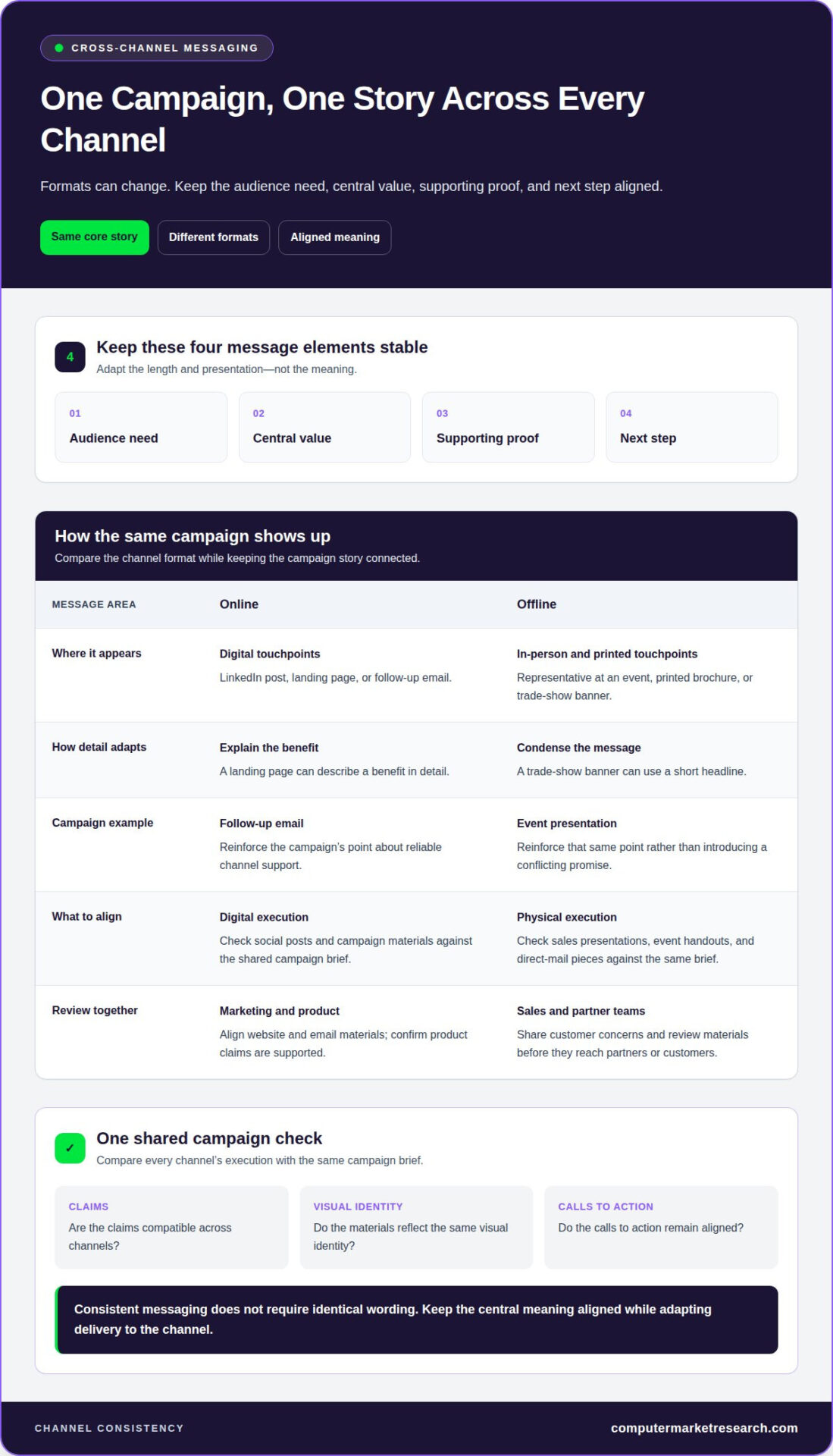
A customer may see a LinkedIn post, meet a representative at an event, then receive a printed brochure. Each interaction should connect to the same core story, even when the format changes. For example, if a campaign emphasizes reliable channel support, the event presentation and follow-up email should reinforce that point rather than introduce conflicting promises. This continuity helps audiences understand what the company offers across digital and physical touchpoints.
Start by defining the message elements that must stay stable: the audience need, central value, supporting proof, and next step. Marketing can then adapt the length and presentation without changing the meaning. A landing page might explain a benefit in detail, while a trade-show banner uses a short headline. Both should express the same priority. This shared structure makes online campaigns and offline conversations easier to connect.
Departmental coordination keeps decisions from becoming isolated. Invite marketing, sales, product, and partner teams to review campaign plans together. For a product launch, sales can surface common customer concerns, product teams can clarify supported claims, and marketing can align the website, email, and printed materials. A cross-functional group focused on the campaign can resolve discrepancies before materials reach partners or customers.
Make collaboration part of the workflow, not just an occasional meeting. Share campaign objectives and approved messages with relevant teams, then invite input on unexpected issues. Use a defined approval process so stakeholders can check materials against brand guidance before publication. This approach encourages early discussion when a proposed claim or channel choice seems difficult to reconcile with the campaign’s main promise.
Ongoing communication also supports trust in agency relationships. The Agency for Toxic Substances and Disease Registry (ATSDR) notes that a lack of ongoing communication or collaboration can lead to mistrust of the agency. In a marketing partnership, clear ownership, timely feedback, and shared campaign updates help teams address inconsistencies before they affect working relationships or audience confidence.
Finally, compare each channel’s execution against the same campaign brief. Check whether a social post, sales presentation, event handout, and direct-mail piece use compatible claims, visual identity, and calls to action. Store approved versions in a shared workspace so teams can quickly find current materials. Reviewing these connections during campaign delivery helps maintain consistency while leaving room to adjust channel tactics as business needs and growth priorities evolve.
Consistent messaging for employees and partners
Employees and partners need the same approved facts, even when their roles differ. A sales representative may explain implementation, while a distributor describes product benefits. Both should use compatible claims, eligibility details, and value propositions. A shared messaging platform can hold current talking points, approved presentations, and campaign updates, giving each group a dependable reference instead of scattered email attachments.
Train partners with a repeatable sequence: introduce the core message, demonstrate it in a realistic customer scenario, then invite practice and feedback. For example, provide a short product explanation and a response to a common customer concern. Ask the partner to explain both in their own words. This builds practical understanding and reveals where guidance needs clarification before a campaign begins.
Use role-specific examples without changing the central facts. An employee might explain a product feature during a sales meeting, while a partner uses that same feature in a customer presentation. Give both approved descriptions and clear boundaries around claims. The Centers for Disease Control and Prevention recommends that hotline staff use organization-approved scripts coordinated with response partners’ approved messaging, a useful model for aligned communication.
How do you train partners to communicate brand messaging consistently? Combine concise written guidance with a walkthrough, sample scenarios, and practice explaining the message. Make the current version easy to find on a shared platform, and designate a communication owner to answer questions and distribute updates to partner teams.
Measure consistency by reviewing partner materials and customer-facing interactions against the approved message. Track whether key claims remain accurate, outdated materials appear, and particular questions repeatedly need clarification. To assess effectiveness, compare engagement and sales outcomes with campaign objectives, then consider changes alongside factors such as audience, channel, and offer. These signals help distinguish message clarity from performance issues elsewhere in the process.
A practical way to ensure consistent partner messaging is to review campaign examples after launch. Collect materials from partner presentations, sales conversations, and customer feedback. Identify recurring gaps, revise the relevant guidance, and share the changes with employees and partners. Success depends on making updates visible, not merely editing a document. When teams can trace each approved message to a current source, they can communicate confidently without improvising unsupported details.
Adapting messages for different channels and audiences
Adaptation changes the delivery, not the central promise. Start with one core statement, then decide which details each audience needs. For example, a manufacturer might emphasize dependable product availability to distributors and easier product selection to retailers. The benefits are framed around each group’s priorities, while the underlying promise remains stable across both conversations.
Audience needs should guide tone, detail, and proof. A technical buyer may want specifications and integration details, while an executive may focus on business impact. A partner speaking with either audience can select relevant evidence without changing product claims. Before drafting, discuss the audience’s main concern, familiarity with the subject, and the action the message should support.
Channel format also shapes how much information fits. A social post needs a concise point and a clear next step; a webinar can explain the same idea with a demonstration. A printed handout can provide a lasting reference, while a sales conversation allows follow-up questions. Each version should preserve the same key claim and avoid adding details that alter its meaning.
Preserve a recognizable voice as you adapt the language. In an email to a new partner, use direct instructions and define specialized terms. For an experienced reseller, concise technical language may be more useful. In both cases, maintain the same level of confidence and avoid making the message sound urgent or casual if that conflicts with the brand’s character.
A practical review can use three checks: confirm the core claim, confirm the audience fit, and confirm the channel format. For example, compare a campaign landing page with its partner email. If the page promises streamlined onboarding but the email emphasizes discounts, revise the emphasis so both support the same customer expectation.
Local context can affect a message’s tone and clarity, even when the audience shares a language. A regional partner may need familiar examples or different terminology. Adapt those details while protecting the original meaning and supported claims. Gather feedback from partner conversations and campaign responses, then revise the relevant version. This process lets teams speak specifically without creating competing messages.
What should a partner messaging toolkit include?
A useful toolkit turns messaging standards into materials partners can apply in real customer interactions. Organize it around practical tasks, such as explaining a product, responding to objections, and introducing a campaign. A partner preparing a customer presentation should be able to find the relevant claim, approved wording, and supporting evidence without searching through old email attachments.
Begin with a concise message map. State the audience, need, central value proposition, proof points, and action the communication should support. For example, a product message could pair a customer challenge with a verified capability and a clear explanation of its business relevance. Include language partners should avoid when it overstates a capability or implies unsupported outcomes.
Give partners materials they can use across different customer touchpoints:
- A short company and product description for introductions and partner profiles.
- Approved benefit statements with supporting evidence and claim boundaries.
- Presentation slides, email templates, and campaign copy with editable sections identified.
- Frequently asked questions covering common objections and accurate responses.
- Logo files, usage guidance, and current visual assets for partner-created materials.
Templates should clarify what partners can tailor. A regional reseller might add local contact details or a relevant customer example while preserving the approved product description. Mark fixed claims separately from editable fields so customization does not change the meaning or create inconsistent promises in a sales email or presentation.
Include operational guidance alongside marketing copy. Name the internal owner for questions, explain how partners submit proposed materials for review, and show where the latest approved files are stored. A clear version label and update date help distinguish current slides from an older saved draft. Remove obsolete assets from shared folders when replacements are issued.
Keep the toolkit current by collecting partner questions and reviewing recurring gaps. If several partners ask how a capability works, add a plain-language answer and a relevant example. If a campaign changes its audience or offer, revise the associated templates and talking points together. This feedback loop makes the toolkit a working resource rather than a static document, helping partners communicate accurately as programs evolve.
Add a brand identity document that outlines the brand’s personality, tone of voice, and key messages to help align the team. Keep physical marketing materials consistent with digital branding, and carry the online brand voice into offline interactions. Include an approval process that brings relevant stakeholders together to check communications against brand guidelines before they go out.
Computer Market Research: PartnerPortal™
Computer Market Research is a practical next step when partner communications rely on scattered records, manual processes, or unclear program information. PartnerPortal™ centralizes partner onboarding, deal registration, and performance tracking, giving channel teams a shared operational foundation. It is relevant when employees and partners need clearer access to consistent program information alongside their customer-facing messages.
PartnerPortal™ supports partner management by bringing key channel activities into one platform. Teams can use centralized partner onboarding to organize how relationships begin, while deal registration structures the recording of partner opportunities. Performance tracking provides visibility into channel activity. These capabilities support coordinated processes, though teams still need clear messaging guidance to explain offers accurately.
Co-op/MDF Management is relevant when partner marketing funds need structured administration. It manages co-op and market development funds, supporting the processes behind partner campaigns. That operational clarity can help teams communicate program information more consistently, such as which approved campaign materials relate to a funding initiative. The messaging itself should still reflect the organization’s current guidelines and campaign terms.
Rebates & Incentives supports the processing of partner incentive programs. Consider it when manual administration makes it harder to maintain reliable program information across internal teams and partners. Clear processing helps employees communicate the same program details that partners use to plan customer or sales activities. The offering addresses administration, while approved guidance remains essential for describing incentive terms.
Deal Registration is useful when partners and internal teams need a defined way to register channel opportunities. Centralizing this activity through PartnerPortal™ can support consistent visibility into registered deals and related partner activity. This matters when teams coordinate opportunity information across sales and channel relationships. It complements messaging alignment by giving teams a shared view of deal activity instead of disconnected records.
These offerings address different operational needs, so the right starting point depends on the process causing friction. PartnerPortal™ supports broader partner management, while Co-op/MDF Management, Rebates & Incentives, and Deal Registration focus on specific channel workflows. Align the selected workflow with the communication gaps partners experience, then connect program information with the guidance they use. To discuss these channel management needs, contact Computer Market Research.
Frequently Asked Questions
What does brand consistency look like?
Brand consistency is recognizable alignment between what an organization says, how it behaves, and how it presents itself. A company that positions itself as responsive, for example, should use clear language and explain what happens next in its communications. Consistency also includes visual choices: customers should recognize the organization across a proposal, event display, and digital campaign without mistaking it for another.
What does consistent partner messaging mean?
It means partners can accurately explain a company’s value without making different or conflicting promises. One reseller may focus on a product’s relevance to a particular customer, while another discusses a different use case. Both should stay within the same approved product claims. A practical test is to compare partner materials and ask whether customers would get compatible answers about the product’s purpose and capabilities.
Why is consistent messaging across partners important?
Aligned partner communication helps customers compare information without having to resolve contradictions themselves. If one reseller describes a service as including a capability that another says is unavailable, customers may question both explanations and delay a decision. Clear, shared messages also help internal sales teams respond confidently to partner questions. This matters especially during launches, when customers may hear about an offer through several channel relationships.
How do you create partner messaging guidelines and a messaging framework?
Start by documenting the audience, business problem, approved value proposition, supporting evidence, and claims partners must not make. Then turn that framework into practical examples, such as a short introduction, a customer email, and answers to common objections. Assign an owner to approve revisions and distribute the current version. For a launch, give partners the framework before campaign materials begin circulating.
How can you adapt messaging for different partner audiences without diluting the brand?
Keep the core claim fixed, then tailor examples, terminology, and supporting details to each partner’s role. A technology reseller might need technical use cases, while a distributor may need concise language for presenting the offer to its sales network. Review each version against the original claim and remove additions that imply unsupported features. This lets partners speak clearly to their audiences without changing what the company promises.

Article by
Del Heles
Del Heles is the founder and CEO of Computer Market Research (CMR), a channel management software company he launched in 1984. With more than 40 years of experience, he’s known for helping manufacturers and distributors simplify complex partner programs through practical, customer-focused technology solutions.