

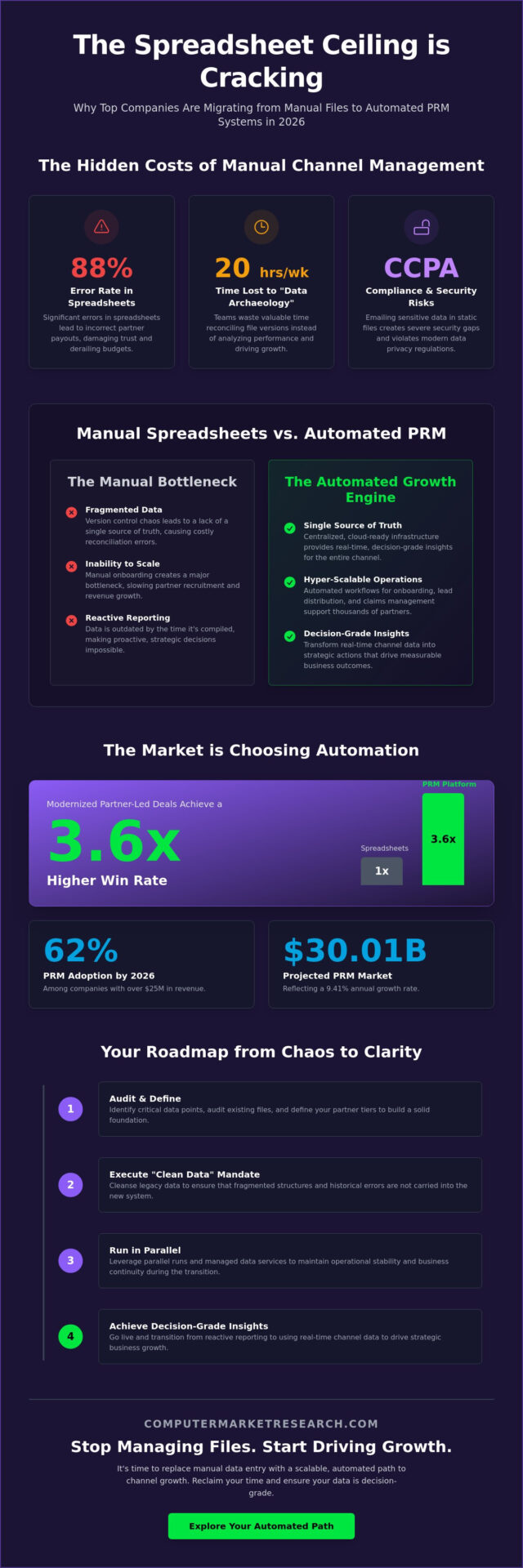
In 2026, PRM platform adoption reached 62% among companies with over $25 million in revenue, signaling a definitive shift away from fragmented manual processes. You likely recognize the friction of managing complex MDF and rebate claims through static files, where a single formula error can derail an entire quarter’s budget. It’s exhausting to deal with version control nightmares and a total lack of real-time visibility into which partners are actually driving growth. Moving from spreadsheets to a PRM system is the only way to reclaim your time and ensure your channel data remains decision-grade.
We understand that the prospect of migrating years of legacy data is daunting. This 2026 guide offers a technical roadmap to transition your records into an automated environment without disrupting your channel operations. You’ll learn how to navigate the migration process, satisfy the latest CCPA risk assessment requirements, and finally achieve the 3.6 times higher win rate that modernized partner-led deals now deliver. It’s time to replace manual data entry with a scalable, automated path to channel growth.
Key Takeaways
- Identify the specific operational costs of manual data entry and why version control is the primary enemy of real-time channel visibility.
- Implement a structured roadmap for moving from spreadsheets to a prm system, focusing on auditing critical data points and defining partner tiers.
- Master the “Clean Data” mandate to ensure your migration doesn’t carry over legacy errors or fragmented file structures into the new environment.
- Leverage parallel runs and managed data services to maintain operational stability while transitioning to automated MDF and rebate management.
- Transition from reactive reporting to decision-grade insights that use real-time channel data to drive strategic business outcomes and growth.
The Spreadsheet Ceiling: Why Manual Channel Management Fails in 2026
Relying on Excel for global channel operations creates a “spreadsheet friction” that quietly erodes profitability. While 62% of companies with over $25 million in revenue have already adopted automated platforms, those still trapped in manual workflows face a growing disadvantage. The transition toward Partner Relationship Management (PRM) isn’t just about convenience; it’s about survival in an ecosystem where 58% of services-led revenue is now partner-sourced. Manual systems simply can’t keep pace with the 9.41% annual growth of the PRM market.
Version control is the primary enemy of real-time channel visibility. When multiple stakeholders edit a shared file, the “single source of truth” evaporates. This leads to catastrophic errors in incentive management, where manufacturers often overpay on Ship & Debit claims due to duplicate entries or outdated price lists. Moving from spreadsheets to a PRM system eliminates these manual headaches by centralizing data in a cloud-ready infrastructure that provides decision-grade insights.
To better understand the shift toward automation, watch this helpful roundtable discussion:
The Fragility of Manual Data Entry
Industry data suggests that 88% of spreadsheets contain significant errors, often hidden within complex formula propagations. In a manual system, a single broken link can result in incorrect partner payouts, damaging trust and wasting administrative hours on reconciliation. These errors create a “data silo” effect where your CRM and your channel spreadsheets never truly align. Additionally, emailing sensitive performance data in static files poses a severe security risk, especially under the 2026 CCPA regulations which mandate strict risk assessments for personal data processing. Without an automated system, you’re one “Reply All” away from a compliance nightmare.
Inability to Scale Partner Onboarding
Manual tracking creates a massive bottleneck for recruitment. Without standardized workflows, onboarding a new partner can take weeks instead of days. This slow response time directly impacts partner loyalty; in a competitive market, partners gravitate toward manufacturers that provide seamless, self-service experiences. A spreadsheet-based model cannot handle the hyper-personalization required in 2026. If your system relies on manual follow-ups, you’re essentially preventing the scaling of indirect sales revenue by design. Moving from spreadsheets to a PRM system allows you to automate lead distribution and performance analytics, ensuring your partners feel supported from day one.
Evaluating PRM Systems vs. Spreadsheets: A Comparison Framework
The choice between maintaining legacy files and moving from spreadsheets to a prm system often comes down to the quality of your data. Fragmented files require constant manual intervention, leading to what we call “data archaeology” at the end of every month. Instead of analyzing performance, your team spends 15 to 20 hours per week just trying to reconcile which version of a file is the most recent. A PRM system replaces this chaos with a single source of truth, where every partner interaction is recorded in real-time.
Scalability is the most visible differentiator in this framework. A manual system might suffice for 10 partners, but it becomes a liability when managing 100 or 1,000 accounts. As the PRM market is projected to reach $30.01 billion in 2026, the industry is moving toward “ecosystem orchestration” that spreadsheets simply cannot support. Automated workflows replace manual follow-ups, ensuring that no lead or claim sits idle in someone’s inbox. If you are ready to stop managing files and start managing growth, you can explore how automated portals streamline these workflows.
Core Functional Differences
Automated Market Development Funds (MDF) management is a primary driver for migration. In a spreadsheet, tracking fund expiration and proof-of-performance is a manual ledger task prone to human error. A PRM automates the entire lifecycle, from request to reimbursement. Similarly, deal registration features use automated validation to prevent channel conflict, a task that is nearly impossible to manage across dozens of shared Excel files. Lead management also shifts from static lists to real-time distribution, ensuring partners receive hot leads while they are still actionable.
The ROI of Automation
The financial impact of moving from spreadsheets to a prm system is measurable through reduced overpayments and reclaimed administrative time. Organizations using data analytics in their partner management strategies see a 25% increase in partner satisfaction. This shift requires adherence to data migration and cleansing best practices to ensure that the “garbage in, garbage out” trap is avoided during the transition. By implementing system guardrails, manufacturers can reduce rebate overpayments by an average of 5% to 10%, directly improving the bottom line. This level of control allows channel managers to focus on strategic planning rather than manual data entry.
Step-by-Step Guide: Moving from Spreadsheets to a PRM System
Moving from spreadsheets to a prm system requires a methodical approach that prioritizes data integrity over speed. While the limitations of spreadsheets often become a bottleneck as your channel grows, the transition to automation must be handled with precision. A successful migration ensures that your historical performance data remains intact while setting the stage for future scalability. By following a structured roadmap, you can eliminate the manual headaches that currently plague your sales operations.
Execution begins with a comprehensive audit of your existing manual processes. It’s not enough to simply export your Excel files; you must identify which data points are critical for your 2026 growth targets. This involves mapping your current spreadsheet columns to specific fields within your new portal, such as Deal Registration, POS data, and MDF balances. A phased migration strategy allows you to validate data accuracy at each step, preventing the “garbage in, garbage out” scenario that often disrupts new software implementations.
Phase 1: Pre-Migration Data Audit
The first step is identifying redundant, obsolete, and trivial (ROT) data within your shared files. Over time, spreadsheets accumulate duplicate partner entries and expired incentive records that will only clutter your new system. You must standardize partner naming conventions across all files to ensure a seamless import. This is also the time to verify current MDF balances and open incentive claims. With the new CCPA regulations that took effect on January 1, 2026, conducting this audit ensures you aren’t migrating sensitive personal data that presents a significant risk to your compliance status.
Phase 2: System Configuration and Mapping
Configuration involves setting up your Partner Relationship Management hierarchy to reflect your actual business structure. You’ll define partner tiers, access levels, and specific permissions for different user roles. Customizing your portal branding is equally important; a professional, manufacturer-branded environment builds partner trust and encourages higher adoption rates. Finally, ensure your PRM is integrated with your existing CRM or ERP systems. This bi-directional flow of data is essential for maintaining a single source of truth across your entire organization.
Phase 3: User Acceptance Testing (UAT)
Before a full-scale launch, run a pilot program with a select group of trusted partners. This testing phase allows you to verify the logic behind your deal registration and lead distribution workflows. You’ll want to ensure that notifications are firing correctly and that the partner experience is intuitive. Collecting direct feedback during UAT helps you refine the user interface and resolve any technical friction points. By the time you move your entire channel from spreadsheets to a prm system, you’ll have the confidence that the platform is optimized for performance.
Managing the Transition: Data Cleansing and Parallel Runs
The “garbage in, garbage out” principle is particularly dangerous when moving from spreadsheets to a prm system. Migration isn’t just a relocation of data; it’s a purification process that requires strict adherence to a “Clean Data” mandate. In 2026, where data accuracy is directly linked to a 25% increase in partner satisfaction, you can’t afford to import unverified or fragmented records. Data cleansing involves more than just deleting duplicate entries. It requires the normalization of disparate formats from various distributors into a unified structure that your new system can actually process for actionable insights.
Success during this phase depends on your ability to reconcile legacy records with modern automation. If you’re currently managing complex distributor networks, the sheer volume of messy Point of Sale (POS) data can quickly overwhelm your internal sales operations team. Attempting to cleanse years of spreadsheet history manually often leads to new errors, which defeats the purpose of the migration. You must ensure that every record, from inventory levels to partner contact details, is verified against the 2026 CCPA standards, especially regarding data deletion requests that must be processed within 45 days.
The Role of Managed Data Services
Outsourcing the collection and cleansing of reports can offload the massive administrative burden of normalization. Managed data services specialize in the “heavy lifting” of POS Data Management and inventory reporting. At CMR, we focus on collecting and validating every line item from your distributors to ensure your Ship & Debit and rebate calculations are based on decision-grade facts. This specialized intervention prevents the common pitfalls of manual ingestion and ensures that your new PRM environment starts with a foundation of absolute accuracy. If you’re ready to eliminate the friction of messy distributor reports, you can schedule a consultation for our managed data services.
Parallel Run Strategy
A 30-day verification window is essential to maintain operational stability. During this time, your team should run the legacy spreadsheets and the new PRM system in parallel. This allows you to cross-reference the automated outputs against your manual sheets to identify any logic discrepancies in fund calculations or lead distribution. It’s a critical safety net that ensures your partners aren’t impacted by migration glitches. You must also set a firm “sunset date” for all spreadsheet-based updates to prevent data drift between the two systems. Training internal stakeholders during this window is equally vital; they need to move away from the old “data entry” mindset and embrace the new automated workflow. Once the PRM outputs consistently match or exceed the accuracy of your legacy files, you can confidently decommission the spreadsheets forever.
Communicating this change to your partners is the final step in a successful transition. You’re shifting the relationship from “clunky email chains” to “streamlined portals,” which is a significant value proposition for them. Clearly explain how the new PartnerPortal™ will simplify their experience with faster claim approvals and real-time visibility into their performance. When partners see that the move away from spreadsheets means they get paid faster and have better access to leads, their adoption rates will soar.
Beyond the Migration: Achieving Decision-Grade Insights
Completing the technical shift of moving from spreadsheets to a prm system is a significant milestone, but it’s only the first step toward true operational excellence. The real transformation occurs when your team stops asking “What happened last month?” and starts asking “What should we do next?” By 2026, the global PRM market has reached $30.01 billion because businesses recognize that manual “data archaeology” is no longer sustainable. Transitioning to an automated environment allows you to leverage real-time channel management data to drive strategic growth rather than just managing administrative tasks.
Measuring the success of your migration requires looking at specific partner engagement KPIs. Organizations that successfully implement data analytics in their partner management strategies see a 25% increase in partner satisfaction. This shift is critical because deals involving a partner-overlay now have a 3.6 times higher win rate and close approximately 28 days faster than direct sales. These aren’t just abstract numbers; they’re the direct result of providing partners with a seamless, automated experience through tools like PartnerPortal™. For Fortune 500 companies, centralizing operations in this way ensures that every dollar spent on MDF or rebates is tied to a verifiable business outcome.
Unlocking Real-Time Channel Visibility
The death of the spreadsheet brings the birth of the dashboard. Instead of waiting for end-of-month reports, you now have instant visibility into inventory levels and sales velocity across your entire network. This transparency allows you to identify high-performing partners who deserve more investment and those who need additional support or training. When you can present the C-suite with hard data on how channel marketing spend translates into POS revenue, you move from being a cost center to a strategic revenue driver. It’s about having the confidence that your data is clean, accurate, and ready for executive-level scrutiny.
Future-Proofing Your Channel Strategy
By the end of 2026, over 60% of channel organizations plan to embed AI within their workflows. Moving from spreadsheets to a prm system prepares your infrastructure for this shift, allowing you to eventually use predictive scoring and intelligent deal routing. You can scale your program to manage thousands of partners without adding headcount to your sales operations team. Automation handles the complexity, while your team focuses on building relationships. If you’re ready to leave manual errors behind and embrace a data-driven future, you can request a demo of CMR’s PartnerPortal™ to start your migration today.
Reclaiming Control of Your Channel Strategy
The path to scaling indirect sales revenue requires leaving fragmented manual workflows behind. By prioritizing data integrity and following a structured migration roadmap, you can eliminate the version control nightmares that currently stifle your growth. Moving from spreadsheets to a prm system is more than a technical upgrade; it’s a commitment to accuracy and partner satisfaction. You’ve seen how automated MDF management and real-time visibility transform reactive reporting into strategic planning.
Computer Market Research was founded in 1984. We’ve spent decades perfecting the management of complex POS and MDF data for Global 2000 and Fortune 500 manufacturers. Our team understands that the transition to automation requires a partner who values clean data as much as you do. Don’t let static files continue to bottleneck your operations. It’s time to build a channel that is ready for the demands of 2026 and beyond.
Stop the spreadsheet headaches, schedule your PartnerPortal™ demo today
Embrace the efficiency of a modernized channel and start making decisions based on facts, not guesswork.
Frequently Asked Questions
How long does it typically take to move from spreadsheets to a PRM system?
A complete transition typically requires between 60 and 120 days, depending on the complexity of your partner network. Moving from spreadsheets to a prm system involves a structured approach that includes data auditing, system mapping, and rigorous testing phases. While some organizations attempt a faster rollout, a 90-day timeline allows for proper data normalization and ensures your internal teams are fully trained on the new automated workflows.
Will my partners actually use a new PRM portal?
Partner adoption is directly linked to the tangible value the portal provides. If the new system streamlines MDF claims and offers real-time visibility into rewards, partners are highly likely to engage. In 2026, PRM adoption reached 62% in organizations with over $25 million in revenue because these systems reduce partner friction. Providing a self-service environment where they can access leads and register deals faster than via email is the key to high utilization.
What happens to my historical data during the migration?
Your historical data is mapped and migrated into the PRM to maintain continuity. It’s essential for identifying long-term performance trends and verifying legacy incentive balances. During the migration process, we ensure that historical POS and inventory records are normalized so they align with the new system’s reporting structure. This allows you to compare current performance against previous years without losing the context of your manual records.
Do I need to clean my spreadsheet data before importing it into a PRM?
You must clean your data to avoid the “garbage in, garbage out” trap. Since research indicates that 88% of spreadsheets contain significant errors, importing them directly would compromise your new system’s accuracy. This migration is the perfect opportunity to eliminate redundant or obsolete records. Standardizing partner names and verifying open rebate claims ensures that your automated environment starts with a foundation of decision-grade data.
Can a PRM system integrate with my existing CRM platform?
Modern PRM solutions are engineered to integrate with your existing enterprise-grade CRM and ERP infrastructure. This connectivity facilitates a bi-directional data flow, ensuring that your direct and indirect sales records remain synchronized across the entire organization. When a partner registers a deal in the portal, the information updates your internal CRM instantly. This automated synchronization eliminates the manual lag times and data entry errors that usually occur when managing channels through static files.
What is the biggest mistake companies make when moving away from spreadsheets?
The biggest mistake is underestimating the complexity of data normalization. Many companies assume that a simple export/import will suffice, but manual spreadsheets often lack the structured format required for automation. Failing to account for the nuances of complex distributor networks can lead to reconciliation errors in Ship & Debit claims. Successful companies avoid this by using managed data services to handle the technical heavy lifting of cleansing messy POS reports.
How do I justify the cost of a PRM system over ‘free’ spreadsheets?
You justify the cost by analyzing the ROI of reclaimed administrative hours and the reduction of financial leakage. While spreadsheets appear free, the hidden cost of manual errors and overpayments on rebates is significant. Data shows that deals with a partner-overlay close approximately 28 days faster and have a 3.6 times higher win rate than direct sales. These performance metrics provide a compelling business case when moving from spreadsheets to a prm system.
What is ‘Decision-Grade Data’ and why does it matter for channel management?
Decision-grade data refers to information that is accurate, validated, and real-time enough to drive strategic business actions. In channel management, this means having a single source of truth for inventory levels, sales velocity, and fund utilization. It matters because it allows you to justify marketing spend to the C-suite with hard facts. Without it, you’re making guesses based on fragmented files that may be weeks or months out of date.

Article by
Del Heles
Del Heles is the founder and CEO of Computer Market Research (CMR), a channel management software company he launched in 1984. With more than 40 years of experience, he’s known for helping manufacturers and distributors simplify complex partner programs through practical, customer-focused technology solutions.