

A genuine product can reach customers through a sales channel its brand never authorized. That is the gray market: trade in authentic goods outside approved distribution, which is not necessarily illegal. Understanding how to manage gray market and unauthorized sales starts by distinguishing unauthorized distribution from counterfeit or black-market activity, then tracing how products entered the channel.
It is understandable to focus on unusually low prices or sellers operating outside approved regions. But a listing alone may not show how goods moved through the supply chain, or whether the product, packaging, and support match customer expectations. Better reseller visibility and product traceability help turn scattered signals into a clearer picture.
This article explains gray-market sales, the risks they can create for brands and customers, and ways to investigate distribution patterns. It also covers how marketplace and reseller data can help flag potential diversion, why product identifiers matter, and how channel management systems can support a more organized response.
Key Takeaways
- Learn how genuine products can move into unauthorized channels, including through excess or slow-moving inventory.
- Recognize why an unusually low price or sales outside approved regions can warrant closer investigation.
- Understand how unauthorized purchases may affect warranty coverage, product support, and confidence in product authenticity.
- See how reseller and marketplace visibility can help reveal distribution patterns and focus follow-up.
- Discover how product identifiers and channel management tools can support clearer traceability and oversight.
What Is the grey market?
Gray-market sales involve genuine products moving through unauthorized distribution channels rather than a brand’s approved network. They are not necessarily illegal, but their route can affect pricing, product oversight, and customer expectations.
Gray Market and Unauthorized Sales
The gray market involves genuine goods sold through channels the brand has not authorized; unauthorized sales are sales outside that approved network. The terms often overlap, but neither automatically means the goods are counterfeit or illegally traded. That distinction matters when a low-priced product appears online: the seller’s status and the product’s origin need to be assessed separately.
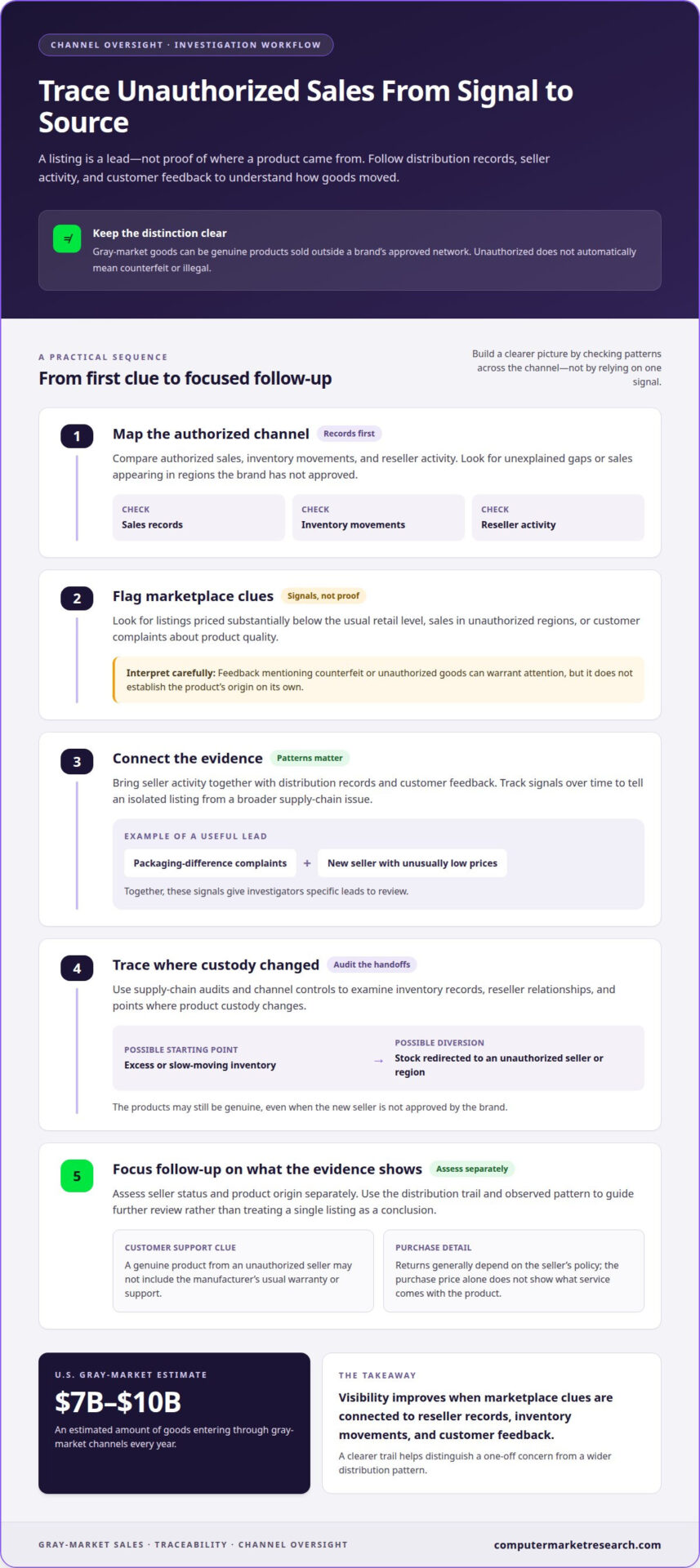
Gray-market goods can include electronics, cosmetics, clothing, and pharmaceuticals. Price differences between countries can create an incentive to move genuine products from one market into another. In the United States, an estimated $7 billion to $10 billion in goods enter through gray-market channels every year.
Brands in the United States can consider several legal routes when evidence supports action. Section 32 of the Lanham Act addresses trademark infringement under 15 U.S.C. § 1114; Section 43(a) addresses false designation of origin under 15 U.S.C. § 1125(a). Section 42 addresses unauthorized imports under 15 U.S.C. § 1124, while Section 526 of the Tariff Act is codified at 19 U.S.C. § 1526. Responses can range from cease-and-desist letters to seizures, ITC actions, or civil litigation.
Movement Outside Authorized Channels
Products can leave authorized distribution when distributors or retailers sell excess or slow-moving inventory outside agreed channels. A wholesaler might redirect stock intended for one region to an unauthorized seller in another. The items may be genuine, even though the new seller lacks the brand’s approval to distribute them.
Supply-chain transparency helps identify where diversion begins. Brands can compare authorized sales, inventory movements, and reseller activity to spot unexplained gaps or sales in unapproved regions. Channel controls and supply-chain audits can then focus on inventory records, reseller relationships, and the points where product custody changes.
Marketplace listings offer another signal. A price substantially below the usual retail level, sales in an unauthorized region, or customer complaints about product quality can prompt investigation. Online feedback mentioning counterfeit or unauthorized goods also warrants attention, though it does not establish the product’s origin on its own.
Monitoring is more useful when teams connect seller activity with distribution records and customer feedback. For example, a cluster of complaints about packaging differences alongside a new seller’s unusually low prices gives investigators specific leads. Tracking these signals over time helps distinguish an isolated listing from a broader supply-chain issue.
Consumer risks when buying from unauthorized sellers
A consumer buying from an unauthorized seller may receive a genuine product without the manufacturer’s usual warranty or support. For example, a camera may work as expected but lack access to the brand’s repair process. Returns generally depend on the seller’s policy, and the manufacturer may not honor warranty claims. The purchase price alone does not show what service comes with the product.
Product condition and authenticity can also be harder to assess. Unauthorized inventory may include expired goods, defective batches, or knock-offs presented in legitimate branded packaging. A sealed box does not prove an authorized supply route. If packaging, labels, or product performance differ from customer expectations, the source may warrant investigation.
Inconsistent customer experiences can affect a brand’s reputation. A consumer who receives a product with unfamiliar packaging may complain to the manufacturer, even if an independent seller made the sale. That confusion can increase support demands and complicate warranty discussions. Clear product pages and packaging can identify authorized retailers and explain what support applies to each purchase route.
- Warranty: Explain whether the manufacturer’s warranty applies to purchases from unauthorized sellers.
- Returns: Tell customers that returns for these products depend on the seller’s policy.
- Product concerns: Provide a clear route for reporting suspected defects, unusual packaging, or authenticity concerns.
Direct-to-consumer sales give brands a controlled way to describe products, support, and purchasing options. They can also make authorized buying routes easier to identify. Consumer education can reinforce that information through official retailer websites, social media, and product packaging. For example, a product page can identify authorized resellers and explain how to find applicable warranty terms before purchase.
Consumer protection considerations matter too. California enforces consumer protection laws against gray-market goods, while product-specific concerns may require separate attention. Brands should keep customer communications precise: distinguish an unauthorized seller from a counterfeit claim, explain warranty limits plainly, and route product complaints for review. These steps help consumers understand what they bought without implying that every unauthorized item is counterfeit or defective.
When reseller records and customer feedback sit in separate systems, teams can struggle to connect a complaint with its sales channel. A more coordinated view of channel data can help organize those signals alongside reseller information. Explore channel data management options to support clearer tracking and consumer communications.
Definition of gray-market goods
Gray-market goods are genuine products sold outside the manufacturer’s authorized distribution network. Gray-market trade can also involve products sold without legal registration to avoid taxes, goods suspended from an official market, or products sold before launch. These circumstances affect how a product reached retailers, but do not by themselves establish counterfeiting.
That distinction matters. A genuine item sold through unauthorized channels differs from a counterfeit, which falsely presents itself as authentic. Gray-market activity may also differ from black-market trade, which involves illegal transactions. In practice, product origin, seller authorization, and compliance with applicable rules are separate questions.
Differences between markets can create incentives for diversion. For example, a retailer or wholesaler may acquire genuine products intended for one region and resell them in another. A product might also enter a channel after its official sale has been suspended or before its planned launch. The term “gray market” describes the distribution route, not a single product condition.
In the United States, the first-sale doctrine and trademark law can affect whether particular imports may be restricted. The Supreme Court’s K Mart Corp. v. Cartier, Inc., 486 U.S. 281, is cited in connection with gray-market imports and the first-sale doctrine. That reference does not make every import lawful; trademark rights and differences between imported and authorized goods can matter.
Enforcement decisions should consider commercial outcomes, not just the number of listings removed. Useful measures include whether diverted inventory continues reaching unauthorized retailers, whether a suspected source has been identified, and whether complaints linked to those goods decline. These signals connect enforcement activity to channel control and customer impact.
Costs for gray-market matters vary by product and seller, so companies can weigh them against the commercial value of intervention. A focused review can compare the scale of suspected diversion, likely impact on authorized distribution, available evidence, and resources needed for follow-up. For example, repeated sales tied to a traceable source may justify a different response from isolated listings with unclear origins.
Track outcomes over time. If takedowns rise but the same goods keep appearing through new retailers, removal counts alone do not show lasting progress. Measures such as repeat seller activity, identified supply sources, and effects on authorized channel sales can help determine whether enforcement is addressing the underlying route.
Marketplace and reseller data visibility
Marketplace visibility helps brands connect seller activity, pricing patterns, and channel records. The goal is to identify possible diversion and understand its commercial impact.
Tools for Tracking Unauthorized Sales
Automated price monitoring tracks reseller listings, price changes, and competitor pricing across online platforms. It helps teams spot patterns that manual searches can miss. Pair listing data with authorized reseller records and distribution agreements to distinguish known partners from sellers outside approved channels.
Track the seller, product, price, marketplace, and date observed. A repeated listing across platforms may point to a wider distribution issue, while an unusual price may need more context. eBay itself is not a gray market, though unauthorized sellers may use it. Combine data insights with human review before choosing a response.
Minimum Advertised Price (MAP) policies can set advertised-price expectations for participating sellers. Monitoring can show where listings appear inconsistent with those policies, but MAP data alone does not identify how goods entered the channel. Compare marketplace signals with reseller agreements, inventory records, and sales data for a clearer view.
Responding to Unauthorized Listings
Responding to an unauthorized listing starts with investigating its scope and potential source. Record listing details, check available channel records, and assess whether the activity connects to a broader pattern. Prioritize follow-up based on its effect on authorized distribution and commercial outcomes, rather than counting removals alone.
Restricting resale or refusing to sell to unauthorized dealers can involve trade-offs. A broad restriction may strain relationships with legitimate resellers or reduce visibility into inventory movements. Distribution agreements should clearly define authorized channels and expectations; decisions should account for the agreement and relevant trademark or consumer-protection considerations.
Some unauthorized sellers can have an outsized effect: one market estimate states that 20% of unauthorized sellers cause 80% of Amazon brand erosion problems for most brands. Treat that figure as a reason to prioritize investigation, not as a substitute for company-specific evidence. Compare seller activity with observed prices, customer feedback, and channel performance.
Useful channel data management can bring reseller and sales information into a more consistent view. That makes it easier to detect patterns, evaluate agreements, and direct attention toward issues with measurable commercial consequences.
Product identification and traceability
Product traceability connects identifying marks, inventory records, and seller information to help investigate suspected diversion. Differences in labels, barcodes, or packaging can provide useful clues, but no single mismatch proves that a product is counterfeit or identifies its source.
Seller and Product Verification
Seller and product verification compares a seller’s status with product identifiers and available distribution records. This matters because genuine goods can move through unauthorized routes, while counterfeit products may use legitimate branded packaging. Teams should assess several indicators together rather than treating one barcode or label difference as proof of inauthenticity.
Companies can work with the U.S. Customs and Border Protection Intellectual Property Rights office to develop a Product Identification Training Guide. Such a guide can help relevant personnel recognize product and packaging differences during inspections or investigations. Consistent records also help connect a specific product concern with a seller, shipment, or inventory record. For example, a reported packaging variation is more useful when linked to the product’s documented distribution history.
Identifying Unauthorized Sellers
Brands can identify possible unauthorized sellers by comparing marketplace activity with authorized reseller records and distribution agreements. A seller operating outside approved channels, combined with product identifiers that differ from authorized stock, gives investigators a concrete lead. Customer complaints and warranty claims can add context when they describe recurring product or packaging concerns.
Record listing details, seller names, product identifiers, and relevant reports together. This creates a traceable case file and helps distinguish isolated activity from a pattern. For teams deciding how to manage gray market and unauthorized sales, organized evidence can guide proportionate follow-up. If the evidence supports escalation, responses may range from cease-and-desist letters to seizures or civil litigation, depending on the circumstances and applicable regulations.
Traceability also applies to inventory that should not return to sale. Certified disposal can involve secure destruction or recycling. Shredding, crushing, or incineration can render products unusable and unfit for resale. Documenting the disposition helps establish what happened to stock removed from circulation and reduces the chance that it re-enters distribution channels.
Clear internal policies connect identification, investigation, and disposition. A company can define how teams record label differences, route authenticity concerns, and document products sent for destruction. A documented process for how to manage gray market and unauthorized sales gives teams a consistent way to connect product evidence with seller activity and inventory records.
Better reseller and inventory visibility can support that process. Explore product and reseller visibility workflows to bring channel information into a more organized view.
Computer Market Research
When reseller information, partner activity, and incentive records sit in separate workflows, channel oversight becomes harder to maintain. Computer Market Research provides cloud-based SaaS solutions designed to automate and streamline channel management. Its solutions are relevant when a business needs more organized partner and sales administration alongside efforts to improve reseller visibility.
PartnerPortal™ centralizes partner onboarding, deal registration, and performance tracking. This gives teams a shared foundation for managing indirect sales and marketing operations. For businesses coordinating a broad partner network, structured partner information can support clearer oversight of authorized relationships. It does not replace investigations into suspected diversion, product authentication, or legal enforcement.
Deal Registration helps organize partner-submitted opportunities within the channel process. When sales teams need a consistent view of registered deals and partner activity, a centralized workflow can reduce reliance on scattered records. Better organization helps teams understand which partners are participating and how channel programs are being used.
Incentive administration is another area where structured processes matter. Co-op/MDF Management supports the management of partner marketing funds, while Rebates & Incentives supports incentive program administration. These offerings are most relevant when program records and partner participation need more consistent management, not as direct tools for identifying counterfeit goods or tracing individual products.
Computer Market Research may be a natural next step when manual processes make partner data difficult to consolidate or channel programs difficult to administer. Its channel partner management platform brings onboarding, deal registration, and performance tracking into a centralized system. This channel-management foundation can complement a company’s separate reseller monitoring and product traceability processes.
A practical starting point is to identify the fragmented channel workflow: partner onboarding, deal registration, co-op/MDF fund management, or incentive administration. This distinction helps connect an operational need to the relevant offering without confusing channel management with legal enforcement. Contact Computer Market Research to discuss the channel management processes your business wants to organize.
Build a More Connected Channel Operation
A durable approach to how to manage gray market and unauthorized sales starts with treating channel data as an operational resource. Clear partner records and consistent program workflows help teams make informed decisions as distribution relationships evolve. The next step is to identify where fragmented information slows oversight, whether in partner onboarding, deal registration, or incentive administration.
Computer Market Research supports channel operations through PartnerPortal™, Co-op/MDF Management, and Rebates & Incentives. PartnerPortal™ centralizes partner onboarding, deal registration, and performance tracking, while the management offerings support partner program administration. These tools address channel workflows and complement separate product identification and enforcement processes.
Choose a focused starting point: define the process that needs more structure, clarify which partner information teams rely on, and align the workflow with channel goals. This creates a practical foundation for improving data visibility without treating every reseller issue as the same problem.
Contact Computer Market Research to discuss the channel workflows you want to organize. A clear operating foundation can help your team move forward with greater confidence.
Frequently Asked Questions
How do you protect your brand?
Protect your brand by connecting channel rules, product records, and customer reports in a consistent review process. For example, a complaint about unfamiliar packaging can be compared with reseller activity and product identifiers before escalation. Set clear internal ownership for reviewing signals, documenting findings, and deciding when to pursue enforcement. Focus on activity that affects authorized sales or customer confidence, rather than treating every unusual listing as equally consequential.
What is the gray market?
The gray market is the sale of genuine products through distribution routes a brand has not authorized. A product intended for one country, for example, may be resold into another market where the brand’s approved channels differ. This route does not automatically mean the item is counterfeit or the transaction is illegal. The key distinction is between the product’s authenticity and whether its seller or route is authorized.
How can companies trace products through distributors and supply chains?
Companies can trace products by connecting identifying marks with distributor, inventory, and sales records. Labels and barcodes can help link a product to records at different points in distribution. For example, if a customer reports a label that differs from authorized stock, investigators can compare that detail with available inventory and reseller information. Keeping these records together makes it easier to follow leads and document where a product’s path becomes unclear.
What channel policies and distributor agreements help prevent unauthorized sales?
Useful channel policies clarify which sellers and distribution routes are authorized, how excess inventory is handled, and what information partners provide about sales. Distributor agreements can document those expectations and define how channel activity is reported. For example, a policy can establish a process for reviewing slow-moving stock before resale. Clear records help teams identify where actual distribution diverges from the arrangements partners have accepted.
How do gray-market sales affect pricing, warranties, product safety, and brand reputation?
Gray-market sales can disrupt regional pricing when genuine goods move between markets with different prices. Consumers may also find that a manufacturer does not honor a warranty for an unauthorized purchase, while returns depend on the seller’s policy. Product condition can vary, and goods may be inferior or unsafe. If customers associate those experiences with the brand, complaints can undermine confidence even when an independent seller handled the transaction.

Article by
Del Heles
Del Heles is the founder and CEO of Computer Market Research (CMR), a channel management software company he launched in 1984. With more than 40 years of experience, he’s known for helping manufacturers and distributors simplify complex partner programs through practical, customer-focused technology solutions.