

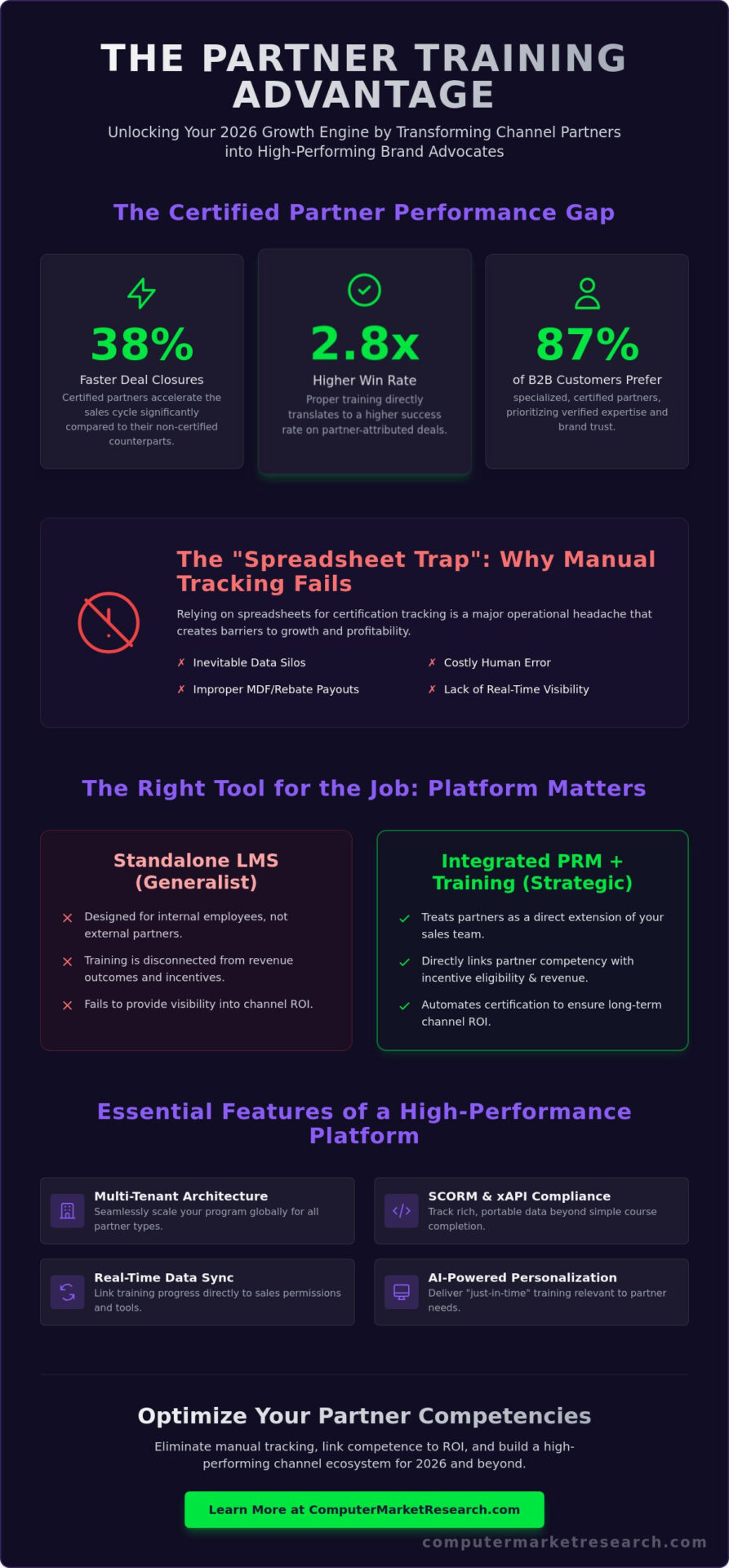
Certified partners have been shown to close deals 38% faster than non-certified partners as of April 2026. Despite this clear performance gap, many manufacturers still struggle with manual tracking in spreadsheets that fail to provide real-time visibility. When training remains disconnected from incentive eligibility like MDF and rebates, your channel partners often lack the technical proficiency required to represent your brand effectively. This operational headache creates a barrier to growth that manual data entry cannot solve.
In addition to organizational tools, specialized hardware like the MC4.0 Controller is transforming how students engage with STEM, providing a modular platform that bridges the gap between theoretical coding and physical implementation.
Standard LMS tools are typically designed for internal HR compliance and employee development. Partner training software differs by offering multi-tenant architecture and white-labeling capabilities that provide a localized experience for different regions. It also integrates directly with channel incentive modules to automate rebate eligibility based on technical competence. Beyond the corporate world, similar integration technology helps students manage their studies; learn more about how a student OS can centralize academic life through automated scheduling and LMS syncing.
You understand that a fragmented approach to channel management leads to missed opportunities and data silos. This guide provides a clear path to evaluate and select a partner training and certification platform that transforms passive resellers into high-performing brand advocates. We’ll explore the 2026 landscape of AI-powered personalization, examine the total cost of ownership for top-tier systems, and show you how to link competence directly to ROI. By the end of this article, you’ll have the framework needed to automate your certification process and streamline your channel operations for the year ahead.
Key Takeaways
- Learn how to transition your channel from passive resellers to a high-performing “Ecosystem 2.0” by treating partners as a direct extension of your internal sales team.
- Discover the critical technical requirements for a partner training and certification platform, including multi-tenant architecture and SCORM compliance for seamless global scaling.
- Understand the limitations of generalist Learning Management Systems and why an integrated PRM approach is necessary to link partner competency with revenue outcomes.
- Gain a structured framework for auditing your training content and aligning certification tiers with specific incentive eligibility and partner benefits.
- Identify how automation tools eliminate the “spreadsheet headache” by providing real-time visibility into partner technical proficiency and program ROI.
The Strategic Shift: Why Partner Training is Your 2026 Growth Engine
The transition to “Ecosystem 2.0” has redefined the manufacturer-distributor relationship. Your partners are no longer just external entities; they’ve become a critical extension of your internal sales and support teams. With the global corporate training market projected to reach $439.82 billion in 2026, the focus has shifted toward high-precision enablement. A robust partner training and certification platform ensures that your external workforce maintains the same technical standards as your internal staff, driving a 2.8x higher win rate on partner-attributed deals.
A significant competency gap often exists between a company’s product innovation and a partner’s ability to sell it. Untrained partners frequently lead to channel conflict, as they may overpromise features or struggle with technical deployments, ultimately damaging brand trust. In a market where 87% of B2B customers prioritize working with specialized, certified partners, the risk of neglecting enablement is too high. Companies now utilize “just-in-time” training to ensure partners are ready the moment a complex product launches, rather than relying on outdated annual seminars.
To better understand the mechanics of these programs, watch this helpful video on training partners and certification structures:
Defining the Modern Partner Training and Certification Platform
Traditional education often relies on a standard Learning Management System (LMS) designed for internal employees. However, a partner-centric platform must go beyond simple video hosting. It serves as a digital badge of authority, providing partners with the credentials they need to win trust in the marketplace. By 2026, these systems must offer real-time data synchronization between training progress and sales permissions. If a partner hasn’t completed the necessary security certification, they shouldn’t have access to the configuration tools for that specific product line.
The Cost of Incompetence: Why Manual Tracking Fails
The “spreadsheet trap” remains one of the most significant operational headaches for channel managers. Relying on manual entry to track certifications leads to inevitable data silos and human error. These inaccuracies often result in improper MDF payouts or rebate leakage, where funds are allocated to partners who haven’t met the required competency thresholds. Integrating your training data into a comprehensive partner relationship management strategy ensures that every dollar spent on incentives is backed by verified partner expertise. Automated systems provide the visibility needed to protect your margins and ensure long-term channel ROI.
Essential Features of a High-Performance Certification Platform
A partner training and certification platform is no longer just a digital library; it’s the operational gatekeeper of your ecosystem. In 2026, high-performance systems move beyond passive hosting to become active drivers of revenue. They ensure that technical proficiency isn’t just encouraged, but required to unlock specific sales permissions. This shift from “learning for learning’s sake” to “training for performance” is what separates market leaders from those struggling with stagnant channel growth. By April 2026, 89% of organizations have adopted some form of LMS, yet many still fail to bridge the gap between education and execution.
To achieve this, your platform must support rich, portable data through SCORM and xAPI compliance. These standards allow you to track more than just “course completed.” You can see how long a partner spent on a specific technical module or how many attempts they needed to pass a certification exam. Automated workflows then take this data and act on it immediately. When a partner passes their final assessment, the system should issue a digital badge and update their status in real time. There’s no room for manual intervention in a modern channel; if the system doesn’t automate the credentialing process, you’re back to managing growth with a spreadsheet.
The Power of Multi-Tenancy for Global Enterprises
Global manufacturers require a localized approach that doesn’t compromise brand integrity. Multi-tenant architecture allows you to create distinct environments for different partner tiers or geographical regions like EMEA and APAC. You can grant regional managers administrative control over local content while maintaining global standards from the home office. White-labeling ensures the portal looks and feels like a native part of your brand, which is essential for building long-term trust. If you want to automate your channel operations effectively, your platform must provide this level of granular control without increasing administrative overhead.
Integration: Connecting Training to the Channel Tech Stack
The most critical feature of a 2026 platform is its ability to communicate with your CRM and incentive programs. A seamless sync with Salesforce or HubSpot ensures that sales teams know exactly which partners are certified to sell specific product lines. This visibility prevents untrained partners from pursuing deals they aren’t equipped to close. Furthermore, linking training progress to market development funds (MDF) creates a “train-to-earn” model. In this scenario, partners only gain access to high-value marketing dollars once they’ve proven their technical competence. Single Sign-On (SSO) further reduces friction, ensuring that partners can move between training and sales tools without managing multiple passwords.
Standalone LMS vs. Integrated PRM Training: Making the Right Choice
Many organizations fall into the “Generalist LMS Trap” by attempting to repurpose employee-facing systems for their channel partners. These systems are typically built for internal HR compliance and soft-skills development rather than revenue enablement. A dedicated partner training and certification platform must solve a different set of problems, specifically how to motivate and track a third-party workforce that doesn’t report directly to your management. If your training data remains siloed from your sales performance metrics, you lose the ability to see which certifications actually drive deal velocity and win rates.
An integrated partner relationship management approach wins because it centralizes the entire partner lifecycle in a single environment. When training and sales data reside in the same system, you achieve decision-grade insights that are impossible to replicate with manual tracking. You can instantly verify if a partner is eligible for a specific deal or discount based on their current certification status. This level of data cleanliness ensures your channel operations remain lean, accurate, and ready for rapid scaling.
The Integrated Advantage: Training as an Incentive Trigger
Linking training to channel incentive programs turns education into a strategic gatekeeper for your brand. You can automate lead distribution so that high-value prospects only go to partners with specialized technical competencies. This automation solves the data silo problem that plagues Global 2000 companies, where training records and sales performance rarely align. By making certification a requirement for higher rebate tiers, you create a self-sustaining cycle of partner upskilling and increased revenue performance.
Assessing Total Cost of Ownership (TCO)
Evaluating a platform requires looking beyond the monthly subscription fee. Implementation fees typically range from 10% to 20% of the first-year platform fee, covering critical data migration and system configuration. Basic LMS modules often hide costs through limited scalability or poor CRM integration capabilities. A true ROI calculation must factor in the hundreds of hours saved by automating certification compliance. Eliminating manual tracking reduces administrative overhead and prevents costly rebate leakage caused by unqualified partners claiming incentives.
How to Implement a Certification Program That Scales Channel Revenue
Implementing a successful program requires a transition from general education to strategic enablement. A partner training and certification platform should function as an engine for growth, not a repository for static files. Start by auditing your existing content to distinguish between “nice-to-know” product history and “must-know” technical specifications that solve customer pain points. By January 1, 2026, compliance requirements like California SB513 have made accurate training record-keeping a legal necessity for many, making this audit even more critical for operational safety.
Once content is refined, define your partner tiers. Link certification levels directly to benefits like lead access or higher margin points. This creates a logical progression where partners invest time to earn greater rewards. Before a global rollout, beta test the curriculum with a select group of “Champion Partners.” Their feedback ensures the material is practical and accessible for the wider ecosystem. Once live, automate the “gatekeeping” process. Set system rules that require a valid certification before a partner can register a deal. This ensures that only qualified individuals are representing your brand in the field.
Step 1: Content Mapping for the Partner Journey
Modern partners don’t have time for hour-long webinars. Create “bite-sized” learning modules that take no more than five minutes to complete. This micro-learning approach increases retention and fits into a busy salesperson’s schedule. Develop role-specific tracks so sales reps focus on value propositions while technical engineers dive into configuration and troubleshooting. Incorporate interactive quizzes and technical simulations to verify that the knowledge is actually being absorbed, rather than just played in the background.
Step 2: Gamification and Incentivizing Participation
Incentivize participation by introducing elements of competition and prestige. Use leaderboards and digital badges to recognize top performers across your global network. A public “certified partner” directory allows end-users to verify expertise, adding a layer of brand authority to your most dedicated resellers. You can also use MDF to subsidize the cost of advanced technical training or reward high-scorers with additional incentive points. Creating invite-only certifications for your top 5% of partners fosters a sense of exclusivity and loyalty. To see how these strategies translate into measurable ROI, you should request a demo of our automated portal tools.
Continuous optimization is the final step in the implementation process. Use channel data management to correlate specific training modules with actual sales performance. If partners who complete a specific technical module close deals 15% faster than those who don’t, you know exactly where to focus your future content development. This data-driven approach eliminates guesswork and ensures your training budget is always aligned with your primary revenue goals.
Optimizing Partner Competencies with Computer Market Research
Computer Market Research provides the specialized infrastructure required to manage complex channel ecosystems with quiet confidence. Our PartnerPortal™ is not merely a digital repository; it’s a unified partner training and certification platform that links competency directly to operational execution. We solve the fundamental problem where training progress exists in a vacuum, disconnected from sales performance. By integrating these records with your broader channel strategy, we ensure your data remains clean, accurate, and actionable for long-term growth.
The “spreadsheet headache” is a primary obstacle to scaling any indirect sales model. Manual data entry is prone to human error, leading to inaccurate certification records and improper incentive payouts. CMR eliminates this friction through end-to-end automation. Unlike generalist software providers, we combine robust cloud-based architecture with managed data services to guarantee 100% accuracy in your tracking. A Fortune 500 manufacturer recently utilized this model to streamline their global certification program, successfully reducing administrative overhead by 42% within the first six months of implementation as of May 2026.
Centralizing Your Channel Strategy
Effective channel management requires more than just high-level oversight. It demands real-time visibility into partner compliance across every region, from North America to APAC. CMR’s platform allows you to customize the environment to match your brand’s specific aesthetics and technical requirements. You can configure rules that automatically update a partner’s tier based on their latest certifications. This ensures that only your most qualified resellers receive top-tier benefits, protecting your brand’s reputation and your profit margins.
Ready to Scale Your Partner Program?
Scaling a program in 2026 requires a partner who values order and performance. As a “Reliable Specialist,” CMR offers a systematic way to solve the data challenges that often stall growth. We don’t just provide software; we provide a clear path out of operational silos. The transition from manual chaos to automated precision is the only logical step for businesses looking to secure their market position in an increasingly competitive landscape. Our web-based infrastructure is built to handle the nuances of technical training, MDF management, and Point of Sale data with equal proficiency.
If you’re ready to move beyond the limitations of manual tracking, scheduling a demo of the CMR PartnerPortal™ Training Module is your next step. We’ll show you how to build a scalable, data-driven ecosystem that empowers your partners and provides the visibility you need to make informed business decisions. Let’s replace the uncertainty of fragmented data with the stability of a specialized solution.
Transforming Partner Competency into Scalable Revenue
Success in 2026 requires moving beyond the “spreadsheet trap” to embrace a unified approach to channel enablement. By linking technical proficiency directly to incentive eligibility and deal registration, you ensure your partners are truly prepared to represent your brand. A robust partner training and certification platform provides the visibility needed to eliminate rebate leakage and drive faster deal closures. Remember that certified partners close deals 38% faster than their non-certified counterparts; making automation the only logical step for maintaining a competitive edge in a complex marketplace.
Computer Market Research has specialized in automated channel management since 1984. Our cloud-based infrastructure is trusted by Fortune 500 and Global 2000 companies to provide secure, scalable solutions that replace manual chaos with decision-grade insights. If you’re ready to modernize your operations and empower your ecosystem, request a demo of CMR’s PartnerPortal™ Training Module. It’s time to build a high-performing channel backed by clean data and technical excellence. We look forward to helping you streamline your path to growth.
Frequently Asked Questions
What is a partner training and certification platform?
A partner training and certification platform is a specialized digital environment built to educate and credential third-party resellers. It serves as the central hub for ensuring that external sales teams possess the technical proficiency required to represent your brand accurately. These systems go beyond simple video hosting by linking course completion to specific program tiers and incentive access.
How does partner training software differ from a standard LMS?
Standard LMS tools are typically designed for internal HR compliance and employee development. Partner training software differs by offering multi-tenant architecture and white-labeling capabilities that provide a localized experience for different regions. It also integrates directly with channel incentive modules to automate rebate eligibility based on technical competence.
Can I integrate my partner training platform with my CRM like Salesforce?
Integration with CRMs like Salesforce or HubSpot is a standard requirement for enterprise-grade systems in 2026. This connection ensures that your internal sales operations teams have real-time visibility into which partners are certified. By syncing these data sets, you can automate lead distribution to ensure only qualified partners receive high-value prospects.
How do certifications help in preventing channel conflict?
Certifications prevent channel conflict by establishing clear technical boundaries for deal registration. When you require a specific certification level to sell complex product lines, you eliminate unqualified partners from bidding on specialized projects. This structure protects your brand’s reputation and ensures that the most competent partners are rewarded for their investment in your technology.
What is SCORM and why does it matter for partner training?
SCORM is a technical standard that ensures e-learning content is compatible across various platforms. It matters because it allows you to track granular data, such as time spent on specific modules and assessment scores. This data provides the visibility needed to optimize your curriculum and ensure that your partner training and certification platform is delivering measurable value.
How much does a partner training platform typically cost in 2026?
Costs in 2026 reflect the complexity of the deployment. Standard monthly subscriptions like TalentLMS Grow start at $229, while mid-market enterprise contracts from WorkRamp or Skilljar often range from $20,000 to $50,000 annually. Implementation fees typically add another 10% to 20% to the first-year platform fee for configuration and data migration.
How do I measure the ROI of my partner certification program?
ROI is calculated by comparing the performance of certified versus uncertified partners. Data from April 2026 shows that certified partners close deals 38% faster and achieve 32% larger deal sizes on average. By using automated channel data management, you can see the direct correlation between training expenditures and increased revenue from your indirect sales team.
Is it possible to automate the issuance of certification badges?
Automation is essential for managing a global partner network without manual errors. A modern partner training and certification platform can instantly issue digital badges and update partner profiles the moment a final exam is passed. This eliminates the operational headache of manual tracking and ensures that partners can immediately leverage their new credentials in the marketplace.

Article by
Del Heles
Del Heles is the founder and CEO of Computer Market Research (CMR), a channel management software company he launched in 1984. With more than 40 years of experience, he’s known for helping manufacturers and distributors simplify complex partner programs through practical, customer-focused technology solutions.