

A channel data warehouse brings partner, sales, inventory, and incentive data into a consistent structure for analysis. To understand what a channel data warehouse is, think of it as a shared analytical foundation: it organizes information from different systems so teams can report on channel performance without disconnected files or manual reconciliation.
Channel information serves different purposes across operations, finance, and partner programs. A transactional system records day-to-day activity; a warehouse is designed to examine that activity over time. This distinction matters when teams need dependable reports, a clearer view of historical performance, or records to support compliance processes.
This article explains how a channel data warehouse collects and prepares information, how it differs from data lakes and operational databases, and how it supports reporting, compliance, and planning. You’ll also see how centralized channel data can reduce manual work, improve consistency across reports, and give decision-makers a more reliable basis for action.
Key Takeaways
- Understand how a data warehouse turns information from separate systems into a consistent foundation for analysis.
- Distinguish analytical warehouses from platforms designed for raw data storage or day-to-day transactions.
- See how historical records help teams identify trends and make more informed plans.
- Learn why data quality and consistent definitions matter for dependable reporting and compliance processes.
- Explore how organized channel data can support clearer visibility into sales, partner activity, and inventory.
What is a data warehouse?
A data warehouse centralizes information from multiple systems and prepares it for analysis. Unlike a transactional database, which records daily activity, a warehouse organizes structured information for reporting and historical comparisons. For example, an organization can bring sales records, product details, and marketing results into a consistent format.
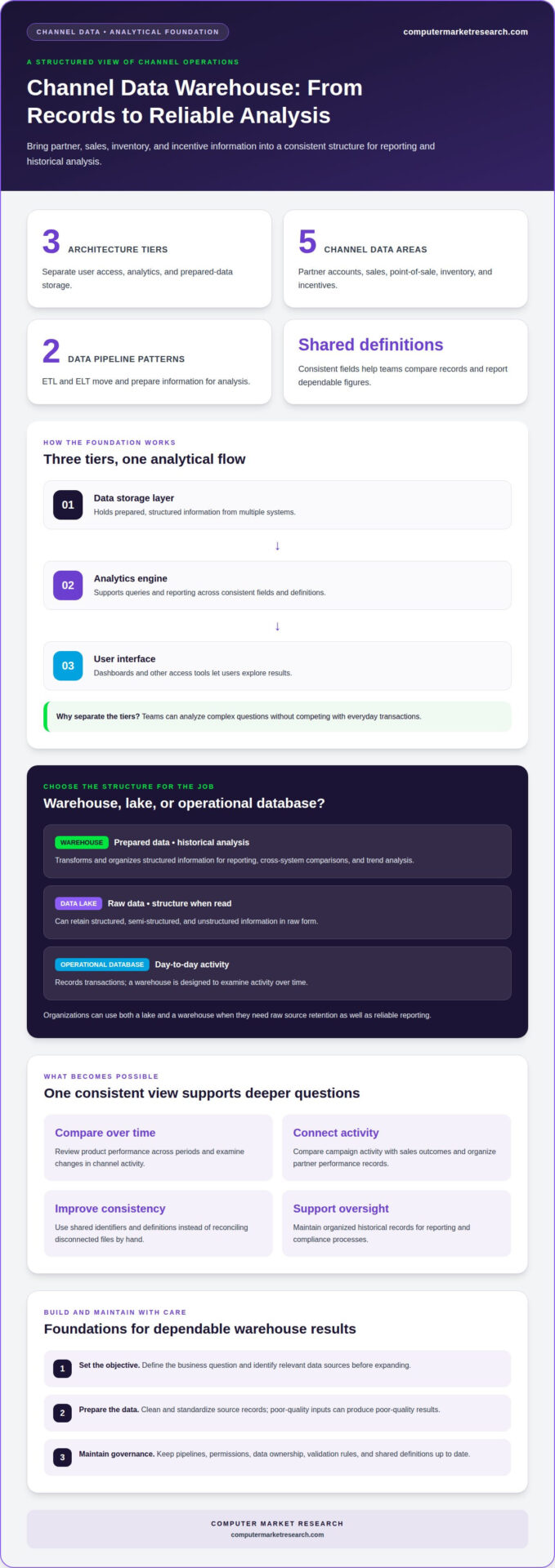
A common design has three tiers: a user interface, an analytics engine, and a data storage layer. The storage layer holds prepared data, while the analytics engine supports queries and reporting. Users explore results through dashboards or other access tools. This separation helps teams analyze complex questions without competing with everyday transactions.
Historical data makes comparisons possible. A sales team can examine product performance across periods, while marketing can compare campaign activity with sales outcomes. Shared definitions also help departments use consistent figures in reports. Without a central structure, teams may reconcile spreadsheets manually or produce different totals from separate systems.
Popular tools and platforms vary by architecture and workload. IBM DB2, PostgreSQL, and MariaDB are examples of traditional data warehouse technologies; cloud and hybrid deployments are also options.
For marketing, a warehouse can combine campaign, customer, and sales information for analysis. Teams can compare campaign results with later sales activity, review changes over time, and identify products or customer groups for further attention. Structured data lets analysts query consistent categories rather than repeatedly merging separate files.
Implementation requires deliberate planning. Organizations should define the business objective, assess available data sources, and plan for growth before expanding the warehouse. Data pipelines, transformations, and governance rules also need ongoing maintenance. Poor-quality source records can lead to poor-quality warehouse results, so cleaning and standardizing data are essential, not optional finishing steps.
Security, privacy, and governance risks include inappropriate access, inconsistent definitions, and inaccurate or outdated records. Access permissions, clear data ownership, and maintained validation rules help control these risks. Governance should specify who can use each dataset and how teams interpret shared fields.
- Use a warehouse for cross-system reporting and historical trend analysis.
- Choose structured formats and shared definitions for consistent reports.
- Start with a clear business objective and relevant data sources.
- Maintain data pipelines, permissions, and validation rules as information changes.
Warehouses centralize data from multiple sources and organize it by subjects such as marketing, accounting, customers, products, or sales. As data proliferated in the 1970s and ’80s, organizations needed ways to store and access it; data warehousing began to take shape in the 1970s. Typical components include storage, ETL tools, metadata, and access tools. Lakes retain structured and unstructured data raw; warehouses transform it before storage.
Data warehouse definition and purpose
A data warehouse combines information from multiple sources in a structured format designed for analysis. Its purpose is to give teams a consistent foundation for examining business activity and historical records.
Warehouse Definitions and Characteristics
A data warehouse is a centralized analytical repository that stores prepared data under a predefined structure. This structure lets teams query information using consistent fields and definitions, rather than interpreting each source separately. For example, a shared product identifier lets analysts compare sales records from different systems without treating the same product as unrelated items.
Relational schemas organize information into tables with defined relationships. This approach suits structured data prepared for SQL queries, such as account details, orders, or product records. A warehouse may use ETL, meaning extract, transform, and load, or ELT processes to move and prepare information. Both approaches align formats and resolve inconsistencies before analysis.
A data lake serves a different purpose: it can preserve raw, semi-structured, and unstructured information, applying structure when data is read. A warehouse transforms data for organized analysis. Organizations can use both when they need raw source retention as well as reliable reporting; the choice depends on how teams plan to query and use each dataset.
For a customer data warehouse, the subject is customer information gathered across systems. It can hold profile details, account identifiers, preferences, order history, billing records, and subscription changes. Teams can query these tables to compare customer activity over time. Unlike a customer data platform, a customer warehouse doesn’t maintain continuously updated profiles for immediate engagement.
Channel and Traditional Warehouse Differences
A channel data warehouse applies warehouse principles to information about indirect sales and partner operations, while a traditional warehouse can cover subjects across an organization. The main difference is the data scope and business model, not the definition of a warehouse. This distinction helps teams organize channel records around the questions they need to answer.
For example, a channel-focused model may bring together partner accounts, sales, point-of-sale records, inventory, and incentive activity. These subjects help teams examine partner performance or reconcile channel activity using shared definitions. A broader enterprise warehouse may also include finance, marketing, or other business areas, depending on its design.
Choose the scope around the decisions the warehouse must support. If teams need a consistent view of partner sales and related program activity, channel-specific organization makes those records easier to analyze together. If analysis spans departments, the channel data can form a defined subject area within a wider warehouse. Explore channel data management options to see how structured channel information can support reporting.
Reporting, trend analysis, compliance, and planning
A warehouse supports decisions by making historical information available for queries, reporting, and business intelligence. Teams can use the same stored records to examine past activity, compare periods, and plan around observed patterns. For channel operations, that could mean reviewing partner sales alongside inventory records to understand performance changes.
Historical analysis and real-time activation serve different needs. A warehouse is designed to analyze data collected over time, while a real-time analytics system examines information as it is created. This distinction matters when deciding whether a team needs reliable retrospective reporting or immediate responses to new activity. A warehouse can inform future plans, but it isn’t a substitute for systems built to act instantly.
Business intelligence tools turn warehouse data into reports, dashboards, and visualizations. Analysts can query stored records, then present results through defined metrics. For example, a channel report could group sales by partner and product, helping managers spot patterns that a row-by-row spreadsheet review might obscure. Consistent definitions make it easier for different teams to interpret the same result.
Trend analysis adds context to a single reporting period. Comparing partner sales across historical records can reveal whether a change is sustained or temporary. Teams can also review product and inventory patterns together, then use the findings to inform forecasts and resource planning. Warehouses can retain historical data over extended periods, letting analysis go beyond the latest reporting cycle.
For compliance-related work, a warehouse can provide a consistent basis for reviewing records and preparing reports. For example, finance and channel operations teams can use shared definitions when examining transactions, incentive activity, or partner data. The system supports analysis; governance still depends on clear permissions, data ownership, and maintained validation rules. Reliable outputs also depend on the quality of records entering the warehouse.
Web analytics can add a view of customer journeys to business analysis. A warehouse may bring together website visits, page views, feature use, and content engagement, allowing analysts to compare these behaviors with other available records. For example, a team could study how engagement changes before or after purchase activity. This is historical analysis, not automatic personalization or live messaging.
Planning is more grounded when teams connect trends to specific decisions. A sales leader might use partner and product reports to guide future targets, while inventory teams examine sales patterns when planning stock. The useful sequence is to define the question, choose relevant metrics, run consistent queries, and translate findings into a decision. This keeps analytics tied to operational priorities.
Centralized data collection and storage
A channel warehouse gathers information from separate platforms and organizes it for consistent analysis. Its value depends on how well each source is mapped, cleaned, and maintained.
Data Collection and Integration
Data integration connects channel sources, aligns their formats, and prepares records for shared use. A warehouse commonly uses ETL: it extracts data from source systems, transforms it, then loads it into centralized storage. ELT loads data before transformation. Either process can standardize fields such as partner identifiers, product codes, and transaction dates.
For example, a sales platform and an inventory system may label the same product differently. A transformation rule maps those labels to one agreed product identifier, allowing an analyst to compare sales with stock records. Validation can also identify missing values or duplicate rows. Since poor-quality source data can lead to poor warehouse data, teams need to maintain pipelines and transformation rules.
Some organizations first route incoming information through a data lake, where raw records remain in their original format. They can then structure selected data for warehouse analysis. This approach separates raw-data retention from prepared reporting data; the right design depends on the questions and data sources involved.
Stored Channel Data
A channel data warehouse stores organized records relevant to partner sales and operations. Examples include partner account information, point-of-sale transactions, inventory levels, deal registration, lead activity, and incentive records. The selected data depends on business questions, available source systems, and reporting needs.
Useful warehouse records preserve the fields needed to interpret an activity, not just its total. A point-of-sale entry, for instance, may need a partner identifier, product code, transaction date, and quantity. Consistent identifiers connect that entry with related product or partner records. Historical records also let teams examine earlier activity alongside current reporting periods.
Storage design defines how records relate. A partner table can connect to sales transactions through a shared partner identifier, while product records connect through a product code. These relationships help analysts query channel activity across systems without treating each platform’s records as isolated information.
Building a Channel Warehouse
Building a channel warehouse means defining its purpose, selecting relevant data sources, preparing records, and enabling analysis. A focused starting point helps organizations validate the data model before expanding it to more channel processes or platforms.
- Set the objective. Define the decisions the warehouse should support, such as reviewing partner sales or comparing sales with inventory.
- Assess sources. Identify which systems hold the required partner, transaction, product, and program records.
- Design the model. Agree on shared identifiers, field formats, and relationships between records.
- Build and test pipelines. Extract, transform, and load data, then validate that records align and reports answer the intended questions.
- Maintain and expand. Review data quality, transformation rules, access controls, and storage needs as new sources are added.
These steps clarify how the warehouse operates: source records are collected, standardized, stored, and made available for queries. Sound decisions depend on reliable mappings, maintained pipelines, and data suited to the analysis.
What is a channel data warehouse?
A channel data warehouse is an analytical repository that organizes information about indirect sales, partners, and related operations. To understand what a channel data warehouse does, start with its purpose: connect records held in separate systems, then make them useful for consistent reporting and decisions.
For example, a manufacturer may receive point-of-sale records from distributors, inventory information from another platform, and partner details from a separate system. A channel warehouse can align these records through shared identifiers, such as partner and product codes. The result is a connected view of channel activity, rather than isolated files that require manual matching.
The warehouse’s scope depends on the business questions it needs to answer. A sales team may need partner transactions and product details to compare channel performance. An operations team may need inventory and shipment information to understand availability. Finance teams may examine incentive and transaction records together. Clear scope prevents unrelated data from obscuring the analysis.
Channel data also requires consistent definitions. One platform might identify a partner by account number, while another uses a location code. Mapping those identifiers helps analysts avoid splitting one partner’s activity across multiple report categories. Similarly, standard product codes make it possible to compare distributor sales with internal product records.
Historical records add context to current channel results. Teams can compare partner performance across reporting periods, assess product movement, and identify patterns that support planning. Preserving the underlying records also helps explain how report totals were assembled. The warehouse supports analysis; it doesn’t replace the source systems that record daily transactions or manage live partner interactions.
Reliable results depend on data quality and governance. If a distributor file contains missing product codes, reports may not connect those transactions to product records. Validation rules can identify these gaps, while defined access permissions help control who can view sensitive partner or transaction data. Teams also need to maintain transformations as source platforms change their formats.
A channel data warehouse is most useful when leaders need a consistent view across partners, products, and operational systems. It can help replace spreadsheet reconciliation with repeatable queries, provided the organization defines shared identifiers, data ownership, and reporting measures. These foundations help teams interpret channel trends consistently and make planning decisions from connected records.
For organizations ready to bring channel information into a more structured workflow, explore the available trial as a practical next step.
Computer Market Research: POS Data Management
Computer Market Research provides POS Data Management for organizations that need stronger control over channel point-of-sale information. When POS records sit across separate systems or require manual consolidation, this service helps support more consistent channel reporting and analysis.
It can also fit into a broader channel operations approach. PartnerPortal™ centralizes partner onboarding, deal registration, and performance tracking, while Co-op/MDF Management and Rebates & Incentives address related channel programs. The right focus depends on the information and workflows your teams need to manage.
If disconnected POS data is complicating your channel operations, contact Computer Market Research to discuss POS Data Management.
Turn channel data into a clearer next step
Understanding what a channel data warehouse can do is only the starting point. The next decision is which channel process needs better visibility first, and which records will make that view useful. A focused priority gives teams a practical basis for aligning metrics, data ownership, and reporting expectations before broadening the scope.
That work may connect with operational tools as well as analytical systems. Computer Market Research offers PartnerPortal™, Co-op/MDF Management, and Rebates & Incentives for channel processes that rely on organized information. Consider how those needs relate to your POS Data Management priorities and the decisions your teams need to make.
A clear starting point can help turn fragmented records into a deliberate data workflow. Define the question your team needs answered, then identify the channel information that supports it. From there, consider how the right platform and process fit your operations.
Explore the next step with Computer Market Research and move toward more structured channel data management.
Frequently Asked Questions
What is the difference between a channel data warehouse and a data lake?
A data lake keeps incoming information in its raw format, while a channel data warehouse prepares selected records for structured analysis. For example, a lake might retain distributor files as received, while a warehouse standardizes partner and product fields for reporting. Organizations can use both: the lake preserves source data, and the warehouse supports consistent queries across prepared channel records.
What are common channel data warehouse architecture and components?
A common architecture has three tiers: data storage, an analytics engine, and a user interface. Supporting components can include ETL or ELT pipelines, metadata, access controls, and tools for queries, dashboards, and reports. In a channel environment, the model might connect partner, product, and transaction records. The specific design depends on the systems feeding data and the analysis teams need to perform.
What are common uses of a channel data warehouse in marketing and sales?
Marketing and sales teams can use warehouse data to connect campaign activity with channel outcomes. For example, analysts might compare partner participation in a promotion with product sales recorded through distributors. Sales leaders can examine performance by partner or product, while marketing teams assess which activities align with sales patterns. These analyses help teams refine campaign planning and set priorities using shared information.
How much does it cost to implement and operate a channel data warehouse?
There isn’t one standard cost; implementation and operating requirements depend on the warehouse’s design and workload. Key factors include the number and complexity of data sources, integration work, data volume, storage and computing needs, reporting tools, and ongoing pipeline maintenance. A practical estimate starts with business objectives, existing systems, required data quality controls, and the skills needed to operate the platform over time.
What are popular channel data warehouse tools and platforms?
Examples include IBM DB2, PostgreSQL, and MariaDB. Cloud and hybrid deployments are also options.

Article by
Del Heles
Del Heles is the founder and CEO of Computer Market Research (CMR), a channel management software company he launched in 1984. With more than 40 years of experience, he’s known for helping manufacturers and distributors simplify complex partner programs through practical, customer-focused technology solutions.