

Measuring PRM ROI is worth the effort when it connects partner activity to financial outcomes. Calculating the value of a PRM system means comparing incremental gross margin attributable to PRM-enabled partner activity with the system’s total cost: subtract the cost from the margin, divide by the cost, then multiply by 100. That gives you a percentage to assess alongside operational gains.
It can be difficult to separate a platform’s impact from the work of partners, sales teams, and other processes. To calculate the value of a PRM system, track engagement and revenue together: this shows whether partners use the system and whether their activity contributes to pipeline and closed business.
This article explains which partner metrics help demonstrate value, how to calculate ROI, and what to include in total cost of ownership beyond software fees. It also shows how to weigh time saved through automated workflows against implementation, administration, and ongoing partner enablement costs, giving you a clearer basis for evaluating a platform.
Key Takeaways
- Clarify how PRM differs from CRM and which partner activities a shared platform can coordinate.
- Choose partner performance measures that connect program activity with business objectives.
- Separate partner-sourced opportunities from partner-influenced ones to reduce double-counting in pipeline analysis.
- Assess whether a PRM system fits your channel’s current needs, including how manageable existing manual processes remain.
PRM software and indirect sales channels
A partner relationship management (PRM) system combines technology, processes, and strategy to manage channel partnerships. It can support lead management, deal registration, opportunity tracking, partner onboarding, and performance reporting. While customer relationship management (CRM) focuses on customer interactions, PRM centers on the business relationship between a company and its partners.
Before choosing a PRM system, map your channel goals, partner types, and existing workflows. Identify where spreadsheets, email, or disconnected portals slow onboarding, deal handling, enablement, or reporting. Then prioritize the functions that address those bottlenecks and the data your team needs to measure progress.
Channel partners may include distributors, resellers, managed service providers, systems integrators, referral partners, technology alliances, and strategic partners. Their needs differ: a reseller may need deal-status visibility, while a distributor may need structured access to sales resources. A PRM system gives these groups a central place to share information, complete activities, and track shared objectives.
Features deliver value when they support specific channel processes. Digital deal registration, for example, can organize opportunity submissions and approvals, while onboarding workflows can guide new partners through role-based tasks and training. Analytics can help managers compare partner activity with sales outcomes, identify partners who need support, and focus investment. Integration with existing systems also helps keep information consistent across teams.
Assess each feature by linking it to a measurable operational need:
- Partner enablement: Centralize training and sales materials so partners can find current resources.
- Deal management: Track registration, ownership, status, and progression through the pipeline.
- Analytics: Review engagement and revenue indicators by partner or channel segment.
- Integration: Reduce repeated entry by aligning partner workflows with existing business systems.
These priorities help you choose a platform for actual channel work, rather than paying for capabilities that do not support defined objectives. A company handling occasional deal submissions through spreadsheets, for example, may have different needs from one coordinating onboarding, incentives, and pipeline reporting across several partner types.
PRM pricing models may include recurring per-user subscriptions, with fees influenced by user numbers, features, and deployment model. Assess monthly software fees alongside implementation, administration, training, and any enablement content or incentives tied to platform use. A subscription figure alone does not represent the full financial commitment.
For a practical comparison, estimate recurring software fees using the vendor’s pricing structure, then list setup and ongoing operating costs separately. Consider which teams will administer workflows, maintain partner information, and produce reports. This gives finance and channel leaders a clearer basis for comparing platforms and calculating the value of a PRM system.
Tracking engagement and revenue to assess PRM value
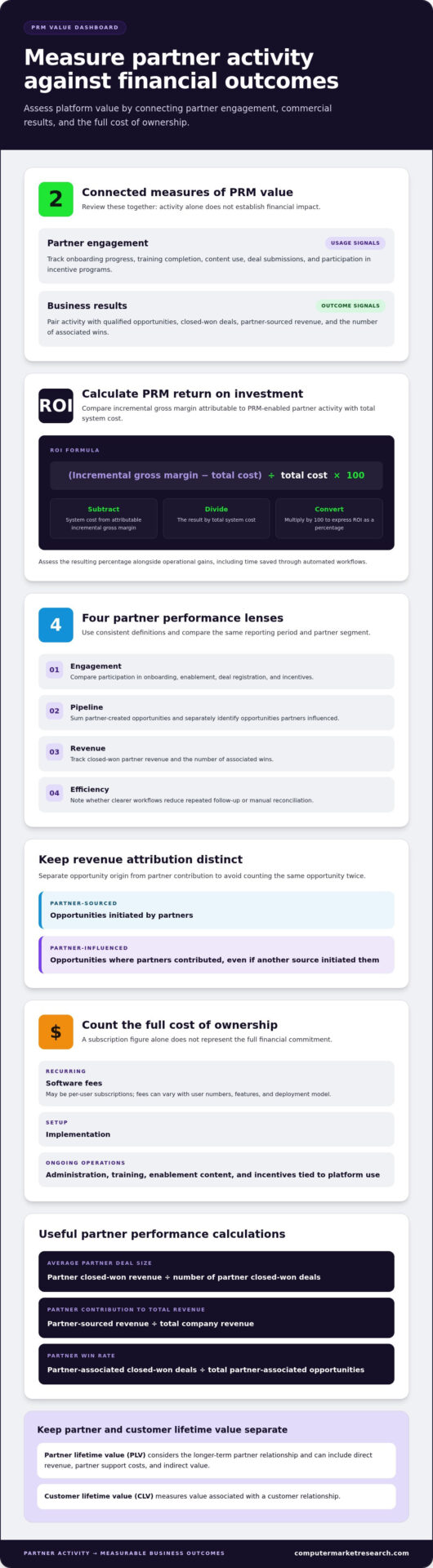
Assess PRM value through two connected measures: partner engagement and business results. Engagement shows whether partners use available processes and resources; revenue shows whether their activities contribute to commercial outcomes. Reviewing both helps distinguish an inactive relationship from one that is active but has not yet produced closed sales.
Track observable activities across the partner relationship, including onboarding progress, training completion, content use, deal submissions, and participation in incentive programs. Pair these measures with outcomes such as qualified opportunities, closed-won deals, and partner-sourced revenue. Increased portal activity alone does not prove financial impact, but it can show where a partner is progressing or encountering friction.
- Engagement: Compare partner participation in onboarding, enablement, deal registration, and incentives.
- Pipeline: Sum opportunities created by partners, and separately identify opportunities they influenced.
- Revenue: Track closed-won partner revenue and the number of associated wins.
- Efficiency: Note whether clearer workflows reduce repeated follow-up or manual reconciliation.
Use consistent definitions for revenue attribution. Partner-sourced revenue comes from opportunities initiated by partners. Partner-influenced revenue relates to opportunities where partners contributed, even if another source initiated them. Keep these categories distinct and remove overlap, or the same opportunity could inflate both pipeline and reported impact.
Useful calculations add context. Average partner deal size equals partner closed-won revenue divided by the number of partner closed-won deals. Partner contribution to total revenue equals partner-sourced revenue divided by total company revenue. Partner win rate equals partner-associated closed-won deals divided by total partner-associated opportunities. Compare these indicators over the same reporting period and within the same partner segment.
Short-term revenue captures current results; partner lifetime value (PLV) considers the longer-term relationship. PLV can include direct revenue, partner support costs, and indirect value. Customer lifetime value (CLV), by contrast, measures value associated with a customer relationship. Keeping PLV separate from CLV prevents partner economics from being blended with customer-level returns.
Interpret the measures together. For example, rising training completion with flat revenue may signal a lag between enablement and sales, while falling deal activity alongside lower engagement may indicate a need to adjust support. Incentive data can add another lens: Co-op/MDF management connects funded partner activities with their attributable revenue, helping teams examine which investments contribute to outcomes.
To estimate PRM’s revenue impact, compare partner results with a defined baseline and account for other changes that affect sales. Track the same measures consistently, then review partner segments separately. This makes performance gaps visible and gives channel teams a disciplined basis for refining enablement, incentives, and collaboration priorities.
Calculating PRM return on investment
Calculate PRM program ROI by comparing incremental gross margin from PRM-enabled partner activities with the system’s total cost. Subtract total cost from attributable gross margin, divide by total cost, then multiply by 100. The result is a percentage, but its usefulness depends on sound attribution and a complete cost baseline.
First, define the measurement period and the business activities to include. Use the same period for returns and costs, and set a baseline that reflects results before the PRM process changed. For example, compare deal outcomes for the same channel segment before and after structured deal registration. Account for changes in pricing, partner mix, or sales coverage that could also affect results.
Use gross margin, rather than total sales revenue, in the ROI numerator. Revenue does not account for the direct costs of delivering what partners sell. Attribute only the margin connected to PRM-enabled activity, and document how you determined that attribution. If partner involvement cannot be distinguished reliably, the calculation may overstate the platform’s contribution.
Automation can add value through time and resource savings, as well as partner sales. Identify the manual tasks the system replaces, such as reconciling deal records, routing approvals, or preparing incentive reports. Estimate the staff time those tasks require, then assess the associated labor cost and operational capacity. Count savings only when automation actually removes or reduces manual effort.
- Deal registration: Assess whether a consistent submission and approval workflow reduces duplicate handling or repeated follow-up.
- Reporting: Compare the effort required to assemble partner performance reports before and after centralized data capture.
- Incentives: Connect eligible partner activity and attributed revenue with the related program spend.
For market development funds, calculate ROI as attributed revenue from MDF-funded activities minus MDF spending, divided by MDF spending. Apply consistent attribution rules across campaigns. This separates the performance of funded activities from broader partner revenue and gives channel teams a clearer basis for allocating future investment.
Use a worksheet to make assumptions visible: record attributable gross margin, total PRM cost, the reporting period, and the evidence supporting each figure. Calculate ROI, then review it alongside operational effects such as reduced manual processing. A positive percentage alone does not show which workflows created value or whether those gains can continue.
Relationship management benefits may also emerge gradually as partners adopt workflows and complete enablement. Separate these leading indicators from realized financial returns. This distinguishes activity from outcomes while showing whether the system is improving channel execution. Next, assess total cost of ownership to ensure the ROI denominator includes the full investment.
PRM platform total cost of ownership
A PRM platform’s total cost of ownership includes more than its software fees. Include implementation, administration, support, training, enablement content, and MDF or incentive spending directly tied to platform use. These costs determine the investment used in ROI calculations. If a partner portal supports several channel processes, include the resources needed to configure and operate those workflows.
Build a cost inventory around the platform lifecycle. Separate initial setup from recurring work, then assign each item to the responsible team or budget. Implementation, for example, may require internal time for workflow design, data preparation, and integration. Ongoing administration can include managing users, updating partner information, maintaining reports, and resolving process issues. Recording these costs separately makes the main cost drivers visible.
Use categories such as these to structure the inventory:
- Software and support: Record licensing and support as distinct line items.
- Implementation: Include configuration, data migration, integration, and launch work.
- Administration: Account for staff effort maintaining records, permissions, and workflows.
- Enablement: Include training materials and content created for partner use.
- Program spending: Count MDF or incentive uplift only when directly tied to PRM usage.
Next, define how each cost relates to your partner relationship management strategy. If the portal handles deal registration and onboarding, assign the implementation and administration effort for those processes. If it also supports incentives, separate platform-related costs from the underlying program allocation. This prevents unrelated channel expenses from distorting the platform’s cost profile.
Compare platforms using the same scope. Lower software fees may be offset by greater implementation or maintenance demands. A platform requiring extensive data preparation or ongoing manual reconciliation, for example, can consume internal capacity after launch. Include these operating demands, not just vendor charges, when comparing options for a growing partner ecosystem.
Keep cost allocation consistent across reporting periods. Separate one-time implementation work from recurring administration, support, and training, then align each category with the period used for the ROI calculation. This makes comparisons more meaningful as partner participation changes or workflows expand. It also shows whether costs rise because of platform operations, additional enablement, or broader incentive activity.
Finally, test the cost inventory against actual workflows. Trace a deal from partner submission through approval and reporting, noting the people, systems, and content involved at each stage. Repeat the exercise for onboarding or MDF activities that use the portal. This captures costs missed by a software-fee-only comparison and gives decision-makers a fuller basis for evaluating platform value.
PRM system purpose and value
A PRM system organizes the tools, processes, and training that help partner businesses sell effectively. It supports the working relationship between a company and its channel partners, while a CRM system focuses on customer interactions. For example, a partner can use a PRM portal to access information, submit opportunities, and follow shared goals.
A PRM platform connects partner activities with the processes and information needed to complete them. Structured onboarding can guide a new reseller through training, sales resources, and program expectations. Deal registration can then provide a consistent process for submitting and managing opportunities. Together, these workflows reduce reliance on scattered email threads and separate files.
PRM value comes from how well connected processes support channel execution, not from a single feature. When partners can find current resources and understand registration status, teams can spend less time resolving basic process questions. When leaders can view partner activity alongside business objectives, they can direct enablement and support toward specific gaps.
- Onboarding: Organize partner tasks, training, and access to the materials needed to begin selling.
- Registration: Record opportunity details and make deal status visible to participating teams.
- Collaboration: Give partners and internal teams a shared place for information and goals.
- Performance visibility: Use partner activity and outcome data to refine support and channel priorities.
These functions are most useful when partner operations are complex enough to benefit from coordination. A business handling deal submissions only occasionally may still manage them through spreadsheets and email. A company building its channel may also need to define its ideal partner and channel plan before a PRM platform can address its core needs.
Assess the purpose before adoption by mapping the partner journey from recruitment through onboarding, enablement, opportunity registration, and performance review. Mark where handoffs fail, information becomes inconsistent, or partners lack visibility. Then connect each issue to a PRM capability and a measurable objective. This makes increasing partner activity a deliberate operational goal, rather than an assumption that software alone will generate growth.
A PRM system can support market expansion and revenue growth when its workflows, partner strategy, and data work together. Clearer registration processes, for example, can improve opportunity coordination, while consistent enablement can help partners use sales resources effectively. Review the platform against the specific channel processes it will organize, then connect those improvements to your ROI and total cost of ownership analysis.
To explore how structured partner workflows support channel execution, review the partner platform trial.
Computer Market Research: PartnerPortal™
Computer Market Research provides PartnerPortal™ for organizations managing partner onboarding, deal registration, and channel performance. When fragmented workflows make it difficult to connect partner activity with revenue and program costs, a centralized platform can organize the information needed for those assessments.
Co-op/MDF Management and Rebates & Incentives support the administration of partner funding and incentive programs. Deal Registration structures opportunity submissions and makes status easier to track. These capabilities can help channel teams maintain clearer records for measuring engagement, attributable revenue, and operational effort.
Use the ROI and total cost framework in this guide to define the workflows that matter most to your channel. Then explore how PartnerPortal™ can support those requirements. Visit computermarketresearch.com to learn more about Computer Market Research.
Turn Your PRM Assessment Into a Clear Next Step
Make PRM performance part of routine channel planning. Assign responsibility for reviewing partner data, agree on how results will inform decisions, and revisit the measures when partner priorities or workflows change. This keeps the assessment useful beyond the initial platform decision.
A practical approach to calculating the value of a PRM system connects financial results with the operational changes behind them. Use those findings to identify where your channel strategy needs stronger processes, clearer accountability, or better visibility. Then assess whether your current infrastructure can support that work as partner relationships develop.
Computer Market Research can help you explore how its partner management solutions fit your channel operations. Explore PartnerPortal™ with Computer Market Research and take a considered next step toward more measurable partner management.
Frequently Asked Questions
Is Measuring ROI Worth the Trouble?
Yes. Measuring ROI helps channel leaders determine whether PRM processes support business objectives. The analysis can also reveal operational value that sales totals miss, such as less manual reconciliation or clearer partner activity records. If a team spends substantial time resolving duplicate deal submissions, for example, tracking processing time can show whether workflow changes improve efficiency. Use the findings to guide investment and identify processes that need refinement.
How do you calculate the ROI of a partner relationship management system?
Compare the incremental gross margin attributable to PRM-enabled partner activities with the system’s total cost. Subtract total cost from that margin, divide by total cost, then multiply by 100 for a percentage. For a reliable comparison, use the same reporting period for costs and returns, define which activities count as PRM-enabled, and document how you attribute partner contributions.
What costs should be included when valuing a PRM system?
Include software fees, implementation, integration, administration, support, training, and enablement content. Also include MDF or incentive spending when it is directly tied to PRM use. If launching a partner portal requires internal data preparation and workflow configuration, for example, account for that staff effort alongside external charges. Separate initial setup from recurring expenses to reflect both launch and ongoing operations.
What financial benefits can a PRM system generate?
A PRM system can contribute to revenue growth by supporting partner onboarding, opportunity handling, performance tracking, and incentive administration. It may also reduce the resources spent on manual tasks, such as compiling partner reports or reconciling program records. Clearer incentive records, for example, can help teams connect eligible activities with related revenue. Assess each benefit against actual operating data rather than assuming software use alone caused the result.
How do you estimate revenue growth attributable to a PRM system?
Set a baseline for partner revenue and pipeline before comparing results after PRM workflows change. Use consistent attribution rules to distinguish partner-created opportunities from those partners influenced, and avoid counting the same deal twice. Compare results by partner segment while documenting changes in sales coverage or incentives. This helps separate PRM-related contribution from other factors affecting channel performance.
What is the typical price of PRM software in the United States?
There is no single price that applies to every PRM deployment. Costs depend on the platform’s licensing structure and requirements such as the number of active partners or the volume of data processed. Implementation, integrations, support, and ongoing administration can also affect the total investment. Compare the full scope of services and operating needs, not just the recurring subscription fee.
How do you calculate PRM payback period and net present value?
Payback period is the time required for cumulative net benefits to equal the initial investment. Track benefits and costs over consistent intervals, then identify when accumulated value covers the upfront outlay. Net present value (NPV) discounts expected future cash flows to present value, then subtracts the initial investment. NPV requires an appropriate discount rate and clearly defined cash-flow assumptions.
What metrics should be used to measure PRM system value?
Pair partner activity measures with commercial and operational outcomes. Useful metrics include onboarding progress, training completion, deal submissions, partner win rate, average partner deal size, partner-sourced revenue, and time spent on manual administration. Choose indicators that match your channel objectives. If improving opportunity handling is a priority, for example, review registration activity alongside opportunity progression and closed-won results.

Article by
Del Heles
Del Heles is the founder and CEO of Computer Market Research (CMR), a channel management software company he launched in 1984. With more than 40 years of experience, he’s known for helping manufacturers and distributors simplify complex partner programs through practical, customer-focused technology solutions.