

Polite feedback can leave the real problems untouched. The right partner program satisfaction survey questions help identify friction in onboarding, enablement, incentives, communication, and other parts of the partner experience, instead of collecting reassuring but vague responses.
A useful survey is concise enough for partners to complete and consistent enough for teams to compare. But one generic question set may not reflect the needs of different partner types, and scores alone won’t tell you what to change. This practical framework shows how to adapt questions to your program, combine consistent rating scales with focused open-ended prompts, and interpret results with care. It also explains how to connect feedback to a specific improvement, assign an owner, and follow up with partners. The goal is not simply to collect responses. It’s to build a reliable process for turning feedback into clear priorities and practical next steps.
Key Takeaways
- Start with a clear survey objective so responses can inform specific partner program decisions.
- Use adaptable partner program satisfaction survey questions to assess communication, support, enablement, process clarity, and overall experience.
- Choose response formats based on the insight you need, and keep answer choices consistent when comparing partner segments or survey cycles.
- Set clear expectations about confidentiality, then assign responsibility for reviewing feedback and communicating follow-up.
- Keep survey collection distinct from program management. Centralized tools such as PartnerPortal can support visibility into program activity and performance.
Why Partner Program Satisfaction Survey Questions Need a Clear Purpose
A partner program satisfaction survey is a structured way to understand how partners experience your program, from communication and support to the processes they rely on. The most effective partner program satisfaction survey questions start with a defined purpose: identify sources of friction, assess the value partners perceive, and give program teams evidence to guide decisions.
A clear purpose also keeps survey results distinct from other performance measures. Sales results show commercial outcomes; activity data shows actions such as deal submissions or training participation. Neither necessarily explains why a process feels difficult or whether enablement is useful. Satisfaction feedback adds context about the partner experience, but it shouldn’t replace performance or participation data.
For an overview of how questionnaire design, sampling, and data collection shape results, see Survey Methodology.
Before writing questions, decide what a response could lead your team to review or change:
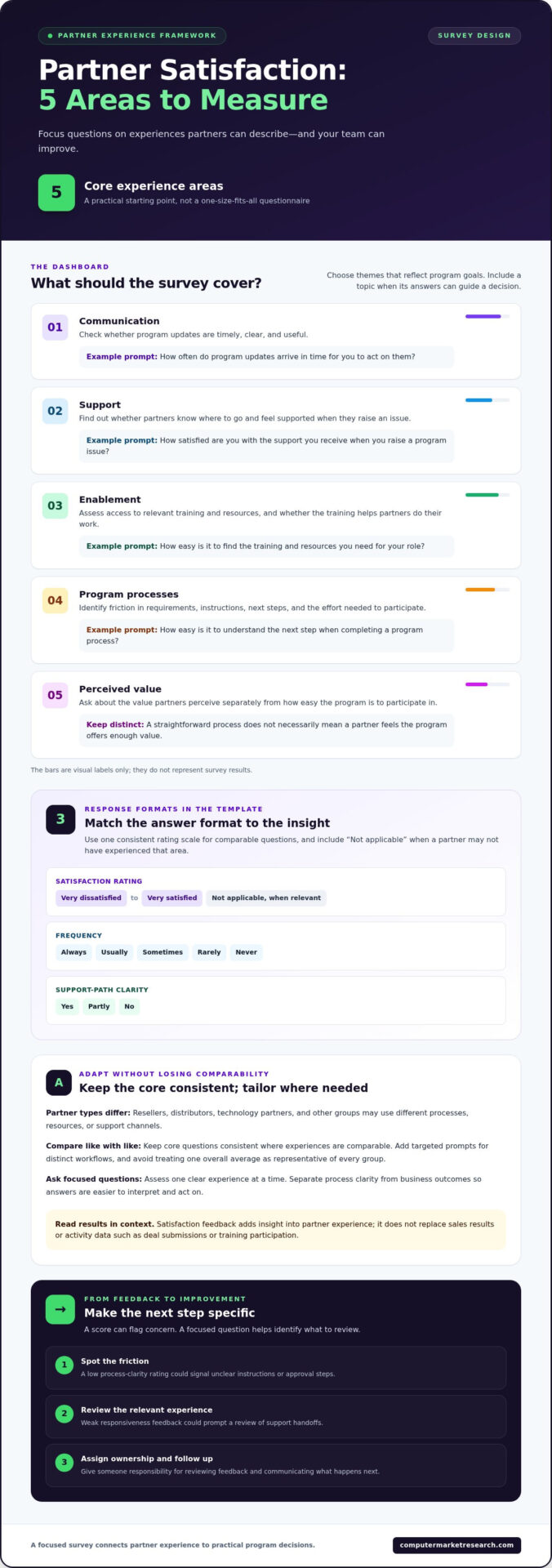
For example, a low rating on process clarity could prompt a review of instructions or approval steps. A weak rating on responsiveness might lead to a review of support handoffs. A broad “How satisfied are you?” score can flag concern, but it rarely identifies the operational change needed. Questions are most useful when they connect a specific experience to a practical next step.
Which parts of the partner experience should a survey cover?
Choose themes that reflect your program’s goals, then keep each question focused on one experience. Relevant areas may include communication, responsiveness, enablement, program processes, and perceived value. Ask about the experience itself, such as whether deal registration instructions are clear, separately from outcomes, such as whether registered deals generate revenue. Combining those signals makes it harder to interpret a response and decide what to improve.
Include a theme when the answer can guide a decision. If communication is a priority, ask about the timeliness or usefulness of updates. If enablement is central, ask whether partners can find the resources they need. Avoid adding topics simply because they’re easy to measure. A focused survey makes patterns easier to interpret and reduces the risk of collecting feedback no one can act on.
How does partner type affect satisfaction questions?
Resellers, distributors, technology partners, and other partner groups may use different program processes, resources, or support channels. Ask only for segment details that help explain those differences, such as partner type or the program experience being evaluated. Then compare like with like. An overall average across groups with different roles can hide a specific friction point or imply that one experience represents the entire channel.
Segmenting doesn’t mean creating a separate survey for every group. Keep core questions consistent where experiences are comparable, and add targeted prompts only when a partner type has distinct workflows. Interpret results alongside response context, not as a standalone ranking. This preserves useful comparisons while showing where a tailored follow-up may be appropriate.
Partner Program Satisfaction Survey Questions: A Ready-to-Adapt Template
Use these partner program satisfaction survey questions as a starting point, not a universal questionnaire. Select prompts that match your program goals, adjust terms to fit your partner model, and remove questions that won’t inform a decision. For rating questions, use one consistent scale, such as “Very dissatisfied” to “Very satisfied,” and include “Not applicable” when a partner may not have experienced that area.
Each question should assess one clear experience or outcome. That way, a response points to something your team can understand and address.
Questions about communication, support, and enablement
These prompts focus on whether partners receive timely information, can find useful resources, and know how to reach the right support. Keep communication, training, and issue resolution as separate topics. If a partner gives a low rating, that distinction helps your team identify whether the gap is in the information itself, access to it, or the support path.
- How satisfied are you with the timeliness of updates about the partner program?
- How often do program updates arrive in time for you to act on them? Always, usually, sometimes, rarely, never
- How easy is it to find the training and resources you need for your role?
- How useful is the training available for supporting your work with our products or services?
- How clear is the information you receive about program requirements and available resources?
- Do you know where to go when you need help with a partner program issue? Yes, partly, no
- How satisfied are you with the support you receive when you raise a program issue?
Questions about program processes and perceived value
Process questions can reveal friction in tasks such as submitting a deal, requesting program funds, or completing a required step. Tailor examples to the processes partners actually use. Ask about perceived value separately from ease of participation: a partner may find a process straightforward but still feel the program doesn’t offer enough value for the effort involved.
- How clear are the requirements for participating in the program?
- How easy is it to understand the next step when completing a program process?
- How satisfied are you with the time and effort required to participate?
- How much value does the program provide relative to the effort you invest? A great deal, a lot, some, a little, none
- Overall, how satisfied are you with your experience in the partner program?
- What is working well in the program and should continue?
- Where do you experience the most friction when participating?
- What one improvement would make the greatest difference to your experience?
Before sending the survey, remove any prompt that doesn’t connect to a possible follow-up. Decide who will review each theme and how findings will inform program operations. If you’re reviewing how partner processes are organized, a 90-day free trial of PartnerPortal lets your team evaluate a platform that centralizes partner program management and performance tracking. Survey responses still need their own collection and review process; PartnerPortal can provide visibility into program activity as your team considers improvements.
How to Adapt Survey Questions, Response Scales, and Partner Segments
Question format affects the kind of evidence you collect. A rating shows how an experience is perceived, a set of choices makes responses easier to group, and an open-text prompt can explain what sits behind a score. Select the format based on what your team needs to learn and how it will use the answer. This makes partner program satisfaction survey questions more useful for interpretation and follow-up.
When should you use rating scales, choices, or open-text questions?
Use a rating scale to assess one defined experience, such as the clarity of program instructions. Offer the same scale and labels wherever you ask that question so responses remain comparable. Multiple-choice options work well for predefined categories, such as the main source of a delay. Open-text prompts capture examples, unmet needs, and suggestions in partners’ own words, but require careful review to identify recurring themes.
- Rating scale: “How clear are the steps for submitting a deal?”
- Multiple choice: “Where do you most often need program support?” with relevant options and “Other.”
- Open text: “What would make this process easier for your team?”
Use open-text questions selectively. They can reveal an issue your preset choices missed, but take more effort to interpret consistently. Pair one with a focused rating or choice question when you need both a comparable signal and context. Make a question optional if it asks for sensitive or identifying context, or if a partner may not have enough experience to answer. Explain why you’re asking, and don’t imply responses are anonymous unless the survey process ensures that.
How can you tailor questions without losing comparability?
Keep core questions and response choices consistent when partner groups share the same process. Add targeted prompts only when a segment has a distinct workflow or support need. Label segments clearly, such as reseller or distributor, and collect only the context needed to interpret answers. This helps teams identify relevant differences without treating a single combined average as representative of every partner.
Comparability depends on more than identical wording. A question about support may refer to different channels or expectations across partner types. If the underlying experience differs, define the scope in the prompt or report results separately rather than forcing a direct comparison. When reviewing results across survey cycles, note meaningful changes to question wording or response options. Otherwise, a shift in answers may reflect the survey design rather than a change in partner experience.
Your program structure can help determine which experiences merit measurement. For a broader view of how partner processes fit together, see this guide to channel partner management software. Use that operational context to select survey themes, then keep the survey focused on partners’ experience of those processes. This makes feedback easier to interpret without mistaking differences in role or workflow for differences in satisfaction.
How to Run the Survey and Turn Partner Feedback into Action
A well-designed survey still needs a dependable operating process. Before sending it, decide who will review responses, how findings will be evaluated, and how the team will communicate next steps. That prevents partner feedback from becoming a report that gets filed but never informs program decisions.
Use a clear sequence to move from survey launch to follow-up:
- Explain the purpose. Tell partners what the survey covers, why their input matters, who will review responses, and how findings may be used.
- Distribute it thoughtfully. Choose a channel partners can access and allow enough time for them to respond. Keep the invitation concise and set expectations about the survey’s scope.
- Review the full response. Look at ratings alongside written comments and relevant partner segments. A score can identify an area to investigate, while a comment may explain the experience behind it.
- Assign follow-up. Record the issue, proposed action, accountable owner, and intended communication back to partners.
- Close the loop. Share what the team heard, what it plans to address, and where a change is still under review.
How can you encourage candid, useful responses?
Use neutral wording that doesn’t suggest a preferred answer or imply that a partner caused a problem. Explain how responses will be handled, including whether they’ll be attributed to the respondent or reviewed in aggregate. Be precise about confidentiality: don’t promise anonymity unless the survey process actually protects respondent identity. A focused survey also respects partners’ time and keeps questions relevant to their experience.
For instance, “How clear were the steps for requesting support?” is more neutral than wording that assumes the process was confusing. If an answer could identify a partner or reveal sensitive context, make the question optional and explain why that information is useful. Partners should be able to distinguish what’s required from what they can leave unanswered.
How should teams interpret results and respond?
Look for repeated themes across comments and partner segments before changing a process. A single comment can surface an important issue, but it may need context before the team treats it as a broader pattern. Compare ratings with partners’ explanations, and avoid letting one overall score stand in for different program experiences.
Feedback needs an owner and a visible next step; otherwise, partners have little reason to believe their input shaped the program. Document the finding, action, responsible team member, and status. If the team can’t make a requested change, explain the constraint and any alternative under consideration. A clear response makes the feedback process more accountable, even when the answer isn’t an immediate program change.
To evaluate how centralized partner program management can support consistent operational follow-through, start a 90-day free trial of PartnerPortal. Use the trial to assess whether the platform’s approach to program management and performance tracking fits your team’s needs.
Connect Partner Feedback to Stronger Program Management
Survey responses can guide decisions about enablement, communication, and program processes, but collecting feedback and managing the program are distinct activities. A survey helps reveal how partners experience a process. Program management is where teams review that signal alongside operational context, decide what to change, and track the work. Keeping those functions separate avoids suggesting that a management platform collects or interprets survey responses.
The most useful partner program satisfaction survey questions point toward areas the team can review. If partners repeatedly report that program information is hard to find, assess how information is organized and communicated. If comments describe confusing requirements, map the relevant process and identify where instructions or handoffs may need attention. Treat feedback as evidence for investigation, not a complete diagnosis on its own.
Where can partner feedback inform program improvements?
Recurring themes can direct focused reviews. Feedback about training may prompt a review of enablement materials; comments about updates may signal a need to assess communication timing or relevance. Process concerns can lead the team to examine requirements, approvals, and partner-facing steps. Compare those themes with relevant partner activity and performance context before setting priorities. This can help distinguish a broad process issue from a concern tied to a particular workflow or partner segment.
For example, if partners report difficulty moving deals through a sales workflow, review the steps involved and consider whether the process is clear and usable. A channel sales management system may be relevant when that review involves partner sales workflows. The survey identifies the reported experience; operational information helps the team decide where to investigate further.
How can a channel platform support consistent follow-through?
Once a team has decided on an improvement, consistent program management can help keep the operational context visible. PartnerPortal centralizes channel program management and performance tracking. Its real-time dashboards, reporting, and analytics provide visibility into channel performance, fund usage, and partner activity. These capabilities can inform program reviews and help teams connect decisions to operational information. They don’t replace survey collection or analyze survey responses.
Centralization also gives teams a clearer foundation for coordinating program processes as they work through follow-up. To understand how those processes fit within a broader channel management approach, review the channel partner management platform. Pair operational visibility with a defined internal process for reviewing feedback, assigning actions, and communicating progress to partners.
If you’re evaluating whether centralized program management fits your organization’s needs, evaluate PartnerPortal with a 90-day free trial. Consider how its program management and performance tracking capabilities could support your team’s follow-through, while keeping survey collection and interpretation in their appropriate workflow.
Make Partner Feedback Part of Your Next Program Decision
Use your next survey as the start of an ongoing feedback practice, not a one-time check-in. Before launching, identify the program decision the responses will inform and how you’ll know whether the resulting change addressed the issue. This gives your team a clear standard for reviewing progress and helps partners see that sharing feedback has a purpose.
As you refine your partner program satisfaction survey questions, keep the connection between partner experience and operational decisions visible. A consistent review process helps your team move from individual responses to priorities that support stronger partner relationships.
To assess whether centralized program management can support your team’s follow-through, evaluate PartnerPortal with a 90-day free trial. Take the next step toward a more deliberate, responsive partner program.
Frequently Asked Questions
Should partner satisfaction surveys be anonymous?
Anonymity can encourage candid feedback, but promise it only if your survey process genuinely protects respondent identity. If responses are identifiable, explain who can access them and how they’ll be used. Also consider whether segment details could reveal someone in a small partner group. For example, naming a narrow partner category alongside a specific operational issue may make the respondent recognizable, even if the survey doesn’t request their name.
How often should you survey channel partners?
Choose a cadence that gives partners time to reflect and your team time to act on previous responses. Match it to meaningful points in the program, such as a major process change or a completed onboarding experience, rather than sending surveys on a fixed schedule without a clear reason. Before launching another round, tell partners what changed after the last one or explain what new decision their feedback will inform.
What response scale works best for partner satisfaction questions?
Use a consistent, clearly labeled scale for similar experiences, such as communication or process clarity. Make both endpoints explicit, such as “Very difficult” and “Very easy,” and keep each item focused on one idea. For partner program satisfaction survey questions about a process that some respondents may not use, include “Not applicable.” That option prevents partners from selecting a rating that misrepresents an experience they haven’t had.
Should partner surveys include open-ended questions?
Yes, include a small number of focused prompts to add context to ratings and uncover issues you didn’t anticipate. Ask for a specific example, such as “What information was missing when you submitted your request?” or one priority improvement. Avoid broad prompts that invite long, unfocused responses. Review comments alongside ratings and relevant partner context, and treat an individual comment as a signal to examine, not proof of a channel-wide pattern.
What should you do if partners give low satisfaction ratings?
First establish which experience the rating concerns, then consider comments and partner context before deciding how to respond. A low score on onboarding may call for a different review than one about ongoing support. Check whether similar concerns appear elsewhere, and avoid assuming the score reveals its own cause. Record a practical follow-up, assign responsibility, and tell partners what the organization can address or is still assessing.
Can you compare satisfaction scores across different partner types?
Yes, if the question, response options, and experience being measured are sufficiently similar across groups. For example, a common question about program-update clarity may support comparison if each group receives comparable updates. Label segments and explain differences in context, since resellers and technology partners may follow distinct workflows. When those experiences differ, report scores separately rather than relying on one combined average to describe the whole channel.
What is the difference between partner satisfaction and partner performance?
Partner satisfaction describes how partners experience the program and relationship; performance reflects business outcomes or activity. The measures provide complementary context, but one can’t stand in for the other. For instance, strong sales activity doesn’t show whether a partner found program requirements clear or support accessible. Review performance information to understand outcomes, and use direct experience feedback to investigate how program processes may be working for partners.

Article by
Del Heles
Del Heles is the founder and CEO of Computer Market Research (CMR), a channel management software company he launched in 1984. With more than 40 years of experience, he’s known for helping manufacturers and distributors simplify complex partner programs through practical, customer-focused technology solutions.