

What if faster rebate decisions depend less on adding reviewers and more on making review criteria explicit? Rebate claim validation rules give each submission a consistent path from intake to decision, but only when eligibility, evidence, and exception handling are clear. Without that structure, incomplete partner claims trigger follow-ups, manual checks vary by reviewer, and unclear requirements can turn routine decisions into disputes.
These challenges are familiar to teams managing complex partner programs. A clear process helps reviewers apply the same standards, explain decisions, and keep exceptions traceable. This guide shows you how to define program-specific requirements, apply them consistently, and refine them using claim outcomes.
You’ll also see how to structure review steps around eligibility checks, supporting documentation, duplicate claims, approvals, and decision records. Centralized workflows and structured channel data can improve visibility into claim status and review activity, making program decisions easier to manage and audit.
Key Takeaways
- Define rebate claim validation rules around each program’s published eligibility, evidence, accuracy, and approval requirements.
- Link every required document and data field to the rule it supports, then check submissions for completeness and consistency.
- Treat duplicate indicators as prompts for review, and classify exceptions so teams can resolve the underlying issue consistently.
- Assign clear ownership across intake, review, exception resolution, approvals, and recordkeeping to make decisions traceable.
- Compare spreadsheets, shared work queues, and centralized systems to find a workflow that improves visibility without treating software as a substitute for sound program policy.
What Rebate Claim Validation Rules Should Define
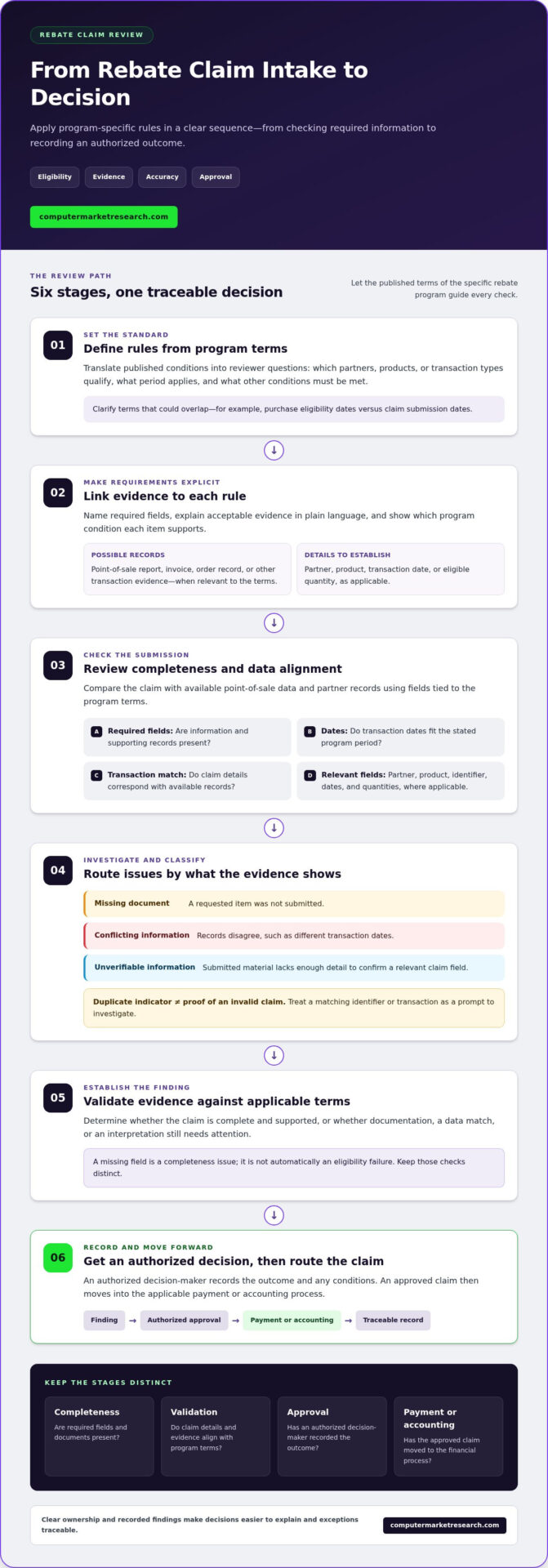
Strong rebate claim validation rules make a program’s terms usable at the point of review. They define documented tests for eligibility, supporting evidence, claim accuracy, and the steps required before an approval decision. In short: Validation checks whether a claim is complete and supported by program terms; processing moves it through review and decision workflows.
Each test must follow the specific rebate program’s published terms. A general checklist can help organize reviews, but it can’t replace the conditions that govern an individual offer. The rules should distinguish three separate questions: Is the required information present? Does the claim meet eligibility terms? Has an authorized approver approved the claim for the next step? Keeping these checks separate makes it easier to identify what needs attention without treating a missing field as an automatic eligibility failure.
Because rebate structures vary, the Rebate (marketing) overview can provide useful background on common rebate formats. The validation criteria themselves need to come from the terms of the program being reviewed.
Which rebate claim rules determine eligibility?
Eligibility rules translate program terms into questions a reviewer can answer. Depending on the program, they may specify which partners, products, or transaction types qualify, what time period applies, and which other program conditions must be met.
Use precise wording where terms could overlap. For example, if a program refers to a qualifying purchase period and a separate claim submission period, clarify which dates determine purchase eligibility and which govern submission. If a partner submits a claim covering multiple products, explain how the program terms apply to each item. These are illustrative cases, not universal requirements. Record how ambiguous wording is resolved so reviewers don’t make conflicting interpretations.
What is the difference between validation and approval?
Validation establishes what the evidence shows in relation to the program rules. A reviewer may find that a claim is complete and appears to meet the stated criteria, or identify missing documentation, a data mismatch, or an unresolved interpretation. That finding supports a decision; it isn’t itself authorization to release payment.
Keep the stages distinct in the workflow and in the record:
- Completeness: Required fields and documents are present.
- Validation: Evidence and claim details align with applicable program terms.
- Approval: An authorized decision-maker records the outcome and any conditions.
- Payment or accounting: The approved claim moves into the applicable financial process.
This separation clarifies responsibilities and preserves a traceable basis for decisions. For broader context on coordinating channel programs, see channel sales management software.
How to Set Evidence and Data Rules for Rebate Claims
Evidence requirements work best when each one answers a specific question in the program terms. For every rule, identify the document or data field that can demonstrate whether it’s met. This keeps review focused: partners know what to submit, and reviewers know what to verify.
Make evidence requirements explicit before submission, and partners can provide relevant records upfront instead of guessing what a reviewer will need. Clear instructions should name required fields, explain acceptable evidence in plain language, and connect each item to the relevant program condition. The FTC advertising guidance offers a useful reference for communicating offer terms clearly. The specific evidence criteria still need to match the applicable program.
What documentation should a rebate claim include?
There’s no universal document set for every rebate. Depending on the terms, examples might include a point-of-sale report, invoice, order record, or other transaction evidence. Request each item only when it helps establish a stated condition, such as the partner involved, product purchased, transaction date, or eligible quantity. Explain the required format or details so submissions are easier to assess and less likely to need follow-up.
Classify evidence issues accurately. A missing document means the requested item wasn’t submitted. Conflicting information means records disagree, such as different transaction dates in the claim and supporting report. Unverifiable information means the submitted material doesn’t provide enough detail to confirm a relevant claim field. These are distinct review findings and may call for different follow-up rather than the same rejection outcome.
How should teams validate POS and transaction data?
Compare the claim with available point-of-sale data and partner-submitted records using fields tied to program terms. Check whether the partner, product, transaction identifier, dates, and quantities align where those details are relevant. Flag data that’s missing, inconsistent, duplicated, or outside the program’s stated period for review. A duplicate indicator is a signal to investigate, not proof by itself that a claim is invalid.
- Completeness: Are required fields and supporting records present?
- Date alignment: Do transaction dates fit the program period?
- Transaction match: Do claim details correspond with available records?
- Duplicate signal: Does a matching identifier or transaction need investigation?
Consistent field definitions and organized records make these comparisons more reliable. For a broader look at data quality and channel information workflows, see the guide to channel data management systems. Structured channel data can support review, while program terms and evidence remain the basis for each assessment.
How to Handle Exceptions, Duplicates, and Disputed Claims
Not every claim that triggers a validation check has the same problem. An exception process should classify the cause before deciding what happens next. Missing evidence may be correctable, a data mismatch may need investigation, and ambiguous wording may require clarification or a consistent interpretation. Clear categories help reviewers respond proportionately instead of relying on ad hoc judgment.
For each exception, record the rule involved, the evidence reviewed, the reviewer’s rationale, any correction requested, and the eventual outcome. This creates a useful history if a claim is resubmitted or disputed. Consistent documentation doesn’t eliminate every disagreement, but it gives teams a shared basis for explaining decisions and applying the same approach to similar cases.
What should happen when a claim fails a validation check?
First, distinguish a correctable submission gap from a substantive eligibility conflict. If a required record is missing, tell the partner which item is needed and which program requirement it supports. If submitted records conflict with a program condition, identify the mismatch and explain what review or clarification is needed. Avoid treating both situations as an automatic denial.
Maintain a status history that shows the initial finding, requested action, resubmission details, and final decision. That record helps the next reviewer understand what changed and why the claim moved forward, remained unresolved, or was declined under the program terms.
How can teams reduce duplicate claims and disputes?
A duplicate alert should prompt comparison, not settle the claim. Review relevant fields such as partner, transaction identifier, product, and program period. A shared transaction or product alone may not establish that two submissions represent the same eligible purchase; differences in other details may explain an apparent match.
Document how potential matches are resolved, including the records compared and the reasoning behind the outcome. If information conflicts, keep the claim in review until the discrepancy is assessed against the applicable terms and evidence. This prevents a system flag or a reviewer’s assumption from becoming the decision by default.
- Missing evidence: Specify what is absent and what action can address the gap.
- Data mismatch: Record the fields that conflict and the records reviewed.
- Rule ambiguity: Capture the interpretation used so similar claims are handled consistently.
- Potential duplicate: Compare relevant identifiers and document why the records do or don’t represent the same claim.
Well-defined rebate claim validation rules make these paths easier to follow, but exception handling still requires documented reasoning. A traceable process gives partners clearer explanations and gives program teams a dependable basis for resolving disputes.
How to Build a Consistent Rebate Claim Review Workflow
A repeatable workflow turns rebate claim validation rules into clear actions, ownership, and status updates. Partners should be able to understand where a claim stands and what happens next, while reviewers need a shared sequence for moving it forward.
Use a defined path from intake to recordkeeping:
- Submission intake: Log the claim, associate it with the applicable program, and confirm it has entered the review queue.
- Initial completeness check: Identify missing fields or documents and assign the claim for follow-up when needed.
- Validation: Compare submitted information with the program’s documented terms and available supporting data.
- Exception review: Route unclear terms, mismatches, or other unresolved issues to the designated owner.
- Decision and recordkeeping: Have the appropriate approver record the outcome, rationale, and next step, then retain the claim history.
Assign responsibility for maintaining program rules, conducting first reviews, resolving exceptions, and recording final approvals. These roles may sit with different people or teams, but ownership should be explicit. Define status labels and escalation paths in partner-friendly language, such as “awaiting information” or “under review,” and explain what action is expected. That reduces uncertainty without implying a decision has been made before review is complete.
Which review controls make decisions more consistent?
Provide reviewers with current criteria, practical guidance for applying them, and reason codes for recurring outcomes. Keep program rule changes separate from individual claim decisions: record what changed, when it took effect, and which claims were reviewed under the earlier terms. Periodic sample reviews can reveal where reviewers interpret the same rule differently and where guidance needs clarification.
Which measures show whether validation is working?
Track review turnaround, incomplete submissions, exception types, and decision reversals. Define how each measure is calculated and what event starts or ends its tracking period before comparing results across time periods or partner groups. A rise in incomplete submissions, for example, may point to unclear instructions, but the metric alone can’t establish the cause.
Use these measures to identify workflow patterns and questions for investigation, not as proof that a rule is correct. Rule quality still depends on clear program terms and careful review.
As teams refine ownership and status visibility, rebate and incentive automation can help structure repeatable workflows. Explore this broader context in the guide to Co-op and MDF management platforms. To see how centralized partner workflows can support program operations, explore PartnerPortal™.
When Rebate Claim Validation Software Can Support Scale
As claim volume grows, spreadsheets can become harder to manage. Repeated data entry, limited status visibility, and multiple versions of program rules make it more difficult to see what has been reviewed and why. A structured system can organize work, but technology only applies the criteria people configure. It can’t replace clear program terms, supporting data, or sound review decisions.
Consider the trade-offs across common approaches:
- Spreadsheets: Flexible for basic tracking, but updates and review histories may be spread across files, making ownership and rule versions harder to follow.
- Shared work queues: Help make assignments and claim status more visible, though supporting records and decision notes may still be stored elsewhere.
- Centralized systems: Can bring partner records, submissions, review status, and decisions into a more connected workflow, supporting traceability while requiring defined rules and responsible ownership.
The right approach depends on whether the current process gives reviewers and program owners a reliable view of claim activity. A system can route work and apply configured checks, but teams still need to decide what qualifies, what evidence supports a claim, and how exceptions are resolved.
When are spreadsheets no longer enough for claim validation?
Look for operational signals: claim volume is rising, staff re-enter the same information, reviewers can’t readily see status, or teams struggle to identify which program terms applied to a past decision. Separate files and manual handoffs can obscure review history and create uncertainty about which rule version is current. Broader workflow considerations are covered in the guide to channel partner management software.
How can a centralized platform support rebate operations?
A centralized workflow can connect partner information with claim submissions, review stages, and recorded decisions, giving teams a clearer view of activity. Configured workflows can support repeatable routing and review steps, while authorized reviewers assess claims against established program rules and evidence. PartnerPortal™ centralizes partner workflows and provides visibility into channel data, supporting rebate and incentive operations. It does not determine claim validity without the relevant rules and supporting data.
For a closer look at PartnerPortal™ in a partner workflow, explore PartnerPortal™.
Build a Clearer Path for Every Rebate Claim
Reliable rebate claim validation rules start with program-specific terms, clear evidence requirements, and defined responsibilities. When teams distinguish missing information from eligibility issues, document exceptions, and keep decisions traceable, they can review claims more consistently and explain outcomes with greater clarity.
As claim activity grows, centralized workflows can make partner records and review status easier to see. PartnerPortal™ supports partner onboarding, deal registration, and performance tracking, while providing visibility into channel data and inventory. Rebates and incentives are also part of Computer Market Research’s channel management offerings. Program terms and supporting data remain the basis for assessing each claim.
Ready to explore a more connected approach to partner workflows? Explore PartnerPortal™ to see how centralized visibility could support your rebate operations. Clear criteria and organized review steps can give your team a steadier foundation for managing claims.
Frequently Asked Questions
What are rebate claim validation rules?
Rebate claim validation rules are documented checks used to assess whether a claim meets a specific program’s terms. They define what information reviewers examine, such as partner and transaction eligibility, required evidence, date alignment, and claim accuracy. Clear rules also distinguish a complete submission from an eligible claim and from a claim authorized for payment. They give reviewers a consistent basis for recording findings and explaining decisions.
What documents are needed to validate a rebate claim?
The required documents depend on the rebate program’s terms and the evidence needed to verify them. Examples may include an invoice, point-of-sale report, order record, or other transaction documentation. Each requested item should support a particular condition, such as the partner, product, purchase date, or quantity. Clear submission instructions should identify required fields and records so partners can provide relevant evidence without guessing what reviewers need.
How do you validate a rebate claim?
Validate a claim by comparing its details and supporting evidence with the applicable program terms. First, check that required information is present. Then review relevant partner, product, transaction, and date details against available records, and flag mismatches, missing evidence, or potential duplicates for investigation. Record the rule applied, the evidence reviewed, and the finding. Keep the validation outcome separate from the final approval and any payment activity.
Can a rebate claim be rejected for missing information?
A claim with missing information may be returned for correction or handled another way, depending on the program’s published terms and review process. Identify what is missing, explain which requirement it relates to, and tell the partner what action is needed. Don’t treat an incomplete submission as automatically ineligible without checking the applicable rules. Record the request and any resubmission so reviewers can follow the claim’s status and decision history.
How can companies prevent duplicate rebate claims?
Companies can reduce duplicate submissions by comparing relevant claim fields, including partner, transaction identifier, product, and program period. Use a possible match as a signal for review, not automatic proof that a claim is invalid. Review the underlying records, resolve conflicting details against the program terms, and document the reason for the outcome. Clear submission instructions and traceable claim records also help teams recognize repeat entries and distinguish them from separate eligible transactions.
What is the difference between rebate claim validation and approval?
Validation checks whether claim information and supporting evidence align with the program’s requirements. Approval is the decision made by the designated authority after considering the validation findings and any exceptions. A claim may pass a validation review but still require an approval decision before moving to payment or accounting activities. Keeping these steps distinct clarifies reviewer responsibilities and preserves a record of both the evidence assessment and the final decision.
How can rebate claim validation be automated?
Automation can route submissions, check required fields, compare claim data with available records, and track review status when those workflows and criteria are configured. It can help make review steps more repeatable, but it can’t replace clear program terms or determine claim validity without rules and supporting data. PartnerPortal™ supports centralized partner workflows and channel data visibility, which can help teams organize rebate and incentive operations as claim activity grows.

Article by
Del Heles
Del Heles is the founder and CEO of Computer Market Research (CMR), a channel management software company he launched in 1984. With more than 40 years of experience, he’s known for helping manufacturers and distributors simplify complex partner programs through practical, customer-focused technology solutions.