

What if the real test of channel rebate management software isn’t how much it automates, but how well it controls eligibility, claims, validation, and payout? Faster processing matters, but it won’t resolve unclear rebate status or financial exposure when partner and transaction data remain fragmented.
If your team relies on spreadsheets and disconnected systems, it can be difficult to see where a rebate stands, verify the information behind it, and understand its impact across the channel. The right solution should support reliable workflows and give leaders useful visibility without forcing unnecessary disruption to established operations.
This guide compares software using practical criteria: program controls, data visibility, partner and transaction workflows, and integration fit. You’ll learn what capabilities to assess and how to distinguish broad channel management platforms from tools focused primarily on rebate administration. PartnerPortal™ brings rebates and incentives into wider channel operations, alongside partner management and channel data visibility. Use these criteria to identify software that fits your program and the systems around it.
Key Takeaways
- Separate rebate program rules from the software workflows used to administer them, so you can define what the system needs to support.
- Map your program’s stages, from communicating terms to reviewing claims and tracking outcomes, while allowing for differences between programs.
- Compare channel rebate management software by workflow fit, data visibility, integration, partner access, and scalability, then weight each criterion to match your needs.
- Prepare for implementation by identifying data sources, system dependencies, and ownership of partner and transaction records.
- Consider how PartnerPortal™ connects rebates and incentives with broader partner operations and channel data visibility.
What Channel Rebate Management Software Should Actually Control
Channel rebate management software helps administer partner rebate programs and their supporting workflows, from communicating program terms to reviewing claims and tracking outcomes. It organizes rebate administration, but it doesn’t define the business rules. Your organization still determines who qualifies, which sales count, what evidence is needed, and how the rebate is awarded.
That distinction matters. A spreadsheet may contain program rules, but it can be difficult to maintain a dependable view of partner activity and claim status when information is spread across files, email, and business systems. General accounting software records financial activity, but it isn’t designed to coordinate the partner-facing and internal steps of a rebate program. Rebate management connects those steps to the program’s rules, while accounting remains responsible for broader financial records.
Useful oversight means understanding how program terms relate to partner activity and where each claim stands in your organization’s process. The precise controls depend on program design. Don’t assume every organization uses the same eligibility checks, approvals, or payout structure.
How partner rebates differ from other channel incentives
A rebate is one form of incentive offered through a channel relationship. It generally rewards a partner for qualifying activity, such as eligible purchases or sales, under the terms of a program. The rebate concept is distinct from co-op and market development funds, which typically support approved partner marketing activity rather than reward qualifying sales. A channel incentive programs guide can provide broader context for comparing these approaches without treating them as interchangeable.
Because organizations may manage rebates alongside other incentives, define each program’s purpose and administration separately. Computer Market Research’s channel sales management software page provides context for viewing rebate administration within wider channel operations.
Which teams use channel rebate management software?
Responsibilities often span several teams. Channel operations may maintain program terms and coordinate partner-facing processes. Sales operations may connect incentive activity with partner or sales performance data. Finance may oversee financial review and records. The exact division depends on the organization’s structure and program design.
The central requirement is shared visibility without blurring accountability. Partners need a clear way to understand applicable terms and their own activity; internal teams need enough information to administer the program and monitor progress. When channel data and partner management sit alongside rebates and incentives, as they do within PartnerPortal™, teams can manage rebate administration as part of broader channel operations rather than as an isolated accounting task.
Map the Rebate Workflow Before Comparing Software
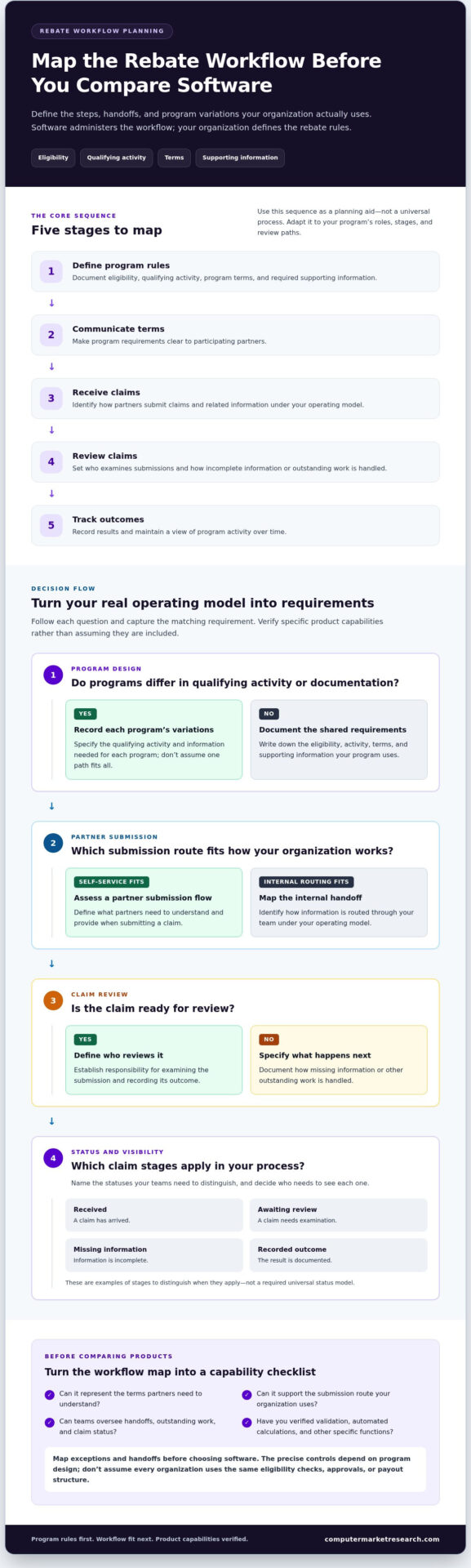
Before comparing platforms, map how a rebate moves through your organization. A simple workflow makes handoffs visible and helps distinguish essential requirements from features that don’t fit your program. Start with these stages:
- Define program rules: Document eligibility, qualifying activity, terms, and required supporting information.
- Communicate terms: Make the program requirements clear to participating partners.
- Receive claims: Identify how partners submit claims and related information under your operating model.
- Review claims: Establish who examines submissions and how incomplete information or outstanding work is handled.
- Track outcomes: Record the result and maintain a view of program activity over time.
This sequence is a planning aid, not a universal process. Programs may use different stages, roles, or review paths. Map the workflow you actually operate, including exceptions and handoffs, before deciding what channel rebate management software needs to support.
From program eligibility to partner claim submission
Check whether the software can represent the terms partners need to understand. Consider how eligibility is described, how relevant program information is organized, and what partners must provide when submitting a claim. If programs have different qualifying activities or documentation needs, record those variations in your requirements rather than assuming one submission path will suit every case.
Partner-facing processes should fit how your organization works. A self-service submission flow may suit one operating model; another may route information through an internal team. Treat validation, automated calculations, and other specific functions as capabilities to verify for each product, not assumptions based on a general product description.
Review, approval, and rebate status visibility
Define what status means at each point in your process. Teams should be able to distinguish a received claim from one awaiting review, missing information, or a recorded outcome, when those stages apply. Identify which users need to see each status and what information helps them understand the next action.
Connected workflow visibility gives teams a shared view of rebate progress, making handoffs and outstanding work easier to oversee. It can also reduce reliance on separate spreadsheets or inboxes for partner questions and internal follow-ups. During evaluation, distinguish your mapped requirements from capabilities a vendor specifically documents. Confirm how the proposed system handles your stages, status definitions, and access requirements before treating them as supported capabilities.
Compare Channel Rebate Management Software with a Buyer Scorecard
Use your mapped workflow to compare channel rebate management software against actual operating requirements. A scorecard separates essential capabilities from attractive extras. Rate each area by importance to your program, then assess how well each option addresses it using documented information and scenarios based on your process.
| Criterion | What to assess | Priority prompt |
|---|---|---|
| Workflow fit | Can the system support your program’s terms, partner submissions, review stages, and outcome tracking? | Which workflow gaps create the most manual work or unclear handoffs? |
| Data visibility | Can relevant teams understand partner activity, claim status, and the information used to administer the program? | What information must each team see to do its part? |
| Integration | How would the system connect with the CRM, ERP, financial, or channel data sources your process depends on? | Which systems and records are essential to the workflow? |
| Partner access | Does the partner-facing process fit your existing relationship model and submission practices? | What should partners be able to access or provide? |
| Scalability | Can the approach accommodate your expected program, partner, and process needs as they change? | Which likely changes would make today’s process difficult to maintain? |
Weight criteria according to operational impact, not a universal formula. If disconnected records are the main source of errors, prioritize data visibility and integration. If partners struggle to submit claims or understand terms, give more weight to partner access and workflow fit. Record each criterion’s importance and the evidence behind your assessment so stakeholders can see why options differ.
Assess data visibility and system integration
Rebate administration may depend on information held across CRM, ERP, financial, and channel systems. Map which records the workflow needs, where they originate, and who owns them. Then assess each vendor’s integration approach against your specific environment, including how data is exchanged and maintained. Evaluate compatibility for your systems rather than assuming it. For more on organizing channel information, see this guide to channel data management systems.
Evaluate partner experience and channel-wide fit
Consider whether rebate processes belong in a dedicated tool or alongside broader partner operations. If teams already manage partner onboarding, deal registration, and performance tracking within a wider channel workflow, connected administration may fit how they work. PartnerPortal™ brings rebates and incentives together with channel management capabilities, partner management, and channel data visibility.
Plan Implementation Around Data, Integrations, and Adoption
Before implementing channel rebate management software, document the process and information it needs to support. Automation won’t resolve unclear ownership or inconsistent records on its own. A readiness review helps your teams identify dependencies early and plan around existing operations instead of assuming every system or workflow connects in the same way.
Prepare channel and financial data for implementation
Start with an inventory of rebate processes, partner records, data sources, and system dependencies. For each source, note what information it holds, which process uses it, and which team maintains it. Depending on your program, relevant records may come from CRM, ERP, financial, partner, or channel systems. Include point-of-sale (POS) data only if it informs eligibility, claim review, or another part of your rebate process. For background on POS and ship-and-debit data contexts, see this channel POS and ship-and-debit whitepaper.
Set clear data ownership before configuring new workflows. If partner identifiers, transaction details, or program terms are recorded differently across systems, teams may struggle to reconcile activity and determine which information should guide administration. Agree on consistent definitions, record sources, and responsibility for updates. Then map how the proposed solution will connect with your environment. Integration requirements depend on your systems and data, so plan for them rather than assuming a connection will work as expected.
Coordinate stakeholders and partner-facing processes
Implementation affects more than the technology team. Map who owns program rules, partner communications, claim handling, financial oversight, and system access. Channel operations, sales operations, finance, and technology teams should understand where their responsibilities begin and end, including how exceptions or incomplete submissions are handled. Approval and payout structures should reflect your organization’s program, not a generic template.
Plan the partner experience as part of the rollout. Explain program terms in language partners can follow, clarify what information they need to provide, and make the submission path fit how they participate in your channel. Clear instructions and consistent processes can reduce avoidable confusion while recognizing that partners may work in different ways.
After launch, monitor practical signals: whether partners understand the requirements, where submissions need clarification, and which handoffs remain difficult for internal teams. Use those observations to refine communications and process steps. Establish a baseline before setting adoption targets.
Computer Market Research provides implementation and integration services for CRM, ERP, and financial systems. Learn about the PartnerPortal™ trial as you plan how rebate administration fits your broader environment.
Assess PartnerPortal™ for Connected Rebate and Channel Operations
A rebate platform should fit how your organization manages partners, program information, and channel activity. PartnerPortal™ is a cloud-based channel management platform that includes rebates and incentives alongside partner management and channel data visibility. That broader context is relevant when assessing whether rebate administration should sit within wider channel operations.
When broader channel management can support rebate operations
Assess the platform against the scorecard you’ve built. Consider whether your rebate workflows relate closely to partner onboarding, deal registration, or performance tracking, and whether centralized partner operations fit your teams’ responsibilities. PartnerPortal™ centralizes partner onboarding, deal registration, and performance tracking, while also providing rebates and incentives capabilities.
Connected scope is a point to evaluate, not a promise of better rebate outcomes by itself. Fit depends on whether the platform’s capabilities align with your program rules, partner processes, data needs, and operating model. Identify which teams need visibility across partner activity and rebate administration, then assess whether a channel management approach supports that requirement.
Integration planning matters too. Computer Market Research provides implementation and integration services for CRM, ERP, and financial systems. The systems involved and the integration approach depend on your environment, so include your existing architecture and data dependencies in the evaluation instead of assuming a particular connection.
Turn the evaluation into a practical next step
Before a trial, document the questions your team needs to answer. Focus on workflow control, channel data visibility, integration needs, and partner fit. Include stakeholders from channel operations, finance, sales operations, and technology so the evaluation reflects partner-facing processes and internal oversight.
Use a representative workflow to assess how the platform’s channel management and rebates and incentives capabilities relate to your requirements. Note where your team needs more detail, especially around data sources, system dependencies, and partner participation. This keeps the evaluation grounded in your operations instead of general feature claims.
For details about the trial, visit the PartnerPortal™ trial page.
Choose a Rebate Workflow You Can See and Support
The right channel rebate management software should reflect how your program operates, not just promise automation. Start with clear workflow requirements, then compare how each option supports partner access, data visibility, and handoffs between teams. Consistent records and defined data ownership also help you plan implementation with fewer unknowns.
PartnerPortal™ brings partner management and rebates and incentives into a broader channel management offering. Computer Market Research also provides implementation and integration services for CRM, ERP, and financial systems, helping organizations plan around their existing environment.
Use your evaluation criteria to explore how PartnerPortal™ fits your channel operations. Claim your 90-day free trial to take the next step toward clearer oversight of rebate processes and a stronger fit across your channel workflows.
Frequently Asked Questions
What is channel rebate management software?
Channel rebate management software helps organizations administer rebate programs offered to channel partners. It supports work such as communicating program terms, receiving and reviewing claims, and tracking activity or outcomes according to each organization’s process. The business sets the program rules, including eligibility and qualifying activity. Unlike general accounting software, rebate management focuses on coordinating partner-related program administration rather than handling broad financial records.
How does channel rebate management software work?
Channel rebate management software organizes information and tasks around a company’s rebate process. An organization defines program terms, communicates them to partners, receives relevant claim information, reviews submissions, and tracks results. The exact stages and responsibilities depend on the program. The software supports those workflows and provides status visibility, helping teams understand where work stands instead of relying only on separate spreadsheets, inboxes, or records.
What features should I look for in rebate management software?
Prioritize capabilities that match your program: clear representation of terms and eligibility, workflows for partner submissions and internal review, understandable claim status, relevant data visibility, partner access, and integration fit. Consider whether the system can accommodate your program’s operating requirements as they change. Treat specific functions, such as automated validation or calculations, as capabilities to verify for each product rather than assuming every rebate platform includes them.
Can channel rebate management software integrate with CRM and ERP systems?
Integration depends on the software and your organization’s systems, data, and requirements. Computer Market Research provides implementation and integration services for CRM, ERP, and financial systems. Before planning an integration, identify which records the rebate workflow relies on, where they originate, and who maintains them. Then assess the integration approach for your environment. Evaluate compatibility and data flows for the specific project rather than assuming they apply across all systems.
How is rebate management software different from co-op or MDF software?
Rebate management software supports administration of partner rebate programs, which typically reward qualifying activity under defined terms. Co-op or market development funds generally support approved partner marketing activities. Both are channel incentives, but their purposes and administration can differ. If your organization runs both, define their requirements separately and consider whether they belong within a broader channel operations platform. The same workflow or controls may not suit every incentive type.
How do I choose the right channel rebate management software?
Start by mapping your current program workflow, partner processes, data sources, and system dependencies. Compare options by workflow fit, data visibility, integration approach, partner access, and scalability. Weight each criterion according to your operational needs, and distinguish documented capabilities from assumptions. Include channel operations, finance, sales operations, and technology stakeholders in the evaluation. A representative program scenario can show whether the software fits your processes and information requirements.
Is channel rebate management software suitable for global enterprises?
It can be suitable when its workflows, data visibility, partner processes, and integration approach align with an enterprise’s operating requirements. Computer Market Research serves global enterprises with PartnerPortal™, a cloud-based channel management platform that includes rebates and incentives, partner management, and channel data visibility. Map the systems, teams, partners, and program processes involved, then assess how the solution fits your environment instead of assuming every organization has the same needs.

Article by
Del Heles
Del Heles is the founder and CEO of Computer Market Research (CMR), a channel management software company he launched in 1984. With more than 40 years of experience, he’s known for helping manufacturers and distributors simplify complex partner programs through practical, customer-focused technology solutions.