

A 1% improvement in pricing and incentive accuracy can lead to as much as a 14% increase in operating profit. For most Global 2000 enterprises, however, this potential remains locked behind fragmented POS data and the limitations of manual tracking. You’ve likely felt the frustration of overpayments caused by calculation errors or the inability to track non-revenue metrics like certifications and lead follow-up. When organizations adopt specialized b2b rebate management software complex conditional rebate structures multiple kpis become manageable assets rather than operational burdens. Managing these programs through legacy spreadsheets isn’t just inefficient; it’s a primary obstacle to your organization’s growth.
We understand that as your channel grows, so does the intricacy of your agreements. This article demonstrates how PartnerPortal™ serves as a central hub to master complex incentive logic and provide real-time visibility into rebate liabilities. We’ll examine the transition from manual claims verification to a modernized, data-driven system that builds partner trust through transparency and accuracy. By the end of this guide, you’ll have a clear path to eliminate margin leakage and automate channel partner performance through technical precision and automated verification of conditional claims.
Key Takeaways
- Identify the specific operational bottlenecks that cause margin leakage. Learn why manual spreadsheets fail to support modern incentive logic.
- Master the deployment of b2b rebate management software complex conditional rebate structures multiple kpis to automate tiered rewards and track non-revenue performance metrics with precision.
- Understand why POS data normalization is the essential foundation for any automated rebate system.
- Gain insights into incentivizing leading indicators like deal registrations and certifications to drive long-term partner engagement.
- Discover how PartnerPortal™ centralizes the incentive lifecycle to provide real-time visibility and build stronger, trust-based channel relationships.
The High Cost of Manual B2B Rebate Management
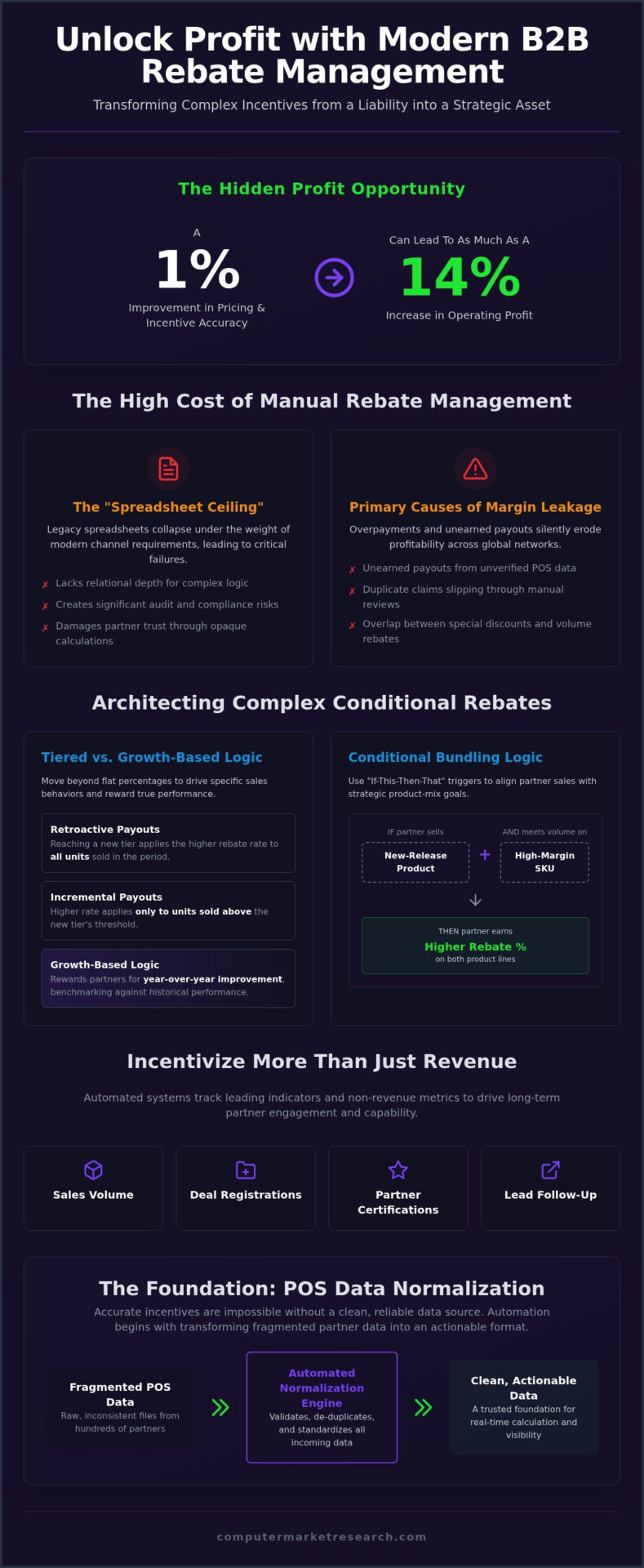
Manual processes in the Global 2000 often lead to significant financial erosion. Based on 2026 market research, a 1% improvement in pricing and incentive accuracy can lead to as much as a 14% increase in operating profit. Margin leakage is the silent killer of B2B profitability. It occurs when a rebate is paid out without meeting the specific performance criteria defined in the contract. When teams rely on human oversight for thousands of line items, overpayments become inevitable rather than accidental.
The “Spreadsheet Ceiling” represents the point where traditional tools collapse under the weight of modern channel requirements. When evaluating b2b rebate management software complex conditional rebate structures multiple kpis must be supported as native features to prevent the collapse of your tracking systems. Excel lacks the relational depth to track these variables accurately. This operational gap creates audit risks and compliance failures that can lead to multi-million dollar restatements. Beyond the financial loss, opaque incentive tracking damages partner trust. If a partner can’t see how their reward was calculated, they’ll stop prioritizing your brand.
Identifying Margin Leakage in Indirect Channels
Margin leakage is the silent killer of B2B profitability. It stems from a lack of granular control over partner data. In indirect channels, this often manifests as unearned payouts triggered by unverified POS data. Without automated validation, companies pay for sales that never happened or were later returned. The ship and debit overlap problem further complicates this; partners might claim a rebate on a transaction that already received a front-end discount. These errors compound across global networks.
- Unearned rebate payouts due to unverified POS data.
- Duplicate claims that slip through manual review cycles.
- Overlap between specialized discounts and standard volume rebates.
Why Legacy ERPs Struggle with Modern Incentives
Legacy ERP systems were built for internal inventory management, not the fluid nature of market-responsive rebate programs. These rigid data structures can’t handle the “Shadow IT” problem where channel teams revert to manual tracking because the core system is too slow to update. Integration bottlenecks between financial systems and partner portals create a vacuum where data remains siloed. Utilizing channel data management systems is often the only way to bridge the gap between raw partner files and actionable financial records. This ensures that incentives remain a tool for growth rather than a source of operational friction. Clear data leads to better decisions.
Architecting Complex Conditional Rebate Structures
Modern incentive design requires a shift from passive rewards to active behavior modification. Simple flat-percentage payouts rarely drive the strategic alignment needed in competitive markets. When deploying b2b rebate management software complex conditional rebate structures multiple kpis are no longer a source of manual error but a driver of strategic growth. This level of granularity ensures that every dollar spent on incentives directly supports your broader commercial goals, such as increasing market share or clearing specific inventory.
Tiered vs. Growth-Based Logic
Tiered structures typically utilize two main calculation methods: retroactive and incremental payouts. In a retroactive model, reaching a new volume threshold increases the rebate percentage for every unit sold during the period. Incremental models only apply the higher rate to units sold above the threshold. While both drive volume, growth-based logic adds a layer of performance benchmarking by rewarding year-over-year improvements. Setting these baseline targets requires high-quality historical data to ensure they remain attainable yet ambitious. Utilizing robust channel sales management software allows managers to automate these calculations, ensuring that growth targets are calculated against verified historical POS records rather than estimates.
Logic can also target product-mix goals through conditional bundling. For instance, a partner might earn a higher rebate on a legacy, high-margin SKU only if they also meet a minimum volume for a new-release product. These “If-This-Then-That” triggers ensure multi-product loyalty and prevent partners from cherry-picking only the easiest products to sell. It’s a method that forces alignment with your most profitable product lines.
Managing Retroactive Adjustments Safely
Mid-quarter program changes often create an accounting nightmare if handled manually. When a company adjusts a threshold retroactively or a partner submits late POS data, the system must perform a “true-up” calculation. Manual systems don’t handle these adjustments well, often leading to financial restatements. Automating these processes ensures that accruals remain accurate. A standardized grace period for data submissions is essential to maintain order. Without these guardrails, late entries can trigger cascading errors across your entire incentive portfolio. Automation provides the stability needed to handle these adjustments without manual intervention, protecting both your margins and your partner relationships. To see how these logic types function in a live environment, you can request a platform demonstration and explore the full suite of automation tools.
Aligning Performance with Multiple KPI Tracking
B2B leaders often focus exclusively on revenue as the primary metric for success. However, lagging indicators like total sales volume don’t provide a complete picture of partner health or future growth potential. When you implement b2b rebate management software complex conditional rebate structures multiple kpis become manageable assets that drive specific business outcomes. This allows you to reward the specific behaviors that lead to sustainable sales, such as technical training or consistent lead follow-up.
Weighting these metrics correctly is essential for balancing short-term revenue with long-term brand equity. If you only reward volume, you might find partners neglecting customer service or technical support. A holistic matrix ensures that every incentive dollar is working to strengthen the entire channel ecosystem. For instance, you might assign a heavy weight to revenue while reserving a portion of the payout for training certifications and lead follow-up speed. This forces partners to maintain a high level of competency and responsiveness if they want to maximize their rebate earnings.
Designing the Multi-KPI Incentive Matrix
A robust incentive matrix categorizes performance into three distinct layers to ensure a balanced approach to channel management. This structure ensures that partners are rewarded for being easy to do business with, not just for their sales numbers. Consider these categories:
- Revenue targets: Focus on volume and value, the traditional drivers of rebate programs.
- Operational KPIs: Measure the efficiency of the partnership, including inventory turnover and the accuracy of POS reporting.
- Behavioral KPIs: Track engagement activities like training completion or MDF utilization.
The Role of Deal Registration in KPI Accuracy
Deal registration serves as a critical qualifier for advanced rebate tiers. It provides a leading indicator of future revenue, allowing brands to forecast more accurately. Automated registration prevents channel conflict by ensuring that the partner who did the heavy lifting on a lead is the one who receives the margin protection. Within a broader What Is Partner Relationship Management (PRM)? strategy, registration data acts as a verification step for complex claims.
By using registration as a trigger, you can ensure that b2b rebate management software complex conditional rebate structures multiple kpis are applied only to verified, high-quality opportunities. This prevents rebate harvesting where partners claim incentives on deals they didn’t actively influence. Providing partners with real-time dashboards creates a scorecard effect, giving them immediate visibility into where they stand against their goals. This transparency builds the trust necessary for a high-performing indirect sales network.
When a partner sees exactly how many more certifications they need to hit the next rebate tier, their behavior shifts from passive participation to active goal-seeking. This real-time feedback loop is what transforms a standard incentive program into a powerful engine for channel growth. It moves the relationship beyond a simple transaction and into a strategic partnership.
The Foundation: POS Data Normalization & Managed Services
The “Garbage In, Garbage Out” trap is the most common failure point for enterprise rebate automation. If your b2b rebate management software complex conditional rebate structures multiple kpis calculations are based on raw partner reports, you will likely encounter significant margin leakage. Raw data is rarely uniform. Global partners use unique reporting formats, varying date ranges, and non-standardized product descriptions. This lack of consistency makes it impossible for a pure software solution to calculate rebates accurately without an initial layer of data refinement. Data normalization is the prerequisite for all complex rebate logic.
Without a foundation of clean data, automated systems simply process errors at a higher velocity. For companies operating across multiple regions, the challenge of mapping disparate data sets into a single source of truth is overwhelming. Automated data mapping must handle hundreds of global partner reporting formats to ensure that every transaction is accounted for and correctly categorized. This process ensures that your incentive spend is an investment in growth rather than a loss due to administrative oversight.
Cleansing and Normalizing Channel Data
Resolving SKU discrepancies is one of the most labor-intensive parts of channel management. One distributor might use an internal part number while another uses the manufacturer’s SKU. Without automated mapping, your system cannot aggregate these sales to trigger tiered rewards or growth-based incentives. Deduplication is equally vital. It identifies the same transaction reported across multiple channels, such as a sale reported by both a distributor and a reseller. Our Channel Data Management (CDM) Guide provides a detailed framework for achieving the accuracy required for high-stakes incentive programs.
Managed Services vs. Pure Software
Most Global 2000 enterprises have learned that software alone doesn’t solve the data problem. While software provides the logic engine, Managed Data Services provide the fuel. This managed approach to data administration allows companies to outsource the tedious work of cleansing, mapping, and verifying POS files. It significantly reduces the internal headcount required for rebate reconciliation, allowing your finance team to focus on strategy rather than data entry. Managed services act as a quality control layer, ensuring that every claim processed by PartnerPortal™ is backed by verified, clean data.
This combination of technical infrastructure and expert oversight is what enables organizations to scale their incentive programs globally without increasing operational overhead. By removing the administrative burden, you ensure that your rebate programs are both accurate and responsive to market changes. To see how this managed approach can stabilize your channel operations and improve your financial accuracy, you can access our 90-day free trial and experience the difference of decision-grade data.
PartnerPortal™: Automating the Incentive Lifecycle
PartnerPortal™ acts as the definitive execution layer for your channel strategy. While the previous sections established the need for clean data and sophisticated logic, this platform provides the infrastructure to run those programs at scale. When using b2b rebate management software complex conditional rebate structures multiple kpis are calculated instantly rather than through weeks of manual reconciliation. The system centralizes the entire lifecycle, from the moment a partner onboards to the final disbursement of earned incentives, ensuring that no step in the process remains opaque or disconnected.
Automated claim processing and ship and debit reconciliation are core strengths of the platform. By matching claims against normalized POS data in real time, the software eliminates the need for manual verification. This speed doesn’t just improve internal efficiency; it builds significant trust with your partners. When they see accurate, real-time reporting on their incentive progress, they’re more likely to align their sales efforts with your strategic goals. Scaling these programs globally is simplified through multi-currency support and regional logic, allowing you to maintain a consistent global strategy while respecting local market nuances.
Integrating PartnerPortal™ with ERP and CRM
A siloed incentive program is a liability. PartnerPortal™ utilizes bi-directional data flows to ensure your ERP and CRM remain accurate sources of truth. This integration prevents the “Shadow IT” problem mentioned earlier by keeping financial records and partner activity synchronized. Because the system uses pre-built channel modules, implementation times are significantly reduced compared to custom-built legacy solutions. You can explore the full technical specifications on the PartnerPortal™ Product Page to see how it fits into your existing tech stack.
Future-Proofing Your Channel Strategy for 2026
The landscape of trade finance is shifting rapidly. By 2026, the industry is moving toward AI-driven predictive incentive modeling and hyper-personalized rewards. Cloud-based platforms are expected to exceed 80% of the market share by 2030, highlighting the obsolescence of on-premise, manual systems. Preparing for this shift means moving toward “Instant Rebates” where partners receive credit as soon as a sale is verified through normalized POS data. This level of responsiveness is only possible when your data administration and software logic are perfectly aligned. To see these systems in action and begin your transition away from manual workflows, schedule a demo of PartnerPortal™ today.
Transforming Incentive Complexity into Competitive Advantage
Mastering channel performance requires more than just setting targets; it demands a technical infrastructure capable of handling the nuances of modern trade finance. By transitioning away from manual spreadsheets, you eliminate the primary obstacle to your organization’s growth. When you implement b2b rebate management software complex conditional rebate structures multiple kpis become clear, manageable pathways to increased profitability rather than sources of financial risk. The integration of expert managed data services ensures that your logic is always fueled by decision-grade POS information rather than fragmented estimates.
PartnerPortal™ provides the stability and precision needed to eliminate 100% of calculation errors and gain real-time visibility into channel ROI. This systematic approach doesn’t just protect your margins; it builds lasting trust with your global partners through transparent, automated tracking. You can now move beyond simple revenue metrics to incentivize the specific behaviors that drive long-term brand equity. To experience how automated verification can stabilize your indirect sales operations, Optimize Your Incentives with PartnerPortal™. Taking the step toward modernized infrastructure is the most logical path to securing your competitive position in an evolving market.
Frequently Asked Questions
What is B2B rebate management software?
B2B rebate management software is a cloud-based SaaS solution designed to automate the entire incentive lifecycle for global enterprises. Systems like PartnerPortal™ centralize partner activity, tracking performance against specific agreements to ensure accurate payouts. By replacing manual spreadsheets, this software provides real-time visibility into accruals and liabilities. It acts as a single source of truth for both manufacturers and channel partners, facilitating trust through transparent data and automated calculation logic.
How do complex conditional rebate structures work?
These structures utilize conditional logic to trigger payouts based on specific criteria beyond simple volume. For instance, a partner might only qualify for a retroactive tier if they also meet a minimum threshold for a new product line. When deploying b2b rebate management software complex conditional rebate structures multiple kpis are calculated automatically by matching verified POS data against these multi-layered rules. This ensures incentives drive strategic behaviors rather than just passive sales volume.
Can rebate software track multiple KPIs simultaneously?
Yes, modern platforms allow manufacturers to weight different performance metrics within a single agreement. You can track revenue targets alongside behavioral indicators like training completion, deal registration volume, or lead follow-up speed. This holistic approach ensures that incentive spend supports long-term brand equity rather than just short-term transactions. Partners receive a digital scorecard showing their real-time progress across every weighted KPI, providing clear guidance on how to maximize their earnings.
What is the difference between rebates and MDF?
Rebates are performance-based financial rewards paid after a sale or specific milestone is achieved, whereas Market Development Funds (MDF) are discretionary funds provided upfront for marketing activities. Rebates are typically calculated based on verified POS data to reward historical performance. MDF is used to stimulate future demand through co-op advertising or events. PartnerPortal™ manages both categories, ensuring that incentive spend is tracked accurately regardless of whether it’s a retroactive reward or a proactive marketing investment.
How does POS data normalization affect rebate accuracy?
Normalization is the essential process of cleansing disparate partner reports into a standardized format. Raw POS data often contains SKU discrepancies and duplicate entries that lead to unearned payouts. By cleansing this information through managed data services, you ensure that the calculation engine is working with accurate, rebate-ready data. This foundation prevents margin leakage and ensures that every incentive payment is backed by a verified, unique transaction that meets your specific contract terms.
Is it possible to integrate rebate software with existing CRM or ERP systems?
Yes, professional platforms are designed to integrate with existing CRM and ERP environments. These bi-directional data flows ensure that your financial records and partner activity remain synchronized in real time. Integration eliminates the need for manual data entry and prevents the development of data silos. Computer Market Research provides specialized implementation services to configure these connections, ensuring that PartnerPortal™ serves as a centralized hub for all indirect sales and marketing operations.
What are the risks of manual rebate tracking in 2026?
Manual tracking in 2026 exposes organizations to significant margin leakage and audit failures. As market complexity grows, spreadsheets can’t handle the retroactive adjustments and multi-layered logic required for modern programs. Errors in manual calculations often lead to overpayments that cost 1-3% of gross revenue. Additionally, the lack of real-time visibility prevents finance teams from accurately forecasting liabilities, which can lead to multi-million dollar restatements and a breakdown in partner trust.
How long does it take to implement a complex rebate management system?
Implementation timelines vary based on the number of partners and the depth of system integrations required. Most organizations can expect the process to take several weeks, which includes technical configuration, branding the portal, and setting up bi-directional data flows with financial systems. Utilizing pre-built modules for b2b rebate management software complex conditional rebate structures multiple kpis significantly reduces setup time. This structured approach ensures a stable transition from legacy manual processes to a modernized, automated infrastructure.

Article by
Del Heles
Del Heles is the founder and CEO of Computer Market Research (CMR), a channel management software company he launched in 1984. With more than 40 years of experience, he’s known for helping manufacturers and distributors simplify complex partner programs through practical, customer-focused technology solutions.