

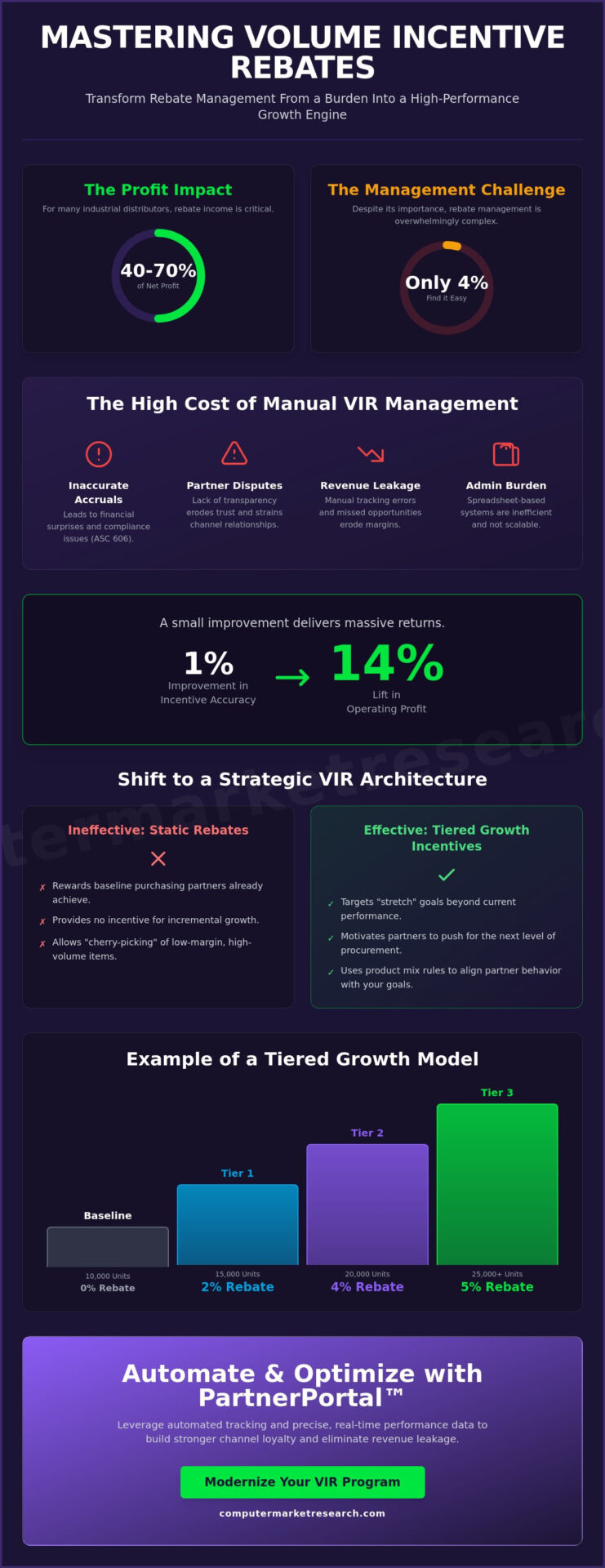
Did you know that for many industrial distributors, rebate income accounts for between 40% and 70% of total net profit? Despite this massive financial impact, only 4% of manufacturers report that managing their volume incentive rebates (vir) is actually easy. It’s a frustrating reality that most finance and operations teams face every day. You’re likely dealing with inaccurate accruals that lead to end-of-quarter surprises and partner disputes that strain your channel relationships. When you lack real-time visibility into partner progress, your incentive program becomes a source of administrative burden rather than a growth engine.
This guide will show you how to master these complexities to eliminate revenue leakage and drive superior channel performance. We’ll explore how to transition from manual, error-prone spreadsheets to automated systems that ensure ASC 606 compliance. Research shows that a 1% improvement in incentive accuracy can translate to as much as a 14% lift in operating profit. You’ll learn how to foster long-term partner loyalty through transparent tracking and data-driven precision. By the end of this article, you’ll have a clear roadmap to transform your rebate management into a streamlined, high-performance operation.
Key Takeaways
- Design tiered architectures that incentivize incremental growth by targeting stretch goals rather than baseline purchasing.
- Identify the specific operational bottlenecks and manual tracking errors that lead to margin erosion and hidden revenue leakage.
- Learn to establish standardized data protocols and clear legal frameworks that reduce administrative friction and partner disputes.
- Leverage PartnerPortal™ to modernize your volume incentive rebates (vir) through automated tracking and precise, real-time performance data.
- Build stronger channel loyalty by providing partners with transparent, reliable visibility into their progress toward every rebate threshold.
What is a Volume Incentive Rebate (VIR)?
A volume incentive rebate (vir) is a retrospective payment issued to a channel partner after they reach specific purchase or sales volume targets. Volume incentive rebates (vir) are performance-based financial incentives used to reward bulk procurement. Unlike upfront discounts that lower the initial invoice price, these incentives are earned over time. To understand the foundational mechanics of these agreements, it’s helpful to look at What is a Rebate? in a broader commercial context. In the B2B sector, VIR programs act as a strategic lever to foster long-term partner commitment and ensure predictable demand for manufacturers.
To better understand this concept, watch this helpful video:
VIR vs. Traditional Rebates: Key Differences
Standard rebates are often static and transactional, but VIR programs are dynamic. They adjust based on real-time performance against predefined thresholds. The defining characteristic of a VIR is its retrospective nature; the payment is only triggered after the partner meets the target. This creates a complex accounting environment. Under standards like ASC 606, these rebates are considered variable consideration. They must be estimated and accounted for as a reduction of revenue at the time of sale. This significantly impacts net-net pricing and margin calculations, as the final profitability of a deal isn’t fully realized until the performance period concludes. If accruals are inaccurate, companies face significant financial surprises at the end of the fiscal quarter.
Common VIR Structures in B2B Channels
Strategic Architecture of High-Performing VIR Programs
Effective architecture transforms a passive discount into a performance engine. While 62% of manufacturers offer some form of volume rebate, very few design them to maximize incremental growth. High-performing volume incentive rebates (vir) don’t just reward current volume; they incentivize the next level of procurement. To achieve this, you must set tiers that represent “stretch” goals. If a partner already purchases 10,000 units annually, setting the first tier at that level provides no new value. Instead, benchmarks should be set using historical POS data to identify the partner’s natural ceiling and push them beyond it.
Strategic design also requires a balance between aggressive targets and partner profitability. If the rebate doesn’t provide a clear path to improved margins, the partner has no reason to prioritize your brand. You should also incorporate product mix requirements within your volume incentive rebates (vir) to prevent “cherry-picking.” This ensures partners aren’t just buying high-volume, low-margin items to hit a total spend threshold. By mandating that a percentage of the volume comes from specific high-value categories, you align partner behavior with your production cycles and inventory goals.
Designing Effective Tiered Incentive Models
Choosing the right math for your tiers determines the program’s success. Linear models provide predictability, while accelerated models drive aggressive end-of-period activity. You can calculate the “Breakeven” point by dividing the total projected rebate cost by your margin per unit. This ensures the program remains profitable even if every partner hits the highest tier.
| Model Type | Structure | Primary Benefit |
|---|---|---|
| Linear Tiers | Consistent % per unit across all levels | Simple to track and budget |
| Accelerated Tiers | Escalating % as volume increases | Strongest incentive for high-growth partners |
Aligning Incentives with Channel Goals
Your VIR program should be a tool for maximizing channel ROI by linking payouts to broader strategic objectives. This might include market share expansion in specific geographic regions or driving the adoption of new product lines. When incentives are tied to these goals, they stop being a cost center and start being a growth catalyst. If you’re ready to see how automated data can refine your tier strategy, you can explore our performance tracking tools to get started.
The High Cost of Manual VIR Management
Many organizations still rely on legacy spreadsheets to track their volume incentive rebates (vir). This “spreadsheet trap” occurs because Excel isn’t built to handle multi-tiered accrual logic across hundreds of partners simultaneously. As data volume grows, the likelihood of manual entry errors increases exponentially. These errors directly contribute to revenue leakage. Revenue leakage is the unintended loss of margin due to calculation errors or unverified claims. When 51% of manufacturers report discrepancies between planned and actual rebate payouts, the financial impact is undeniable. It’s a direct hit to your bottom line that often goes unnoticed until an audit reveals the damage.
The administrative burden is equally taxing. Finance teams often spend hundreds of man-hours every quarter on manual reconciliation, cross-referencing disparate POS reports against complex contract terms. This labor-intensive process isn’t just inefficient; it’s a primary obstacle to growth. Instead of focusing on strategic optimization, your most expensive talent is stuck in a cycle of forensic accounting. This manual approach also creates a lag in communication. If a partner doesn’t know their current status, they’re less likely to push for that next volume tier, defeating the purpose of the incentive entirely.
Compliance and Audit Risks in 2026
Audit trails are non-negotiable under SOX and international standards like IFRS 15. Manual systems often rely on “shadow accruals,” which are estimates kept on side-spreadsheets that don’t reflect real-time performance. This practice obscures the balance sheet and creates significant risk during external audits. When payouts don’t match partner expectations due to calculation flaws, the result is strained relationships and costly legal disputes. Precise documentation is the only way to maintain the quiet confidence required for B2B financial integrity. Without a systematic record of every transaction and calculation, your organization remains vulnerable to financial surprises.
Data Fragmentation and Visibility Gaps
Normalizing data from different partner POS formats is a massive hurdle for many businesses. Without a centralized system for channel data management, your visibility into the channel is fragmented. This gap prevents you from making essential mid-cycle adjustments to your volume incentive rebates (vir). If you don’t know a partner is falling short of a threshold until the quarter has already concluded, you’ve missed the opportunity to drive the specific purchasing behavior you’re paying for. Real-time data isn’t a luxury; it’s the foundation of a modern, responsive incentive program that actually delivers ROI.
Best Practices for VIR Program Implementation
Successful implementation of volume incentive rebates (vir) starts with eliminating ambiguity. Vague contract terms are the primary root of partner friction and financial uncertainty. You must establish non-ambiguous legal agreements for every rebate tier to ensure both parties fully understand the performance requirements. Standardized data collection protocols are equally vital. Without a uniform way for partners to report sales, your team will remain trapped in a cycle of manual data normalization. Automation is the final pillar of this strategy. By automating the accrual process, you ensure financial predictability and eliminate the risk of shadow accruals mentioned in the previous section.
Step-by-Step Implementation Framework
Moving from manual tracking to a modernized system requires a methodical approach. Start with data cleansing and normalization of historical sales to establish accurate, reliable baselines. This step is critical; if your baseline data is flawed, your new tiers won’t drive the desired “stretch” behavior. Next, integrate your incentive software with your existing ERP and CRM systems. This integration creates a “Single Source of Truth” where sales data and rebate logic live in harmony, ensuring that every calculation is based on verified transaction records. Finally, pilot your rebate logic with a select group of partners. This phase allows you to stress-test the tiers and calculation accuracy before a full-scale rollout across your entire channel.
Communication and Dispute Resolution
Transparency is the most effective tool for building partner loyalty and reducing administrative friction. Providing partners with a self-service dashboard allows them to track their own progress in real-time, removing the need for constant status inquiries. You should set up automated notifications for “Threshold Near” alerts. These alerts act as a powerful nudge, driving the end-of-period purchasing behavior that maximizes your program’s ROI. When discrepancies occur, a standardized workflow for resolution prevents small errors from escalating into legal disputes. Proactive engagement is most efficiently managed through the PartnerPortal™, which offers a centralized environment for performance tracking. If you’re ready to move beyond fragile spreadsheets and secure your margins with precision, you can claim your 90-day free trial to see these best practices in action.
Optimizing Rebates with PartnerPortal™
PartnerPortal™ represents the final step in modernizing your channel operations. By utilizing CMR’s automated VIR module, organizations replace fragmented spreadsheets with a unified system of record. This environment allows for the precise execution of volume incentive rebates (vir) even across the most complex tiered structures. Real-time tracking ensures that both vendors and partners are aligned on performance metrics, eliminating the visibility gaps that lead to missed thresholds and revenue leakage. This centralized approach transforms rebates from a static cost into a dynamic growth engine.
The platform doesn’t just track data; it executes logic. Automated payout calculations integrate directly with your existing financial systems, ensuring that accruals are always accurate and compliant with ASC 606 standards. This level of precision builds a foundation of trust that manual methods simply can’t match. When partners see that their performance is tracked accurately and payouts are issued without dispute, their loyalty to your brand increases. It’s a shift from a combative relationship over discrepancies to a collaborative partnership focused on mutual ROI.
Key Features of CMR’s Rebate Management
Precision and transparency are at the core of the platform’s design. Dynamic dashboarding provides a dual-view perspective: vendors get a bird’s-eye view of channel health, while partners see exactly how much they’ve earned and what’s required to reach the next tier. For finance teams, the system generates robust audit trails and compliance reporting, providing the documentation necessary for stringent internal and external audits. This infrastructure is built for scale. It supports Global 2000 enterprises that must manage thousands of partners across multiple regions without sacrificing calculation speed or data integrity.
Measurable Business Outcomes
Transitioning to an automated system delivers quantifiable results that impact the entire organization. You’ll see a significant reduction in administrative overhead as your finance team is freed from the burden of manual reconciliation and error correction. Financial accuracy improves immediately, leading to faster quarter-end closing and more reliable balance sheets. Most importantly, you’ll likely see an increase in channel sales. When incentives are highly visible and attainable, partners are more motivated to hit those stretch goals discussed earlier in this guide. Clear data drives clear action. If you’re ready to secure your margins and empower your partners, you can request a demo of PartnerPortal™ to automate your volume incentive rebates (vir) today.
Modernizing Your Incentive Strategy for Sustainable Growth
Optimizing your volume incentive rebates (vir) is no longer just a sales initiative; it’s a financial necessity for protecting your bottom line. We’ve explored how transitioning from manual tracking to automated systems eliminates the revenue leakage that often hides in complex spreadsheets. By implementing strategic tier architecture and standardized data protocols, you create a transparent environment where partners are motivated to reach higher performance levels.
Since 1984, we’ve focused on automating channel management for Fortune 500 and Global 2000 companies. Our systems provide the real-time visibility into complex rebate tiers that finance and operations teams require for absolute accuracy. You don’t have to settle for end-of-quarter surprises or strained partner relationships caused by calculation errors. If you’re ready to secure your margins and drive superior channel performance, it’s time to see the impact of professional automation firsthand. Schedule a PartnerPortal™ Demo to begin your journey toward error-free incentive management. Modernizing your infrastructure is the most logical step toward a more profitable and predictable future.
Frequently Asked Questions
How do volume incentive rebates differ from standard rebates?
Volume incentive rebates (vir) are retrospective and conditional on reaching specific procurement targets, whereas standard rebates are often flat, transactional discounts. While standard rebates might apply to a single purchase, a VIR is earned over a defined performance period, such as a quarter or a year. This requires tracking cumulative sales data across multiple transactions to determine if the partner met the final payout threshold.
Can VIR programs be integrated with my existing ERP like SAP or Oracle?
What is the most common cause of revenue leakage in rebate programs?
The most common cause of revenue leakage is manual calculation errors stemming from fragmented data sources and disconnected spreadsheets. When companies lack a centralized system, they often overlook duplicate claims or fail to verify if a partner actually met specific tier requirements. These small discrepancies aggregate into significant margin loss, which often goes unnoticed until a formal audit reveals the financial damage.
How do tiered rebate structures drive better partner performance?
Tiered structures create incremental “stretch” goals that motivate partners to increase their purchasing volume to reach higher reward percentages. By offering escalating incentives, you encourage partners to prioritize your brand over competitors as they approach a new threshold. This strategy transforms a passive discount into an active sales tool that drives consistent, predictable growth throughout the entire performance window.
What financial compliance standards apply to VIR accruals in 2026?
ASC 606 in the United States and IFRS 15 internationally are the primary standards governing how volume incentive rebates (vir) are handled. These regulations require that rebates be treated as variable consideration, meaning they must be estimated and deducted from revenue at the time of the initial sale. Maintaining robust audit trails and accurate accrual logic is essential for passing internal and external financial audits.
Is it possible to automate rebates for multi-currency global partners?
Automated platforms can handle complex multi-currency calculations by applying real-time exchange rates to global transaction data. This capability is critical for enterprises managing partners across different regions. It ensures that payouts are accurate and consistent regardless of the local currency used for the purchase, reducing the administrative burden on global finance teams and minimizing currency-related disputes with international partners.
How often should partners receive updates on their VIR threshold progress?
Partners should ideally have real-time access to their progress, but automated updates should be sent at least monthly or whenever they are near a threshold. Frequent visibility acts as a performance nudge, reminding partners of the financial benefit of placing additional orders. Providing a self-service dashboard ensures they don’t have to wait for manual reports to understand their current standing.
What are the risks of managing VIR programs in Excel?
Excel lacks the version control, robust audit trails, and complex logic processing required for modern rebate management. Managing these programs in spreadsheets leads to “shadow accruals” and high error rates that compromise balance sheet accuracy. Without a centralized system, you risk straining partner relationships through payment delays and losing significant margin to unverified claims that are difficult to track manually.

Article by
Del Heles
Del Heles is the founder and CEO of Computer Market Research (CMR), a channel management software company he launched in 1984. With more than 40 years of experience, he’s known for helping manufacturers and distributors simplify complex partner programs through practical, customer-focused technology solutions.