

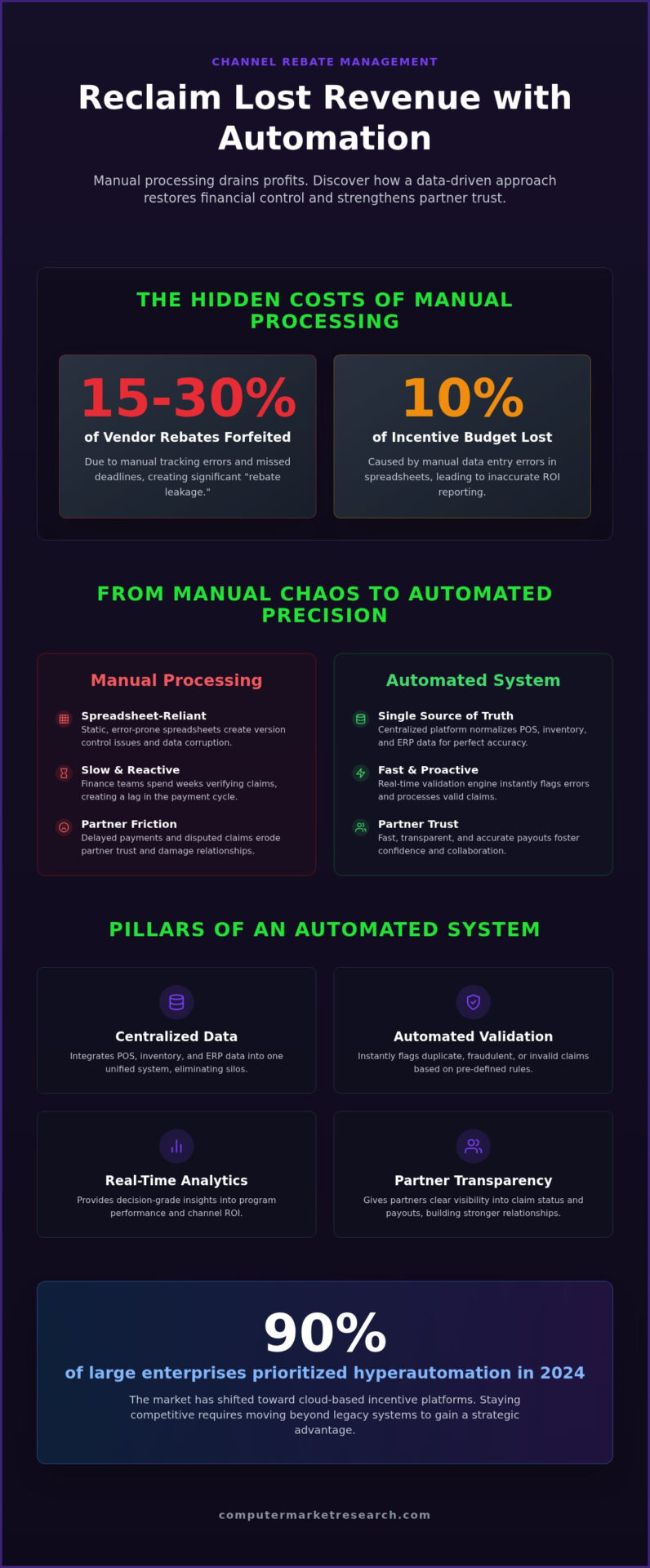
Manufacturing companies are estimated to forfeit between 15% and 30% of their earned vendor rebates due to manual tracking and missed deadlines. You likely feel the strain of claim processing delays and the constant threat of duplicate or fraudulent payments. Transitioning to channel rebate automation isn’t just a technical upgrade; it’s a strategic move to reclaim lost revenue and restore order to your financial workflows.
This guide explains how to eliminate manual errors and maximize ROI through automated channel rebate management. We’ll examine the shift toward hyperautomation and how PartnerPortal™ delivers decision-grade insights for better partner satisfaction. You’ll learn to move beyond the bottlenecks of legacy systems toward a systematic, data-driven approach that ensures every dollar is accounted for. By normalizing POS and inventory data, you can achieve error-free processing that builds trust with your distribution network. This transition provides the transparency your partners expect and the financial precision your organization requires to scale effectively.
Key Takeaways
- Identify the specific operational bottlenecks and financial leaks that occur when enterprises rely on manual claim processing.
- Explore how channel rebate automation transforms fragmented spreadsheets into a centralized, error-free system for better financial control.
- Learn how automated validation engines use POS and inventory data to instantly flag duplicate or fraudulent rebate claims.
- Discover the essential steps for implementing a robust automation strategy, from data auditing to defining clear incentive rules.
- See how PartnerPortal™ leverages decades of enterprise experience to provide the real-time visibility needed to maximize your program’s ROI.
What is Channel Rebate Automation?
Channel rebate automation represents the systematic orchestration of incentive programs through specialized software designed to manage the entire claim lifecycle. It replaces the traditional manual validation of sales data with algorithmic precision. To understand the foundation, one must first ask What is a Rebate? and how it functions as a delayed price reduction to incentivize specific partner behaviors. In a B2B context, this automation bridges the gap between disparate data sources like point-of-sale (POS) reports and internal ERP systems. By 2026, global volatility and supply chain fluctuations have made real-time incentive visibility a requirement for survival. SaaS platforms now serve as the single source of truth, centralizing fragmented data that previously lived in disconnected silos.
The Evolution of Rebate Management
Legacy processes relied heavily on static spreadsheets and manual data entry. These methods are no longer just inefficient; they’re the primary obstacle to channel growth. Traditional systems force finance teams into a reactive posture where they spend weeks verifying a single month of claims. Modern channel data management systems have shifted this model toward a proactive workflow. With 90% of large enterprises prioritizing hyperautomation as of 2024, the industry has moved toward cloud-based incentive modules. These systems provide a clear competitive advantage by allowing leaders to adjust strategies based on current performance rather than historical guesswork. The transition from manual chaos to automated precision is the only logical step for organizations looking to scale.
Key Benefits of an Automated Approach
Efficiency gains are the most immediate outcome of an automated strategy. By deploying a robust validation engine, businesses can eliminate overpayments and catch duplicate claim submissions before they impact the bottom line. This reduces the administrative overhead that typically bogs down finance and sales teams. Beyond the numbers, channel rebate automation builds partner trust. When payouts are fast and transparent, partners feel more confident investing in your brand. Using a dedicated tool like PartnerPortal™ ensures that every stakeholder has access to the same decision-grade insights. This transparency eliminates the friction of disputed claims and fosters a more collaborative relationship between manufacturers and their distribution network. Accurate data normalization ensures that every rebate paid is a rebate earned.
The Hidden Costs of Manual Rebate Processing
Manual rebate management often leads to “rebate leakage,” where capital exits the organization through overpayments and unverified claims. Research indicates that manufacturing companies forfeit between 15% and 30% of earned vendor rebates simply because of tracking failures and missed deadlines. Beyond direct financial loss, these manual processes create operational bottlenecks that stall growth. Integrating channel rebate automation provides the stability needed to stop these leaks and ensure every dollar is accounted for. When finance teams spend hundreds of hours on manual verification, they aren’t just wasting time. They’re creating a lag that triggers channel conflict. Delayed payments and disputed claims erode partner trust, often leading to a breakdown in the very relationships your incentives were designed to strengthen. These frictions make it difficult to maintain a competitive edge in a volatile market.
The Spreadsheet Trap
Legacy systems like Excel are not sustainable for modern enterprise needs. Relying on spreadsheets creates an environment where version control issues and data corruption are inevitable. A single incorrect formula or a misplaced decimal point can lead to catastrophic reporting errors. Manual data entry errors are estimated to cost enterprises up to 10% of their total incentive budget. These inaccuracies ripple through the organization, resulting in ROI reports that are essentially guesswork. Without channel rebate automation, strategic decisions are based on fragmented information rather than hard performance data. Order and performance are impossible to maintain when your data is trapped in a static document that lacks real-time connectivity. This fragmentation prevents leadership from seeing which incentives actually drive volume and which are simply draining resources.
Compliance and Audit Risks
Auditing a manual rebate program is a monumental task that often leaves companies vulnerable to both internal and external scrutiny. Ensuring adherence to complex global trade and tax regulations requires a level of precision that manual workflows cannot provide. This is particularly evident in programs involving The Risks of Inaccurate Ship & Debit Claims Data, where discrepancies can lead to significant regulatory penalties and financial restatements. Automated systems provide a clear, immutable audit trail, documenting every transaction from initial submission to final payout. This level of transparency ensures that your program remains compliant while significantly reducing the administrative burden of financial reviews. To see how organized data can transform your operations, consider exploring how a platform trial can streamline your current workflows and eliminate these operational risks.
Core Components of a Robust Automation System
A robust infrastructure for channel rebate automation consists of several interconnected layers that transform raw sales reports into verified financial transactions. A high-performing system is built on four core pillars that ensure reliability and scalability. First, a centralized partner portal like PartnerPortal™ provides a secure environment for claim submission. This eliminates the confusion of email-based claims and lost attachments. Second, an automated validation engine compares these submissions against verified POS and inventory data. This step is critical to prevent the overpayments discussed earlier. Third, real-time dashboards give stakeholders immediate visibility into ROI and claim status. These tools allow managers to see which regions or partners are overperforming, enabling dynamic adjustments to incentive strategies. Finally, the system must integrate directly with existing ERP and CRM platforms to maintain financial integrity across the enterprise. When rebate data is synchronized with your CRM, sales teams can see exactly which incentives are driving behavior during the deal registration process, creating a unified sales motion.
Data Normalization: The Foundation
Raw channel data is notoriously messy. Many organizations struggle with the “garbage in, garbage out” dilemma where inaccurate POS reports lead to faulty rebate calculations. Clean data is the essential foundation for any successful program. Computer Market Research specializes in the normalization of POS and inventory reports, drawing on over 40 years of experience to cleanse data for Fortune 500 companies. Managed data services offload the administrative burden of manual cleansing, allowing your team to focus on strategy rather than data entry. For a deeper look at this process, consult our Definitive Guide to Channel Data Management. By ensuring your data is normalized before it reaches the validation engine, you significantly reduce the risk of disputed claims and financial discrepancies.
Incentive and SPIF Management
Effective systems must differentiate between standard rebates and more targeted Sales Performance Incentive Funds (SPIFs). Automating multi-tier incentive structures requires a flexible engine that can handle complex eligibility criteria and varying payout schedules. Integrating Ship & Debit workflows into the same environment ensures that all channel incentives are managed under a single governance model. This holistic approach prevents overlapping claims and provides a clear picture of total incentive spend. By centralizing these functions within PartnerPortal™, enterprises can maintain control over global programs while providing the speed and accuracy that modern partners demand. This systematic approach ensures that incentives remain a tool for growth rather than an administrative burden.
Implementing Channel Rebate Automation
Transitioning from manual workflows to a modernized system requires a structured approach to data alignment and organizational governance. It isn’t enough to simply install software; you must audit your current rebate processes to identify where historical errors have occurred. This audit serves as the blueprint for your new digital infrastructure. By defining clear incentive rules and eligibility criteria upfront, you eliminate the ambiguity that leads to disputed claims. Selecting a platform like PartnerPortal™ ensures you’re using a system built specifically for the nuances of B2B data rather than a generic financial tool. This specialization is what allows for the high-quality information required to drive long-term growth.
Step 1: Data Source Identification
You must first identify every point where POS and inventory data originates within your network. This often involves gathering reports from diverse partners who use different naming conventions and formats. Mapping these partner data fields to a standardized format is the most critical phase of implementation. Without this normalization, your automation engine will struggle to validate claims accurately. Ensuring data transparency across the entire channel creates a foundation of accountability. When both you and your partners see the same verified numbers, the friction of manual verification disappears. This clarity allows you to move away from reactive troubleshooting toward proactive channel optimization.
Step 2: Workflow Configuration
Once your data sources are aligned, you must configure automated approval hierarchies that reflect your organization’s financial policies. These workflows ensure that claims are automatically checked against inventory levels and sales dates before reaching a human reviewer. Configuring real-time notifications and partner alerts keeps all stakeholders informed of claim status, which significantly improves partner satisfaction. For a broader perspective on these strategies, consult A Guide to Effective Channel Management. These alerts reduce the administrative burden on your support teams by providing partners with self-service visibility into their incentive earnings.
The final stage involves integrating your automation platform with your internal financial systems to facilitate automated payouts. This connection ensures that once a claim is validated, the payment is triggered without further manual intervention. Monitoring and measuring performance through real-time dashboards allows you to optimize your programs for maximum ROI. You can quickly pivot away from underperforming incentives and double down on the strategies that drive volume. If you’re ready to eliminate operational bottlenecks and secure your channel data, you can start your 90-day free trial to experience the precision of automated management firsthand.
Maximizing ROI with CMR PartnerPortal™
PartnerPortal™ serves as the command center for your entire distribution network. By centralizing all channel operations, the platform eliminates the fragmentation that typically leads to financial leakage and operational chaos. Implementing channel rebate automation through this specialized SaaS environment allows you to transform raw, messy reports into high-quality information. You aren’t just buying software; you’re adopting a systematic approach to data integrity. This results in decision-grade insights that empower leadership to make informed adjustments to incentive programs based on real-world performance. When your data is normalized and verified, your ROI reporting moves from speculative to definitive. This clarity ensures that your marketing and sales budgets are allocated to the partners and products that generate the highest returns. The administrative costs associated with manual verification drop significantly, which in turn increases partner engagement. Partners stay motivated when they receive fast, accurate payouts without the friction of constant disputes or delayed communications.
Expert Solutions Since 1984
Trust is earned through decades of performance. Since its founding in 1984, Computer Market Research has focused on the specialized needs of B2B data administration. Fortune 500 and Global 2000 companies rely on this expertise because they understand that complex channel relationships require more than a generic CRM plugin. CMR specializes in the normalization of POS and inventory reports, a critical step that many generalist providers overlook. Our 40 years of experience mean we’ve encountered nearly every data challenge imaginable. We’ve built systematic ways to solve these issues, ensuring that your transition to automation is seamless and reliable. By choosing a managed data partnership, you gain an expert peer who understands the nuances of financial tracking and incentive compliance. This level of technical competence ensures stability and reassurance as your organization scales into new global markets.
Next Steps: Partner Smarter
Moving beyond legacy systems is a strategic necessity for 2026. Requesting a tailored demo of the Rebates & Incentives module is the first step toward reclaiming your incentive budget through channel rebate automation. During the onboarding phase, implementation fees cover your specific branding and deep technical integration with your existing ERP or CRM systems. This ensures the portal feels like a natural extension of your brand while maintaining the technical depth required for complex data normalization and automated validation. By aligning your infrastructure with a proven expert, you create a clear path out of operational bottlenecks. Optimize your channel ROI with CMR today to secure your competitive advantage and build a more transparent, profitable channel network.
Securing Your Channel’s Financial Future
The transition from manual tracking to modernized digital infrastructure is no longer optional for growth oriented enterprises. By adopting channel rebate automation, you eliminate the fragmentation that leads to overpayments and eroded partner trust. This systematic approach ensures that every incentive paid is backed by verified, normalized data; this protects your bottom line from the “rebate leakage” that often plagues legacy systems. High quality information is the only reliable foundation for scaling complex distribution networks in a volatile market.
PartnerPortal™ provides the stability and technical depth required to manage these relationships with precision. Trusted by Global 2000 companies for over 40 years, our SaaS platform is specifically designed to handle the nuances of complex enterprise channels. You can move beyond operational bottlenecks and start making strategic decisions based on real time performance metrics. It’s time to replace reactive manual processing with the steady, expert led control your organization deserves. Automate Your Rebates with PartnerPortal™ and experience the clarity of decision grade data. We look forward to helping you build a more efficient and profitable channel today.
Frequently Asked Questions
What is the primary benefit of channel rebate automation?
The primary benefit of channel rebate automation is the elimination of manual processing errors that lead to financial leakage. By automating the claim lifecycle, enterprises can reclaim up to 30% of forfeited rebates caused by missed deadlines or tracking failures. This systematic approach also improves partner satisfaction by providing faster, more transparent payouts. It allows your finance team to shift from tedious data entry to high level strategic analysis.
How does rebate automation prevent overpayments?
Automation prevents overpayments by utilizing a validation engine that cross references every claim against verified POS and inventory data. This process identifies duplicate submissions and fraudulent entries before they reach the payment stage. By setting clear eligibility rules within the software, you ensure that payouts only occur when specific performance criteria are met. This level of algorithmic precision provides the financial control necessary to protect your incentive budget.
Can rebate automation software integrate with my existing ERP?
Yes, modern solutions like PartnerPortal™ are designed to integrate seamlessly with existing ERP, CRM, and financial platforms. During the implementation phase, technical experts configure these connections to ensure a unified flow of information across your enterprise. This integration is vital for maintaining financial integrity and providing sales teams with real time visibility into incentive performance. It turns your channel data into a cohesive asset that supports broader business objectives without manual transfers.
How long does it take to implement a rebate automation system?
Implementation timelines vary based on the complexity of your partner network and the depth of required technical integrations. The process typically involves initial setup, custom branding, and the configuration of automated approval hierarchies. Since every organization has unique data sources and incentive rules, a structured onboarding phase ensures that the system is perfectly aligned with your specific operational needs. This methodical approach guarantees that the platform is stable before global rollout.
What is the difference between a rebate and a SPIF?
A rebate is typically a retrospective payment made to a partner organization based on reaching specific volume or value targets over time. In contrast, a SPIF, or Sales Performance Incentive Fund, is a short term incentive targeted directly at individual sales representatives to drive the sale of specific products. While both are managed within channel rebate automation systems, they require different tracking methods and payout structures to ensure they effectively motivate the intended sales behaviors.
How does clean POS data improve rebate accuracy?
Clean POS data is the essential foundation for any accurate incentive program because it eliminates the discrepancies found in raw, unformatted reports. When data is normalized and cleansed, the automation engine can verify claims with absolute certainty. Computer Market Research specializes in this normalization process, ensuring that “garbage in, garbage out” scenarios don’t compromise your financial reporting. High quality data ensures that every payout is justified by an actual sale, protecting your ROI.
Is automation suitable for small partner programs?
Automation is highly suitable for smaller programs that are looking to scale without increasing administrative headcount. While previously viewed as a tool for large enterprises, mid-market companies now use these systems to build professional, transparent relationships with their partners from day one. Implementing a systematic approach early prevents the chaos of manual spreadsheets from taking root. It provides the same decision grade insights and financial control enjoyed by Global 2000 companies.
What reporting features should I look for in rebate software?
You should look for software that offers real time dashboards, predictive partner scoring, and comprehensive audit trails. Effective reporting must provide visibility into incentive ROI, allowing you to see which programs drive the most volume. Automated alerts for claim status and data discrepancies are also vital for maintaining operational flow. These features ensure that your team has access to the precise information needed to optimize channel strategies and improve overall performance.

Article by
Del Heles
Del Heles is the founder and CEO of Computer Market Research (CMR), a channel management software company he launched in 1984. With more than 40 years of experience, he’s known for helping manufacturers and distributors simplify complex partner programs through practical, customer-focused technology solutions.