

A partner program can attract capable partners and still fall short when expectations, workflows, and business goals don’t align. The elements of a successful partner program connect the value partners receive with the outcomes your organization needs, giving both sides a clear basis for action and measurement.
When goals are unclear, partners may not know where to focus. Manual onboarding, communication, incentives, and performance tracking can also make it harder to support partner activity or see what’s working. A well-designed program sets consistent expectations, provides useful enablement, and gives teams reliable information for managing the relationship.
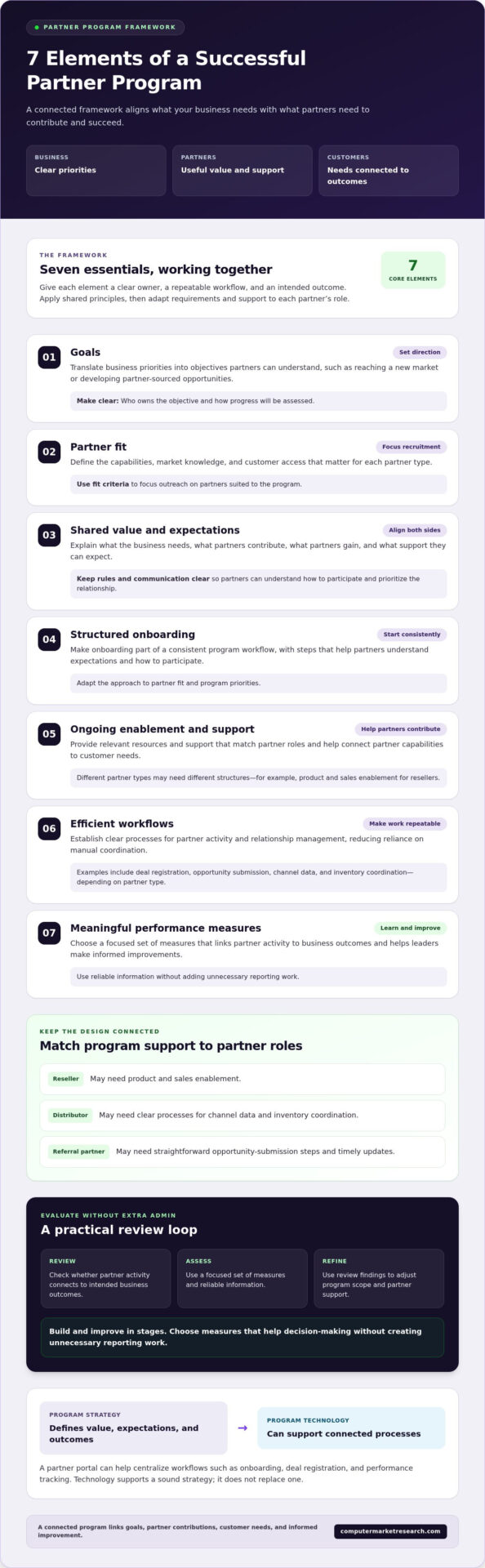
This guide explains seven essentials for designing, managing, and evaluating a partner program. You’ll learn how to define shared value and clear goals, set expectations, structure onboarding, provide ongoing enablement and support, establish efficient workflows, and track meaningful performance measures. These elements help leaders make informed improvements and connect partner activity to business outcomes. Program technology can support connected processes, but it works best when it enables a sound strategy rather than trying to replace one.
Key Takeaways
- Use the elements of a successful partner program as a connected framework, with a clear owner, workflow, and intended outcome for each.
- Assess partner fit and program priorities before choosing onboarding, enablement, and incentive approaches.
- Select a focused set of measures that links partner activity to business outcomes without adding unnecessary reporting work.
- Build and refine the program in stages, using review findings to adjust its scope and partner support.
- Consider how PartnerPortal™ capabilities such as onboarding, deal registration, and performance tracking can support the workflows your program needs.
Why the Elements of a Successful Partner Program Must Work Together
The elements of a successful partner program work best as a connected system, not as separate recruitment, training, incentive, and reporting activities. A partner program is the structured approach a business uses to recruit, enable, support, and evaluate its partners. It connects business goals with partner contributions and customer needs, while making the value and expectations clear to everyone involved.
A partner program is the strategy, rules, and operating processes that guide a working relationship. A partner portal is a technology tool that can support those processes, for example by centralizing onboarding or deal registration. The tool can help teams coordinate program activities, but it doesn’t define the partner value proposition or determine which outcomes matter.
For an overview of the organizations involved in channel relationships, see this explanation of a Channel partner. To hear a discussion of what can help a program succeed or fail, watch:
Connect program goals to partner contributions
Start by defining what the business needs from its indirect-sales relationships and how partners can contribute. Depending on the partner model, market, and business strategy, goals might include reaching a new market, generating partner-sourced opportunities, or providing service coverage in locations or segments the business doesn’t address directly. Treat these as objectives to design around, not guaranteed results.
Next, connect each objective to a customer need and a partner’s role. If the goal is to reach a particular market, for example, identify the partner capabilities or relationships that could support that effort—much like how partner sites such as Internet and Wireless Deals cater directly to customers searching for fiber and mobile connectivity packages. This gives recruitment, enablement, and measurement a shared direction.
Make participation valuable to partners
Partners need a clear reason to invest time and resources in a vendor relationship. Revenue targets may matter to the vendor, but they don’t explain what partners gain or what support they can expect. Describe expectations, available resources, incentives, and processes in terms partners can understand and use.
When rules are unclear or communication changes from one interaction to the next, partners may struggle to prioritize the program. Reciprocal value helps: the vendor clarifies its goals and provides relevant support, while partners understand how their contributions fit and what the relationship offers them. Each program component should reinforce both sides of that exchange.
For operational support, a channel partner management platform can help organize workflows. Technology can improve coordination, but a deliberate program still depends on aligned goals, clear expectations, and a meaningful reason for partners to participate.
The Core Elements of a Successful Partner Program
The elements of a successful partner program form a working framework, not a checklist to complete once and file away. Each element needs an accountable owner, a repeatable workflow, and an intended outcome. Together, they help partners understand where to focus and help program leaders assess whether the design supports business priorities.
- Goals: Translate business priorities into objectives partners can understand, such as reaching a market or developing partner-sourced opportunities. The program owner defines the objective and how progress will be assessed.
- Partner fit: Define the capabilities, market knowledge, and customer access that matter for each partner type. Recruitment teams can use these criteria to focus outreach on partners suited to the program.
- Onboarding: Map the steps from acceptance to readiness. Explain program requirements, available resources, key contacts, and what partners should do next.
- Enablement: Provide relevant product knowledge, sales resources, training, and ongoing support. Assign ownership so materials stay useful and partners know where to get help.
- Incentives: State eligibility criteria, submission steps, and review expectations clearly. The team administering incentives should make the process easy to understand and consistent with program goals.
- Communication: Set a reliable cadence for sharing updates, resources, and process changes. Name the communication owner and choose channels partners can access.
- Measurement: Decide who maintains performance information, how it will be reviewed, and which outcomes matter. Use consistent definitions so reports can inform program decisions.
Turn the framework into partner-ready operations
Start with business priorities, then shape partner criteria and onboarding around the contributions needed. For example, if the objective is to develop opportunities in a particular market, identify partners with relevant customer access, explain how to register an opportunity, and provide sales resources that support that role. Make the next step clear to both the partner and the internal owner.
Clarity also builds trust. Partners should understand what support is available and how incentives work, not just what the vendor wants to achieve. The University of Michigan’s equitable partnership principles offer a useful perspective on shared value and trust that can inform commercial relationships as well.
These responsibilities are part of partner relationship management: coordinating program rules, communications, and partner-facing processes. A clear framework makes those activities easier to align without assuming every partner needs the same support.
How to Evaluate Partner Program Effectiveness Without More Admin
Measurement should make decisions clearer, not add another layer of reporting work. Program structure and software can create complexity if they lead to duplicate entry, extra approvals, or dashboards no one uses. Start with a small set of measures tied to the program’s objectives, partner activity, and business outcomes. Add a measure only when it answers a practical question or informs a decision.
Choose measures that reflect program objectives
Separate participation and activity indicators from business results. Onboarding progress, deal registrations, lead follow-up, and incentive utilization can show whether key processes are being used. Partner-sourced revenue and pipeline progress can help assess business outcomes. Choose measures based on what the program is designed to accomplish.
Establish a baseline and consistent definitions before setting targets. A useful target for one partner model or market may not suit another, so avoid applying universal benchmarks without context. For example, if the objective is to improve lead follow-up, define what counts as a completed follow-up and review that measure alongside the opportunities it supports.
| Program objective | Possible measure | Potential data source |
|---|---|---|
| Make partners ready to participate | Onboarding progress | Onboarding records or partner portal |
| Improve opportunity visibility | Deal registrations and status | Deal registration records or CRM |
| Support timely lead handling | Lead follow-up status | Lead management records or CRM |
| Assess incentive engagement | Eligible incentive submissions and utilization | Incentive program records |
| Evaluate commercial contribution | Partner-sourced revenue or pipeline | CRM and relevant sales records |
Reduce friction through connected processes and data
Manual tracking can obscure performance as well as consume time. Re-entering the same partner or opportunity details in separate files, waiting on unclear approvals, and receiving inconsistent partner reports all point to workflow gaps. Compare the current process with the one you want: Can teams see the same status? Are definitions applied consistently? Is information captured once and available where it’s needed?
CRM, ERP, and partner workflows may need to exchange relevant information, but connect only the data that supports program decisions. Define the source of truth for each measure and assign responsibility for keeping records complete. This makes reporting easier to interpret and helps prevent administrative steps from multiplying.
For more guidance on organizing reliable channel information, see the channel data management guide. Connected tools can support visibility and consistent workflows, but the measures still need to reflect program priorities.
How to Build and Improve a Partner Program Step by Step
A partner program is easier to manage when its requirements match a defined business need and a specific partner segment. Build the operating model in stages and document decisions as you go. This keeps the initial scope focused and gives you a clear basis for reviewing what works before expanding.
Design the program around a defined partner segment
Begin by reviewing current partner relationships, business objectives, and operational constraints. Identify where partner contributions could support those objectives, then choose an initial segment, such as resellers or distributors, rather than trying to accommodate every partner type at once. For instance, specialized providers such as Apex Tax Solutions LLC tailor their professional software packages and support directly to the operational needs of tax preparers and partner offices. Define success for that segment using outcomes and process measures that fit your starting point.
Use a practical sequence to turn that scope into a program:
- Set the objective and scope. Document the business priority, intended partner contribution, customer need, and the partners the program is designed to support.
- Map the partner journey. Outline requirements from recruitment and onboarding through ongoing participation. Specify the steps partners take, the resources they need, and where handoffs occur.
- Assign owners and rules. Name internal owners for onboarding, enablement, partner support, incentives, and reporting. Write partner-facing rules in clear language, including how processes work and where questions go.
- Test and prepare. Ask partners to review whether expectations, resources, and next steps are understandable. Use their feedback to clarify confusing instructions before launch.
- Launch with a focused workflow. Introduce the agreed processes and reporting responsibilities to the selected segment. Keep the initial design manageable so the team can observe how it operates.
Launch, review, and refine the operating model
A launch is the start of evaluation, not the finish line. Set a consistent review cadence and bring together partner feedback, process status, and measures tied to the program objective. Look for specific bottlenecks, such as repeated requests for clarification, delays at an approval handoff, or incomplete reporting. Then adjust the relevant rule, resource, or workflow and check whether the change addresses the issue.
As the program develops, keep documentation current. Partners need to see the same requirements that internal teams use, and staff need clear ownership of follow-up. For more guidance on coordinating sales processes and channel workflows, explore channel sales management.
Technology can support these workflows once the operating model is clear. If you’re evaluating how PartnerPortal™ could support partner processes, explore the free trial.
How PartnerPortal™ Can Support a More Connected Program
Technology can make a well-designed partner program easier to operate, but it can’t replace program strategy or strong partner relationships. The right platform supports defined workflows, keeps relevant information accessible, and helps teams coordinate partner activity. Its value depends on fit: capabilities should address real process gaps rather than add tools partners and staff don’t need.
Connect program workflows in one operating environment
PartnerPortal™ centralizes partner onboarding, deal registration, and performance tracking. These capabilities can support a clearer path from partner setup to opportunity management and program review. Depending on program requirements, teams can also use capabilities for co-op and MDF funds, rebates and incentives, lead management, POS data, inventory, or ship-and-debit workflows.
Not every program needs every capability. A business focused on opportunity visibility may prioritize deal registration and performance tracking. A program that manages partner funds may need co-op and MDF management. Match the tools to the partner experience and reporting needs you’ve defined. For an overview of the platform and its channel management capabilities, visit the PartnerPortal™ overview.
Decide whether a platform fits your program
Before evaluating a platform, document where work currently stalls. Check for repeated data entry, unclear ownership, approval delays, limited visibility into partner activity, or difficulty reconciling channel data. Then identify which workflows should be consistent across partners and where different partner models require distinct processes. Review what information each workflow uses and what internal teams and partners need to access.
Use those findings to assess whether a platform’s capabilities align with your requirements. Consider how onboarding, deal registration, performance tracking, incentives, and channel data fit your current processes. Identify which capabilities address specific needs, and keep program rules and partner communication clear. Technology should support the operating model, not dictate it.
The elements of a successful partner program remain its goals, partner value, and clear operating practices. PartnerPortal™ can provide an operational layer for the workflows your organization chooses to manage through a platform. If you’re ready to evaluate that fit, explore the 90-day free trial and compare its workflows with your program requirements.
Put Your Partner Program Framework Into Practice
The elements of a successful partner program connect business objectives with clear partner expectations, relevant support, and measurable outcomes. Start with a focused design, assign owners to key workflows, and review a manageable set of measures to identify where the program needs refinement.
Technology can help coordinate those workflows, but it should support the strategy rather than define it. PartnerPortal™ supports partner onboarding, deal registration, and performance tracking, giving teams tools to organize important parts of partner operations. Computer Market Research, founded in 1984, provides channel management software.
If you’re evaluating how a platform could support your partner workflows, explore the 90-day free trial and consider how its capabilities align with your program requirements. A clear plan and a practical way to manage it can help you build stronger partner operations over time.
Frequently Asked Questions
What are the most important elements of a successful partner program?
The most important elements of a successful partner program are clear goals, suitable partner fit, structured onboarding, useful enablement, transparent incentives, consistent communication, and relevant measurement. These elements should reinforce one another: goals define the expected contribution, partner fit informs recruitment, and support and incentives help partners act on that expectation. Assign each element an owner, a workflow, and an intended outcome, then adapt the model to the partner type and market.
How do you measure the success of a partner program?
Measure success by connecting a small set of indicators to program objectives, partner activity, and business outcomes. Onboarding progress, deal registration, lead follow-up, or incentive utilization can show whether partners are participating in key processes. Partner-sourced revenue or pipeline can indicate commercial contribution. Establish a baseline, use consistent definitions, and review the measures regularly. Useful targets depend on your program context and available data, not universal benchmarks.
What makes a partner program attractive to potential partners?
A partner program is more attractive when it explains the value of participation and makes expectations easy to understand. Potential partners need to know which customers or opportunities the program supports, what resources and enablement are available, how incentives work, and where to get help. Clear rules and consistent communication reduce uncertainty. A strong offer considers partner needs and customer value, rather than focusing only on the vendor’s revenue goals.
How can a company improve partner engagement?
Improve partner engagement by making participation useful and straightforward. Provide relevant product knowledge and sales resources, communicate program updates consistently, and give partners clear next steps for processes such as deal registration or lead follow-up. Invite feedback to identify unclear requirements or gaps in support. Then make specific adjustments and explain what changed. Reviewing engagement alongside partner outcomes can help distinguish process friction from a mismatch between the program and partner needs.
Can a partner program work without partner management software?
Yes. A company can manage a partner program without dedicated software, especially when its workflows and reporting needs are straightforward. It still needs clear ownership, documented rules, and a reliable way to track partner activity and outcomes. As processes become fragmented across spreadsheets, email, or separate records, visibility and consistency can suffer. Partner management software can support connected workflows, but it doesn’t replace program strategy or the relationships behind it.
How do you structure incentives in a partner program?
Structure incentives around the outcomes and partner actions that matter to the program. Define eligibility, the activity or result being recognized, submission steps, and review expectations in clear language. Check that partners understand how to participate and that internal owners can administer the process consistently. Track utilization alongside relevant program outcomes, then review whether the incentive remains aligned with business priorities and partner value.
What is the difference between a partner program and a partner portal?
A partner program is the strategy and operating model for recruiting, enabling, supporting, and evaluating partners. A partner portal is a technology platform that can support selected program workflows. For example, PartnerPortal™ centralizes partner onboarding, deal registration, and performance tracking, with additional capabilities for channel processes such as incentives and lead management. The program defines the goals and rules; the portal can help organize how those processes are carried out.

Article by
Del Heles
Del Heles is the founder and CEO of Computer Market Research (CMR), a channel management software company he launched in 1984. With more than 40 years of experience, he’s known for helping manufacturers and distributors simplify complex partner programs through practical, customer-focused technology solutions.