

Why are your partners leaving millions in co-op funds on the table while your internal teams drown in administrative red tape? You likely recognize the friction caused by managing complex channel programs through fragmented spreadsheets and manual verification. These legacy processes don’t just waste time; they actively discourage partner participation and hide your true marketing impact. Modernizing your co-op advertising claim processing is no longer just an operational upgrade for the back office. It is a strategic necessity for any organization looking to maintain a competitive edge in 2026.
We understand that moving away from established manual workflows feels daunting; however, the transition to automated data transparency is the only logical step for a growing enterprise. This guide provides a definitive roadmap to master these complexities and implement systems that offer real-time visibility into fund utilization. You will learn how to automate the entire lifecycle of a claim to reduce errors and improve speed. We will examine the shift from traditional tracking to modernized infrastructure, ensuring your channel marketing becomes a measurable driver of high-quality growth rather than a source of operational frustration.
Key Takeaways
- Understand how co-operative advertising is evolving from traditional media into high-impact digital retail and social commerce channels to meet 2026 market demands.
- Discover how to leverage decentralized partner networks to scale your brand reach while significantly reducing your cost-per-acquisition through shared financial risk.
- Streamline your operations by automating co-op advertising claim processing to eliminate the manual errors and unutilized funds that hinder program growth.
- Identify the specific objectives and standardized accrual models needed to build a data-driven strategy that maximizes channel marketing ROI.
- Transition from legacy manual tracking to centralized systems like PartnerPortal™ to gain real-time visibility into partner performance and fund balances.
What Is Co-operative Advertising? Definition and 2026 Trends
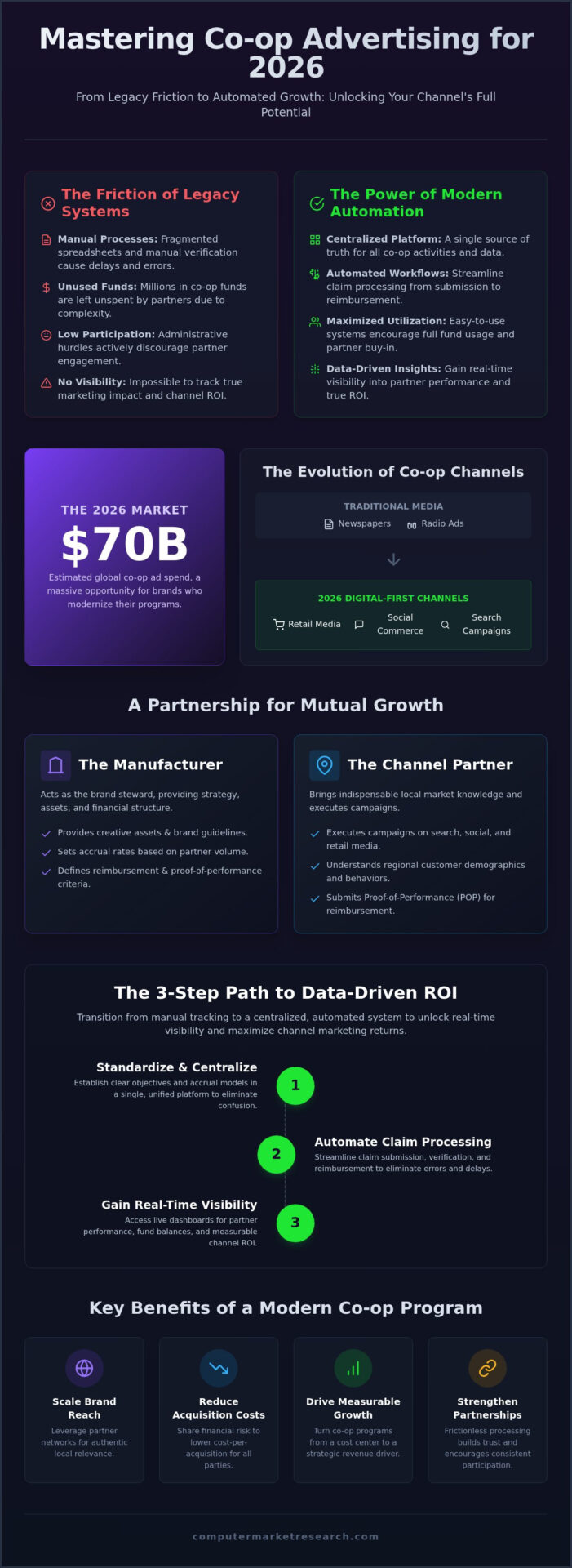
What Is Co-operative Advertising? In its most technical sense, it is a cost-sharing arrangement where manufacturers and their channel partners share the financial burden of local marketing efforts. This partnership allows brands to extend their reach into specific territories while partners benefit from reduced overhead costs. While the concept isn’t new, the methodology has undergone a radical transformation. By 2026, the global opportunity for co-op spend is estimated to reach $70 billion. This represents a massive opportunity for brands to scale their local presence without bearing the full cost of media buys, yet much of this remains unspent due to friction in co-op advertising claim processing.
The landscape has shifted from legacy mediums like local newspapers and radio to a digital-first approach. Today, programs prioritize retail media networks, social commerce, and targeted search campaigns. This evolution requires a more sophisticated approach than the manual tracking used in previous decades. It’s also vital to distinguish these programs from market development funds. While MDF is often granted upfront for strategic growth, co-op funds are typically accrual-based, meaning partners earn a percentage of their total purchase volume to reinvest into advertising.
The Role of the Manufacturer in Cost-Sharing
Manufacturers act as the brand stewards in these relationships. Their primary responsibility involves providing high-quality creative assets and strict brand guidelines to ensure consistency across disparate markets. They also determine the financial structure of the program by setting accrual rates based on partner purchase volume. To protect the brand’s integrity and financial health, manufacturers establish clear reimbursement criteria. These rules define which media types qualify for funding and what documentation is necessary to complete the co-op advertising claim processing workflow without delays.
The Role of the Channel Partner in Execution
How Co-op Advertising Programs Drive Mutual Channel Growth
Co-op advertising functions as a force multiplier for brand equity. It enables manufacturers to scale their reach through a decentralized network of local partners who possess deep regional insights. When these partners launch localized digital campaigns, they boost the brand’s local SEO and search visibility in ways a centralized campaign cannot. This decentralized model shares the financial risk, effectively lowering the cost-per-acquisition for both manufacturer and partner. Referencing the legal definition of cooperative advertising ensures that both parties understand the compliance framework necessary for these cost-sharing arrangements.
Success in these programs hinges on the partner’s willingness to participate. If co-op advertising claim processing is hindered by manual tracking and administrative hurdles, partners often view the program as a burden rather than a benefit. By streamlining this workflow, manufacturers provide tangible financial support that builds trust and encourages consistent marketing activity. High-quality data from these transactions allows for better visibility into channel ROI, moving the program from a cost center to a strategic revenue driver.
Benefits for the Manufacturer: Reach and Control
Manufacturers achieve a national brand presence while maintaining local relevance. By providing pre-approved ad templates, they control the brand narrative across thousands of touchpoints. This ensures that even the smallest local partner reflects the brand’s high standards. Additionally, manufacturers gain valuable insights into which regional markets are most responsive. This data transparency allows operations leaders to shift resources toward high-performing territories with precision, ensuring that marketing spend is never wasted on unresponsive demographics.
Benefits for the Partner: Credibility and Budget
For the channel partner, co-op programs provide access to professional-grade marketing materials that would otherwise be cost-prohibitive to produce. By utilizing 50/50 or 100% reimbursement models, partners effectively double their marketing reach without increasing their out-of-pocket expenses. Associating their local business with a globally recognized brand builds immediate credibility with their customer base. When the co-op advertising claim processing is handled through an automated portal, partners receive their reimbursements faster, which significantly increases their satisfaction and loyalty. If you are ready to modernize your incentive programs, you can start your 90-day free trial to see the impact of automated fund management.
Solving the Friction in Co-op Advertising Claim Processing
The transition from a cost center to a strategic revenue driver often stalls at the administrative level. Many organizations face a “Red Tape” problem where partners actively avoid co-op programs because the reimbursement journey is too taxing. This friction leads to a significant amount of unutilized funds and expired accruals, which essentially represents wasted marketing potential. Beyond simple participation rates, manual co-op advertising claim processing introduces substantial compliance risks. Without automated guardrails, brands struggle to ensure every local ad meets strict standards before a payout occurs, often leading to brand erosion and financial leakage.
The Friction of Manual Claim Processing
Legacy methods relying on spreadsheets and email chains create dangerously long approval cycles. When a partner waits weeks or months for reimbursement, their cash flow is impacted, which discourages them from launching subsequent campaigns. These manual systems are also prone to duplicate claims and fraudulent proof-of-performance documentation that are difficult to catch in a sea of fragmented data. Modern channel management requires a shift toward automated verification. By replacing human error with systematic validation, companies can approve legitimate claims in a fraction of the time, keeping partners engaged and motivated to sell.
The Data Visibility Gap
Operational leaders often operate in a vacuum, unable to track fund utilization in real-time across thousands of global partners. This lack of transparency makes it impossible to correlate co-op spend with actual POS sales data, leaving the true ROI of the program a mystery. You can’t optimize what you can’t measure. Centralized channel data management bridges this gap by aggregating disparate data points into a single source of truth. This visibility allows teams to identify which partners are effectively using their accruals and which funds are at risk of expiring. Eliminating the reliance on manual tracking isn’t just about speed; it’s about gaining the decision-grade insights necessary to refine your incentive structures. When co-op advertising claim processing is integrated into a broader data ecosystem, it transforms from a back-office burden into a precision tool for market expansion.
Building a Data-Driven Co-op Advertising Strategy
A successful co-op program requires more than just available funds; it needs a structured framework that aligns manufacturer goals with partner capabilities. You must start by defining clear objectives. Are you driving high-level brand awareness or focusing on local foot traffic for specific SKUs? By aligning these financial incentives with specific growth targets, you ensure that every dollar spent serves a broader corporate mission. Integrating these programs directly into your partner relationship management system allows for a seamless flow of information. This integration supports a performance-based tier system, where high-performing partners are rewarded with higher accrual rates or prioritized reimbursements.
Step 1: Simplify the Rules of Engagement
Complexity is the primary enemy of partner participation. You should develop a comprehensive “Co-op Playbook” designed for non-marketers. This document must clearly outline eligible media types, such as PPC, social commerce, print, and local events. To help your partners maximize their impact on these platforms, you can learn more about SocialPosterr and how AI-driven scheduling can be integrated into your digital channel strategy. It’s essential to mirror current industry standards, such as the digital submission mandate now seen in major HVAC and carrier programs. Your playbook should define the exact documentation required for a successful claim to avoid back-and-forth communication. For example, if your program caps media commissions at 17%, state this clearly to prevent financial friction during the audit phase.
Step 2: Automate the Approval Workflow
Modern co-op advertising claim processing shouldn’t rely on manual oversight. Implementing a pre-approval system ensures that partner ads meet brand standards before the money is spent. This proactive approach eliminates the risk of rejected claims after a campaign has already run. Using a digital portal for instant proof-of-performance uploads allows partners to track their claim status in real-time. This modernization can reduce reimbursement turnaround times from several months to just a few days. Faster payouts keep partners’ cash flow healthy and encourage them to reinvest in the next marketing cycle immediately.
Step 3: Measure and Optimize ROI
You can’t optimize what you don’t track. By linking your advertising spend to POS data management, you gain a clear view of true sell-through. This visibility helps identify “dead zones” where funds are allocated but never utilized, allowing you to reallocate those resources to more active territories. You should also adjust fund allocation based on seasonal trends and historical partner performance. This data-driven approach ensures your $70 billion global opportunity isn’t wasted on underperforming channels. If you’re ready to see how automation can transform your channel ROI, claim your 90-day free trial today and start optimizing your fund management.
Scaling Channel ROI with CMR PartnerPortal™
Managing a global channel network requires a level of precision that manual spreadsheets can’t provide. For Global 2000 companies, PartnerPortal™ serves as a centralized hub for co-op/MDF management, replacing fragmented information with a single source of truth. This platform eliminates the reliance on legacy tracking methods by providing real-time visibility into fund balances and claim statuses across the entire partner ecosystem. By automating the audit trail, organizations ensure financial compliance and significantly reduce the risk of fraudulent activities. Integrating co-op advertising claim processing with other incentive programs, such as ship and debit, creates a holistic strategy that aligns all partner incentives with corporate sales goals.
Seamless Partner Experience
Partners often abandon incentive programs because of administrative friction and delayed payouts. PartnerPortal™ addresses this by offering a single interface for all channel operations, from fund accrual tracking to performance reporting. Automated notifications alert partners to upcoming fund expirations and provide instant updates on claim approvals. This transparency removes the uncertainty of reimbursement, fostering a sense of trust and reliability between the brand and its distributors. By reducing the administrative burden on both the manufacturer and the partner, the system ensures that marketing professionals spend their time executing campaigns rather than chasing paperwork. It’s a pragmatic shift that values partner performance above all else.
Enterprise-Grade Reporting
Decision-grade data is the cornerstone of any high-performing channel program. PartnerPortal™ generates real-time reports on program health and marketing ROI, allowing operations leaders to identify high-performing territories with surgical precision. The platform exports clean, validated data that integrates seamlessly with existing CRM and ERP systems. This ensures that financial records remain accurate and consistent across the entire enterprise infrastructure without the need for manual reconciliation. PartnerPortal™ reduces manual processing time by up to 50%, enabling your team to focus on strategic optimization rather than repetitive data entry. Modernizing your co-op advertising claim processing through this specialized infrastructure transforms your incentive program into a stable, scalable driver of revenue growth.
Modernizing Your Channel Strategy for 2026
The transition from legacy manual tracking to automated data transparency is the only logical step for organizations looking to capture the $70 billion global co-op opportunity. By centralizing your operations within a specialized infrastructure, you eliminate the administrative red tape that currently prevents partners from fully utilizing their accrued funds. Shifting to a digital-first approach provides the real-time visibility necessary to correlate marketing spend with actual POS performance. This evolution ensures your co-op advertising claim processing is no longer a bottleneck but a precision tool for driving mutual growth across your entire partner network.
Computer Market Research has specialized in automated channel management since 1984, providing the stability and technical competence required by Global 2000 and Fortune 500 companies. Our PartnerPortal™ solution replaces fragmented spreadsheets with an integrated audit trail, protecting your brand while accelerating partner reimbursements. It’s time to move beyond the errors of manual entry and embrace a systematic way to manage your indirect sales incentives. You can claim your 90-day free trial of PartnerPortal™ today to experience the benefits of real-time fund visibility. We look forward to helping you build a more efficient, transparent, and profitable channel ecosystem.
Frequently Asked Questions
What is the typical split for co-operative advertising costs?
The most common arrangement is a 50/50 split, where the manufacturer and partner share the cost of the advertisement equally. However, some manufacturers offer 100% reimbursement for specific campaigns or high-performing partners. These rates are usually determined by the partner’s accrual balance, which is based on their net purchase volume. Clear communication regarding these splits is essential to prevent financial discrepancies during the audit phase of the program.
How does co-operative advertising differ from MDF?
Co-op advertising is an accrual-based fund earned through a partner’s purchase history, whereas Market Development Funds (MDF) are typically granted upfront for strategic market expansion. Co-op funds focus on sharing the cost of local advertising to drive short-term sales. MDF is often more flexible and can be used for training or infrastructure. Understanding this distinction helps operations leaders allocate resources more effectively across their channel network.
What counts as proof-of-performance (POP) in co-op advertising?
Proof-of-performance (POP) includes documentation that verifies an advertisement actually ran according to brand guidelines. For digital campaigns, this typically involves screenshots of live ads, click-through reports, and final invoices from the media platform. Physical media might require tear sheets from newspapers or notarized broadcast logs for radio and television. Providing these documents is a mandatory step in the co-op advertising claim processing workflow to ensure financial compliance.
Why do many co-op advertising funds go unspent each year?
A significant portion of co-op funds remains unutilized because of complex administrative red tape and manual tracking methods. Partners often find the reimbursement process too taxing, leading them to ignore available accruals rather than deal with lengthy approval cycles. Additionally, a lack of real-time visibility into fund balances means partners aren’t always aware of their eligibility. This friction results in billions of dollars in wasted marketing potential across global channels.
Can co-op advertising be used for digital marketing and social media?
Cooperative advertising programs must comply with the Robinson-Patman Act in the United States, which requires manufacturers to offer funds to competing partners on proportionally equal terms. This prevents discriminatory pricing and ensures fair competition within the marketplace. Programs must also follow specific guidelines from the Code of Federal Regulations regarding cost-sharing and proof-of-performance. Maintaining a standardized audit trail is essential for protecting the brand against legal and financial liability.
How can I automate my co-op advertising claim process?
You can automate co-op advertising claim processing by implementing a centralized SaaS solution like PartnerPortal™. This system replaces manual spreadsheets with a digital interface where partners can upload documentation and track their reimbursement status in real-time. Automation streamlines the audit phase by using pre-defined rules to verify compliance instantly. This modernization reduces manual processing time by up to 50% and accelerates the payout cycle for your channel partners.
Is co-op advertising effective for B2B companies?
Co-operative advertising is highly effective for B2B companies that rely on a network of distributors or resellers to reach specialized markets. It allows manufacturers to maintain brand consistency while leveraging the technical expertise and local relationships of their partners. By sharing the financial risk of marketing, B2B brands encourage their channel to promote complex solutions more aggressively. This collaborative approach strengthens partner loyalty and drives sustainable revenue growth through indirect sales.

Article by
Del Heles
Del Heles is the founder and CEO of Computer Market Research (CMR), a channel management software company he launched in 1984. With more than 40 years of experience, he’s known for helping manufacturers and distributors simplify complex partner programs through practical, customer-focused technology solutions.