

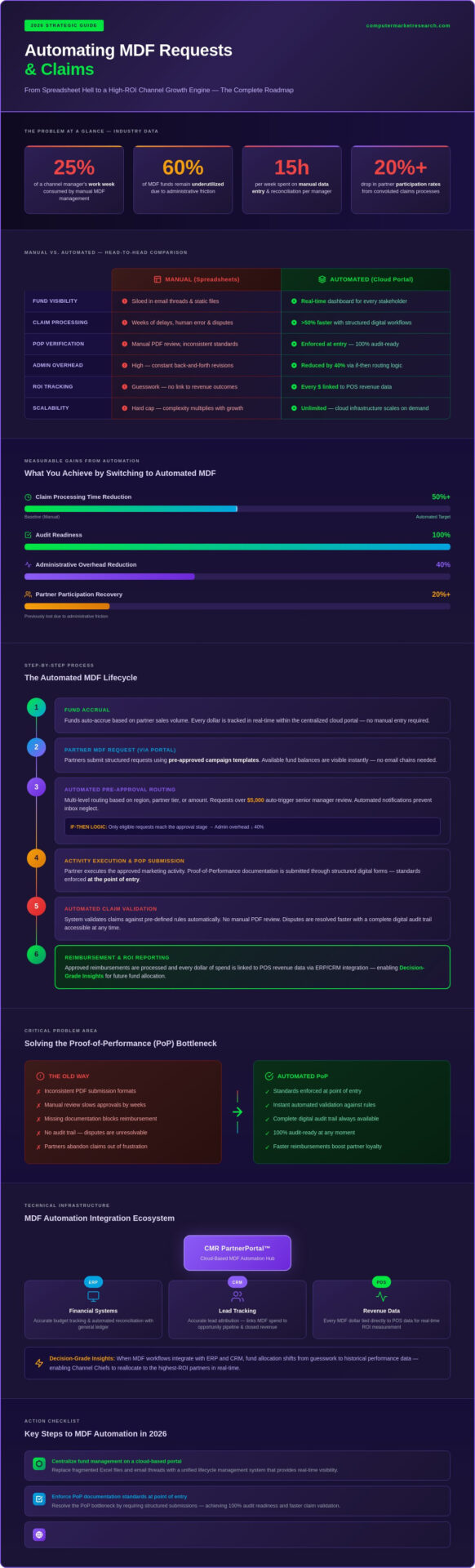
Industry data indicates that manual MDF management consumes up to 25% of a channel manager’s work week, yet nearly 60% of these funds often remain underutilized due to administrative friction. If your team is buried in an administrative swamp of email chains and disputes over Proof-of-Performance documentation, you aren’t alone. Most manufacturers still rely on fragmented systems that obscure fund utilization and leave balances in a state of constant uncertainty. It’s an inefficient cycle that drains resources and stifles partner motivation.
We understand that the death of the spreadsheet is the only path to true channel scalability. By automating mdf requests and claims, you can eliminate these manual bottlenecks and transform your program into a high-ROI growth engine. This guide provides a strategic roadmap for 2026 to help you reduce claim processing time by over 50%, achieve 100% audit readiness, and directly link every dollar of spend to POS revenue data. We’ll explore the transition from manual silos to a cloud-based infrastructure that offers the actionable insights you need to lead your channel with precision.
Key Takeaways
- Identify how to transition from the “administrative swamp” of manual spreadsheets to a centralized, cloud-based lifecycle management system.
- Discover the operational benefits of automating mdf requests and claims through a unified partner portal that streamlines the path from accrual to reimbursement.
- Learn how to resolve the Proof-of-Performance (PoP) bottleneck by enforcing documentation standards at the point of entry for faster verification.
- Understand the technical requirements for integrating MDF workflows with your existing ERP and CRM ecosystems to ensure accurate lead tracking.
- Explore strategies for future-proofing your channel program by leveraging scalable, decision-grade data that drives measurable ROI.
Escaping Spreadsheet Hell: The Case for Automating MDF Requests and Claims
For many manufacturers, managing Market development funds (MDF) still feels like a relic of the 1990s. While sales teams have migrated to sophisticated CRM systems, the financial engine of the channel often remains trapped in a fragmented web of Excel files and email threads. Automating MDF requests and claims replaces this “administrative swamp” with a centralized, cloud-based system designed to handle the entire fund lifecycle. It moves the process from static, disconnected documents to a real-time digital workflow that ensures every dollar is accounted for and every claim is validated against pre-defined rules.
By 2026, the sheer complexity of indirect sales models makes manual tracking a significant liability. Relying on spreadsheets isn’t just a minor inconvenience; it’s the primary barrier to scaling. If your data lives in silos, you lack the agility to pivot marketing strategies or reward high-performing partners quickly. For those looking for a deeper dive into foundational concepts, our strategic guide to market development funds provides the necessary context for modern channel growth.
To better understand how digital transformation simplifies these complex interactions, watch this helpful video:
The High Cost of Manual Inefficiency
Manual processing creates a cascade of hidden expenses that drain resources. Recent industry studies indicate that channel managers spend up to 15 hours per week on manual data entry and reconciliation. Human error in these entries leads to overpayments or missed deadlines that frustrate partners. When partners face a convoluted claims process, participation rates typically drop by 20% or more. They don’t have the time to fight through red tape to get reimbursed for their marketing efforts. Ultimately, manual MDF processing is a tax on channel growth that limits your competitive edge.
From Bureaucracy to Strategy: The ROI of Automation
Automating MDF requests and claims shifts the focus from simple paperwork to strategic marketing spend. Instead of wondering where the budget went, Channel Chiefs gain real-time visibility into every dollar. This transparency allows for “Decision-Grade Insights,” where fund allocation is based on historical performance rather than guesswork. If you can see which activities drive the highest ROI in real-time, you can reallocate funds to the partners who deliver results. This transition turns a cost center into a powerful engine for predictable revenue.
To ensure offline marketing activities are easily trackable, partners can use QR Sense and learn more about creating custom QR codes for their physical collateral to bridge the gap between print and digital performance data.
The Automated MDF Lifecycle: A Step-by-Step Workflow
The transition from fund accrual to final reimbursement often represents a primary bottleneck for manufacturers. By automating mdf requests and claims, organizations replace fragmented email threads with a unified partner portal. Centralizing these interactions ensures every stakeholder has visibility into available balances and pending actions. This shift marks the death of the PDF claim form; manual data entry is replaced by structured digital inputs. Partners utilize pre-approved campaign templates to align with brand standards without the need for constant back-and-forth revisions.
Streamlining the Pre-Approval Process
Manual approval cycles can delay marketing initiatives by weeks. Automation introduces multi-level routing that directs requests based on specific criteria like region, partner tier, or fund amount. If a request exceeds a specific threshold, such as $5,000, the system automatically triggers a secondary review from a senior manager. Automated notifications ensure these requests don’t stall in neglected inboxes. Following channel partnership best practices involves creating clear “if-then” logic. This ensures only eligible requests reach the approval stage, reducing administrative overhead by up to 40% according to 2024 industry benchmarks.
Frictionless Partner Submissions and Proof-of-Performance
The claim phase is traditionally where disputes arise. Modern channel management software simplifies this by allowing partners to upload proof-of-performance (PoP) documents directly to the portal. Digital audit trails provide a transparent record of every interaction, which minimizes friction during the audit process. When partners can submit invoices and media placements in a few clicks, the time-to-reimbursement often drops from 60 days to under 15 days.
Automating mdf requests and claims creates a predictable rhythm that builds partner trust. It eliminates the “black hole” of manual processing where claims are lost or forgotten. To see how these efficiencies impact your bottom line, you can explore our MDF management solutions. By the time 2026 arrives, the ability to process claims in real-time will be a baseline requirement for any competitive channel program.
Solving the Proof-of-Performance (PoP) Bottleneck
Manual verification of marketing activities remains the primary friction point in channel partnerships. When partners submit claims without standardized evidence, channel managers spend 30% of their work week chasing missing invoices or blurred screenshots of digital ads. This administrative drag slows down reimbursement cycles and creates tension between manufacturers and their distributors. By automating mdf requests and claims, companies shift the burden of proof from the back-end auditor to the front-end submission process. The system acts as a digital gatekeeper, ensuring that no claim progresses until every required document is uploaded and verified against pre-set criteria.
This structural discipline is vital for financial audit readiness. According to a report by Forbes, partner-to-partner ecosystems require high levels of transparency to maintain trust and regulatory compliance. Automation provides a permanent, time-stamped paper trail that satisfies both internal controllers and external auditors. It replaces the “back-and-forth” email chains with a centralized repository of clean, actionable data.
Automated Validation and Compliance Checks
Modern platforms use intelligent validation rules to flag non-compliant claims the moment a partner attempts to submit them. If a claim lacks a required third-party invoice or if the activity date falls outside the approved window, the system denies the entry immediately. This functionality prevents the marketing team from acting as “compliance police,” a role that often damages partner relationships. For Global 2000 companies managing 1,000+ international partners, these automated checks ensure that brand standards and local tax regulations are met without increasing headcount. It’s a scalable way to maintain order across diverse geographical regions where manual oversight is impossible.
Linking Spend to POS and Inventory Data
The most significant advantage of a specialized system is its ability to integrate with channel data management (CDM) infrastructure. Instead of looking at marketing spend in a vacuum, managers can correlate MDF disbursements with actual inventory movement and sales performance. If a partner claims a 15% increase in local demand following a “discount campaign,” the system verifies this claim against Point of Sale (POS) data from that specific period. Automating mdf requests and claims within this framework creates a “closed-loop” process where every dollar of marketing investment is directly tied to a validated sales outcome. This level of visibility transforms MDF from a nebulous expense into a measurable driver of revenue growth, providing the hard data needed to justify future budget allocations.
Integrating MDF Automation with Your Financial Ecosystem
Finance departments often resist new software because they fear data silos and broken workflows. However, automating mdf requests and claims doesn’t mean creating an isolated island of information. Modern channel management platforms use robust REST APIs to synchronize data directly with ERP systems like SAP, NetSuite, or Microsoft Dynamics. This connectivity ensures that every approved fund request instantly updates the general ledger. By automating accruals, companies maintain 99.9% balance sheet accuracy, removing the traditional guesswork from quarterly financial reporting. This technical integration also bridges the gap between marketing spend and channel incentive programs, providing a unified view of partner profitability.
Closing the Loop: CRM and Deal Registration Alignment
Channel visibility fails when MDF exists apart from the sales funnel. Integrating your MDF portal with Salesforce or HubSpot ensures that leads generated from funded activities flow directly into the deal registration pipeline. This allows managers to track the exact conversion rate of partners using automated funds compared to those who remain on manual systems. Data from 2024 indicates that partners using integrated MDF workflows see a 22% faster lead-to-opportunity conversion rate. It creates a single source of truth, eliminating the “spreadsheet lag” that frequently slows down sales operations. When a partner sees their marketing efforts lead directly to protected deals, their loyalty to your brand increases.
Financial Accuracy: Payments, Credits, and Ship & Debit
Automated claim approval triggers immediate action in the ERP, whether it’s a direct payment or a credit memo. This automation is critical when managing the complexity of Ship & Debit claims alongside marketing funds. Without a synchronized system, reconciling these overlapping incentives takes approximately 15 to 20 hours of manual labor per week for a mid-sized manufacturer. Modern systems now handle complex tax requirements and regulatory compliance across 190 countries automatically. This precision prevents overpayments and ensures that the manufacturer only pays for validated performance. It transforms the finance department from a bottleneck into a strategic partner.
Future-Proofing Your Program with CMR PartnerPortal™
Manual spreadsheets are the primary obstacle to sustainable channel growth. Computer Market Research acts as the bridge between operational chaos and decision-grade data, providing the stability manufacturers need to scale. Our cloud-based infrastructure scales seamlessly with your program. Whether you manage 50 partners or 5,000, the system maintains peak performance without increasing your administrative headcount. By automating mdf requests and claims, you replace reactive firefighting with a systematic approach to fund management. This technical competence builds a foundation of trust between you and your distributors, positioning your brand as a reliable leader in the channel.
The competitive advantage of automated fund management lies in speed and precision. Partners prefer manufacturers who pay claims quickly and accurately. By removing the friction of manual approvals, you become the preferred vendor in a crowded marketplace. Our role as a Reliable Specialist is to provide the tools that make this possible, ensuring your channel operations are a source of strength rather than a bottleneck. It’s about moving away from “good enough” data and toward a state of total visibility and control.
Predictive ROI and Program Optimization
Industry data shows that reactive fund management often leads to 15% of MDF budgets remaining unspent or misallocated. CMR PartnerPortal™ changes this by utilizing historical claim data to predict which partners will deliver the highest returns. Real-time dashboards provide immediate visibility into fund utilization rates across your entire network. If a partner isn’t using their allocated budget by the mid-quarter mark, managers can proactively reallocate those resources to high-performing accounts. This shift from manual tracking to strategic investment ensures that your marketing spend directly correlates with sales outcomes.
The Managed Data Services Advantage
Software alone isn’t a silver bullet. If your partner reports are inconsistent, incomplete, or contain errors, automation will only speed up the production of bad data. CMR offers a specialized advantage through our Managed Data Services, where we cleanse and normalize messy partner submissions. We ensure every claim is backed by “clean data” for total financial accuracy before it ever reaches your accounting department. This meticulous approach eliminates the headaches of duplicate entries and formatting errors that plague traditional systems. It’s the only way to achieve a truly efficient channel. Schedule a demo of PartnerPortal™ to see MDF automation in action and move your program into the future.
Securing Your Competitive Edge for 2026 and Beyond
The shift from manual tracking to a streamlined, digital workflow isn’t just an upgrade; it’s a necessity for survival in the 2026 channel landscape. By automating mdf requests and claims, manufacturers eliminate the spreadsheet hell that historically throttles growth and creates friction with partners. Solving the Proof-of-Performance bottleneck through automated validation ensures that funds are deployed effectively and visibility remains absolute across the entire financial ecosystem.
Since 1984, Computer Market Research has provided the technical competence required to manage complex B2B data. With over 40 years of channel expertise, we’ve become the trusted partner for Fortune 500 and Global 2000 enterprises looking to move beyond manual errors. Our unified cloud platform integrates MDF, Co-op, and Ship & Debit management into a single source of truth. This approach provides the stability and accuracy your sales operations professionals need to make informed decisions.
Automate your MDF program today with CMR PartnerPortal™
Your path to operational excellence starts with a system built for performance.
Frequently Asked Questions
What is the main difference between manual and automated MDF management?
The primary difference lies in the transition from fragmented spreadsheets to a centralized, cloud-based portal. Manual processes often lead to a 20% error rate in data entry and create significant visibility gaps. By automating mdf requests and claims, manufacturers eliminate these silos and gain real-time oversight of fund allocation. This shift replaces tedious email chains with structured workflows that ensure every dollar is tracked accurately from the initial request to final reimbursement.
How does automating MDF claims improve partner engagement?
Automation increases partner engagement by reducing the typical reimbursement cycle from several months to under 15 days. Partners are 30% more likely to participate in marketing programs when they’ve a clear, predictable path to funding. When you remove the administrative burden of manual filing, partners focus on selling rather than paperwork. This transparency builds trust and strengthens the manufacturer-distributor relationship through reliable, data-driven interactions that reward performance without the usual delays.
Can MDF automation software integrate with my existing CRM like Salesforce?
Modern MDF platforms integrate directly with CRMs like Salesforce through robust API connections. This creates a bi-directional flow where lead data and claim status sync automatically across both systems. By 2026, 85% of high-performing channel teams will utilize these integrations to eliminate duplicate data entry. It ensures your sales and marketing teams work from a single source of truth, providing actionable insights without the need for manual data exports or complex reconciliations.
What kind of Proof-of-Performance (PoP) is typically required in an automated system?
Automated systems require digital uploads such as PDF invoices, social media screenshots, or campaign analytics reports. Most platforms now mandate 100% digital submission to ensure audit readiness and financial compliance. This structured approach prevents the loss of physical documents that often plagues manual systems. By requiring specific file types and metadata at the point of submission, manufacturers ensure that every claim meets pre-defined brand guidelines and financial standards before approval.
How does automation help in measuring the ROI of marketing development funds?
Automating mdf requests and claims allows manufacturers to link fund expenditures directly to Point of Sale (POS) data. This connection provides a 15% clearer view of which activities actually drive revenue. Instead of guessing which campaigns worked, managers use hard data to calculate the exact return on every dollar spent. It transforms MDF from an opaque expense into a measurable strategic investment that scales effectively with your business growth and market demands.
Is automated MDF management compliant with global financial regulations?
Automated platforms are designed to meet strict global standards like GDPR and Sarbanes-Oxley (SOX) compliance. Every action within the system generates a permanent, time-stamped audit trail that tracks approvals and fund movements. This level of oversight reduces the risk of financial fraud by 40% compared to manual spreadsheet tracking. It provides CFOs with the quiet confidence that their channel spending adheres to both internal controls and international legal requirements without extra manual effort.
What happens to underutilized MDF budgets in an automated system?
Underutilized funds are flagged in real-time, allowing managers to reallocate them to high-performing partners before the fiscal quarter ends. Automated alerts notify stakeholders when funds remain stagnant for more than 30 days. This proactive management typically increases overall budget utilization by 10% or more across the channel. It prevents the common year-end scramble to spend remaining balances, ensuring that capital is deployed where it generates the most significant market impact and revenue growth.
How long does it typically take to implement an automated MDF portal?
A standard implementation for a cloud-based MDF portal typically spans 6 to 12 weeks. This timeframe includes data migration, system configuration, and partner onboarding sessions. Most organizations achieve full operational status within 60 days of the project kickoff. While legacy systems often took months to deploy, modern web-based architectures allow for a phased rollout that minimizes disruption to existing channel operations and provides immediate relief from manual errors and data silos.

Article by
Del Heles
Del Heles is the founder and CEO of Computer Market Research (CMR), a channel management software company he launched in 1984. With more than 40 years of experience, he’s known for helping manufacturers and distributors simplify complex partner programs through practical, customer-focused technology solutions.