

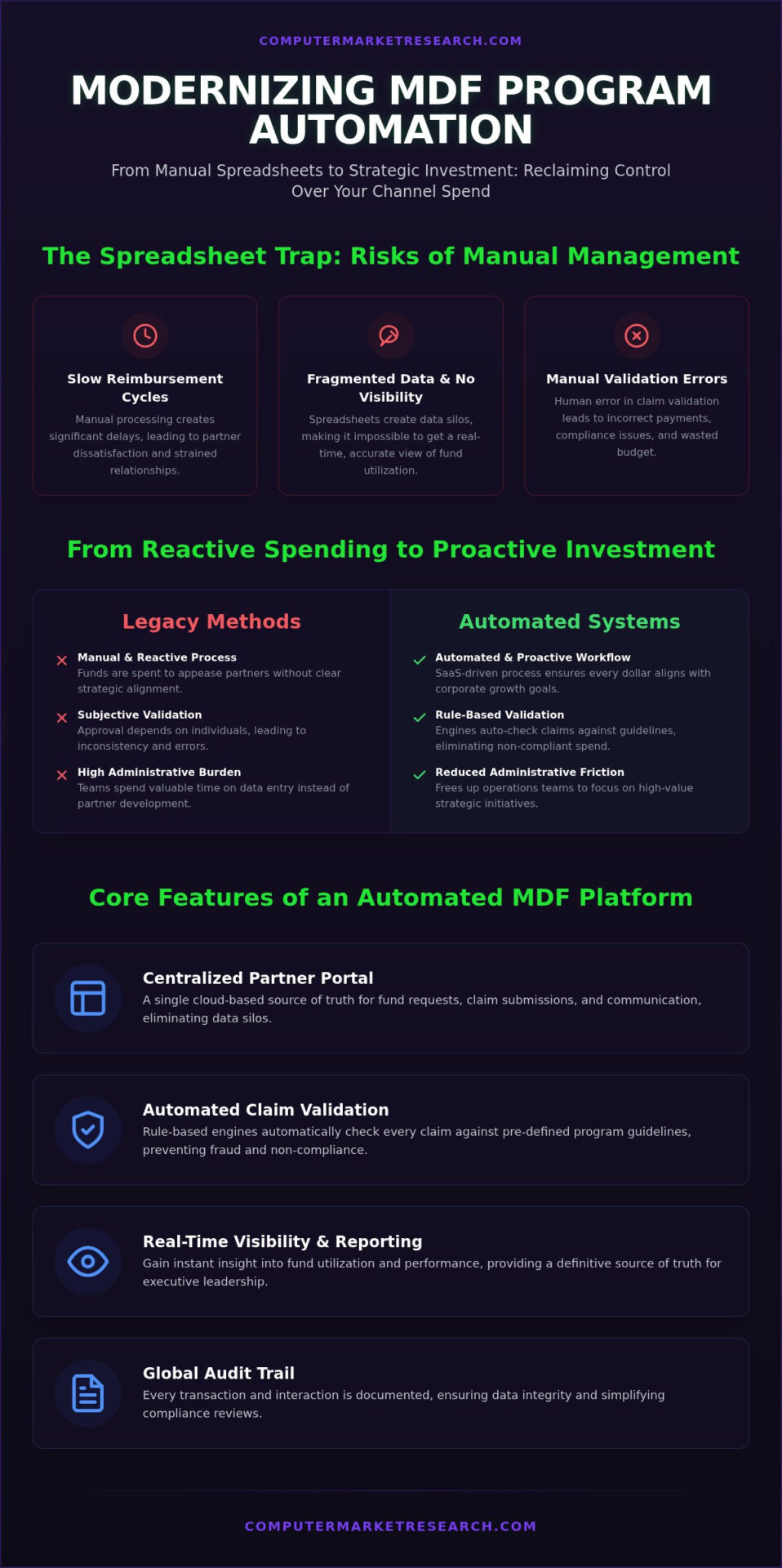
Your current spreadsheet-based tracking isn’t just a nuisance; it is a primary obstacle to your organization’s ability to scale. Relying on manual claim validation and fragmented data sets creates a visibility gap that most Global 2000 brands can no longer afford. Implementing mdf program automation is the definitive solution to these operational bottlenecks, allowing you to move away from the administrative weight of verifying every line item. You likely recognize the friction caused by slow reimbursement cycles, which often leaves your partners dissatisfied and your marketing budget underutilized.
This strategic guide provides a clear path to reclaiming control over your channel spend by introducing a systematic approach to automated MDF management. We’ll show you exactly how to eliminate manual administrative burdens while maximizing your channel marketing ROI through modernized infrastructure. You’ll gain a technical understanding of how to achieve real-time visibility into fund utilization and accelerate claim-to-payment turnarounds. We also outline the standardized reporting structures necessary to satisfy executive leadership and ensure data integrity across your entire partner network in 2026.
Key Takeaways
- Transition from reactive spending to proactive strategic investment by adopting cloud-based SaaS workflows for fund management.
- Eliminate manual validation errors and reduce administrative friction by implementing mdf program automation with centralized partner portals.
- Identify the hidden operational costs and data fragmentation risks inherent in legacy spreadsheet-based tracking methods.
- Secure cross-departmental alignment between marketing, sales, and finance to ensure a seamless transition to modernized management systems.
- Utilize PartnerPortal™ to gain real-time visibility into fund utilization and establish a definitive source of truth for executive reporting.
What is MDF Program Automation and Why It Matters
To understand the future of channel growth, one must first look at how organizations manage their resources. Traditionally, many leaders viewed What are Market Development Funds as a reactive “pot of money” used to appease partners. This legacy mindset creates a passive marketing culture where funds are spent without clear strategic alignment. MDF program automation transforms this process into a SaaS-driven workflow that prioritizes proactive strategic investment over simple fund distribution. MDF automation is the digital orchestration of fund allocation, claim validation, and reimbursement. By digitizing these touchpoints, manufacturers ensure that every dollar spent aligns directly with corporate growth objectives rather than disappearing into unverified activities.
Automation serves as the critical bridge between high-level manufacturer goals and granular partner execution. Without a centralized system, there’s a disconnect between what a brand wants to achieve and what a reseller actually does. A robust MDF platform ensures that program guidelines are baked into the workflow. This means partners only request funds for activities that have a high probability of driving ROI, while the system provides the guardrails necessary to keep marketing efforts on track.
The Evolution of Market Development Funds
The journey of fund management has moved far beyond the era of physical mail-in claims and manual verification. In the high-velocity 2026 channel landscape, legacy methods fail because they can’t keep pace with rapid market shifts or complex data privacy requirements. Modern cloud infrastructure allows for global fund distribution that is both secure and instantaneous. Digital portals have replaced spreadsheets, providing a single source of truth that remains accessible to stakeholders regardless of their geographic location. This transition ensures that data flows smoothly from the partner to the finance department, eliminating the delays that once plagued manual systems.
Key Benefits for Global 2000 Enterprises
For large-scale organizations, the shift to mdf program automation delivers measurable operational stability. One of the most immediate gains is a substantial reduction in administrative overhead. Organizations moving from manual tracking to automated systems report that they can process claims much faster, allowing operations teams to focus on partner development rather than data entry. This efficiency doesn’t just save money; it improves partner satisfaction by creating predictable, transparent reimbursement cycles.
Beyond speed, automation enhances financial compliance and fraud prevention. Automated validation engines check every claim against pre-defined rules, ensuring that funds are never released for non-compliant activities. This level of precision protects the brand’s capital and provides the standardized reporting that executive leadership requires for audits and performance reviews. By establishing a clear audit trail, businesses can confidently scale their channel programs without increasing their risk profile.
Core Features of an Automated MDF Management Platform
Automated Claim Validation and Processing
Rule-based engines are the primary defense against subjective approval errors. These systems automatically check every submission against your pre-defined program guidelines, rejecting non-compliant requests before they ever reach your finance team. This level of rigor is vital for improving channel performance because it sets clear expectations for partners. Standardized proof-of-performance (PoP) documentation becomes a requirement rather than a suggestion, ensuring that every payout is backed by verifiable data. By streamlining the workflow from submission to payout, you reduce the claim-to-payment cycle from weeks to days. This speed builds trust with your partners, encouraging them to invest more heavily in your brand’s growth initiatives.
Real-Time Visibility and Reporting
Modern platforms provide real-time dashboards that offer immediate insights into fund utilization across different partner tiers. You don’t have to wait until the end of a quarter to see if your budget is being used effectively. Instead, you can track the direct impact of MDF spend on lead generation and sales as it happens. This visibility allows for mid-cycle adjustments, ensuring that funds are redirected to the partners and activities driving the highest ROI. It transforms the marketing budget from a static expense into a dynamic strategic asset.
Integration with existing CRM and ERP systems is a non-negotiable feature for large enterprises. When your MDF data flows directly into your financial systems, you achieve a level of transparency that manual methods cannot replicate. This creates a decision-grade environment where data is cleansed and normalized for executive reporting. For a deeper look at how this data structure supports your business, explore our Channel Data Management (CDM): The Definitive Guide. To see how these features can be tailored to your specific needs, you may explore our PartnerPortal capabilities for a more detailed technical overview.
The Spreadsheet Trap: Risks of Manual MDF Management
Manual tracking methods aren’t actually free, even if they utilize existing software like Excel. These legacy systems hide substantial operational costs that erode your marketing budget through lost productivity. They create an environment of data fragmentation where no single version of truth exists to guide executive decision-making across departments. Undetected formula errors or duplicate entries in manual spreadsheets can lead to significant financial leakage, where funds are disbursed for the same activity multiple times or calculated incorrectly. This lack of precision is particularly dangerous in regulated industries, where the absence of an automated audit trail creates compliance risks. Manual logs are easily manipulated and difficult to verify, leaving your organization vulnerable during formal audits. Transitioning to mdf program automation is the only way to establish the technical discipline required for modern channel management.
The Administrative Burden on Channel Teams
Channel teams frequently find themselves trapped in endless back-and-forth email chains trying to secure missing proof-of-performance (PoP) documentation from partners. This manual chase consumes valuable hours that should be spent on strategic partner development and recruitment. Scaling a global program becomes an impossible task when every claim requires individual human intervention to validate and process. Without the support of dedicated Partner Relationship Management Software, your team remains reactive, buried under administrative tasks that provide little value to the bottom line. The complexity of managing multiple currencies and local tax regulations only adds to this burden, making manual systems a primary bottleneck for international growth.
Partner Dissatisfaction and Disengagement
Slow reimbursement cycles are a primary driver of partner disengagement and can severely damage your brand’s reputation in the channel. When a partner has to wait months for a payout, they perceive it as a lack of commitment or financial stability from the manufacturer. This friction is compounded by opaque approval processes that leave partners guessing about the status of their funds and the criteria for success. High-performing partners will naturally migrate toward vendors who provide clear, automated workflows and faster payment cycles. By failing to adopt mdf program automation, you risk losing your most valuable channel assets to competitors who prioritize operational transparency and partner experience. To see how a centralized system can stabilize these relationships, you should evaluate the capabilities of a modern PartnerPortal.
Best Practices for Implementing MDF Automation
You need to identify the specific KPIs your automation must track before the first line of code is configured. Are you measuring lead volume, conversion rates, or simply fund utilization? Mapping your existing manual workflows helps identify which steps are redundant and which can be streamlined through digital logic. Consulting with IT early is essential for seamless CRM and ERP integration. This ensures that your channel sales management software talks to your financial systems without manual data export. This technical alignment is the foundation of a scalable channel infrastructure.
Partner Onboarding and Training Strategy
Partner adoption is the ultimate metric for success. If the system is too complex, partners will disengage and revert to legacy communication methods. Creating intuitive self-service portals for fund requests simplifies the partner journey. You should provide clear documentation on the “rules of the road” directly within the interface to minimize submission errors. Automated notifications keep partners informed of claim status, which drastically reduces the administrative burden on your support team. By prioritizing partner ease-of-use, you drive the platform adoption necessary to justify the investment. A phased rollout allows you to refine these training materials with a small group of power users before a full global release.
A well-executed implementation plan removes the uncertainty typically associated with digital transitions. It replaces fragmented manual processes with a logical, results-driven system that scales with your business. Ready to see how a structured approach improves your channel operations? You can start your 90-day free trial to explore the impact of automated fund management.
Optimizing Channel ROI with CMR PartnerPortal™
CMR PartnerPortal™ provides the technical foundation required to move from reactive fund distribution to a performance-based model. By centralizing MDF, Co-op, and incentive management within a single cloud-based environment, you eliminate the fragmented data silos that typically lead to financial leakage. The platform doesn’t just track funds; it cleanses and normalizes incoming partner data to ensure that mdf program automation delivers accurate, actionable results. This specialized data administration removes the manual errors that often compromise the integrity of channel reports. For Global 2000 operations, this level of precision is essential for maintaining a clear audit trail while simultaneously driving partner performance.
One of the most significant advantages of this infrastructure is the ability to close the loop between marketing spend and actual POS data results. Instead of viewing MDF as an isolated expense, leaders can see exactly how specific fund allocations correlate with sales volume and inventory movement. This real-time visibility allows you to identify high-performing partners and replicate their success across the network. By anchoring your strategy in high-quality information, you transform your channel marketing from a cost center into a predictable engine for revenue growth.
Centralizing Indirect Sales Operations
Managing a global channel requires a unified interface that handles more than just financial claims. The CMR PartnerPortal™ allows you to leverage a single platform for partner onboarding, deal registration, and MDF management. This consolidation ensures that partner data remains consistent across all stages of the lifecycle. Having Decision-Grade Insights at your fingertips means you no longer have to cross-reference multiple spreadsheets to verify a partner’s eligibility or performance history. The system does the heavy lifting, providing a stable environment where both manufacturers and partners can operate with total transparency.
Achieving Scalable Growth in 2026
Fortune 500 companies have trusted CMR with complex data management since 1984 because of our disciplined approach to channel integrity. In the 2026 landscape, where data privacy regulations like the California Delete Act and various state-level AI laws increase compliance complexity, having a secure, automated system is a necessity. Positioning your channel for long-term success requires moving away from the obsolescence of manual tracking. By adopting modern infrastructure, you create a systematic way to solve data challenges before they impact your bottom line. For a deeper analysis of these trends, consult our Market Development Funds (MDF) Strategic Guide to understand how to align your automation goals with broader corporate objectives.
Secure Your Strategic Advantage in 2026
Transitioning away from the spreadsheet trap is no longer optional for organizations aiming for global scale. You’ve seen how manual tracking creates financial leakage and partner disengagement. By implementing mdf program automation, you replace these legacy bottlenecks with a disciplined, data-driven framework that ensures every dollar aligns with corporate goals. This modern infrastructure provides the real-time visibility necessary to optimize channel performance while satisfying rigorous executive reporting requirements through standardized data sets.
Computer Market Research brings over 40 years of channel management expertise to your digital transformation journey. Since 1984, we’ve helped Global 2000 brands move from fragmented systems to high-integrity data environments. Our cloud-based PartnerPortal™ is trusted by Fortune 500 enterprises to centralize fund management and eliminate administrative errors. It’s time to reclaim your team’s time and focus on high-value partner development instead of manual data entry. You can Request a Demo of CMR’s MDF Management Platform to see how our systematic approach can stabilize your operations. We look forward to helping you build a more resilient and profitable channel network.
Frequently Asked Questions
What is the difference between MDF and Co-op fund automation?
MDF is typically discretionary and used for future market development, while Co-op funds are earned through past purchases. Automation manages these by applying distinct logic gates to each fund type within a single system. This allows for discretionary grants to be tied to strategic initiatives while earned credits are calculated automatically based on purchase history, ensuring financial accuracy and preventing over-allocation across your partner tiers.
How long does it take to implement an automated MDF program?
Implementation typically ranges from several weeks to a few months, depending on the complexity of your partner network and existing data structures. A phased rollout often begins with a pilot group to refine workflows before a global launch. This structured approach allows for technical adjustments and ensures that integrations with your financial systems are fully validated before the system goes live across all territories.
Can MDF automation software integrate with existing sales stacks?
Yes, robust mdf program automation platforms are built with open APIs to integrate seamlessly with enterprise CRM and ERP systems. These integrations ensure that deal registration and fund requests are linked directly to specific partner records. By synchronizing data across your sales stack, you eliminate manual reconciliation and provide your team with real-time visibility into partner activities without requiring them to navigate multiple disconnected interfaces.
What are the most common proof-of-performance (PoP) documents required?
Standard proof-of-performance requirements usually include invoices, digital tear sheets, social media analytics reports, and event attendee lists. Automated systems allow partners to upload these documents directly to the portal during the claim process. The software then validates these files against your pre-defined program guidelines. This ensures that every payout is supported by verifiable evidence of the marketing activity performed, maintaining a clean audit trail.
How does automation help prevent fraudulent MDF claims?
Automation prevents fraud by using rule-based validation engines that detect duplicate claims and unverified activities. These systems cross-reference every submission against pre-defined budgets and historical data to identify inconsistencies. By establishing a digital audit trail, the software ensures that funds are only disbursed for compliant marketing efforts. This significantly reduces the risk of financial leakage or subjective approval errors that often plague manual systems.
Will my partners actually use a new automated portal?
Partners are highly likely to use an automated portal if it simplifies their workflow and accelerates their reimbursement cycle. Providing an intuitive, self-service interface reduces the friction associated with manual claim submissions. When partners see that mdf program automation leads to faster payouts and clearer communication, they naturally engage more frequently with the program. This improved experience strengthens partner loyalty and encourages more aggressive local marketing efforts.
What metrics should I track to measure the ROI of my MDF automation?
Key metrics for measuring ROI include fund utilization rates, the speed of the claim-to-payment cycle, and the direct correlation between spend and lead generation. You should also track the reduction in administrative overhead and the growth in partner participation. These data points provide executive leadership with a clear view of how automated fund management contributes to the organization’s bottom line through improved efficiency and better resource allocation.
How much administrative time can I expect to save with automation?
Organizations often see a reduction in administrative overhead of up to 75% after moving from manual spreadsheets to automated systems. This efficiency gain comes from eliminating repetitive data entry and the manual chase for missing documentation. Your channel operations team can then focus on higher-value partner development and strategic recruitment, ensuring that your program scales effectively without requiring a linear increase in headcount.

Article by
Del Heles
Del Heles is the founder and CEO of Computer Market Research (CMR), a channel management software company he launched in 1984. With more than 40 years of experience, he’s known for helping manufacturers and distributors simplify complex partner programs through practical, customer-focused technology solutions.