

How much revenue is currently trapped in the “black hole” of your distribution network because of fragmented spreadsheets? For many global manufacturers, the answer is often hidden behind weeks of manual data cleansing and inconsistent partner formats. You likely recognize the struggle of managing channel inventory and pos reporting when every distributor uses a different template. It’s a system that leads to inevitable stockouts, overstocking, and delayed decision-making.
You’ve likely found that manual data entry and reactive reporting have become primary obstacles to your organization’s growth. This guide promises to show you how to eliminate those blind spots by implementing automated validation and normalization. You’ll learn how clean, real-time data flow ensures accurate ship-and-debit claims and precise inventory tracking across every global region. We’ll explore the transition from manual Excel workflows to modernized, integrated systems that provide the transparency your operations require.
Key Takeaways
- Discover how modern channel inventory and pos reporting eliminates manual data cleansing and reduces the risk of costly stockouts.
- Understand the technical shift from legacy manual files to automated data harvesting through direct API and EDI integrations.
- Learn how to normalize inconsistent partner SKUs to create a single source of truth for global inventory tracking.
- See how validated sales data automates Ship & Debit claims and rebate calculations to ensure financial accuracy.
- Build a scalable reporting strategy by auditing partner data quality and tracking critical KPIs like sell-through velocity.
Defining Channel Inventory and POS Reporting in 2026
In 2026, the baseline for operational success is decision-grade data. Channel inventory tracking is the systematic, real-time monitoring of stock levels across your entire partner network. While inventory tracking tells you what is sitting on the shelf, Point of sale (POS) reporting reveals exactly when and where those products transition to the end-user. Together, these two pillars form the backbone of modern channel inventory and pos reporting, allowing manufacturers to move beyond guesswork and manual spreadsheets.
Manufacturers must distinguish between sell-in and sell-through data to maintain a healthy supply chain. Sell-in represents the volume shipped to distributors, while sell-through measures actual demand from the end-customer. Relying solely on sell-in data often masks underlying issues like channel stuffing or stagnant inventory. High-quality, normalized data serves as the foundation for channel data management systems, ensuring that every strategic move is backed by verified performance metrics rather than optimistic forecasts.
The Evolution of Channel Data Management
The industry is moving away from the friction of monthly batch uploads. Legacy EDI systems, once the gold standard, are now being supplemented or replaced by cloud-based SaaS portals that favor real-time API integrations. This shift is critical as we face the continued supply chain volatility of 2026. Transparency isn’t just about efficiency; it’s a survival mechanism. Modern infrastructure allows for the immediate visibility needed to reroute stock or adjust production before a minor delay becomes a regional stockout. It’s about moving from a reactive posture to a proactive strategy.
Key Components of a POS Data Stream
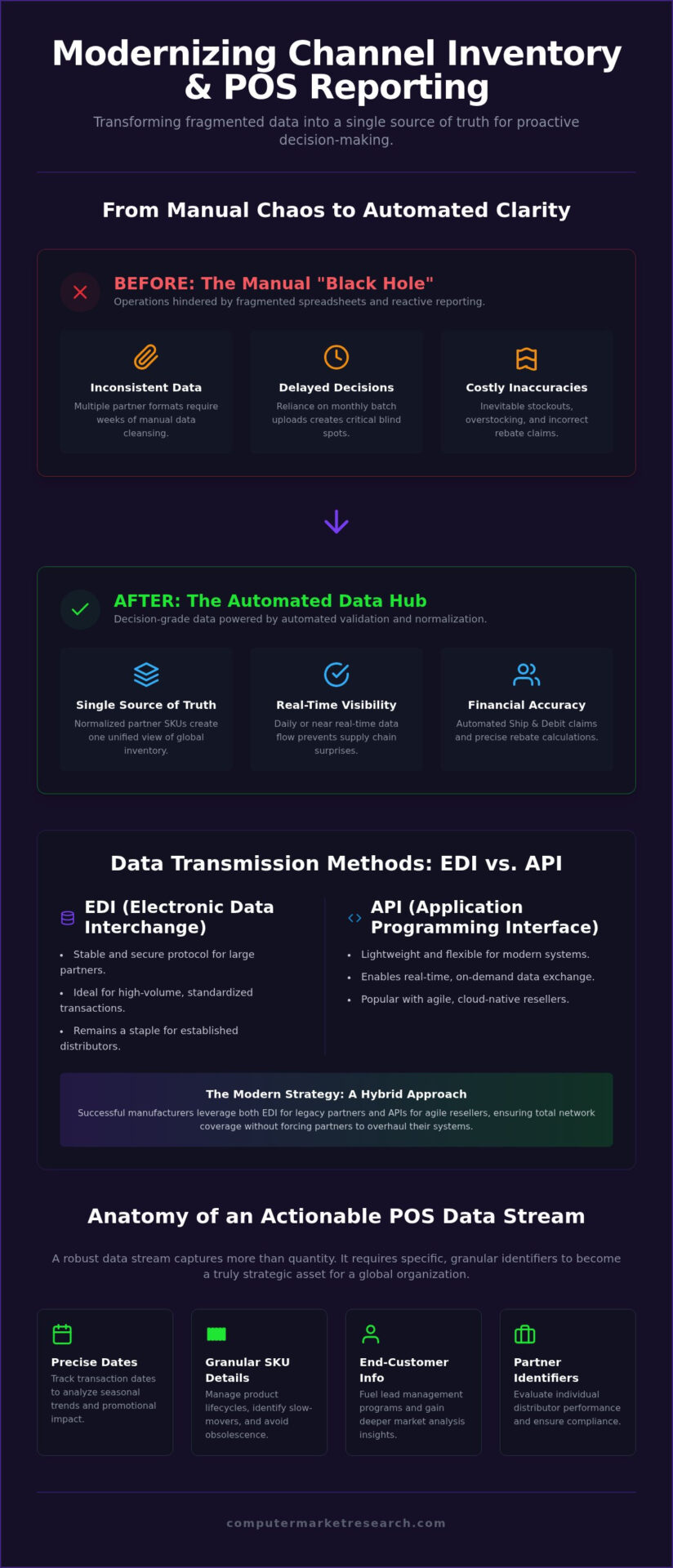
A robust POS stream captures more than just a quantity sold. It requires a specific set of identifiers to be truly actionable for a global organization. These components include:
- Precise transaction dates to track seasonal trends and promotional impact.
- Granular SKU details to manage product life cycles and avoid obsolescence.
- End-customer information to fuel lead management and deeper market analysis.
- Partner-specific identifiers to evaluate individual distributor performance and compliance.
Collecting this level of detail allows operations professionals to validate ship-and-debit claims and refine incentive programs with surgical precision. When you have access to this granular level of information, you don’t just see that a sale happened; you understand the context that drove it.
The Mechanics of Modern POS and Inventory Data Collection
Collecting data from a global partner network often feels like translating a dozen different languages simultaneously. To achieve effective channel inventory and pos reporting, your systems must move beyond manual file ingestion. Modern data collection relies on automated harvesting directly from partner ERP and CRM systems. This eliminates the “human factor” that frequently introduces errors into spreadsheets. By using PartnerPortal™, manufacturers can create a seamless intake process that accepts diverse formats including CSV, XLS, and EDI without requiring partners to overhaul their existing workflows.
Frequency has become the new benchmark for competitive advantage. In the past, weekly reporting was considered sufficient; however, 2026 market conditions demand daily or even near real-time visibility. If you’re waiting seven days to see a spike in demand, you’re already too late to adjust your supply chain. Ensuring partner compliance is much easier when you provide intuitive reporting interfaces that reduce their administrative burden. A simple, reliable connection encourages distributors to share high-quality data more frequently.
Data Transmission Methods: EDI vs. API
Electronic Data Interchange (EDI) remains a staple for large-scale distributors due to its established stability and security. It’s excellent for high-volume, standardized transactions. Conversely, RESTful APIs are rising in popularity for their lightweight, real-time data exchange capabilities. Most successful manufacturers now employ a hybrid approach. They use EDI for their largest legacy partners while leveraging APIs for agile, cloud-native resellers. This flexibility ensures that no partner is left behind because of technical limitations.
Inventory Visibility Across the Tiers
True transparency requires looking beyond your primary distributors. You need to track stock levels through every layer, including resellers and retailers. This multi-tier visibility is the only way to identify “phantom inventory,” stock that appears on the books but isn’t actually available for sale. It also prevents the common pitfall of channel stuffing, where products are pushed into the channel to hit sales targets without actual end-user demand. When your channel data management systems are integrated correctly, inventory fluctuations can trigger automated reorder points, maintaining optimal stock levels without manual intervention. If you’re ready to see how this works in practice, you might explore a 90-day free trial to validate your own data streams.
Overcoming the Challenges of Fragmented Channel Data
Data collection is a necessary prerequisite, but raw data is rarely actionable on its own. Most manufacturers suffer from the “Garbage In, Garbage Out” phenomenon, where fragmented channel inventory and pos reporting leads to flawed strategic decisions. Your partners likely use internal codes, non-standard descriptions, and inconsistent date formats that don’t align with your corporate systems. Without a rigorous normalization process, your dashboards become a collection of noise rather than a source of truth. You must map these disparate data strings to your master SKU list and validate them against your current product catalog to ensure every transaction is accounted for correctly.
The business impact of inaccurate data is immediate and expensive. When reporting is flawed, you risk overpaying on incentive claims or missing critical demand shifts in specific regions. Decision-grade intelligence requires more than just a summary; it requires a granular, cleaned view of every sell-through event. Transitioning to a system that prioritizes data integrity allows your operations team to stop acting as data janitors and start acting as strategic analysts.
The Role of Managed Data Services
Manual data cleansing is a primary obstacle to scaling your channel operations. If your internal team spends weeks in spreadsheets just to prepare a monthly report, they aren’t analyzing performance; they’re simply surviving the data. This administrative burden is why many Global 2000 companies turn to Managed Data Services. By leveraging channel data management systems, you can offload this friction entirely. We achieve 99%+ data accuracy by combining automated algorithmic cleansing with expert human validation. This hybrid approach ensures even the messiest partner files are transformed into reliable intelligence within hours.
Data Security and Partner Trust
Partners are often hesitant to share granular POS data because they fear a manufacturer might use that information to bypass them or sell directly to their customers. Building trust is a strategic requirement for any reporting initiative. You can alleviate these concerns by implementing role-based access and strict data encryption standards that protect sensitive end-user details. It’s also vital to position data sharing as a mutual benefit. When partners provide transparency through a secure hub like PartnerPortal™, you can help them optimize their inventory levels and reduce their carry costs. Transparency shouldn’t be a one-way street; it’s a tool for collective growth.
How POS Data Fuels Accurate Incentives and ROI
Incentives shouldn’t be a guessing game based on optimistic forecasts. When you integrate channel inventory and pos reporting into your financial workflows, you ensure that every dollar spent on partner rewards is tied to a verified sale. Most legacy systems rely on “sell-in” data, which only tracks what you shipped to a distributor. This approach creates a significant financial risk because it doesn’t account for what actually reached the end-user. By shifting to “sell-through” validation, you reward actual performance rather than warehouse stocking.
High-quality sales data allows you to manage complex financial programs with confidence. You can drive better results by:
- Automating Ship & Debit claims using validated POS reporting to prevent overpayments.
- Calculating rebates and incentives based on actual sell-through metrics.
- Measuring the ROI of your marketing spend by managing co-op/MDF funds with granular sales data.
Eliminating Ship & Debit Overpayments
Ship-and-debit claims are often the source of significant revenue leakage. Without automated validation, manufacturers frequently pay out on claims that don’t match actual sales transactions or apply to the wrong date ranges. Using ship and debit management software allows you to cross-reference every claim against your POS data stream. This process reduces claim processing time from several weeks to just a few days while ensuring that every credit issued is legitimate. You can find more technical details on this integration in our whitepaper on POS and Ship & Debit.
Strategic Market Analysis and Forecasting
Clean POS data provides a window into regional demand that sell-in reports simply can’t offer. You can identify geographic sales trends long before they become obvious through distributor reorders. This foresight allows you to adjust production schedules based on real-time channel stock levels rather than lagging indicators. For a deeper look at these processes, refer to our guide on channel data management systems. When you understand the velocity of your products in the field, you can prevent both stockouts and costly overstock situations.
Transitioning to a data-driven incentive model ensures your capital is deployed effectively across your partner network. If you want to see how automated validation can stop revenue leakage in your channel, you can start your 90-day free trial today.
Implementing a Scalable Channel Reporting Strategy
Building a reliable system for channel inventory and pos reporting requires a structured roadmap rather than a fragmented approach. You should start by auditing your current partner data quality to identify the specific gaps and format inconsistencies that hinder your visibility. Once you’ve established a baseline, define your critical KPIs, such as inventory turns and sell-through velocity, to ensure your reporting aligns with overarching business goals. This clarity ensures that you aren’t just collecting data, but generating actionable intelligence.
A centralized system is the only way to manage these streams at scale across a global network. Deploying a robust platform allows you to move beyond the manual tracking methods that act as primary obstacles to growth. You should also look for ways to incentivize partner participation. When distributors see that accurate reporting leads to faster rebate payouts and improved stock availability, they’re much more likely to comply with data requests. Finally, you must continuously refine your data cleansing rules to maintain high accuracy as your partner network and product catalog evolve.
Choosing the Right Channel Management System
Cloud-based solutions offer the global scalability required for 2026 operations, providing real-time updates across multiple time zones. On-premise systems often lack the agility needed to integrate with modern partner ERPs or handle the volume of modern data streams. A user-friendly interface is just as important as technical depth because if the system is difficult for partners to navigate, adoption will stall. You can explore PartnerPortal™ for channel management to see how a centralized hub simplifies these complex interactions while providing the transparency your leadership team demands.
Partner Training and Onboarding
Successful implementation depends on how well you support your partners during the transition. Smaller partners may lack the technical infrastructure of larger distributors, so standardizing reporting templates is essential for their success. Providing clear documentation on data requirements helps minimize confusion and reduces the need for constant back-and-forth corrections. Dedicated support plays a vital role in this process, ensuring that any integration hurdles are cleared quickly. This proactive approach builds the trust necessary for long-term collaboration and high-quality data flow.
Securing Your Channel Competitive Advantage for 2026
Transitioning away from legacy manual tracking isn’t just an efficiency play; it’s a strategic necessity for global scalability. By moving toward real-time API integrations and automated normalization, you replace operational blind spots with decision-grade intelligence. This guide has detailed how mastering channel inventory and pos reporting allows you to validate every ship-and-debit claim and optimize stock levels across complex, tiered distribution networks. When you connect sales data directly to incentive accuracy, you ensure that every dollar of your budget drives measurable performance.
Since 1984, we’ve provided specialized data administration to Fortune 500 and Global 2000 companies. Our 40 years of expertise ensures that your organization eliminates the manual cleansing errors that frequently stall growth and lead to revenue leakage. You don’t have to navigate these technical complexities alone. If you’re ready to secure a clear path out of operational bottlenecks, schedule a demo of PartnerPortal™ to see how we automate POS and inventory reporting. We look forward to helping you build a more transparent and profitable channel ecosystem.
Frequently Asked Questions
What is the difference between POS data and inventory data?
Point-of-Sale (POS) data records the specific moment a product is sold to an end-user, capturing price, date, and customer details. Inventory data represents the current volume of stock sitting at a partner’s location. While POS reporting tells you what happened in the past, inventory tracking tells you what’s available for future sales. Combining both provides the visibility needed to manage supply chains effectively and avoid regional stockouts.
How often should partners report their channel inventory?
Partners should ideally report their inventory levels daily to account for the supply chain volatility expected in 2026. While weekly reporting was once the industry standard, it’s no longer sufficient for managing high-velocity channels or volatile markets. Real-time data transmission through APIs ensures that your production schedules remain aligned with actual demand. Frequent reporting allows for proactive stock rebalancing before a minor delay becomes a critical operational bottleneck.
Can POS reporting help reduce channel conflict?
Accurate POS reporting reduces channel conflict by providing an objective record of sales transactions and end-customer ownership. When manufacturers have clear visibility into who sold what and where, they can better enforce deal registration rules and lead management protocols. This transparency prevents multiple partners from claiming the same sale and ensures that incentive payouts are distributed fairly. It builds trust by replacing subjective arguments with verified, decision-grade data.
What are the common challenges in channel data normalization?
The most persistent challenges include inconsistent file formats, non-standard SKU descriptions, and varying date structures across a global partner network. Partners often use internal identifiers that don’t match your master price list, creating “garbage in, garbage out” scenarios. Successfully normalizing this information requires mapping disparate data strings to a single source of truth. Without rigorous cleansing, your channel inventory and pos reporting will produce flawed insights that lead to expensive financial errors.
How does automated POS reporting impact ship and debit claims?
Automated reporting eliminates the manual verification process that typically slows down ship-and-debit claims. By cross-referencing every claim against validated POS transactions, the system ensures that credits are only issued for eligible sales. This prevents revenue leakage caused by overpayments or duplicate claims. Automation reduces the administrative burden on your finance team, turning a process that once took weeks into a streamlined workflow that finishes in just a few days.
Is a PRM system necessary for inventory tracking?
While you can track inventory through basic spreadsheets, a centralized Partner Relationship Management (PRM) system or specialized portal is essential for global scalability. Manual methods are prone to human error and lack the real-time integration capabilities needed for modern operations. A dedicated hub like PartnerPortal™ provides a secure environment for partners to upload data and view their own performance. It transforms fragmented data into a cohesive strategy for long-term growth.
How do managed data services improve reporting accuracy?
Managed data services improve accuracy by offloading the complex task of data cleansing to specialized experts. These services use a combination of automated algorithms and human validation to achieve accuracy levels of 99% or higher. By normalizing messy partner files before they enter your system, these services ensure your channel inventory and pos reporting remains reliable. This allows your internal team to focus on strategic analysis rather than spending hours fixing broken spreadsheets.
What is the role of API in modern channel reporting?
APIs serve as the modern infrastructure for real-time, lightweight data exchange between different partner ERP systems. Unlike legacy EDI methods, which often rely on batch processing, APIs allow for immediate visibility into sales and stock levels. They’re essential for cloud-native partners who require agile integrations. Implementing a RESTful API strategy ensures your channel reporting is fast, secure, and capable of handling the high-frequency data demands of a 2026 market.

Article by
Del Heles
Del Heles is the founder and CEO of Computer Market Research (CMR), a channel management software company he launched in 1984. With more than 40 years of experience, he’s known for helping manufacturers and distributors simplify complex partner programs through practical, customer-focused technology solutions.