

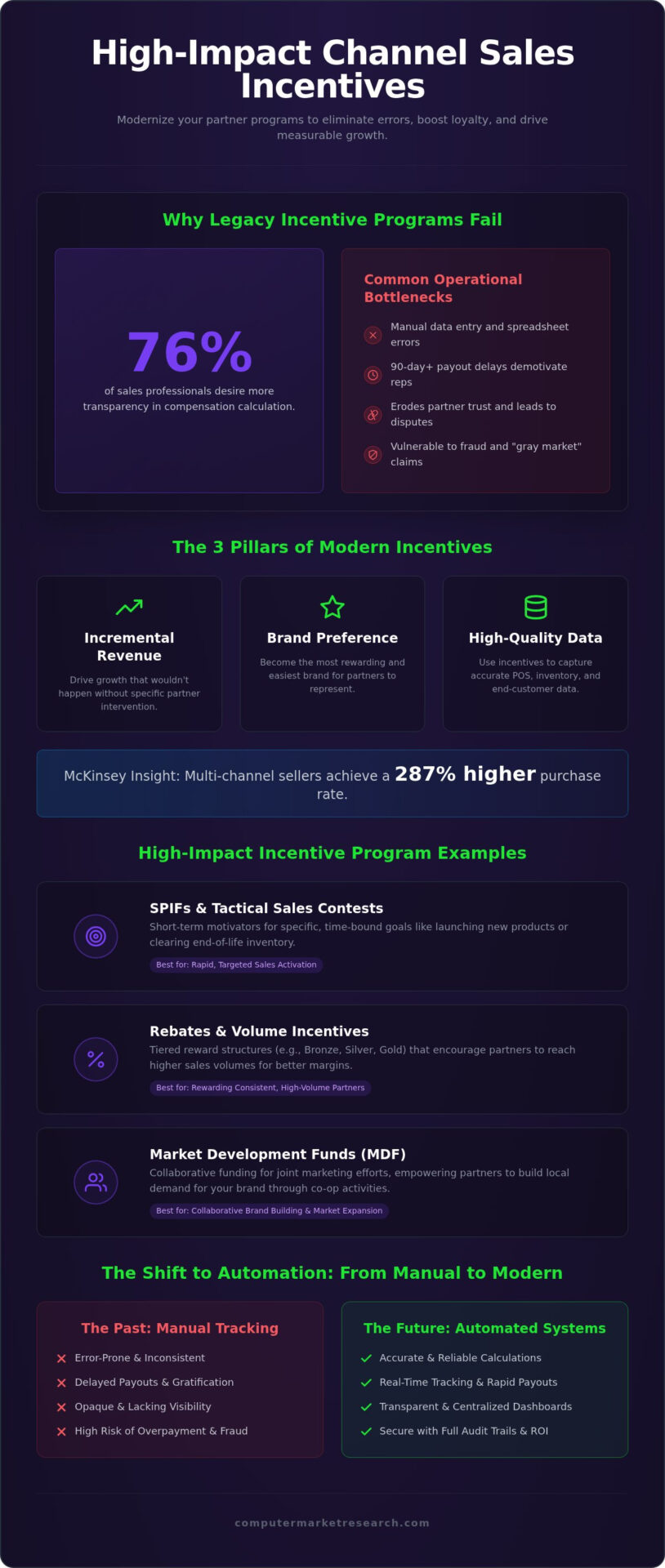
Did you know that 76% of sales professionals in 2026 report a desire for more transparency in how their compensation is calculated? While the global channel sales market is projected to generate over $4 trillion this year, many organizations still rely on manual tracking methods that invite errors and partner disputes. These legacy processes are the primary obstacles to scaling a successful ecosystem. This guide provides high-impact channel sales incentive program examples designed to replace fragmented workflows with high-quality, automated information.
We agree that the most sophisticated reward structure is worthless if your data infrastructure cannot support accurate, real-time payouts. You need a system that eliminates overpayments and provides clear visibility into which incentives actually drive incremental revenue. This article promises to show you how to automate your channel rewards to drive partner loyalty and measurable ROI. We will preview the transition from manual bottlenecks to modernized systems like PartnerPortal™, ensuring your 2026 strategy is built on technical competence and operational precision.
Key Takeaways
- Identify high-impact channel sales incentive program examples, including SPIFs and volume rebates, to strategically influence partner behavior across your sales network.
- Implement advanced protections such as Deal Registration and Ship-and-Debit to stabilize margins and mitigate channel conflict in complex distribution models.
- Transition from manual tracking to automated POS data normalization to ensure incentive accuracy and eliminate the risk of ‘gray market’ claims.
- Define measurable KPIs beyond simple redemptions, focusing on ROI and participation rates to validate the effectiveness of your 2026 channel strategy.
- Centralize disparate reward structures into a single hub like PartnerPortal™ to provide the transparency and rapid payout cycles that motivate modern sales reps.
What Is a Channel Sales Incentive Program?
A channel sales incentive program is a structured strategic framework designed to motivate indirect partners to prioritize your brand over competitors. In 2026, these programs moved beyond simple transactional kickbacks. They now function as essential levers for channel management, aligning partner behavior with complex corporate objectives. As partner-driven deals now account for two-thirds of global IT spend, according to Omdia, the ability to influence these third-party reps is no longer optional. It’s the difference between market dominance and long-term obsolescence.
Modern channel sales incentive program examples focus on relationship-based motivation rather than just the next purchase order. This shift recognizes that partners are no longer just fulfillment centers; they’re extensions of your brand. However, the primary “incentive killer” remains manual tracking. When vendors rely on fragmented spreadsheets, they inadvertently create a culture of distrust. Legacy processes lead to disputes and slow payout cycles, which de-motivate the very sales reps you aim to inspire. When evaluating channel sales incentive program examples, you must prioritize the data infrastructure behind the reward.
The Core Objectives of Modern Incentives
Success in today’s ecosystem requires more than just volume targets. Effective programs focus on three primary pillars:
- Incremental Revenue: Driving growth that wouldn’t happen without specific partner intervention.
- Brand Preference: In a market where partner selling is nearly universal, your brand must be the most rewarding to represent. McKinsey notes that multi-channel strategies see 287% higher purchase rates, making your brand’s presence across those channels vital.
- High-Quality Data: Using incentives to capture accurate channel data, including POS and inventory levels.
Why Legacy Incentive Methods Fail Today
The “spreadsheet trap” is a significant operational bottleneck. Manual errors in calculating payouts erode partner trust instantly. Delayed gratification is also a deal-breaker. A 90-day payout cycle doesn’t work when sales reps expect the same transparency and speed they find in modern consumer applications. Recent industry assessments highlight that while a significant majority of sales professionals use dedicated tools, many legacy systems still fail to provide the real-time visibility required to keep reps engaged. Without automated audit trails, your organization also faces heightened risks of incentive fraud and “gray market” claims that drain your ROI.
5 High-Impact Channel Sales Incentive Program Examples
To drive measurable ROI in 2026, you must deploy specific tactics that align with your broader business goals. These channel sales incentive program examples represent the most effective levers used by Global 2000 operations to maintain competitive advantage. Each model serves a distinct purpose, from clearing immediate inventory to building long-term partner equity.
SPIFs and Tactical Sales Contests
A SPIF is a targeted, short-term motivator for specific sales behaviors. These funds are particularly effective when you need to clear end-of-life inventory or introduce a new product line rapidly. Success requires setting clear, time-bound goals. If a contest runs too long, you risk partner burnout and diminishing returns. Short, punchy bursts of activity keep reps engaged without exhausting their focus. This tactical approach ensures that your channel remains responsive to sudden market shifts.
Rebates and Volume Incentives
Volume-based rebates reward the “heavy lifters” within your network. Most organizations utilize tiered rebate structures, often categorized into Bronze, Silver, and Gold frameworks. This encourages partners to move into higher tiers to unlock better margins. The primary challenge here is accuracy. Implementing automated rebates & incentives tracking is essential to prevent overpayments. Growth rebates are another powerful variation, rewarding partners specifically for year-over-year performance gains rather than just total volume. This structure ensures that your most consistent partners feel valued and protected.
Market Development Funds (MDF)
Market Development Funds focus on collaborative brand building. It’s important to understand the nuance between MDF and Co-op funds; while Co-op is earned through past sales, MDF is usually granted prospectively for future growth. Eligible activities in 2026 often include webinars, localized SEO, and industry events. Ensuring compliance requires an automated claim process to verify that activities actually occurred before funds are disbursed. This level of oversight protects your marketing budget from leakage and ensures every dollar spent contributes to brand visibility.
Training and Certification Incentives build technical partner equity by rewarding reps for deepening their product knowledge. This ensures your products are sold correctly and reduces support tickets. Finally, Retention and Loyalty Bonuses provide long-term stability. By rewarding partners for multi-year consistency, you reduce the churn that often plagues indirect sales channels. Ensuring these programs function without manual errors requires a robust data foundation. You can see how automation transforms incentive accuracy with a 90-day trial of our specialized platform.
Beyond the Transaction: Advanced Incentive Strategies
While basic rewards address volume, sophisticated channel sales incentive program examples must account for the complex financial realities of B2B distribution. High-volume environments require more than just a simple percentage of sales. They need mechanisms that protect the integrity of the channel itself. Advanced strategies like referral fees for consultants and soft-skill incentives for lead nurturing ensure that every partner, whether they transact or not, remains aligned with your organizational growth objectives.
Deal Registration and Margin Protection
Implementing deal registration is the most effective way to prevent a “race to the bottom” in pricing. When multiple partners pursue the same lead, conflict is inevitable without a formal protection system. By granting the first partner to register a deal a guaranteed margin, you incentivize them to invest significant time in the sales cycle. Automating this approval workflow ensures partner speed-to-market, which is critical in competitive landscapes. Additionally, the data gathered from these registrations allows leadership to forecast future channel revenue with far greater precision than legacy methods allow.
Inventory-Based Incentives and Price Protection
For high-volume distributors, managing ship-and-debit claims is a constant operational challenge. Price protection keeps these partners loyal during volatile market shifts by ensuring they don’t take a loss on inventory already in stock. Effectively managing these claims requires real-time POS data to verify actual sales prices against original costs. This visibility prevents over-incentivizing and ensures that price adjustments are applied accurately across the network. Without this technical depth, your channel sales incentive program examples risk becoming financial liabilities rather than strategic assets.
Referral fees expand your reach to non-transacting partners like consultants or industry influencers who don’t want to manage fulfillment but have significant sway over buyer decisions. Similarly, soft-skill incentives reward partners for the technical heavy lifting of the pre-sales process, such as lead nurturing and conducting proofs of concept (POCs). This ensures that the entire buyer journey is supported, not just the final transaction. By rewarding these behaviors, you build a resilient ecosystem that values expertise as much as it values volume.
How to Design and Automate Your Incentive Framework
Designing a framework requires more than picking channel sales incentive program examples from a list. It demands a technical architecture that connects reward triggers to verified performance data. Organizations that fail to automate this connection often find themselves trapped in a cycle of manual disputes and financial leakage. A modernized approach ensures that every dollar allocated to incentives is backed by accurate, decision-grade information.
Step 1: Partner Segmentation
Value-Added Resellers (VARs) operate on different margin requirements and sales cycles than high-volume distributors. While a distributor responds to ship-and-debit price protection, a VAR often requires specialized training incentives or MDF for localized lead generation. Tailoring rewards to regional dynamics also prevents over-incentivizing in mature markets while stimulating growth in emerging territories. Segmentation ensures incentive spend is directed toward the partners with the highest growth potential.
Step 2: Automating the ‘Claim-to-Pay’ Cycle
Manual verification is the primary source of operational friction. By implementing automated MDF management, you eliminate the “spreadsheet trap” that bogs down your finance department. This modernization allows for real-time claim processing, where rewards are triggered automatically by validated POS data. Providing partners with a self-service dashboard for reward tracking builds trust and reduces the volume of support inquiries regarding payout status.
Defining success requires looking beyond simple redemption rates. You must track participation rates and, most importantly, the ROI per incremental dollar spent. This level of analysis is only possible when you integrate your incentive data with central CRM and ERP systems. This connectivity ensures that every reward paid is anchored to a legitimate transaction recorded in your financial records, eliminating the risk of “gray market” claims or duplicate payouts.
Continuous optimization relies on robust channel data management. By normalizing disparate POS and inventory feeds, you gain the visibility needed to adjust your 2026 strategy on the fly. This data-driven approach ensures your channel sales incentive program examples remain competitive and financially sound as market conditions shift. You can streamline your incentive automation today and begin capturing the insights needed to drive measurable partner loyalty.
Modernize Your Incentives with CMR PartnerPortal™
The channel sales incentive program examples we’ve explored require more than just creative planning; they demand a technical foundation that ensures every transaction is verified and every payout is accurate. When your data is fragmented across various spreadsheets and legacy systems, your incentives become a source of friction rather than motivation. Computer Market Research (CMR) solves this by centralizing all reward types within a single, branded PartnerPortal™. This hub acts as the definitive source of truth for your entire channel ecosystem.
Our Managed Data Services represent a fundamental shift in how organizations handle “dirty” channel data. We specialize in normalizing disparate POS and inventory feeds from global partners, turning messy information into decision-grade insights. This precision is why Global 2000 companies trust CMR for maximizing channel ROI. By ensuring that your financial tracking is beyond reproach, we protect your margins and eliminate the overpayments that often plague unmanaged programs.
Automate Complex Rebates and MDF
CMR handles multi-layered rebate structures that standard CRM tools often can’t process without heavy customization. Whether you’re managing complex ship-and-debit claims alongside tiered volume rebates, our system automates the validation process in real time. We streamline co-op and MDF workflows from the initial request through to final reimbursement, ensuring compliance at every step. This transparency reduces dispute rates significantly, as partners have clear visibility into why and when they are being paid. It’s a pragmatic solution that builds trust through technical competence.
Ready to Scale Your Channel Sales?
Transitioning to a centralized, cloud-based management system is the only logical step for organizations looking to grow in 2026. Legacy manual methods are no longer sustainable in a market where partners expect rapid, accurate fulfillment of their earned rewards. A data-first approach allows you to identify exactly which channel sales incentive program examples are performing and which need adjustment. This level of visibility gives executives the confidence to scale their indirect sales efforts without increasing administrative overhead.
Don’t let manual tracking errors de-motivate your most valuable partners. It’s time to replace operational bottlenecks with a streamlined, automated infrastructure that delivers measurable results. You can experience the power of a modernized incentive framework firsthand. Claim your 90-day free trial of CMR PartnerPortal™ today!
Scale Your Channel Strategy for 2026
Success in indirect sales requires a transition from manual tracking to technical precision. We’ve examined high-impact channel sales incentive program examples, but their effectiveness depends entirely on the quality of your underlying data. By automating the claim-to-pay cycle and normalizing POS data in real time, you eliminate the operational friction that erodes partner loyalty. Since 1984, Computer Market Research has helped Fortune 500 and Global 2000 companies navigate these complexities with quiet confidence. We’ve successfully processed billions in channel incentives, ensuring that every reward is backed by cleansed, decision-grade information.
It’s time to stop fighting legacy spreadsheets and start leveraging a modernized infrastructure. You can protect your margins and drive measurable ROI by centralizing your reward structures within a single, authoritative hub. This proactive approach ensures your 2026 strategy remains both competitive and financially sound. Claim your 90-day free trial of CMR PartnerPortal™ today! We’re ready to help you build a more resilient and profitable partner ecosystem that thrives on accuracy and performance.
Frequently Asked Questions
What are the most common channel sales incentive program examples?
The most effective channel sales incentive program examples include SPIFs, volume-based rebates, Market Development Funds (MDF), and deal registration rewards. These programs are designed to influence different stages of the sales cycle. While SPIFs drive immediate tactical results, volume rebates and loyalty bonuses focus on long-term partner stability. Using a strategic mix ensures your brand remains the preferred choice for indirect sales reps.
How do I calculate the ROI of a channel incentive program?
You calculate ROI by comparing the incremental revenue generated against the total cost of the incentive, including administrative and software expenses. It is vital to isolate sales that were specifically influenced by the reward. By tracking participation rates alongside redemption data, you can determine if the spend actually changed partner behavior or simply rewarded transactions that would have occurred without the incentive.
What is the difference between a SPIF and a rebate?
A SPIF is a short-term, tactical motivator used to drive specific sales behaviors, such as clearing end-of-life inventory. In contrast, a rebate is a volume-based financial return paid after a predetermined period. SPIFs provide immediate gratification for sales reps, while rebates focus on rewarding the “heavy lifters” in your network. Both require a robust data foundation to ensure payouts are accurate and timely.
Can I automate MDF and co-op fund management?
Yes, automation is the only logical way to manage these complex workflows without drowning in spreadsheets. Modern systems like PartnerPortal™ digitize the entire claim-to-pay cycle, from the initial fund request to final reimbursement. This automation ensures that every marketing activity meets strict compliance standards before any funds are disbursed. It significantly reduces the administrative burden on your finance team while improving partner trust.
How do I prevent incentive fraud in my partner program?
Preventing fraud requires real-time POS data normalization to verify that every claim corresponds to an actual end-customer sale. Automated audit trails eliminate “gray market” risks by preventing duplicate claims for the same transaction. When your incentive platform is integrated with verified inventory and sales data, you create a transparent environment where every payout is anchored to a legitimate, non-duplicate financial record.
What is the best software for managing channel partner incentives?
The most effective software is a centralized hub like PartnerPortal™ that can handle complex channel sales incentive program examples such as tiered rebates and ship-and-debit claims. You should prioritize platforms that offer managed data services to cleanse and normalize incoming partner data. This technical depth ensures that your payouts are always based on accurate information rather than partner-reported estimates that often contain errors.
How often should I update my channel incentive strategy?
You should review your incentive strategy at least quarterly to stay aligned with shifting market dynamics and product lifecycles. While core volume rebates might remain consistent for a year, tactical SPIFs should be updated more frequently to address competitive pressures. Regular data audits help you identify which partner segments are providing the best return, allowing you to reallocate your budget toward high-growth areas.
What role does POS data play in incentive accuracy?
POS data serves as the definitive trigger for all accurate incentive payouts. Without normalized point-of-sale information, vendors are forced to rely on manual partner reports, which frequently lead to overpayments and disputes. Decision-grade POS data ensures that you only pay for verified sales to legitimate end users. This level of transparency protects your margins and provides the visibility needed to scale your partner ecosystem with confidence.

Article by
Del Heles
Del Heles is the founder and CEO of Computer Market Research (CMR), a channel management software company he launched in 1984. With more than 40 years of experience, he’s known for helping manufacturers and distributors simplify complex partner programs through practical, customer-focused technology solutions.