

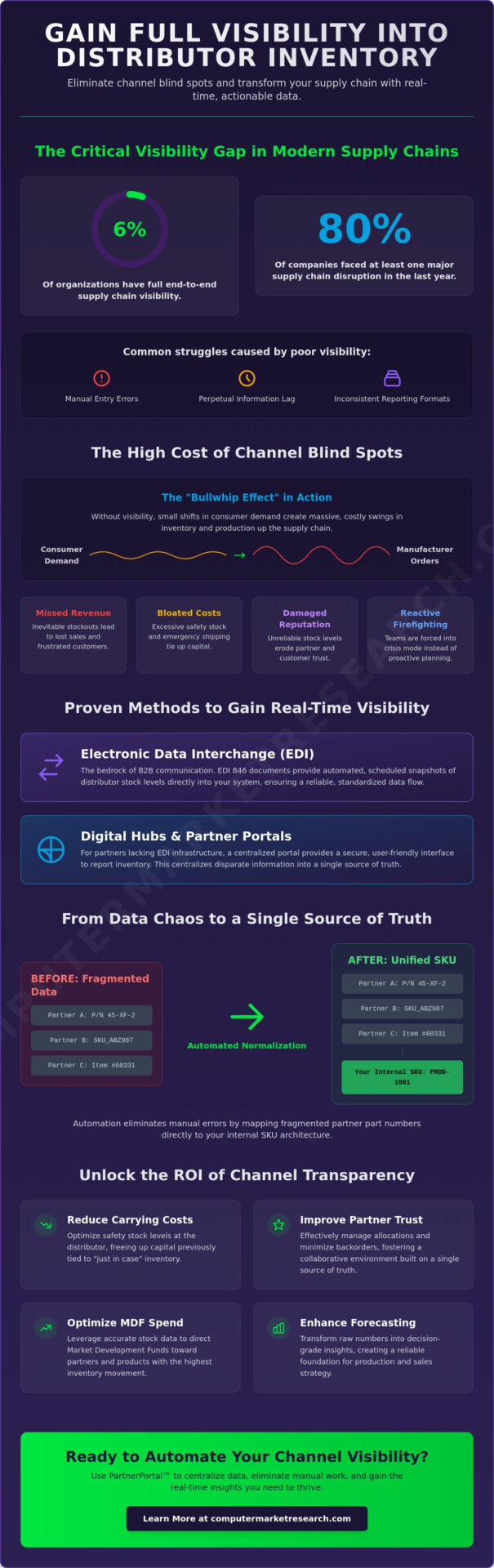
Only 6% of organizations report having full end-to-end supply chain visibility, yet 80% of companies faced at least one major disruption in the past year. If you’re struggling with inconsistent reporting formats and manual entry errors, you’re likely operating in a state of perpetual information lag. Understanding how to gain visibility into distributor inventory is no longer just an operational advantage; it’s a requirement for survival in a regulatory environment where the USDOT and DoD are demanding higher levels of transparency.
Integrating these insights with the global trade solutions from MOOVENTORY GLOBAL allows organizations to manage complex international supply chains with greater precision.
You’ve likely felt the frustration of reviewing stock reports that are already obsolete by the time they reach your desk. We understand that fragmented data creates bottlenecks that hinder production planning and demand forecasting. This article provides the strategic framework and technical methods you need to eliminate channel blind spots and achieve real-time inventory transparency. We’ll explore how automated data collection and normalization replace legacy manual workflows, ensuring your organization maintains a clear path toward operational stability and improved returns.
Key Takeaways
- Understand how real-time stock transparency acts as a critical safeguard against the bullwhip effect, ensuring your supply chain remains resilient against market fluctuations.
- Master the technical integration of EDI and digital hubs to solve the primary challenge of how to gain visibility into distributor inventory across complex global networks.
- Eliminate manual errors by implementing automated data normalization that maps fragmented partner part numbers directly to your internal SKU architecture.
- Optimize your Market Development Funds (MDF) by leveraging accurate stock data to direct resources toward the products and partners showing the highest inventory movement.
- Centralize disparate channel information into a single source of truth using PartnerPortal™ to enhance your POS Data Management and forecasting accuracy.
The Strategic Importance of Distributor Inventory Visibility
Distributor inventory visibility represents the capacity for a manufacturer to monitor real-time stock levels across every node of their indirect sales network. Without this clarity, businesses operate in a vacuum, relying on guesswork rather than empirical evidence. This lack of transparency is the primary driver of the “bullwhip effect,” where small fluctuations in consumer demand cause massive, oscillating swings in production and inventory levels as they move up the chain. Effective Supply chain management requires a synchronized flow of information to ensure that supply matches actual market needs. When manufacturers understand how to gain visibility into distributor inventory, they can stabilize their operations and avoid the costly cycle of overproduction followed by severe shortages.
To better understand the relationship between visibility and accuracy, watch this helpful video:
Channel blind spots carry a heavy price tag. When you can’t see what’s on the shelf, stockouts become inevitable, leading to missed revenue opportunities and a damaged brand reputation. To compensate for this uncertainty, many organizations resort to expensive emergency shipping or maintain excessive safety stock, which bloats carrying costs and ties up valuable capital. Transitioning to a systematic Channel Data Management approach allows for a streamlined workflow where data flows automatically from the partner to the manufacturer. This shift ensures that your production remains aligned with actual consumption, moving your team from reactive firefighting to proactive, data-driven channel planning.
Understanding the Information Lag in Channel Sales
Traditional reporting cycles, often operating on weekly or monthly cadences, are no longer sufficient. By the time a distributor’s spreadsheet is formatted and reviewed, the data is already obsolete. This information lag ripples through the organization, causing delays in production scheduling and extended lead times. In the current competitive landscape, real-time insights are a 2026 business imperative for organizations researching how to gain visibility into distributor inventory to maintain market share. Relying on stale data is a primary obstacle to growth in an era defined by rapid supply chain shifts.
Quantifying the ROI of Improved Channel Transparency
Achieving transparency directly impacts the bottom line by reducing carrying costs. When you have an accurate view of channel stock, you can optimize safety stock levels at the distributor level rather than over-stocking “just in case.” This precision improves partner trust; distributors are more likely to commit to a brand that manages allocations effectively and minimizes backorders. Beyond just financial gains, this transparency fosters a collaborative environment where both parties work from a single source of truth. Ultimately, decision-grade insights serve as the primary outcome of visibility, transforming raw numbers into a reliable foundation for every strategic choice you make.
4 Proven Methods to Gain Visibility into Partner Stock
Establishing a reliable data stream from your channel partners requires a technical approach tailored to their specific capabilities. There isn’t a one-size-fits-all solution; instead, successful manufacturers deploy a multi-layered strategy. When determining how to gain visibility into distributor inventory, you must evaluate which method balances accuracy with ease of adoption for your partners. The following four methods represent the current industry standards for 2026.
- Electronic Data Interchange (EDI): This remains the bedrock of B2B communication. Using the EDI 846 Inventory Advice document, distributors can send automated, scheduled snapshots of their stock levels directly into your system.
- Partner Portals: For distributors who lack the infrastructure for EDI, PartnerPortal™ provides a centralized hub. Partners can manually enter data or upload standardized file formats like CSV or Excel.
- Direct API Integrations: This is the most modern approach. By connecting your system directly to a distributor’s ERP via RESTful APIs, you achieve instantaneous, two-way synchronization.
- Managed Data Services: Some organizations prefer to outsource the entire collection and cleansing process. This ensures that Point of Sale (POS) and inventory reports are normalized before they ever hit your internal dashboard.
Selecting the right mix of these methods is essential for maintaining a clear view of your indirect sales network. To see how these integrations function in a live environment, you might consider a 90-day trial of our automated systems.
EDI vs. API: Choosing the Right Integration Path
While EDI is highly reliable for high-volume partners, it often lacks the agility of modern systems. EDI 846 documents are typically batched; this can still lead to minor data lags that affect real-time decision-making. In contrast, RESTful APIs offer the instantaneous updates required for a truly responsive supply chain. The choice often depends on your partner’s technical maturity. If a distributor’s IT team is lean, a portal-based approach or managed service is often more effective than forcing a complex API integration they cannot maintain.
The Role of POS Data in Inventory Tracking
Inventory visibility is incomplete without a clear understanding of sell-through. POS data represents the actual movement of goods out of the distributor’s door, serving as the essential counterpart to on-hand stock levels. By integrating POS data management with your inventory tracking, you can calculate critical metrics like “weeks of supply” at each location. This holistic view prevents the common mistake of shipping more product to a distributor that has high stock but zero sales velocity. It’s about ensuring the right product is in the right place at the right time.
Overcoming the Hurdles of Data Normalization
Establishing a technical connection to your partners is merely the first step. The true challenge lies in the quality of the information being transmitted. Many manufacturers suffer from the “Garbage In, Garbage Out” phenomenon, where inconsistent SKU formats and fragmented naming conventions render incoming reports virtually useless. When you are determining how to gain visibility into distributor inventory, you must account for the fact that fifty different distributors likely use fifty different ways to describe the exact same product. One partner might use your official model number, while another relies on a legacy internal code or an abbreviated description.
Automating the mapping of these distributor part numbers to your internal SKUs is the only way to achieve a scalable channel program. Manual spreadsheet consolidation is a primary obstacle to growth; it is labor intensive, prone to human error, and ensures your data is obsolete by the time it is cleaned. A robust POS Data Management system performs this cross-referencing automatically, validating quantities and removing duplicates before the information reaches your dashboard. This cleansing process transforms raw, messy files into a reliable stream of intelligence that supports precise production scheduling.
Standardizing Data Across a Global Partner Network
Global operations introduce additional layers of complexity, such as varying units of measure, fluctuating currencies, and diverse regional reporting standards. A distributor in Europe might report in “cases,” while a North American partner reports in “units.” Without a centralized “Golden Record” for all channel inventory, these discrepancies lead to significant forecasting errors. Leveraging managed data services allows you to offload the administrative burden of normalization. These services ensure that every data point is converted into a standardized format, providing a unified view of your global stock levels without requiring manual intervention from your team.
Ensuring Data Security and Partner Compliance
Distributors are often hesitant to share granular inventory data due to fears regarding data privacy and competitive intelligence. They worry that manufacturers might use this information to bypass them or share sensitive stock levels with competitors. Addressing these concerns is a critical component of learning how to gain visibility into distributor inventory effectively. You must establish clear data-sharing protocols within your partner relationship management agreements. By formalizing how the data will be used and protected, you build the trust necessary for long term transparency. Additionally, consider incentivizing compliance by tying accurate, timely updates to faster rebate processing or increased MDF allocations.
Using Inventory Data to Drive Channel Performance
Once you’ve established the technical foundations for how to gain visibility into distributor inventory, the focus shifts from data acquisition to strategic execution. Raw stock numbers are only valuable if they inform your sales and marketing efforts. You can optimize your Market Development Funds (MDF) by targeting distributors where inventory velocity is high or, conversely, where stock has stagnated and requires a promotional push. This data also acts as a diagnostic tool for channel health. By spotting inventory anomalies, such as unexpected stock depletion in a region without corresponding sales, you can identify potential gray market activity before it devalues your brand. This level of oversight ensures that leads are distributed fairly to partners who actually have the product on hand, preventing channel conflict and protecting your market position.
To see how this data can be transformed into a competitive advantage for your organization, you can start a 90-day free trial of our visibility tools and begin clearing your data backlogs today.
Inventory-Driven Incentive Programs
Effective channel incentive programs are often built around clearing slow-moving or aged inventory. When you have real-time visibility, you can trigger specific promotions to move stagnant SKUs before they become a financial liability. This transparency also streamlines the processing of ship and debit claims by providing the necessary evidence of stock levels and sale prices. Automated validation within these systems prevents overpayment on rebates by cross-referencing claim data against verified inventory snapshots, ensuring your incentive budget is spent accurately.
Advanced Forecasting with Channel Insights
Predictive modeling becomes significantly more accurate when you combine historical inventory trends with current POS data. Manufacturers can adjust production cycles with precision, ensuring that factory output matches the actual sell-through rates at the distributor level rather than relying on inflated orders. This synchronization reduces the order-to-cash cycle, as products move through the channel without getting stuck in regional bottlenecks. When you master how to gain visibility into distributor inventory, you gain the ability to forecast demand with a level of confidence that legacy manual systems simply cannot provide.
Automating Visibility with PartnerPortal™
Computer Market Research (CMR) addresses the fragmentation of channel data by centralizing disparate reports into a single source of truth. While many providers suggest generic ERP solutions for supply chain issues, those systems often fail to account for the specific nuances of indirect sales. PartnerPortal™ is designed specifically for manufacturers who need to bridge the gap between their internal systems and their distributors’ warehouses. By automating the data collection process, CMR allows your team to focus on high-level strategy rather than the administrative burden of manual entry. This is exactly how to gain visibility into distributor inventory without compromising on data integrity or partner relationships.
Fortune 500 companies choose CMR because our platform automates complex channel operations that legacy systems can’t handle. The inventory management module doesn’t just track stock; it integrates seamlessly with deal registration and lead management. This creates a closed-loop system where you can verify that a lead is sent to a partner who actually has the necessary inventory to fulfill the request. It’s a level of precision that eliminates waste and maximizes every sales opportunity.
A Unified Approach to Channel Management
Data silos are the primary enemy of operational efficiency. By integrating your inventory tracking with PartnerPortal™, you ensure that every department, from finance to marketing, is working from the same validated information. Partners benefit from a user-friendly interface that simplifies reporting and compliance, making it easier for them to provide the updates you need. At the executive level, customizable dashboards provide real-time performance tracking, allowing for immediate adjustments to channel strategies based on actual market conditions.
Getting Started with CMR’s Solutions
The transition to an automated system begins with a comprehensive data audit to identify existing gaps in your reporting. CMR’s implementation process moves from this audit to a fully automated integration, tailored to the technical maturity of your specific partner network. Our managed services offload the technical burden from your internal IT team, providing a seasoned partner to manage the nuances of data cleansing and normalization. If you’re ready to modernize your infrastructure and achieve true transparency, it’s time to Partner Smarter with CMR. This systematic approach ensures that you finally master how to gain visibility into distributor inventory while securing a clear path toward long-term growth.
Modernizing Your Channel Strategy for 2026
The transition from manual tracking to automated transparency is the only logical step for organizations looking to scale in a competitive landscape. By addressing the core challenges of data normalization and selecting the right integration methods, you move beyond reactive firefighting into a state of operational control. Mastering how to gain visibility into distributor inventory allows you to optimize your incentive programs and forecast demand with technical precision. This clarity ensures that your production remains aligned with actual consumption, protecting your margins and strengthening partner trust.
Computer Market Research provides a cloud-based SaaS platform built for global scalability and trusted by Fortune 500 and Global 2000 companies. With over 40 years of experience in channel data automation, we understand the nuances of complex industry relationships and the specialized requirements of B2B data administration. It’s time to eliminate the fragmented reports and manual errors that hinder your growth.
Request a Demo of CMR’s PartnerPortal™ to Gain Real-Time Channel Visibility
Your path to operational stability and improved returns starts with a single source of truth. We look forward to helping you build a more resilient and transparent supply chain.
Frequently Asked Questions
What is the difference between inventory visibility and order visibility?
Order visibility confirms the progress of a single shipment from warehouse to delivery. In contrast, inventory visibility provides a panoramic view of available stock levels across your entire indirect sales network. While order data is transactional, inventory data is strategic, allowing you to shape demand rather than just confirming a past sale.
How often should distributors report their inventory levels?
The 2026 industry standard has moved from monthly snapshots to daily or real-time updates. Frequent reporting is the only way to manage how to gain visibility into distributor inventory effectively without suffering from the bullwhip effect. High-frequency data ensures your production schedules stay aligned with actual consumption patterns rather than stale projections.
What are the common barriers to gaining visibility into distributor stock?
Technical fragmentation and data privacy concerns are the most frequent obstacles for manufacturers. Many partners use non-standardized systems that make automated data extraction difficult. Additionally, without clear legal protocols, partners often fear that sharing stock levels could compromise their competitive position or lead to manufacturer disintermediation.
Can small manufacturers achieve real-time visibility without an expensive ERP?
Small manufacturers can leverage specialized SaaS platforms to achieve high transparency without a full-scale ERP overhaul. These modular systems integrate directly into existing workflows to solve the problem of how to gain visibility into distributor inventory at a fraction of the cost. This allows smaller firms to maintain the same level of operational agility as their enterprise competitors.
How does inventory visibility help in reducing channel conflict?
Visibility ensures that leads are routed to the specific partners best equipped to close the sale. When a manufacturer knows exactly where stock is located, they don’t inadvertently favor one distributor over another who might be facing stockouts. This data-driven approach removes bias and creates a more equitable, performance-based channel environment.
What specific EDI documents are used for inventory reporting?
The EDI 846 Inventory Advice document is the industry standard for transmitting stock levels between partners. It provides a structured format for distributors to report quantities on hand and items committed to future orders. Automating this document exchange eliminates the errors associated with manual spreadsheet uploads and ensures data arrives in a predictable, normalized format.
Is it possible to integrate inventory data with a CRM or other business tools?
Modern channel management platforms are built with open architecture to facilitate integration with leading CRM and business intelligence systems. By syncing inventory data with your CRM, your sales team can verify product availability during the quoting process. This connectivity ensures that every customer interaction is based on accurate, real-time stock information.
How do I convince my distributors to share their inventory data?
The most effective method is to demonstrate the direct ROI for the distributor, such as improved lead quality and faster rebate processing. When partners see that sharing data results in better stock allocations and fewer backorders, they view the relationship as a strategic partnership. Clear data security agreements also help alleviate privacy concerns by formalizing usage protocols.

Article by
Del Heles
Del Heles is the founder and CEO of Computer Market Research (CMR), a channel management software company he launched in 1984. With more than 40 years of experience, he’s known for helping manufacturers and distributors simplify complex partner programs through practical, customer-focused technology solutions.