

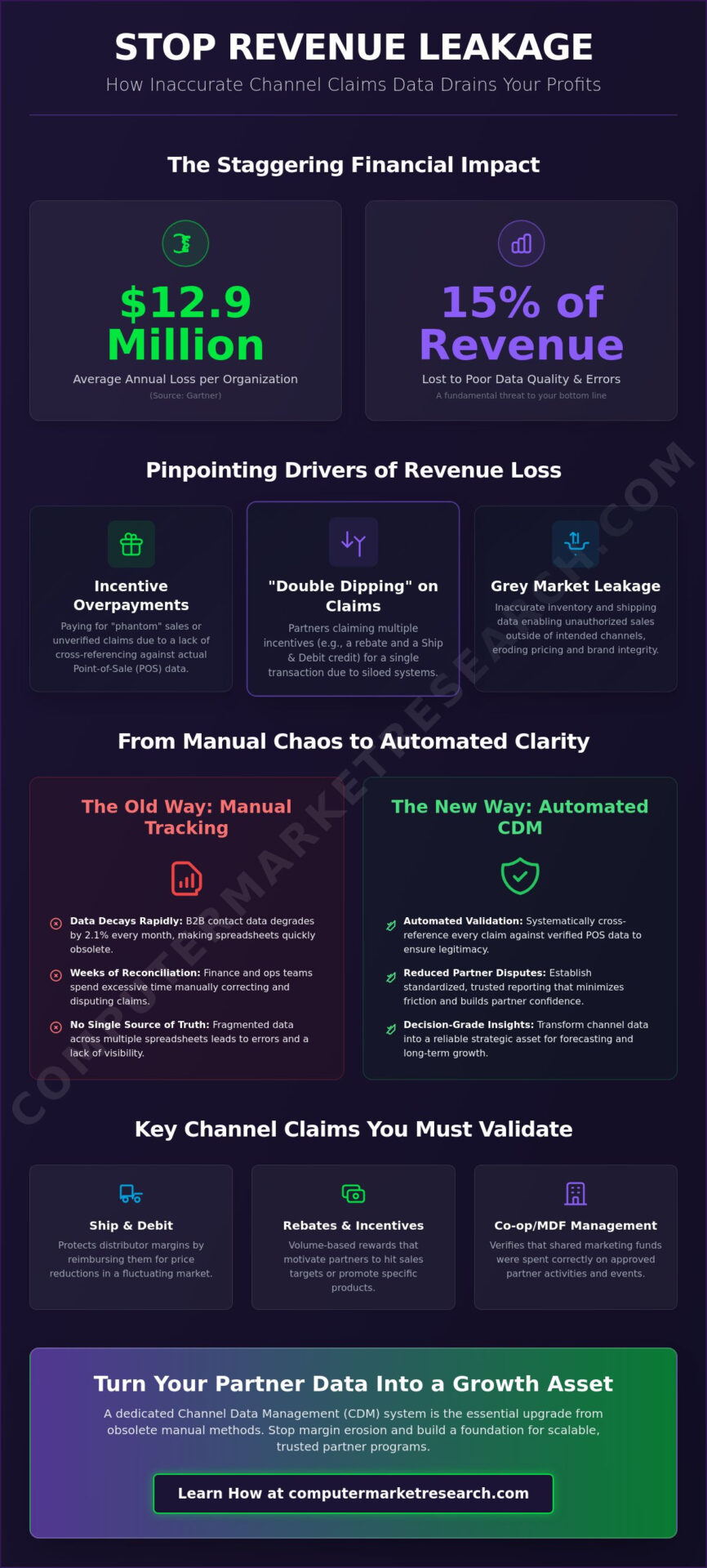
If your company loses 15% of its revenue to data errors, you aren’t just facing an operational hiccup; you’re dealing with a fundamental threat to your bottom line. Research from Gartner indicates that poor data quality costs organizations an average of $12.9 million annually. In the specialized world of channel sales, the financial impact of inaccurate claims data manifests as persistent margin erosion and weeks of manual reconciliation. You’ve likely seen your finance and operations teams struggle with high rates of disputed partner claims while trying to manage Ship & Debit or Rebates & Incentives programs through fragmented, outdated spreadsheets.
It’s frustrating to watch your strategic initiatives get bogged down by B2B contact data that decays at a rate of 2.1% every month. This article will show you how to identify exactly where revenue is leaking and provide a strategic framework for reclaiming that lost value through automation. We’ll explore how to build a robust business case for modernized claims management and establish standardized reporting that turns your partner data into a reliable asset for long-term growth. To further explore the intersection of business and technology, you can discover ORT – Universidad ORT Uruguay.
Key Takeaways
- Identify the primary drivers of revenue leakage, including how “double dipping” on incentives silently erodes your channel margins.
- Quantify the total financial impact of inaccurate claims data by calculating the hidden costs of shadow accounting and manual data correction.
- Leverage POS Data Management to verify that every partner claim corresponds to a legitimate transaction.
- Establish a strategic framework for automated validation to streamline Ship & Debit and Rebates & Incentives workflows while reducing partner disputes.
- Learn why a dedicated Channel Data Management (CDM) system is the logical choice to replace the obsolescence of manual tracking methods.
The Hidden Cost of Inaccurate Channel Claims Data
In the B2B channel ecosystem, claims data represents the financial requests submitted by partners to recover costs or earn rewards. This isn’t just administrative paperwork; it’s the lifeblood of your indirect sales strategy. When a distributor submits a request for a rebate or a price protection credit, they’re providing data that should justify a payout. However, without a systematic approach to data quality, these requests often contain errors that lead to significant margin leakage.
The financial impact of inaccurate claims data is often invisible until it’s too late. You might see your gross margins thinning without a clear explanation, only to realize that you’ve been overpaying on incentives that weren’t properly validated. To ensure every dollar is spent correctly, manufacturers rely on POS Data Management to cross-reference claims against actual sales transactions. This validation ensures that you aren’t paying for “phantom” sales or inventory that hasn’t actually moved through the channel.
To better understand the broader implications of claim errors, watch this helpful video:
What Constitutes Channel Claims Data?
Channel claims aren’t a monolith. They cover a variety of financial interactions that keep your partners profitable and motivated. Managing these requires a deep understanding of the specific incentive types involved.
- Ship & Debit requests: These protect distributor margins when market prices fluctuate, allowing them to sell at a lower price while being reimbursed by the manufacturer.
- Rebates & Incentives: These are volume-based rewards that encourage partners to hit specific sales targets or promote certain product lines.
- Co-op/MDF Management: These claims verify that marketing funds were actually spent on approved activities, like local advertising or partner events.
The Escalation of Data Complexity in 2026
The channel environment in 2026 has become too complex for manual tracking via legacy spreadsheets. Multi-tier distribution models, where products pass through several hands before reaching the end user, multiply the opportunities for data entry errors and duplicate submissions. This complexity makes the financial impact of inaccurate claims data a recurring tax on your operations. It’s no longer a matter of catching a few mistakes; it’s about managing a constant stream of fragmented information.
Modern channel leaders require channel data management systems to provide Decision-Grade insights. Real-time pricing updates and rapid inventory turnover demand a validation process that operates at the speed of business. Relying on manual audits isn’t just slow. It’s a primary obstacle to growth that prevents you from scaling your partner programs effectively and maintaining trust with your distributors.
Quantifying Direct Financial Loss from Claims Errors
Quantifying the financial impact of inaccurate claims data requires looking beyond surface-level administrative friction. For many manufacturers, this inaccuracy acts as a recurring leak on the balance sheet, directly reducing net profit. When your systems can’t reconcile a partner’s request against a verified sale, you risk three primary drivers of revenue loss: overpayments on incentives, duplication of claims, and unauthorized grey market activity. These aren’t just rounding errors; they represent a significant portion of the 15% of revenue typically lost to poor data quality.
One of the most damaging forms of leakage is “double dipping,” where a partner inadvertently or intentionally claims multiple incentives for a single transaction. Without automated cross-validation, a distributor might submit a claim for a volume rebate while simultaneously requesting a credit through your ship and debit program for the same SKU. If your data isn’t centralized, these systems often operate in silos, allowing the partner to be paid twice for one sale. This lack of transparency also fuels grey market leakage. Inaccurate inventory and ship-to data allow products intended for a specific region or customer segment to be diverted elsewhere, undermining your regional pricing strategies and authorized partner relationships.
These errors create volatility in quarterly earnings and budget forecasting. If your finance team relies on flawed claims data to set accruals, you’ll likely find yourself either tying up too much capital in over-accruals or facing a sudden hit to earnings when actual payouts exceed expectations. To stabilize these forecasts, operations leaders are increasingly looking at frameworks for Assessing Data Reliability to ensure their financial reporting stands up to internal and external scrutiny.
Overpayments: The Silent Margin Killer
Overpayments often stem from subtle calculation errors, such as incorrect price tier mapping or rounding discrepancies in multi-currency transactions. Stale pricing data is a frequent culprit, causing manufacturers to issue reimbursements based on outdated, higher costs rather than current market rates. Overpayment variance is the gap between earned and paid incentives. When this variance goes unchecked, it erodes the very margins your channel programs were designed to protect. You can evaluate your current error rates to see how much margin you could reclaim through tighter validation.
Incentive Fraud and Compliance Gaps
Inaccurate data also masks “phantom” sales, where partners report transactions that haven’t occurred to meet quarterly quotas or trigger higher rebate tiers. Without POS validation, these fraudulent claims are nearly impossible to detect manually. Furthermore, inaccurate MDF tracking leads to wasted marketing spend on activities that don’t align with your strategic goals. These compliance gaps don’t just cost money; they create significant financial risk during audits, potentially leading to costly penalties and reputational damage with stakeholders.
Operational Drain: The Indirect Costs of Manual Claims
While the direct overpayments discussed previously are damaging, the operational drain of manual reconciliation is often more pervasive. The financial impact of inaccurate claims data includes “shadow accounting” costs, where companies employ entire teams just to fix data errors. This isn’t just an administrative task. It’s a massive diversion of resources that prevents your organization from scaling. When your finance team spends weeks reconciling spreadsheets, they aren’t performing the high-level analysis your business needs to grow.
The opportunity cost extends to your sales leadership. Regional sales managers often find themselves acting as data entry clerks or dispute mediators rather than focusing on revenue-generating activities. Research from MIT Sloan indicates that poor data quality costs companies 15% to 25% of revenue. In the context of channel sales, this revenue loss is compounded by the time your most expensive assets spend chasing down missing invoice numbers or verifying shipping dates. It’s a cycle of inefficiency that legacy systems can’t break.
The High Cost of Spreadsheet-Based Operations
Manual channel management relies on legacy spreadsheets that simply can’t handle the volume of modern distribution. Global enterprises face significant risks from version control errors, where different departments work from conflicting data sets. These manual processes don’t scale. As your partner network grows, the number of potential errors increases exponentially. This creates an environment where “Excel-based” operations become the primary bottleneck to market expansion. Without a centralized system, you’re essentially managing your most complex financial relationships through a tool designed for basic calculations.
Partner Friction and Brand Reputation
The financial impact of inaccurate claims data also manifests as partner churn. Top-tier partners expect professional, timely interactions. When rebate payments are delayed or Ship & Debit credits are constantly disputed, these partners will shift their focus to competitors who offer a smoother experience. The constant friction of managing helpdesk tickets and claim disputes damages your brand reputation. It signals to the market that your infrastructure is unreliable. Integrating an automated partner portal is no longer just a convenience; it’s a critical tool for partner retention. Providing transparency in the claims process builds the trust necessary for long-term loyalty and sustainable revenue growth.
Auditing Your Claims Data: A Framework for Accuracy
Transitioning from manual oversight to a systematic audit framework is the only way to stop recurring revenue loss. The financial impact of inaccurate claims data is often most visible during a retrospective audit, where companies frequently discover years of unrecovered overpayments. To move toward a more stable operational model, you must replace reactionary checking with a proactive, five-step framework designed for data integrity.
- Step 1: Centralize all disparate data sources into a single source of truth to eliminate silos between finance and sales.
- Step 2: Implement automated validation rules for every incoming claim to catch errors before they reach the payment stage.
- Step 3: Conduct a historical “Leakage Audit” to identify and reconcile past overpayments from the last 12 to 24 months.
- Step 4: Establish a “Partner Scorecard” system to track data submission accuracy and incentivize better reporting behavior from your distributors.
- Step 5: Integrate POS data directly with your incentive management modules to ensure every payout is backed by a verified transaction.
By following this structured approach, you can mitigate the long-term financial impact of inaccurate claims data and ensure your channel programs remain profitable. If you’re ready to see how these steps look in practice, you can start your 90-day free trial and begin auditing your data today.
Establishing Data Validation Rules
Precision at the point of entry is critical. You should set up automated flags that immediately identify duplicate serial numbers or conflicting claim dates across different partner submissions. This system should also verify claim amounts against real-time global price lists to prevent over-rebating due to stale data. Most importantly, ensure every claim is tied to a verified deal registration record. This link confirms that the partner was authorized to sell that specific product at that specific price point, closing the loop on potential incentive fraud.
The Role of Real-Time Visibility
Relying on end-of-month reporting is a legacy habit that leaves your margins vulnerable for weeks at a time. By the time an error is caught in a monthly report, the capital has already left your accounts. Real-time visibility allows you to stop invalid claims the moment they’re submitted. This immediate feedback loop also provides “clean” POS data, which is essential for accurate inventory forecasting and demand planning. Implementing real-time visibility reduces claim processing time by up to 80% while simultaneously increasing the accuracy of your financial accruals.
Modernizing Claims with Automated Data Management
The financial impact of inaccurate claims data is a systemic challenge that cannot be solved through periodic manual audits alone. It requires a fundamental transition from reactive error correction to a proactive, automated management model. By implementing a dedicated Channel Data Management (CDM) system, manufacturers can eliminate the structural bottlenecks that erode gross margins. Computer Market Research (CMR) provides the specialized infrastructure needed to automate the entire claims lifecycle, ensuring that every transaction is validated against real-time sales data before a payout is ever authorized.
This modernization effort delivers a measurable ROI by reclaiming the 15% of revenue typically lost to poor data quality. Beyond simple error reduction, automated systems provide the transparency necessary to optimize future incentive strategies. When you close the loop between sales activities and financial payouts, you gain a clear view of which programs actually drive growth. This data-driven approach transforms claims management from a burdensome administrative task into a strategic lever for channel performance. For businesses in specialized sectors like construction, platforms like PAYearned provide similar efficiencies by automating complex billing cycles and standardized G702 and G703 documentation to ensure financial accuracy.
Features of a High-ROI Claims System
A high-performance CDM platform doesn’t just store information. It actively validates every data point to ensure compliance and accuracy. This functionality is critical for maintaining the integrity of complex B2B incentive structures. Key features of a modernized system include:
- Automated Ship & Debit reconciliation: Reconcile distributor requests against verified POS data to prevent overpayments.
- Precise Rebates & Incentives calculation: Ensure volume-based rewards are based on actual, non-duplicated sales records.
- Seamless Ecosystem Integration: Connect your claims data directly with existing ERP and CRM systems to maintain a single source of truth.
- Self-Service Dashboards: Utilize the PartnerPortal™ to provide distributors with real-time claim status, significantly reducing administrative helpdesk inquiries.
Securing Your Channel Future
Accurate data is the prerequisite for advanced predictive analytics. When you can rely on the precision of your channel information, you gain the ability to forecast market demand and adjust inventory levels with confidence. This stability allows you to be more agile in your pricing and incentive strategies, responding to market shifts without the fear of unmanaged margin leakage.
There is also a distinct competitive advantage in being the “easiest manufacturer to do business with.” Partners naturally gravitate toward brands that offer transparency, professional data handling, and fast, accurate payouts. By removing the friction of manual disputes and delayed credits, you strengthen your partner relationships and encourage long-term loyalty. Modernizing your infrastructure isn’t just an operational upgrade; it’s a commitment to a more reliable and profitable channel. Partner Smarter with CMR’s automated claims solutions and reclaim control over your channel margins today.
Reclaiming Your Channel Gross Margin
The financial impact of inaccurate claims data extends far beyond simple accounting errors; it acts as a persistent drain on your organization’s gross margin and operational capacity. By moving away from the obsolescence of manual tracking, you eliminate the shadow accounting costs that stifle growth and erode partner trust. Real-time visibility into your channel performance ensures that every incentive dollar is an investment in verified revenue rather than a casualty of data decay. This transition to automated infrastructure provides the stability and precision needed to scale complex distribution models without increasing administrative overhead.
Trusted by Fortune 500 and Global 2000 companies, our systems are designed to eliminate manual spreadsheet errors and provide immediate clarity into your channel ROI. It’s time to stop reacting to margin leakage and start managing your partner programs with technical competence and strategic confidence. You can request a demo of CMR’s PartnerPortal™ to stop margin leakage and begin your 90-day trial today. Building a more accurate, profitable channel is the only logical step for your growing organization.
Frequently Asked Questions
What is the most common cause of inaccurate claims data?
Fragmented spreadsheets and manual entry remain the primary drivers of data errors in channel management. When partners submit information in various formats without a centralized validation system, inconsistencies in serial numbers and pricing become inevitable. These legacy methods lack the real-time cross-referencing capabilities required to stop errors at the point of entry. This systemic failure creates a recurring cycle of administrative friction and unverified payouts.
How much revenue is lost to channel margin leakage?
Organizations lose an average of 15% of their revenue due to inaccurate data according to research from Gartner. In high-volume channel environments, the financial impact of inaccurate claims data manifests as over-rebating and unvalidated price protection credits. Implementing automated systems helps reclaim these margins by ensuring every payout is backed by a verified POS transaction. This precision protects your bottom line from the silent erosion caused by manual data processing.
Can automated claims management integrate with my CRM?
Modern claims management systems are designed to integrate seamlessly with your existing CRM and ERP infrastructure. This connectivity ensures that deal registration records and partner profiles remain synchronized without the need for manual data migration. By bridging these systems, you create a unified environment that reduces version control errors and provides your sales teams with better visibility into partner performance across the entire lifecycle.
What is the difference between a rebate and a ship and debit claim?
Rebates and incentives are typically volume-based rewards issued after a partner meets a specific sales threshold or performance target. Conversely, Ship & Debit claims protect a distributor’s margin when market conditions force them to sell a product below their original acquisition cost. While both are essential for channel health, they require different validation rules to ensure that price protections and performance rewards aren’t double-counted for the same transaction.
How does inaccurate data affect financial compliance?
Inaccurate data creates significant compliance risks by causing incorrect financial accruals and quarterly earnings volatility. Beyond internal reporting, new state privacy laws in Indiana, Kentucky, and Rhode Island mandate stricter data handling standards effective January 1, 2026. Failing to maintain precise records of partner transactions can lead to non-compliance penalties and a lack of transparency that complicates both internal and external financial audits. This inaccuracy makes it difficult to defend your financial position during rigorous scrutiny.
Is it possible to recover overpayments from previous quarters?
It’s possible to recover lost revenue through a historical leakage audit of previous fiscal cycles. By comparing past POS data against incentive payouts, you can identify instances where “double dipping” or calculation errors occurred. Once these discrepancies are documented, you can work with partners to reconcile the overpayments or apply credits toward future incentive cycles. This process restores your channel’s financial integrity and sets a professional standard for data accuracy moving forward.
How do I convince partners to provide accurate POS data?
Incentivize partners by offering faster claim processing and payment cycles in exchange for high-quality, standardized data. Implementing a PartnerPortal™ provides distributors with real-time visibility into their claim status, which builds the trust necessary for better collaboration. Using partner scorecards to track submission accuracy also helps partners understand that clean data leads to more predictable reimbursements. This transparency transforms a purely administrative requirement into a mutual benefit for both manufacturers and distributors.
What are the first steps to auditing my incentive program?
The first step is to centralize your disparate data sources to identify where silos exist between sales and finance. Begin by cross-referencing a sample of recent claims against your POS Data Management records to look for obvious variances or duplicates. This initial assessment provides the baseline needed to quantify the financial impact of inaccurate claims data. It helps you build a business case for an automated management system that can scale with your organization.

Article by
Del Heles
Del Heles is the founder and CEO of Computer Market Research (CMR), a channel management software company he launched in 1984. With more than 40 years of experience, he’s known for helping manufacturers and distributors simplify complex partner programs through practical, customer-focused technology solutions.